The First Paragraph Changed Everything
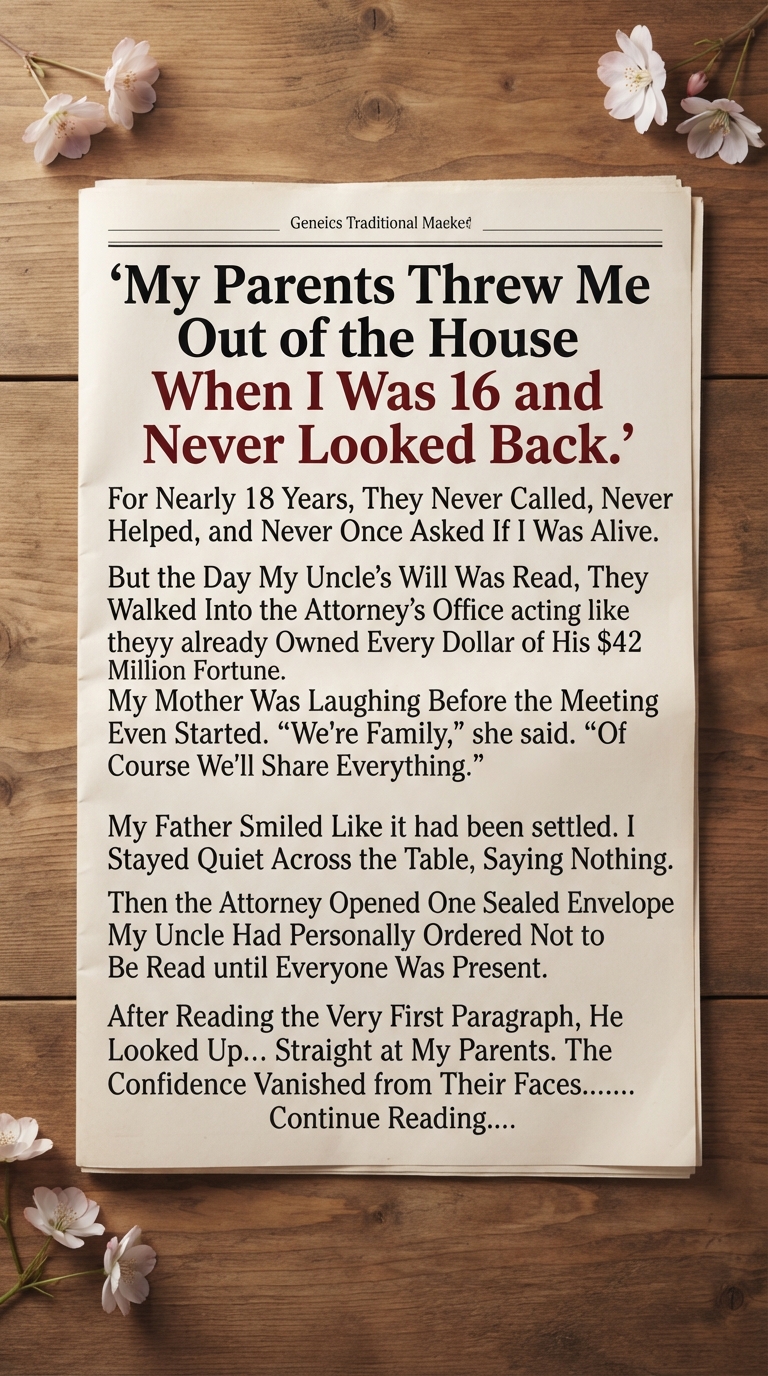
My parents threw me out of the house when I was sixteen and never looked back.
For nearly eighteen years, they never called.
Never helped.
Never asked where I lived.
Never asked whether I was alive.
And they certainly never asked whether I was okay.
But the day my uncle’s will was read, they walked into the attorney’s office acting like they already owned every dollar of his $42 million fortune.
My mother was laughing before the meeting even started.
“We’re family,” she said.
“Of course we’ll share everything.”
My father smiled beside her as if the matter had already been settled.
I stayed quiet across the table.
I didn’t correct them.
I didn’t remind them that they had thrown me out at sixteen.
I didn’t remind them that my uncle David was the person who found me that night.
I didn’t remind them that for eighteen years, he was the only family member who called me every birthday.
I didn’t need to.
Then the attorney opened one sealed envelope my uncle had personally ordered not to be read until everyone was present.
He read the first paragraph.
Then he stopped.
Slowly, he looked up.
Straight at my parents.
The confidence vanished from their faces.
Because my uncle had apparently left more than a fortune.
He had left the truth.
I was sixteen when my parents decided I was no longer worth keeping.
There wasn’t a dramatic argument.
No screaming.
No shattered dishes.
It was worse than that.
It was quiet.
Cold.
My mother stood in the kitchen with her arms crossed.
My father held the back door open.
“You need to go,” he said.
I stared at him.
“Go where?”
“Anywhere.”
I laughed nervously.
“You’re joking.”
He wasn’t.
My mother looked away.
“You’re old enough to figure something out.”
“I’m sixteen.”
“We can’t keep doing this.”
“Doing what?”
Neither answered.
My father put a backpack on the floor.
“Your things are inside.”
I looked at my mother.
“Why?”
She finally looked at me.
“Because your father and I need a fresh start.”
I didn’t understand.
I thought maybe there was another explanation.
Another conversation.
Another chance.
There wasn’t.
I was outside fifteen minutes later.
The door closed.
The lock clicked.
And that was it.
I spent that first night at a bus station.
The second night on a friend’s couch.
The third night, my uncle found me.
David had always lived differently from my parents.
He didn’t care about appearances.
He didn’t care what neighborhood you lived in.
He didn’t care whether you wore designer clothes.
He cared whether you kept your word.
He pulled up beside me in an old blue sedan.
“Get in.”
I did.
He looked at my backpack.
“Did they give you enough clothes?”
I shook my head.
He said nothing.
He drove to a 24-hour store.
Bought me clothes.
Food.
A toothbrush.
A blanket.
Then he brought me home.
“Your room is upstairs.”
I stared at him.
“My room?”
“Yes.”
“What if they call?”
He looked at me.
“They won’t.”
He was right.
They didn’t.
Not once.
Uncle David became my family.
He helped me finish high school.
Paid my college tuition.
Taught me how to drive.
He took me to my first job interview.
When I failed an important exam, he didn’t yell.
He simply said:
“Try again.”
When I graduated, he took me to dinner.
When I got married, he stood beside me.
When I bought my first home, he helped me choose the kitchen table.
And when my parents occasionally came up in conversation, he never told me to forgive them.
He only said:
“You’re allowed to decide what you want your relationship with them to be.”
For years, I said:
“Nothing.”
He accepted that.
David built his fortune quietly.
His company started as a small manufacturing business.
Then he expanded into logistics.
Real estate.
Technology.
Investments.
By the end of his life, his estate was worth approximately $42 million.
But you’d never know it by looking at him.
He still drove an old car.
Still wore the same leather watch.
Still bought his shoes when the old ones wore out.
Once, I asked him why he never lived like a rich man.
He laughed.
“Because I already live like a happy one.”
Then he became sick.
He told me he had six months.
He lived nineteen.
During those nineteen months, he organized everything.
His businesses.
His charitable foundation.
His estate.
His will.
His trusts.
He also called me every Sunday.
Exactly at 5:00.
One Sunday, his voice sounded tired.
“There’s something I want you to know.”
“What?”
“If anything happens to me, don’t let anyone rush you.”
“About what?”
“Anything.”
I laughed.
“David, what are you talking about?”
He smiled.
“Just remember.”
Those were the last words we had about his estate.
When he died, my parents appeared.
I hadn’t heard from them in eighteen years.
Yet somehow, three days after the funeral, my mother called me.
“Sweetheart.”
I almost hung up.
“We need to talk about David’s estate.”
“Why?”
“Because we’re family.”
I said nothing.
She continued:
“Your uncle would want us to share.”
I asked one question.
“Why?”
She became irritated.
“Because that’s how families work.”
I hung up.
The next week, they arrived at the law office.
They walked in smiling.
My mother hugged people she’d never met.
My father shook hands.
Then she sat beside me.
“We’re finally all together.”
I looked at her.
She smiled.
“It feels right.”
I didn’t answer.
The attorney entered carrying several folders.
Then he placed one sealed envelope on the table.
His expression changed.
“This was delivered to me directly by Mr. Mercer six months ago.”
My father frowned.
“What’s inside?”
“Instructions.”
My mother laughed.
“Another sentimental letter?”
The attorney didn’t smile.
“No.”
He looked around the room.
“Mr. Mercer specifically instructed me not to open this until all direct family members were present.”
My mother nodded.
“Fine.”
The attorney broke the seal.
Opened the letter.
And began reading.
“To my attorney,
If this letter is being read, then my brother and his wife are sitting in the same room as my niece.”
My mother stopped smiling.
The attorney continued.
“Before any part of my estate is discussed, I want the following statement read aloud.”
He looked at my parents.
“My brother and his wife abandoned their sixteen-year-old daughter.”
My father’s face changed.
My mother whispered:
“This is unnecessary.”
The attorney kept reading.
“They did so without legal support, financial assistance, or even a single attempt to maintain contact.”
My father shifted in his chair.
“They knew where she lived because I told them.”
My mother looked at me.
I said nothing.
“I told them she was safe.”
“They never asked.”
The room was silent.
The attorney turned the page.
“I spent eighteen years watching them remember my money while forgetting their daughter.”
My mother’s face had gone pale.
Then came the sentence that destroyed the confidence they’d walked into the room with.
“They are not beneficiaries of my estate.”
My mother stood.
“What?”
The attorney continued.
“Neither of them.”
My father stared at him.
“That’s impossible.”
The attorney looked at him.
“Please sit down.”
The next paragraph was even worse.
“My niece is the primary beneficiary of my estate because she was my family when no one else wanted the responsibility.”
My mother’s mouth opened.
No sound came out.
The attorney looked at me.
Then back at the document.
“I leave her the controlling interest in my company.”
My father whispered:
“No.”
“The majority of my investment portfolio.”
“No.”
“Three commercial properties.”
My mother sat down slowly.
“And the remaining assets are to be distributed through charitable trusts and employee benefits.”
The attorney paused.
“Total estimated value passing directly or indirectly to my niece is approximately $38.4 million.”
My father looked at me.
My mother started crying.
“You can’t.”
The attorney closed the document.
“He already did.”
My mother turned toward me.
“Your uncle was angry with us.”
I shook my head.
“No.”
“He hated us.”
“No.”
“He wanted to punish us.”
I looked at her.
“He didn’t spend eighteen years preparing revenge.”
I paused.
“He spent eighteen years preparing a future.”
She looked away.
That was the truth.
David hadn’t built my inheritance to punish my parents.
He had built my independence because he knew exactly what they were capable of.
Then the attorney pulled out another document.
“This is a trust protection provision.”
My father frowned.
“What does it say?”
The attorney read:
“If either parent attempts to challenge, pressure, intimidate, or manipulate the beneficiary regarding this inheritance, that parent shall receive no discretionary payment from any remaining family trust.”
My mother stared.
“So we get nothing?”
“You receive what the will specifically grants.”
“How much?”
The attorney turned a page.
“Nothing.”
My mother’s face collapsed.
My father stood.
“This is absurd.”
The attorney looked at him.
“No. What’s absurd is abandoning a sixteen-year-old and then appearing eighteen years later because you heard someone left her money.”
I expected to feel victorious.
Instead, I felt tired.
I looked at my mother.
She was crying.
My father had stopped speaking.
For eighteen years, I’d wondered whether I would ever stop caring that they left.
Now I realized something.
I didn’t care that they had left anymore.
I cared that they had returned only when there was something to take.
That was the part that hurt.
Not the money.
The timing.
After the meeting, my mother followed me into the hallway.
“Please.”
I kept walking.
“I know I failed you.”
I stopped.
She was crying.
“I was wrong.”
I turned.
“Why did you do it?”
She wiped her face.
“Your father wanted a different life.”
“And I didn’t fit into it?”
She shook her head.
“I don’t know.”
I looked at her.
“You were my mother.”
“I know.”
“You were supposed to protect me.”
“I know.”
“And you didn’t.”
She closed her eyes.
“No.”
I waited.
Then she whispered:
“I’m sorry.”
I believed her.
That didn’t change anything.
“I forgive you.”
Her eyes lifted.
Then I said:
“But forgiveness doesn’t make you entitled to what David left me.”
Her face fell.
“I know.”
My father never apologized.
He sent one letter.
It said he believed David had manipulated me.
I never responded.
My mother sent several more.
I read one.
Then stopped.
I wasn’t angry anymore.
I simply didn’t want them back in my life.
The estate took months to settle.
The company transferred control.
The trust was established.
Assets were cataloged.
Employees received bonuses David had already arranged.
His foundation continued.
And I became responsible for the company he’d spent his life building.
That frightened me more than the money.
I had never expected to run a company worth millions.
But then I remembered what David used to say.
“Don’t be intimidated by a big number.”
So I learned.
I hired people smarter than me.
I listened.
I worked.
And eventually, I understood why he’d trusted me.
Not because I was perfect.
Because I knew what it meant to build something instead of simply expecting to inherit it.
A year after the will was read, I visited David’s grave.
I brought the old blue sedan’s key.
He had left the car to me too.
I placed a flower beside the headstone.
“I understand now,” I whispered.
The wind moved through the trees.
“You weren’t trying to make me rich.”
I smiled.
“You were trying to make sure nobody could ever make me feel powerless again.”
I sat there for a while.
Then I said the thing I’d never been able to say when I was sixteen.
“Thank you for coming.”
Because that’s what he had done.
He had come.
When everyone else walked away.
I eventually used part of the inheritance to create a foundation for teenagers who had been abandoned by their families.
The first program provided emergency housing.
Food.
Legal assistance.
Education.
The first recipient was a sixteen-year-old boy whose parents had thrown him out.
He came into my office nervous.
I recognized the look immediately.
The look of someone trying not to cry because crying feels dangerous when you have nowhere to go.
I handed him a key.
“What’s this?”
“Your room.”
His eyes filled with tears.
“I’m not staying long.”
I smiled.
“You don’t have to leave until you’re ready.”
He looked at me.
“Why are you helping me?”
I thought about David.
Then answered:
“Because someone helped me once.”
Years later, my parents were still alive.
We had no relationship.
I occasionally heard about them through distant relatives.
They had downsized.
Their finances were ordinary.
Life continued.
I didn’t send money.
I didn’t seek revenge.
I simply kept the distance they had created eighteen years earlier.
The difference was that now, the silence was my choice.
That mattered.
My uncle’s $42 million fortune had changed my financial life.
But it hadn’t changed who I was.
The greatest thing he gave me wasn’t money.
It was proof.
Proof that someone had seen me when I was sixteen.
Proof that being abandoned didn’t mean being unlovable.
Proof that family could be chosen.
And proof that sometimes the person who looks like they have nothing is actually carrying something much more valuable:
Someone who believed in them.
When my parents walked into that attorney’s office saying,
“We’re family. Of course we’ll share everything,”
they thought blood gave them ownership.
My uncle had spent eighteen years proving the opposite.
The attorney opened one sealed envelope.
Read one paragraph.
And suddenly, the people who had abandoned me were forced to hear the truth they’d spent eighteen years avoiding.
They had lost their daughter long before they lost the inheritance.
And I had gained a family long before I gained the fortune.