Please Make Sure You Have All Your Belongings
Three weeks. That was the deal when my son Brendan and his wife Sarah asked to stay with me while their townhouse got painted. Three weeks, a little company in a house that had felt too quiet since my husband passed the year before, and then they’d be back in their own place. I’d even looked forward to it, foolishly, the way you look forward to filling a silence you’ve been sitting in alone for too long.
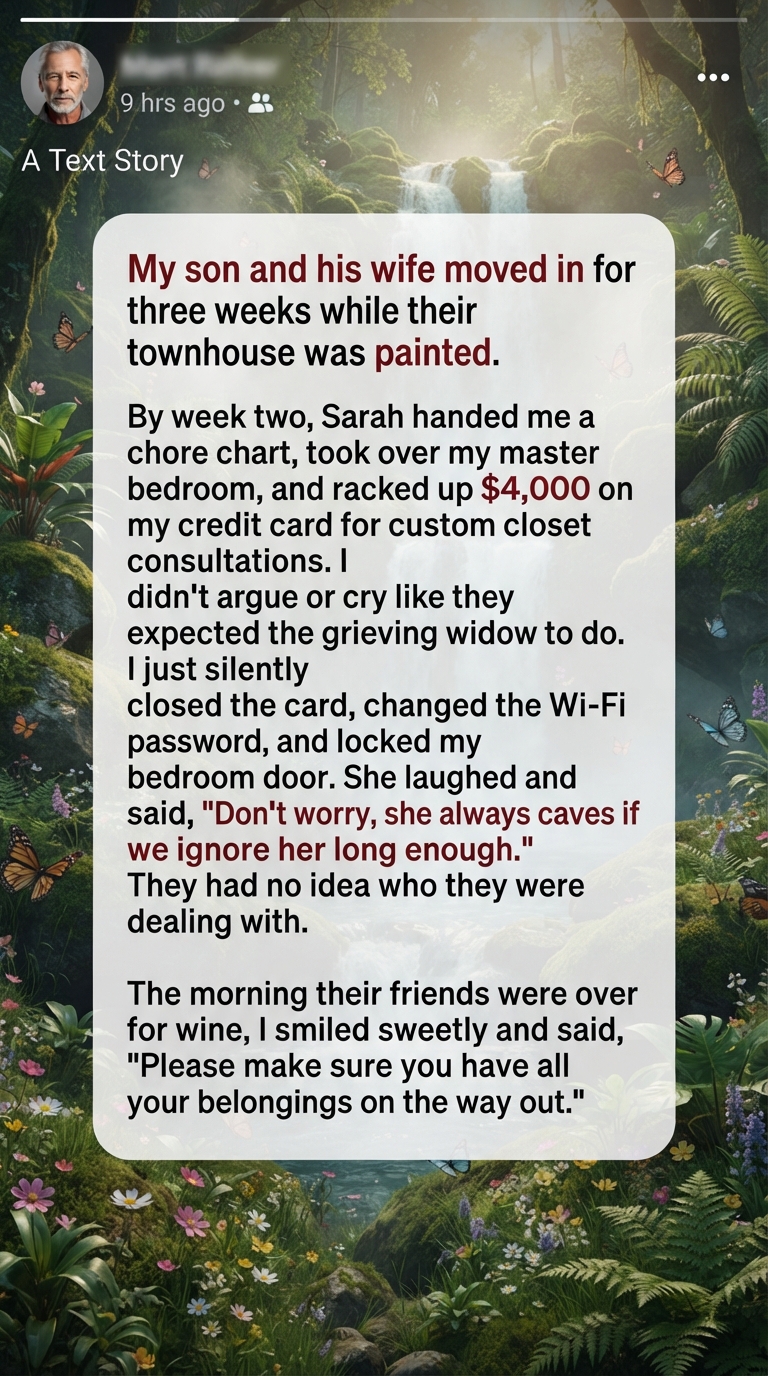
By the start of week two, Sarah had handed me a laminated chore chart with my name on it, right next to theirs, assigning me dishes and laundry in a house I’d owned and run for thirty-one years. She’d also, without asking, moved into my master bedroom—my bedroom, the one my husband and I had shared—claiming the guest room “wasn’t getting enough natural light for her skincare routine.” I’d been relocated to the guest room in my own home.
Then I opened my credit card statement and found $4,000 in charges for something called a “custom closet consultation,” a design service Sarah had booked for the master closet—my closet—along with two “concept sessions” for a renovation nobody had asked me about, in a house that wasn’t hers.
I didn’t cry. I didn’t argue. I’d spent forty years being the reasonable one, the accommodating one, the grieving widow everyone assumed would just absorb whatever was put on her rather than cause a scene. I understood, watching Sarah refill her wine glass in my kitchen that night, that this was exactly what she was counting on.
I heard her on the phone with a friend later that evening, laughing. “Don’t worry, she always caves if we ignore her long enough.”
She wasn’t wrong about who I’d been. She was about to find out who I still was.
The next morning, before either of them woke up, I called my credit card company and closed the account entirely, disputing the closet consultation charges as unauthorized. I called my bank and moved my accounts to a branch across town, just to be safe. I changed the Wi-Fi password and didn’t share the new one. And I went into what had briefly become “Sarah’s room,” gathered my own belongings—my clothes, my husband’s watch I kept in the nightstand, the photo of us on our wedding day—and moved back into my bedroom, locking the door behind me for the first time in thirty-one years.
Sarah noticed the Wi-Fi first, predictably, and complained loudly about it not working. I told her, pleasantly, that I must have reset it by accident and didn’t remember the new password. She noticed the credit card next, when her closet designer called asking about a declined payment. I told her, just as pleasantly, that I’d had to close the account due to some suspicious charges I hadn’t authorized. She noticed the locked bedroom door last, and said nothing at all, because by then I think she understood something had shifted, even if she couldn’t name it yet.
I let it sit for four days. I wanted to see if she’d apologize, or even acknowledge it. She didn’t. Instead, she invited three friends over for wine on a Thursday evening, in my living room, without asking, pouring from a bottle of Cabernet I recognized as one I’d been saving.
I walked in wearing my nicest cardigan, smiled warmly at her guests, and said, loud enough for the room, “It’s lovely to meet you all. I hope you had a good visit.” Then I turned to Sarah, still smiling. “Please make sure you have all your belongings on the way out. The painters finished your townhouse Tuesday. I called to check.”
The silence in that room was its own kind of satisfaction.
Sarah’s face went through several stages—confusion, embarrassment, and finally something closer to fury—while her friends exchanged glances and quietly gathered their purses, sensing correctly that this was not a conversation for an audience. Brendan, to his credit, at least had the decency to look ashamed when he came downstairs and realized what his wife had been doing under his roof—my roof—for two weeks.
They were gone by that evening. Sarah didn’t say goodbye. Brendan hugged me at the door and said, quietly, “I didn’t know about the card, Mom. I’m sorry.” I believed him, mostly, though I noted he hadn’t known because he hadn’t been paying attention, which was its own kind of failure.
The closet consultation charges were reversed within the week once the bank’s fraud department confirmed I’d never authorized them. I had new locks installed the following Monday, on every door, not because I expected trouble, but because I’d decided I was done making myself easy to walk over, in my own home, in my own life, at any age.