The Morning I Stopped Being Family
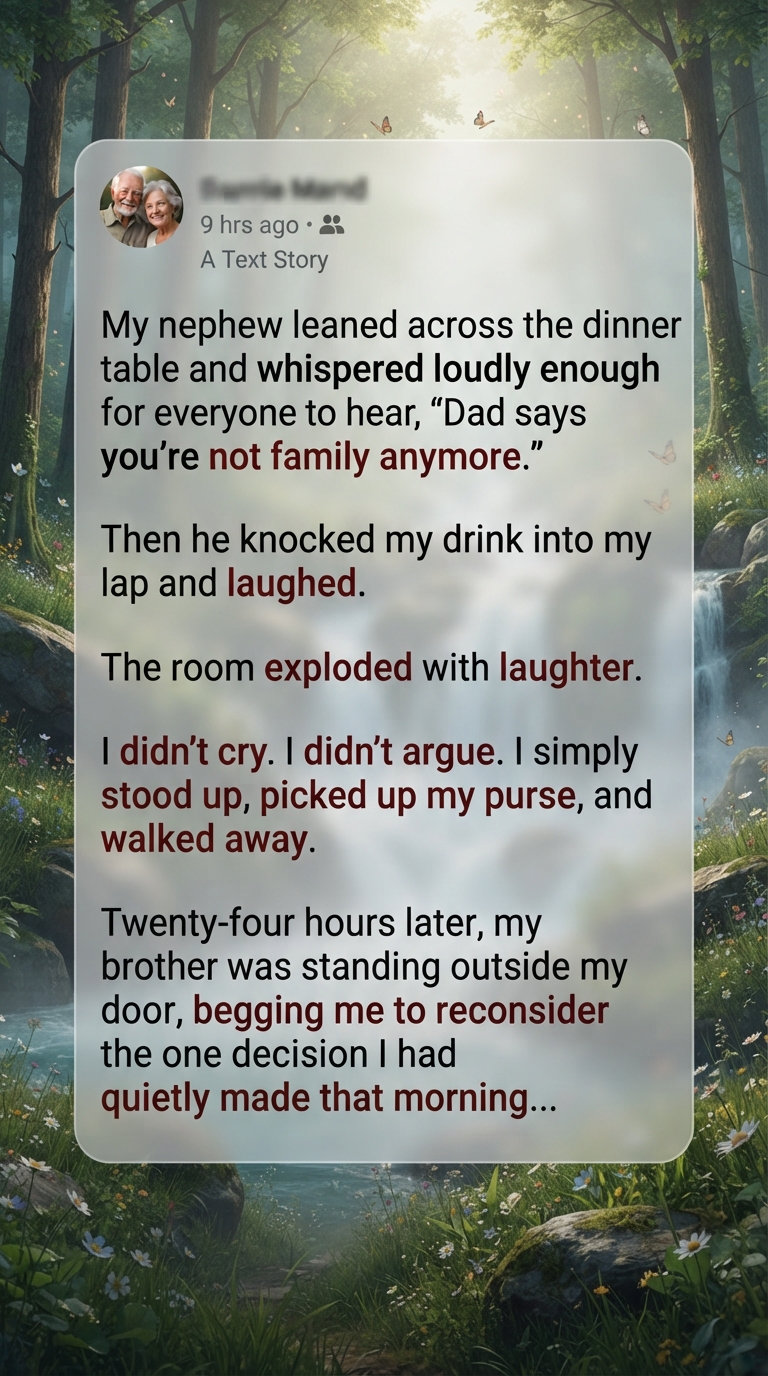
My nephew leaned across the dinner table and whispered loudly enough for everyone to hear,
“Dad says you’re not family anymore.”
Then he knocked my drink into my lap and laughed.
The room exploded with laughter.
My brother laughed.
His wife laughed.
Even my parents smiled awkwardly.
I didn’t cry.
I didn’t argue.
I didn’t ask anyone why they thought humiliating me was funny.
I simply stood up, picked up my purse, and walked away.
Twenty-four hours later, my brother was standing outside my door, begging me to reconsider the one decision I had quietly made that morning.
Because he had finally realized something.
For years, he had treated me like a relative when he needed me and like a stranger whenever he didn’t.
But that morning, I had finally stopped playing the role he had assigned me.
My name is Rachel.
And this is what happened when I decided that being family didn’t mean being available for abuse.
My brother, Daniel, was five years older than me.
When we were kids, he was always the confident one.
He played football.
I studied.
He was loud.
I was quiet.
He loved attention.
I preferred staying in the background.
But we were close.
At least, I thought we were.
When our parents needed help, Daniel would call me.
When he couldn’t pay a bill, he’d call me.
When his first child was born, I bought the crib.
When his second child arrived, I paid for the hospital parking, meals, and several nights of groceries because Daniel said money was tight.
When his car broke down, I loaned him $3,200.
He promised he’d pay me back.
He never did.
I didn’t chase him.
He was my brother.
That’s what I kept telling myself.
Then Daniel started a business.
I helped with the first deposit.
He promised I would be paid back within six months.
Six months became a year.
Then two.
Whenever I asked about it, he’d smile.
“Come on, Rachel. We’re family.”
That sentence became his favorite shield.
Whenever he needed something, we were family.
Whenever I needed respect, suddenly I was being “too sensitive.”
I ignored it.
For years.
Until that dinner.
It was my mother’s birthday.
Everyone was gathered around the table.
My parents.
Daniel and his wife, Melissa.
Their two children.
My aunt.
And me.
The food was good.
The conversation was normal.
Then my nephew, Tyler, looked across the table at me.
He was nine years old.
He leaned forward.
“Dad says you’re not family anymore.”
The table went silent.
I looked at Daniel.
He shrugged.
“Kids repeat everything.”
Tyler laughed.
Then he deliberately reached for my glass.
He knocked it over.
Cold soda spilled across my dress and into my lap.
He burst out laughing.
The room exploded.
Daniel laughed.
Melissa laughed.
My father chuckled.
My mother covered her mouth.
I sat there soaked.
And something inside me went completely still.
I looked around the table.
Nobody got up.
Nobody apologized.
Nobody even looked embarrassed.
Then I realized something.
This wasn’t a joke.
It was permission.
They had all decided I was someone they could humiliate without consequences.
I stood.
“Rachel,” my mother said.
I picked up my purse.
“Where are you going?”
“Home.”
Daniel laughed.
“Oh, come on.”
I looked at him.
He was still smiling.
I said only four words.
“You’re right, Daniel.”
His smile disappeared.
“We’re not family.”
Then I walked out.
I drove home without turning on the radio.
My dress was still wet.
My hands were shaking.
But I wasn’t crying.
When I got inside, I changed clothes.
Then I sat at my kitchen table.
For the first time in years, I opened a folder I had kept hidden in my desk.
Inside were receipts.
Bank statements.
Loan agreements.
Emails.
Texts.
Everything I’d ever paid for Daniel.
I added it all.
The crib.
The hospital expenses.
The car loan.
The business deposit.
The emergency transfers.
The unpaid loans.
The total was staggering.
$86,700.
I stared at the number.
Eighty-six thousand seven hundred dollars.
That was what I had given my brother over the years.
And somehow, I had still been the one sitting at a family dinner being told I wasn’t family.
I laughed.
Not because it was funny.
Because suddenly the absurdity of it all was impossible to ignore.
Then I opened my computer.
I logged into my bank.
There were two automatic transfers scheduled for the next morning.
One was the monthly payment toward Daniel’s business loan.
The other was a recurring transfer for his family’s expenses.
I had been making both for years.
I canceled them.
Then I opened my email.
There was one more thing I’d been putting off.
The ownership agreement for the business property.
Daniel had used my money for the down payment.
I had never demanded my share.
I had never asked for anything.
I had simply trusted him.
I called my attorney.
“Can we review the agreement?”
“Of course.”
“I think it’s time.”
The next morning, at 8:17 a.m., my phone rang.
Daniel.
I didn’t answer.
He called again.
Then again.
Then again.
Finally, he left a voicemail.
“Rachel, what’s going on? The payment didn’t go through.”
I listened.
Then deleted it.
At 9:03, he called again.
“Rachel, please call me.”
At 9:21:
“Did you cancel the transfer?”
At 9:47:
“You can’t just do that.”
I smiled.
Because that sentence told me everything.
He didn’t ask if I was okay.
He didn’t apologize for the dinner.
He didn’t mention Tyler.
He didn’t ask whether his son had intentionally embarrassed me.
He only cared about the money.
I didn’t call him back.
At 11:30, someone knocked on my door.
I looked through the window.
Daniel.
He was standing on my porch.
He looked exhausted.
I opened the door but didn’t invite him inside.
“What do you want?”
“Rachel, please.”
“Please what?”
“Don’t do this.”
I stared at him.
“Do what?”
“You know what.”
“No. Explain it.”
He rubbed his forehead.
“The business payment.”
“You’ll have to handle it yourself.”
“I can’t.”
“You said you could.”
“I thought you were helping.”
“I was.”
He looked at me.
“Then why are you stopping now?”
I answered quietly.
“Because last night you told your son I wasn’t family anymore.”
His face changed.
“I didn’t mean it like that.”
“Then how did you mean it?”
“I was angry.”
“At me?”
“Yes.”
“Why?”
He didn’t answer.
I waited.
Finally he said:
“Because I knew you were going to stop helping.”
I almost laughed.
“So you insulted me before I could leave?”
“No.”
“Then what was the plan?”
He looked away.
I knew the answer.
He had assumed I’d keep paying.
Forever.
Because I was his sister.
Because family was his excuse whenever he wanted something.
But he had forgotten that family works both ways.
Daniel lowered his voice.
“Please don’t cut us off.”
“I haven’t cut anyone off.”
“You canceled everything.”
“I canceled financial support.”
“That’s the same thing.”
“No.”
I shook my head.
“It’s not.”
“You’re punishing my children.”
“I love your children.”
“Then why would you do this?”
“Because loving them doesn’t mean I have to fund your life.”
He went silent.
Then he said something I never expected.
“Tyler didn’t mean what he said.”
“I know.”
“Then why are you taking it so seriously?”
“Because he learned it from you.”
Daniel looked down.
That was the first time he didn’t have an answer.
A week later, my attorney called.
“Rachel, there’s something you need to know.”
“What?”
“We reviewed the business documents.”
“And?”
“You’re not just entitled to repayment.”
I frowned.
“What does that mean?”
“You are listed as a 40% financial partner in the original agreement.”
I froze.
“What?”
“Your contribution was documented as an investment.”
“I thought it was a loan.”
“So did Daniel, apparently.”
My attorney paused.
“But legally, the paperwork is clear.”
I sat down.
“So I own forty percent?”
“Yes.”
I couldn’t believe it.
For years, Daniel had acted like he had built everything himself.
But my name had been on the original agreement the entire time.
I had simply never enforced my rights.
Then my attorney told me something else.
“There’s also a clause requiring your written consent for major changes to the company’s ownership.”
“Why?”
“Because you were one of the original investors.”
I stared at the wall.
Then everything suddenly made sense.
Daniel hadn’t just been using my money.
He had been relying on me to remain silent.
Two days later, Daniel came back.
This time, he wasn’t angry.
He looked frightened.
“Rachel.”
I opened the door.
“I know about the agreement,” he said.
“I assumed you would.”
“You’re going to take forty percent?”
“No.”
His shoulders relaxed.
Then I continued.
“I’m going to take what the agreement says I’m entitled to.”
His face fell.
“Please.”
“You told me I wasn’t family.”
“I was wrong.”
“You were.”
“I didn’t mean it.”
“But you said it.”
He nodded.
“I know.”
“And you let your son humiliate me.”
“I’ve talked to him.”
“Good.”
“He feels terrible.”
“I hope so.”
Daniel looked at me.
“Can we fix this?”
I thought for a moment.
“Yes.”
His eyes lifted.
“How?”
“You repay what you owe me.”
He swallowed.
“All of it?”
“Yes.”
“And the forty percent?”
“I’ll decide what to do with it after you make things right.”
He looked stunned.
Then he whispered:
“You’re really serious.”
“For the first time in a long time.”
Months passed.
Daniel sold a second vehicle.
He refinanced the business.
He repaid part of the money.
Then more.
It wasn’t easy.
But for the first time, he was responsible for his own choices.
He also brought Tyler to my house.
The boy stood on my porch with his head down.
“I’m sorry.”
I knelt.
“For what?”
“For what I said.”
“Did you understand what you were saying?”
He shook his head.
“Dad told me you weren’t family.”
I looked at Daniel.
He looked ashamed.
I turned back to Tyler.
“Listen to me. Adults sometimes say things when they’re angry. That doesn’t make them true.”
“Are you still my aunt?”
I smiled.
“If you want me to be.”
He nodded quickly.
Then he hugged me.
I hugged him back.
Because I had never been angry at a nine-year-old.
I had been angry at the adult who taught him that cruelty was funny.
A year later, Daniel’s business was doing well again.
But something had changed.
He no longer called me for money.
He called to ask how I was.
He sent birthday cards.
He invited me to dinner.
Sometimes I went.
Sometimes I didn’t.
There were boundaries now.
Real ones.
My parents eventually apologized too.
My mother admitted that everyone had become comfortable with me being the person who solved problems.
My father said:
“We should have stopped him.”
I nodded.
“Yes, you should have.”
There was no dramatic reconciliation.
No magical moment when everything became perfect.
Trust doesn’t work that way.
It has to be rebuilt.
Slowly.
One choice at a time.
But I learned something that night at the dinner table.
Leaving wasn’t revenge.
Stopping the money wasn’t punishment.
Taking back control of my finances wasn’t selfish.
It was a boundary.
And sometimes the people who benefit most from your generosity will call your boundaries cruel simply because they can no longer benefit from your lack of them.
Daniel had spent years telling me:
“We’re family.”
He was right.
We were family.
But family isn’t a credit card.
Family isn’t an unlimited bank account.
Family isn’t permission to humiliate someone and expect them to keep paying the bills afterward.
And when my nephew knocked that drink into my lap and everyone laughed, I thought I was walking away from my family.
I wasn’t.
I was walking away from the version of family that required me to disappear so everyone else could be comfortable.
And that was the best decision I had ever made.