The Whisper Before Goodbye
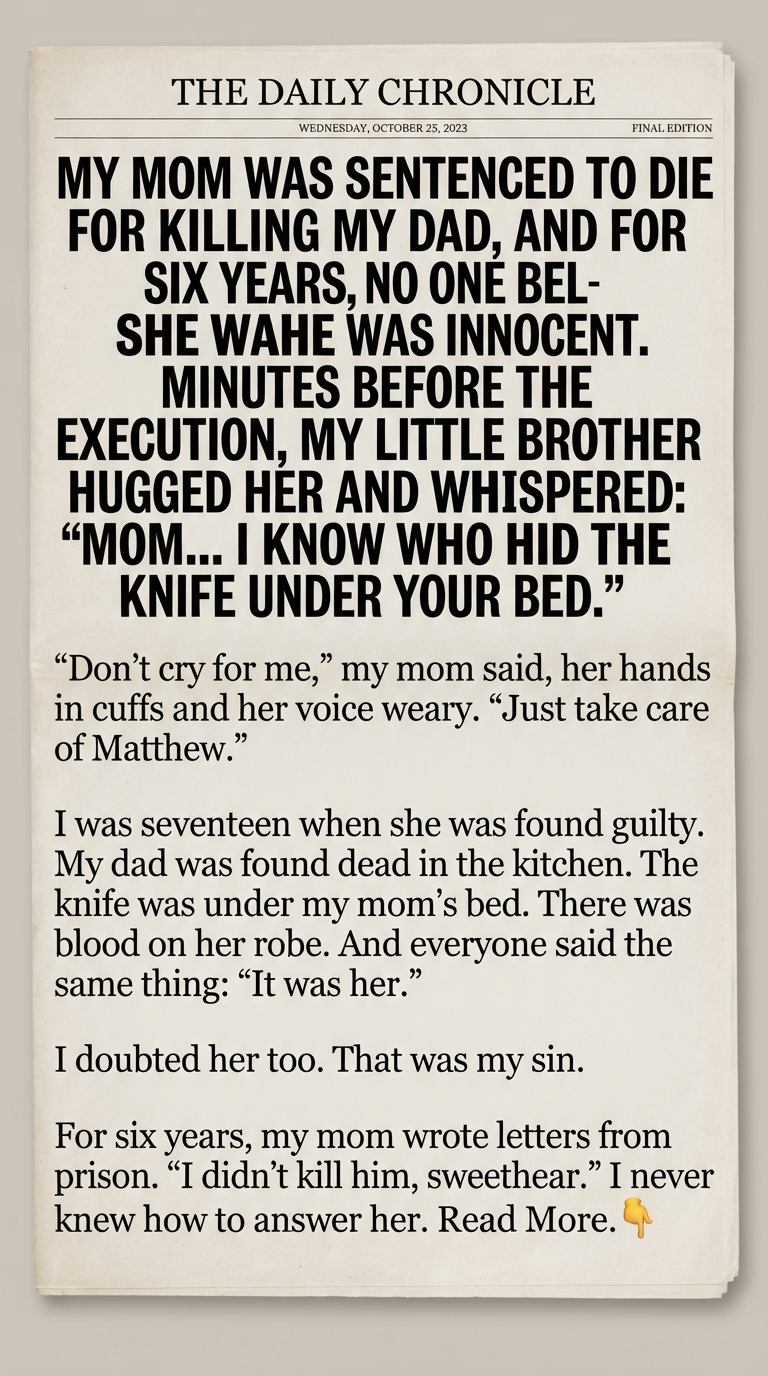
“Don’t cry for me,” my mom said, her hands in cuffs and her voice weary.
“Just take care of Matthew.”
I was seventeen when she was found guilty of killing my father.
My dad was found dead in our kitchen. A knife was discovered under my mother’s bed. There was blood on her robe.
And everyone said the same thing.
“It was her.”
For six years, I carried that verdict inside me.
And the worst part?
I doubted her too.
That was my sin.
For six years, my mom wrote letters from prison.
I didn’t kill him, sweetheart.
I never knew how to answer.
Sometimes I wrote nothing.
Sometimes I wrote about Matthew—how he was growing taller, how he had started playing basketball, how he still hated vegetables and left his socks everywhere.
I never wrote what I was really thinking.
What if you did it?
Because a part of me believed she had.
A part of me remembered my parents arguing.
I remembered Dad shouting.
I remembered Mom crying behind their bedroom door.
And when the police showed me the photographs, the knife, the blood-stained robe, I thought there was no way all of it could be a mistake.
My mother had always been gentle with us.
But people said you never really knew what happened behind closed doors.
Eventually, I started believing them.
Matthew never did.
He was eleven when Dad died.
Too young to understand courtrooms.
Too young to understand evidence.
Too young to understand why our mother disappeared behind a glass wall and had to speak to us through a telephone.
But old enough to remember things.
Things none of us thought mattered.
The morning of the execution, I almost didn’t go.
I told myself I couldn’t watch.
I told myself I had already said goodbye enough times.
But Matthew stood in the doorway of my apartment before sunrise, dressed in a black shirt that was too big for him.
He was seventeen now.
The same age I had been when our mother was convicted.
“You’re coming,” he said.
It wasn’t a question.
So I went.
The prison was cold.
Everything about it felt cold.
The gray walls.
The metal doors.
The silence.
Even the people waiting in the observation room spoke in whispers.
My mom was brought in wearing white.
Her hands were cuffed in front of her.
For a moment, she looked smaller than I remembered.
Older too.
Six years had taken something from her.
But when she saw us, she smiled.
A real smile.
The kind that made me hate myself even more.
“Hi, my babies.”
Matthew broke first.
He rushed forward and wrapped his arms around her.
I followed more slowly.
I didn’t know what to say.
How do you apologize to someone when you’re not even sure what you’re apologizing for?
My mom looked at me.
“I love you, Emily.”
My throat closed.
“I love you too.”
It was the first time I had said it without adding anything else.
Without thinking about the trial.
Without looking at the guards.
Without wondering whether she was lying.
Then Matthew hugged her again.
He held her tightly.
Too tightly.
And suddenly, his face changed.
He looked terrified.
“Mom,” he whispered.
She leaned closer.
“Mom… I know who hid the knife under your bed.”
Everything stopped.
I stared at him.
My mother went completely still.
“What did you say?”
Matthew pulled back.
His eyes filled with tears.
“I remember.”
The guard beside us shifted.
“What do you remember?” I asked.
Matthew looked at me.
Then at our mother.
And for the first time in six years, I saw the little boy he used to be.
“I saw Uncle Daniel.”
My blood turned cold.
Our father’s younger brother.
The man who had testified at Mom’s trial.
The man who had stood beside us at Dad’s funeral.
The man who had hugged me while cameras waited outside the courthouse.
Matthew’s hands were shaking.
“The night Dad died,” he said. “I woke up because I heard someone downstairs.”
Mom stared at him.
“Matthew…”
“I was scared. I went to the hallway.”
His voice cracked.
“And I saw Uncle Daniel.”
The guard called for someone.
People started moving.
But Matthew kept talking.
“He had something in his hand. I thought it was Dad’s tool box or something. Then I saw him go into your room.”
I felt my knees weaken.
“He came back out a few minutes later,” Matthew continued. “And he saw me.”
My mother covered her mouth.
“What did he say?” I whispered.
Matthew started crying.
“He told me Dad was sick. He said not to wake anyone up.”
“And you never told anyone?”
“I tried.”
The words hit me like a slap.
“I told you.”
I looked at him.
He was right.
Two days after Dad died, Matthew had asked me if Uncle Daniel had been at the house.
I had told him he was confused.
I had told him everyone had been there that night.
At the time, I thought he was mixing memories together.
A scared eleven-year-old trying to understand something terrible.
I had brushed him off.
Just like everyone else.
Just like I had brushed off Mom’s letters.
The prison officials immediately stopped the execution.
Detectives were called.
Matthew gave his statement.
And within hours, another piece of evidence was discovered.
An old security camera across the street had recorded the corner of our driveway.
The footage had never been collected because investigators believed there was no need.
They already had their suspect.
My mother.
The video was blurry.
But clear enough.
At 11:43 p.m., my uncle’s car pulled up.
At 12:19 a.m., it left.
The prosecution had claimed he never came to the house that night.
Then the police reopened the case.
And everything began to fall apart.
My uncle had been drowning in debt.
My father had recently discovered that Daniel had been stealing money from their family business.
They had fought about it the week before Dad died.
The night of the murder, Daniel went to confront him.
The argument became violent.
My father was stabbed.
Then Daniel panicked.
He dragged Mom’s robe from the laundry basket and used it to wipe his hands.
He hid the knife beneath her bed.
And he left.
By the time Mom woke up, she found Dad in the kitchen.
She tried to help him.
That was how the blood got on her.
But no one cared about that explanation.
Because the evidence already told a better story.
A simpler story.
A wife kills her husband.
Case closed.
Three months later, Daniel was arrested.
He confessed after detectives confronted him with the footage, the financial records, and one more piece of evidence.
His fingerprints.
Not on the knife.
He had wiped that clean.
But on the small wooden box beneath my mother’s bed—the box he moved when he hid the weapon.
It had been there all along.
My mom came home two weeks before Christmas.
I expected the moment to feel joyful.
Instead, I cried so hard I could barely breathe.
I kept saying the same words.
“I’m sorry.”
Again.
And again.
And again.
For not believing her.
For ignoring her letters.
For letting six years pass while she sat in a prison cell waiting to die.
My mother held my face in both hands.
“Emily,” she said softly, “look at me.”
I did.
“You were seventeen.”
“But I should have known.”
“No,” she said. “You were a child who was scared and hurt and trying to understand something impossible.”
I shook my head.
“You kept telling me.”
“I know.”
“You wrote me.”
“I know.”
“And I didn’t answer.”
Her eyes filled with tears.
“But you’re here now.”
That sentence broke something inside me.
Because she had lost six years.
Six birthdays.
Six Christmases.
Six years of watching her children grow up from behind glass.
And somehow, she was still comforting me.
Matthew came into the room and wrapped his arms around both of us.
For a long time, none of us spoke.
Then Mom looked at him.
“My brave boy.”
Matthew shook his head.
“I should have remembered sooner.”
“No,” she said.
She touched his cheek.
“You remembered when it mattered.”
Sometimes I lie awake and think about how close we came to losing her.
Minutes.
That was all.
Minutes separated my mother from death.
And the truth from being buried forever.
I still have every letter she wrote me.
For years, I kept them in a box because I couldn’t bear to read them.
Now I keep them beside my bed.
Sometimes, I open one.
The words are almost always the same.
I didn’t kill him, sweetheart.
And every time I read them, I feel that old guilt rise inside me.
Because she was telling the truth.
For six years, she was telling the truth.
And I was too afraid to believe her.
But then I remember what my mother told me the night she came home.
She took my hand and said:
“Don’t spend the rest of your life punishing yourself for being afraid to believe. Spend it remembering that sometimes, the truth needs someone willing to listen.”
So that’s what I do now.
I listen.
Especially when the person speaking is afraid.
Especially when everyone else has already decided they’re lying.
Because sometimes the whole world can be convinced of something.
A judge.
A jury.
A family.
An entire town.
And still be wrong.
And sometimes, the truth comes from the smallest voice in the room.
A frightened little boy.
A forgotten memory.
And one whisper…
Minutes before it was too late.