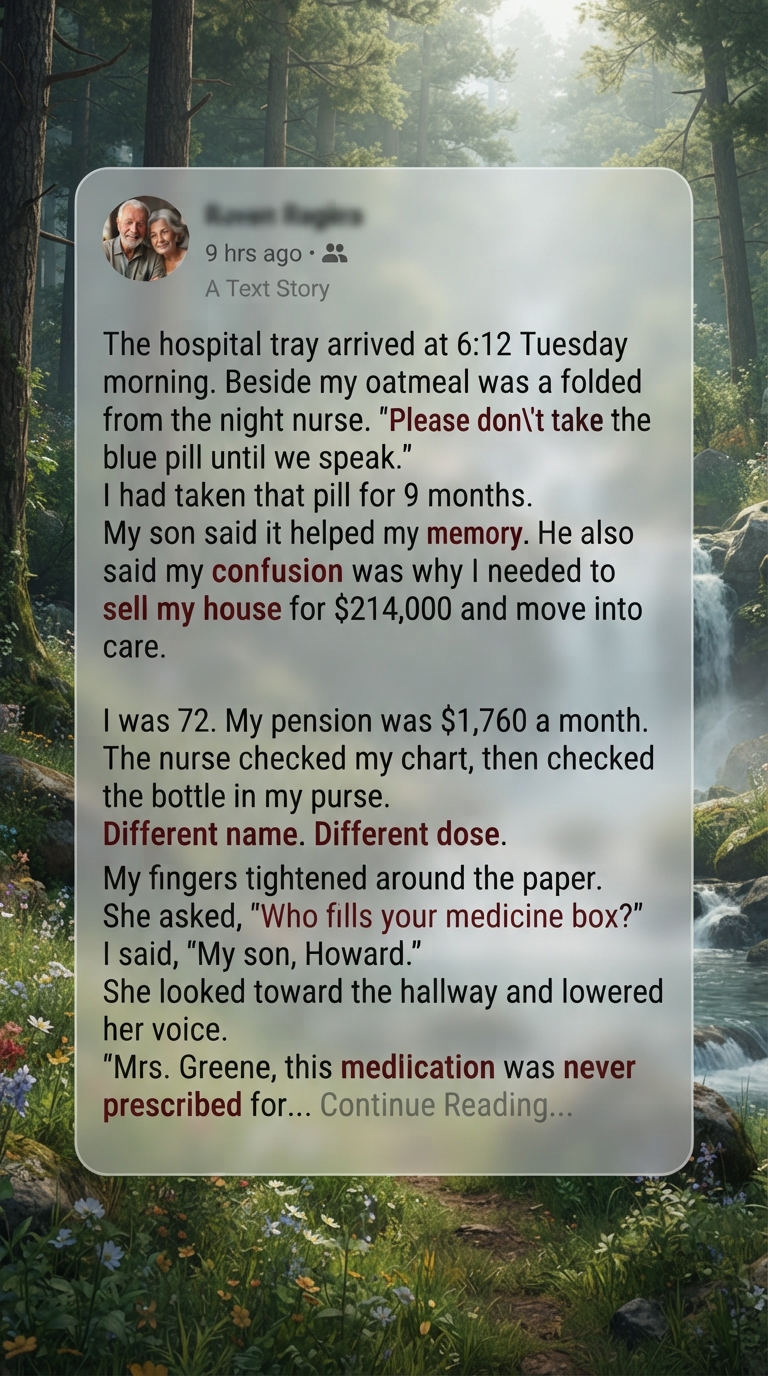
The hospital tray arrived at 6:12 Tuesday morning.
Beside my oatmeal was a folded note from the night nurse.
“Please don’t take the blue pill until we speak.”
I had taken that pill for nine months.
My son said it helped my memory.
He also said my confusion was why I needed to sell my house for $214,000 and move into care.
I was 72.
My pension was $1,760 a month.
The nurse checked my chart, then checked the bottle in my purse.
Different name.
Different dose.
My fingers tightened around the paper.
She asked, “Who fills your medicine box?”
I said, “My son, Howard.”
She looked toward the hallway and lowered her voice.
“Mrs. Greene, this medication was never prescribed for you.”
I stared at her.
“What?”
She pulled up the medication record on the computer.
“This bottle doesn’t match your prescriptions.”
My heart began pounding.
“Then what have I been taking?”
She hesitated.
“A medication that can make a person unusually sleepy, dizzy, confused, and unsteady.”
I looked at the blue pills.
“I thought I was getting worse.”
The nurse’s expression softened.
“That’s what concerns me.”
She closed the door.
“Your doctor never ordered this medication.”
I couldn’t speak.
For nine months, Howard had told me the same thing whenever I forgot a word or misplaced my glasses.
“Mom, your memory is getting bad.”
Whenever I asked why I was tired, he said,
“That’s because you’re getting older.”
Whenever I stumbled, he said,
“See? This is why you can’t live alone anymore.”
And whenever I mentioned my house, he reminded me how expensive everything was.
“$214,000 would give you security, Mom.”
I had believed him.
Because he was my son.
The nurse asked me something.
“Mrs. Greene, do you have your phone?”
I handed it to her.
“Do you have any messages from Howard about your medication?”
I opened the conversation.
There were months of them.
Take the blue one after dinner.
Don’t forget your evening pill.
You get confused when you skip it.
Then another message from three months earlier:
The realtor is coming Thursday. Try not to worry. I’ll handle everything.
The nurse read it.
Then another.
You need to trust me. You’re not capable of managing the house anymore.
My stomach twisted.
“How long have you been trying to sell my house?”
“I don’t know.”
She looked at me carefully.
“Has anyone asked you to sign papers?”
I remembered.
The kitchen table.
Howard sitting across from me with a folder.
He’d said the papers were just for “elder-care planning.”
I had signed two pages.
Maybe three.
But I couldn’t remember exactly what they said.
The nurse immediately contacted the hospital’s social worker.
By 8:00 that morning, my doctor had arrived.
He reviewed my chart and frowned.
“I’ve been treating you for mild age-related memory complaints,” he said. “Nothing in your records explains the level of confusion you’ve been experiencing.”
I looked at him.
“Could the blue pills have caused it?”
He nodded cautiously.
“They may have contributed.”
My eyes filled with tears.
“So I wasn’t imagining it?”
“No.”
Those two words broke something open inside me.
For months, I’d been apologizing for myself.
For forgetting.
For asking the same question twice.
For needing extra time to understand things.
I’d started keeping notes on everything because I didn’t trust my own memory.
And now I wondered how much of that confusion had actually been caused by what I was taking.
The hospital stopped the unidentified medication and notified the appropriate authorities.
They also documented everything.
My medication list.
The bottle.
The messages.
The possible financial pressure surrounding my house.
The pages Howard had brought me to sign.
A hospital social worker asked whether I wanted someone present before Howard came back.
I said yes.
A few hours later, my son walked into the room carrying flowers.
“Hey, Mom.”
He smiled.
Then he saw the nurse.
Then the social worker.
Then the folder on my table.
His smile disappeared.
“What happened?”
I looked at him.
“What are the blue pills?”
His face went pale.
“I told you. They’re for your memory.”
“Who prescribed them?”
He didn’t answer.
“Howard.”
Silence.
“Who prescribed them?”
“I got them from someone.”
“Who?”
“It’s not a big deal.”
The social worker wrote something down.
“It is a very big deal,” she said.
Howard became defensive.
“I was trying to help her.”
I stared at him.
“You were trying to help me sell my house.”
“No.”
“You brought me papers.”
“Because you need a plan.”
“You told me I was too confused to live alone.”
“Because you were confused!”
“And why was I confused?”
He stopped talking.
I had never seen my son look so frightened.
The hospital contacted my attorney.
The documents Howard had asked me to sign were reviewed.
One was an authorization related to the eventual sale of my property.
Another would have given him broad control over certain financial matters.
The attorney told me something that made my hands shake.
“These papers don’t transfer your house by themselves,” she said. “But we need to make sure nothing else was filed or signed without your informed consent.”
She immediately placed protective measures on my finances and contacted the relevant offices.
Howard tried to explain.
He said he had been overwhelmed.
He said he was worried about me.
He said he thought I would eventually need a care facility.
He said he had only been trying to “get ahead of the problem.”
But none of that explained the bottle.
None of it explained the messages.
And none of it explained why he had never told my doctor about the medication.
The investigation continued.
My medication history was reconstructed.
People who knew me before the pills were interviewed.
My handwriting and behavior were compared with the period afterward.
Slowly, a pattern emerged.
I hadn’t simply become “old and confused.”
Something had been happening to me.
And somebody close to me had benefited from it.
Weeks later, I returned home.
My house looked different.
Not because the walls had changed.
Because I had.
For the first time in months, I walked from room to room without wondering whether I was too confused to be there.
I opened the kitchen cabinet.
There were my old blue coffee mugs.
I knew exactly where I’d put them.
I opened the drawer by the front door.
My keys were there.
I remembered leaving them there.
I laughed.
Then I cried.
My memory wasn’t perfect.
It never had to be.
I was seventy-two.
I was allowed to forget where I left my glasses.
I was allowed to ask the same question.
I was allowed to grow older without being treated like an obstacle standing between my family and my property.
Howard eventually sent me a letter.
He didn’t ask for the house.
He didn’t mention the money.
He wrote:
“I thought if I took control before you got worse, I could prevent something terrible from happening.”
I read it twice.
Then I wrote back.
“Something terrible did happen. You decided my confusion made me easier to control.”
I didn’t send the letter immediately.
I waited.
Then I added one more sentence.
“You were my son before you were the person I had to protect myself from.”
That was the truth I couldn’t escape.
The legal investigation took time.
The family conversations took even longer.
Trust, once damaged, doesn’t return because someone says they’re sorry.
It returns through choices.
Through transparency.
Through accountability.
Through time.
I changed my medication routine.
I asked my doctor to review everything with me directly.
I arranged independent financial oversight.
And I made one decision Howard could never undo.
I stayed in my house.
The $214,000 never became a sale price.
It remained the estimated value of the home where I had raised my children, celebrated birthdays, buried my husband, and spent forty-three years making ordinary memories.
One morning, months later, I sat on my porch with a cup of coffee.
The sunlight hit the front windows.
For the first time in nearly a year, I felt completely present.
My phone rang.
It was my doctor.
“How’s your memory?”
I smiled.
“Pretty good.”
“Any confusion?”
I looked around my house.
“No.”
I paused.
“Just one thing.”
“What’s that?”
“I still can’t remember why I ever believed I had to leave my own home.”
She was quiet for a moment.
Then she said,
“Maybe you don’t have to remember.”
I smiled.
“Maybe not.”
Because sometimes the most important thing isn’t remembering every detail of what happened.
It’s finally remembering who you are.
And I was Mrs. Greene.
Seventy-two years old.
A woman with a pension, a house, imperfect memory, and every right to make her own decisions.
My son had spent months trying to convince me that confusion meant I was helpless.
The blue pill had nearly convinced me too.
But the nurse’s little note changed everything.
Please don’t take the blue pill until we speak.
Sometimes a single sentence is enough to stop a person from disappearing inside someone else’s version of their life.
And sometimes, being believed is the first step toward getting yourself back.