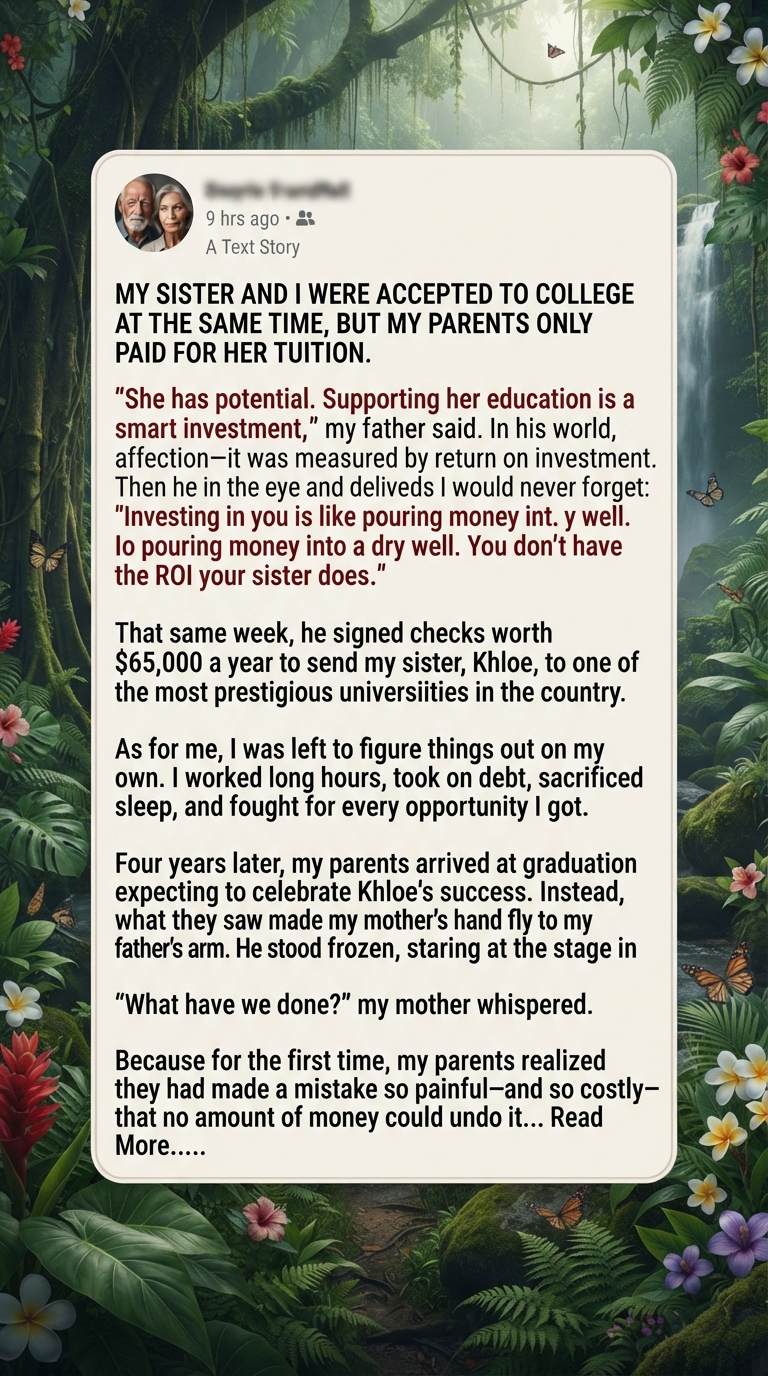
MY SISTER AND I WERE ACCEPTED TO COLLEGE AT THE SAME TIME, BUT MY PARENTS ONLY PAID FOR HER TUITION.
“She has potential. Supporting her education is a smart investment,” my father said.
In his world, love and affection—it was measured by return on investment.
Then he looked me in the eye and delivered words I would never forget:
“Investing in you is like pouring money into a dry well. You don’t have the ROI your sister does.”
That same week, he signed checks worth $65,000 a year to send my sister, Khloe, to one of the most prestigious universities in the country.
As for me, I was left to figure things out on my own.
I worked long hours, took on debt, sacrificed sleep, and fought for every opportunity I got.
Four years later, my parents arrived at graduation expecting to celebrate Khloe’s success.
Instead, what they saw made my mother’s hand fly to my father’s arm.
He stood frozen, staring at the stage.
“What have we done?” my mother whispered.
Because for the first time, my parents realized they had made a mistake so painful—and so costly—that no amount of money could undo it.
The truth was, my parents weren’t attending my graduation.
They were attending Khloe’s.
At least, that’s what they thought.
Khloe and I had graduated on the same weekend, but from completely different places.
She had gone to an elite private university three states away.
I had started at a community college with a cracked laptop and $14 in my checking account.
Then I transferred to a state university.
Then, through a mixture of scholarships, paid internships, and sleepless nights, I earned my degree.
I never told my parents how difficult it had been.
Every time Dad asked how school was going, I said,
“Fine.”
Whenever Mom asked whether I needed anything, I said,
“I’m okay.”
Because I’d already learned something important:
People who measure your worth by your financial return rarely appreciate the cost of your struggle.
My parents were obsessed with Khloe’s achievements.
Her acceptance letter was framed.
Her first-year grades were printed and placed on the refrigerator.
When she got an internship at a major financial firm, Dad told everyone at Thanksgiving.
“My daughter is going places.”
I sat across from him.
He never mentioned me.
Not once.
Then something unexpected happened during my junior year.
I applied for an engineering fellowship I thought I had no chance of receiving.
There were hundreds of applicants.
The program selected six.
I was one of them.
The fellowship covered tuition, provided a salary, and placed students into a paid research program.
For the first time, I could breathe.
I stopped working three jobs.
I got eight hours of sleep.
I started doing something I’d forgotten how to do.
Think about the future.
My research project focused on improving battery efficiency for large-scale energy storage.
I loved it.
I was good at it.
And one professor noticed.
His name was Dr. Marcus Lee.
He pulled me aside one afternoon.
“You understand this work better than most graduate students I’ve taught.”
I laughed.
“Maybe I just don’t know enough to be intimidated.”
He smiled.
“That’s why you’re dangerous.”
He recommended me for a position at a technology company that was developing next-generation energy systems.
I applied.
Six interviews later, they offered me a full-time position.
Then came the offer I almost didn’t believe.
They wanted me to lead a new research team.
I called my mother.
“Mom, I got the job.”
She sounded distracted.
“Oh, that’s nice, honey. How’s Khloe doing?”
I almost laughed.
“She got an offer from the investment firm.”
“That’s wonderful!”
“Yeah.”
There was a pause.
Then she asked,
“Are you still planning to stay in that little apartment?”
I looked around at my tiny kitchen.
“Probably for a while.”
“Well, as long as you’re happy.”
She said it kindly.
But I could hear what she wasn’t saying.
Khloe had a future.
I had a life that was “fine.”
The graduation ceremony arrived four years after Dad’s cruel speech.
I knew my parents would be there.
Not for me.
For Khloe.
Her university’s commencement ceremony was that morning.
Mine was that afternoon.
Dad had somehow convinced himself that he could attend Khloe’s graduation and then stop by my university for “a quick photo.”
I didn’t argue.
I didn’t need to.
Because something happened before the ceremony that none of us expected.
My company had announced a major breakthrough in battery storage.
And the research paper had my name at the top.
The project was being featured in a national technology publication.
But that wasn’t what made my parents freeze.
It was the message that appeared on the giant screen before the ceremony began.
“2026 University Excellence Award — Recipient: Emily Carter.”
My name.
I had been selected as the university’s top graduating student.
Not my department.
The entire graduating class.
The award came with a graduate research grant and a five-year partnership between the university and the company where I had accepted my job.
I walked across the stage.
My professors stood.
The audience rose.
People I barely knew were cheering.
And when I looked into the crowd, I saw my parents.
My mother had one hand over her mouth.
My father wasn’t clapping.
He was staring.
Because behind me, the university displayed a slide showing the research team I would lead.
My salary.
My fellowship.
My published research.
My awards.
My future.
None of it had been purchased by my parents.
Every line had been built by me.
Then the dean said something that changed the room.
“Emily Carter’s research has received an initial investment of $18 million toward commercial development.”
My mother grabbed my father’s arm.
He whispered,
“What?”
The dean continued.
“Her work has the potential to significantly improve large-scale energy storage efficiency.”
The crowd applauded.
I walked back to my seat.
I didn’t look at my parents again.
After the ceremony, I found them waiting for me.
Mom cried first.
She hugged me.
“I’m so proud of you.”
I stood there awkwardly.
“Thank you.”
Dad remained several feet away.
He looked at me for a long time.
Finally he said,
“I didn’t know.”
I nodded.
“You didn’t ask.”
He lowered his eyes.
“When did this happen?”
“While you were busy investing in Khloe.”
He flinched.
My mother started crying harder.
“Emily…”
I wasn’t angry anymore.
That surprised me.
Four years earlier, I had wanted to prove my father wrong.
That day, I realized I no longer cared whether he was wrong.
I had built a life without his approval.
Dad swallowed.
“I thought I was helping Khloe.”
“You were.”
“But I thought you didn’t have the same potential.”
“I know.”
He looked at me.
“I was wrong.”
Those three words should have felt satisfying.
They didn’t.
They felt late.
Very late.
Then he asked,
“Can we make it right?”
I looked at him.
“You can start by understanding what you actually did.”
He waited.
“You didn’t just refuse to pay my tuition.”
My voice remained calm.
“You told me I wasn’t worth the investment.”
Dad looked away.
“You taught me that I had to earn basic love.”
My mother covered her face.
“And then I spent four years learning that I didn’t.”
Neither of them spoke.
Then Dad asked the question I expected.
“What can we do now?”
I smiled sadly.
“Nothing.”
His face fell.
“Nothing?”
“You can’t go back to when I was eighteen.”
“I know.”
“You can’t give me the nights I lost working.”
“I know.”
“You can’t erase the student loans I paid myself.”
“I can help with those.”
“No.”
He stared at me.
“I don’t need you to pay for the life I already built.”
That was the moment my mother started crying again.
But Dad didn’t argue.
For once, he listened.
Then he asked,
“Does Khloe know?”
I nodded.
“She knows.”
Khloe arrived twenty minutes later.
She had already graduated from her university and received an offer from the same financial firm that had recruited her.
She walked toward us slowly.
She looked at me.
Then at our parents.
Then she said,
“I tried to tell Dad.”
I frowned.
“Tell me what?”
She took a breath.
“That you were the one I was worried about.”
Dad looked confused.
She continued.
“Every time you compared us, I hated it.”
My mother stared at her.
Khloe wiped her eyes.
“I was getting a great education, yes. But Emily was the one I called whenever I was overwhelmed.”
She smiled sadly.
“Do you know who helped me prepare for my final interview?”
Dad didn’t answer.
“Emily.”
The silence was painful.
“She reviewed my presentation for three nights.”
She turned toward me.
“You never told them, did you?”
I shook my head.
Khloe laughed through her tears.
“Of course you didn’t.”
Then she hugged me.
“I’m proud of you.”
I hugged her back.
For the first time, there was no comparison between us.
No favorite child.
No investment.
No ROI.
Just two sisters who had taken different roads.
My father eventually changed.
Not overnight.
Not because he suddenly became a perfect parent.
But because he finally understood that relationships weren’t spreadsheets.
He stopped asking about salaries.
He stopped comparing achievements.
He started asking questions.
Real ones.
How was I sleeping?
Was work stressful?
Did I like my new apartment?
He came to my first major research presentation.
He sat in the front row.
When I finished, he stood before anyone else.
He applauded until his hands turned red.
Afterward, he hugged me.
“I used to think success was about what came back from an investment.”
I smiled.
“And now?”
He looked at me.
“Now I think I was measuring the wrong thing.”
I didn’t tell him he was forgiven.
I didn’t need to.
Our relationship changed slowly.
Carefully.
Honestly.
Some wounds don’t disappear because somebody finally sees what they did.
But they can stop bleeding.
Years later, my mother asked me what I remembered most about that graduation.
I told her the truth.
“It wasn’t the award.”
“It wasn’t the job.”
“It wasn’t the money.”
“What was it?”
I smiled.
“The moment Dad realized he had spent $65,000 a year trying to buy someone else’s future while the daughter he called a bad investment built one without him.”
My mother laughed softly.
Then she said,
“Your father still hates that phrase.”
“What phrase?”
“ROI.”
I laughed.
“So do I.”
She squeezed my hand.
And somehow, after all those years, that was the first time I thought about what my father had said without feeling like a wound.
Because he had been wrong.
I wasn’t a dry well.
I was a seed.
And he simply wasn’t willing to wait long enough to see what I could grow into.