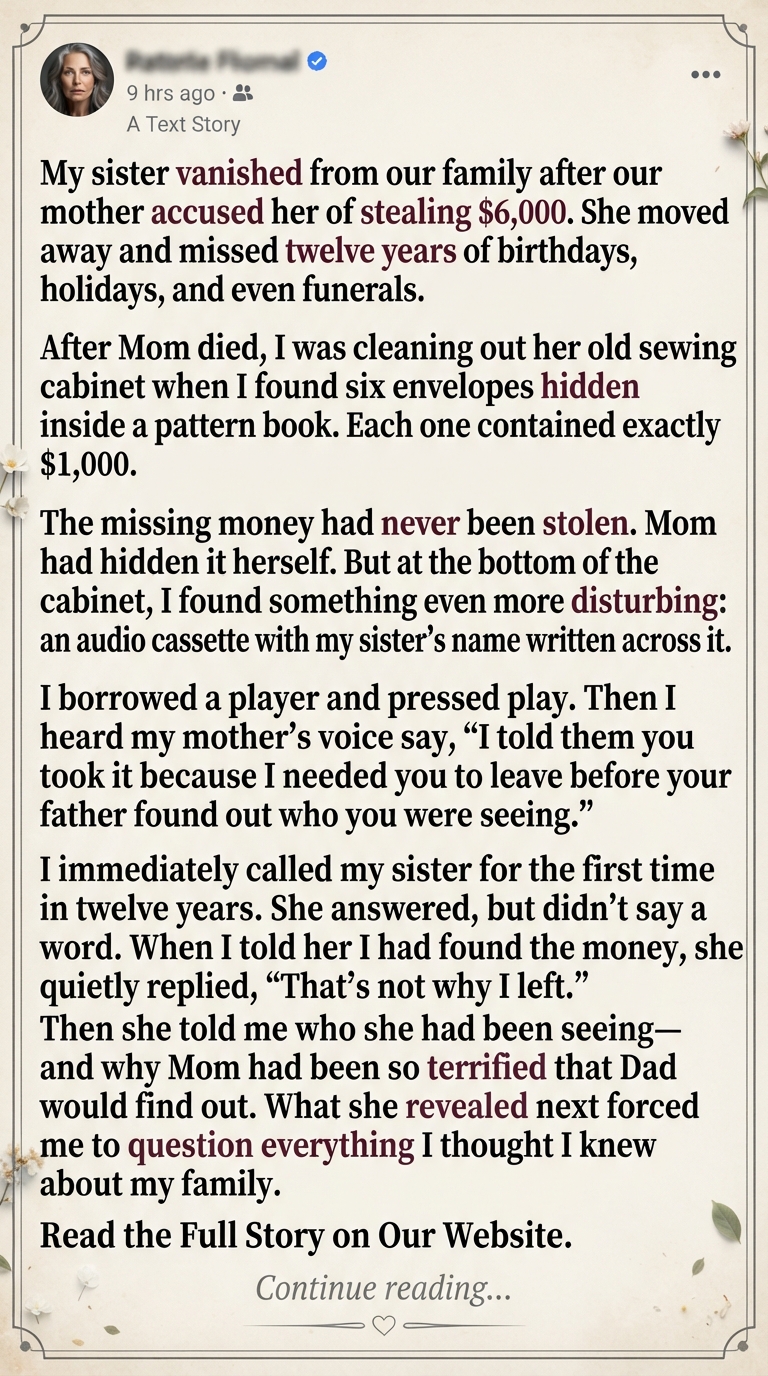
My sister vanished from our family after our mother accused her of stealing $6,000.
She moved away and missed twelve years of birthdays, holidays, and even funerals.
For twelve years, I believed the same story everyone else did.
My sister, Claire, had stolen the money.
Mom had caught her.
Claire had run away because she was ashamed.
Then Mom died.
And everything I thought I knew about my family began to fall apart.
I was cleaning out Mom’s old sewing room when I found her sewing cabinet.
It was the same cabinet she’d owned for as long as I could remember.
Inside were old patterns, buttons, spools of thread, and faded photographs.
Then I noticed something strange.
One of the pattern books was heavier than the others.
I opened it.
Six envelopes slipped onto the floor.
I picked them up.
Each contained exactly $1,000.
Six envelopes.
$6,000.
I sat down on the floor.
The missing money had never been stolen.
Mom had hidden it herself.
But why?
I searched the cabinet again.
At the very bottom, underneath an old piece of fabric, I found something else.
An audio cassette.
Written across it in Mom’s handwriting were two words:
CLAIRE — PRIVATE
My heart started pounding.
I drove to a store across town and bought an old cassette player.
That night, I sat alone at my kitchen table and pressed play.
There was static.
Then Mom’s voice.
Weak.
Shaking.
And unmistakable.
“I told them you took it because I needed you to leave before your father found out who you were seeing.”
I froze.
I rewound the tape.
Played it again.
Then again.
Mom had lied.
She had deliberately accused Claire of stealing $6,000.
She had destroyed her relationship with the entire family.
And she’d done it to force Claire to leave.
But why?
I picked up my phone.
For twelve years, I’d been too afraid to call my sister.
Now I dialed the number I’d kept even after everyone told me to delete it.
It rang four times.
Then someone answered.
Neither of us spoke.
Finally, I whispered:
“Claire?”
Silence.
“It’s me.”
A long pause.
Then I heard her breathe.
“Why are you calling?”
My voice broke.
“I found the money.”
Another silence.
Then she quietly said:
“That’s not why I left.”
I closed my eyes.
“I know.”
She sounded tired.
“Then what did Mom tell you?”
I told her about the cassette.
For several seconds, she said nothing.
Then she whispered:
“Mom knew about Daniel.”
I frowned.
“Daniel?”
“My boyfriend.”
I sat up.
“You had a boyfriend?”
“Yes.”
“Why would Mom care?”
Claire took a shaky breath.
“Because Daniel was Dad’s son.”
I couldn’t speak.
“What?”
“Not biologically,” Claire said. “Dad wasn’t Daniel’s father.”
My mind raced.
“Then who was?”
Claire answered quietly.
“Mom.”
I stared at the phone.
“That doesn’t make sense.”
“It didn’t to me either.”
Then Claire explained everything.
Years earlier, before Dad married Mom, Mom had been involved with another man.
She became pregnant.
But the man disappeared.
Mom eventually married Dad and raised the child as if he were her younger brother’s son.
That child was Daniel.
And Claire had fallen in love with him.
They had met without knowing the connection.
They only discovered the truth after Claire became serious about him.
When Mom found out, she panicked.
Not because Claire had done anything wrong.
But because Dad had never known the truth.
And Mom was terrified that if he discovered Daniel wasn’t biologically related to the family member everyone believed he was, an old inheritance dispute would explode.
So she created a story.
She told everyone Claire had stolen $6,000.
She knew Dad would never forgive her.
She knew Claire would leave.
And she was right.
“But why didn’t you tell me?” I asked.
Claire laughed bitterly.
“Because Mom made me promise.”
“Promise what?”
“That I’d never come back.”
My chest tightened.
“She told me if I stayed, she’d tell Dad everything and destroy Daniel’s life.”
I looked at the cassette.
“She recorded this?”
“I think she made it near the end.”
“Did she ever contact you?”
“No.”
“Not once?”
“No.”
Then Claire said something that broke my heart.
“I didn’t leave because I didn’t love my family.”
“I left because I thought they hated me.”
I started crying.
“Claire…”
“I waited for someone to call.”
My throat tightened.
“No one did.”
“I know.”
“Do you know how many times I almost came home?”
I couldn’t answer.
“Every birthday,” she whispered.
“Every Christmas.”
“Every funeral.”
I covered my mouth.
“I was there,” I said.
“I know.”
“I should have looked for you.”
“Yes.”
That one word hurt more than anything else.
Because she was right.
I had believed the easiest version of the story.
I had trusted Mom.
And in doing so, I had abandoned my sister too.
The next morning, I drove six hours to Claire’s apartment.
When she opened the door, we stared at each other.
Twelve years disappeared in a single second.
She looked older.
So did I.
Neither of us knew what to say.
Then I held out the six envelopes.
“These belong to you.”
She stared at the money.
“I don’t want it.”
“It’s not about the money.”
“I know.”
I handed her the cassette.
She took it with trembling hands.
“Why now?”
“Because Mom can’t control the story anymore.”
Claire looked down.
Then she started crying.
So did I.
We hugged in the doorway.
For the first time in twelve years, my sister was home.
Not because Mom had allowed it.
Not because Dad had forgiven her.
Not because the family had finally discovered the truth.
Because she had never actually stopped being my sister.
Months later, I learned one more thing.
The $6,000 wasn’t the only thing Mom had hidden.
There was another envelope inside the sewing cabinet.
This one contained a letter.
It was addressed to Claire.
Mom had written it shortly before she died.
The letter didn’t excuse what she had done.
It didn’t ask Claire to forgive her.
Instead, it contained one sentence that stayed with me:
“I thought protecting the family secret was worth breaking my daughter’s heart. I was wrong.”
Claire read the letter twice.
Then she folded it carefully.
“I don’t forgive her yet,” she said.
“You don’t have to.”
She nodded.
“But I think I finally understand why she did it.”
I looked at her.
“Does that make it easier?”
“No.”
She looked toward the window.
“It just makes it possible to stop carrying it.”
A year later, Claire came to our family’s Christmas dinner.
The first one she’d attended in twelve years.
There were empty chairs.
There were painful conversations.
There were questions nobody knew how to answer.
But there was also laughter.
Real laughter.
The kind we hadn’t heard in years.
And when Claire placed her hand over mine beneath the table, I realized something.
The $6,000 had never been the real theft.
Mom had hidden the money.
But the lie had stolen twelve years from all of us.
Twelve birthdays.
Twelve Christmas mornings.
Twelve years of ordinary moments that could never be returned.
And the most disturbing part wasn’t discovering that my mother had lied.
It was realizing how easily the rest of us had believed her.
Sometimes the biggest family secrets aren’t buried in graves.
They’re hidden in old cabinets, forgotten recordings, and stories everyone stopped questioning.
And sometimes, finding the truth doesn’t give you back the years you lost.
It simply gives you the chance to stop losing any more.