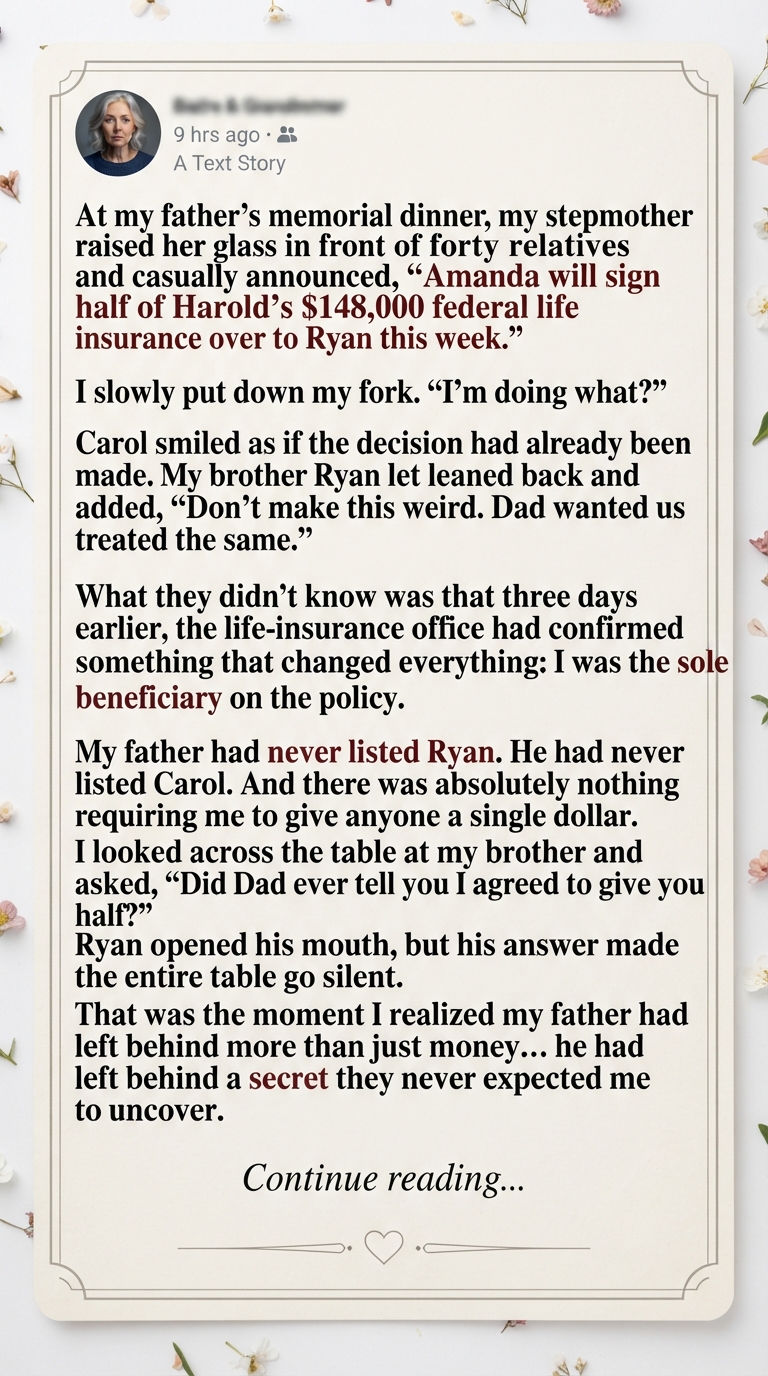
At my father’s memorial dinner, my stepmother raised her glass in front of forty relatives and casually announced:
“Amanda will sign half of Harold’s $148,000 federal life insurance over to Ryan this week.”
I slowly put down my fork.
“I’m doing what?”
Carol smiled as if the decision had already been made.
My brother Ryan leaned back in his chair.
“Don’t make this weird. Dad wanted us treated the same.”
I looked around the table.
Forty relatives.
Forty pairs of eyes.
And apparently, everyone already knew about a decision I had never made.
Three days earlier, the life-insurance office had confirmed something that changed everything.
I was the sole beneficiary on the policy.
My father had never listed Ryan.
He had never listed Carol.
And there was absolutely nothing requiring me to give anyone a single dollar.
But I hadn’t told them.
Not yet.
I looked across the table at Ryan.
“Did Dad ever tell you I agreed to give you half?”
Ryan opened his mouth.
Then he stopped.
Carol’s smile disappeared.
Finally, Ryan said:
“Dad told me you would do the right thing.”
The entire table went silent.
I stared at him.
“That wasn’t my question.”
Ryan shifted in his chair.
“He said you understood.”
“Understood what?”
He didn’t answer.
I looked at Carol.
She suddenly became very interested in her wineglass.
That’s when I knew.
There was something they weren’t telling me.
And I was about to find out what it was.
My father, Harold, had always been complicated.
After my mother died, he married Carol.
I was seventeen.
Ryan was eleven.
From the outside, we looked like a normal blended family.
But Ryan was always treated differently.
He got the expensive college.
The new car.
The business loan.
The vacations.
Whenever I asked Dad about it, he would say:
“Ryan needs more help than you do.”
I stopped arguing.
I learned to build my own life.
I moved out at nineteen.
I paid my own bills.
I built a career.
And over the years, Dad and I became close again.
Not perfect.
But close.
We had coffee every Sunday morning.
We talked about everything.
Except money.
Three days before the memorial dinner, I had met with the federal life-insurance office.
They confirmed the policy.
$148,000.
My name was the only beneficiary.
I asked whether there had been any recent changes.
“No,” the representative told me.
“Your father designated you years ago.”
I remember staring at the paperwork.
“Are you sure?”
“Yes.”
I left the office with the documents in my bag.
I didn’t tell Carol.
I didn’t tell Ryan.
I wanted to understand why Dad had made that decision.
Now, sitting at the memorial dinner, I finally had my answer.
Or at least I thought I did.
I looked at Ryan.
“What exactly did Dad tell you?”
He glanced at Carol.
That glance told me everything.
Carol finally spoke.
“Harold always wanted his children treated equally.”
“Then why did he name only me?”
She hesitated.
“Because he trusted you.”
I almost laughed.
“That’s not an answer.”
Ryan leaned forward.
“You’re acting like we’re strangers.”
“No.”
I looked directly at him.
“I’m acting like someone who just learned that her family made a financial decision on her behalf without asking her.”
Several relatives lowered their eyes.
Nobody defended them.
Then Ryan said something that made my stomach tighten.
“Dad told me you knew about the other account.”
I froze.
“What other account?”
Ryan looked at Carol.
She whispered:
“Ryan.”
But it was too late.
I stood up.
“What account?”
Ryan shook his head.
“Forget it.”
“No.”
My voice was calm.
“What other account?”
He looked around the table.
Then quietly said:
“Dad had another life-insurance policy.”
My heart stopped.
“How much?”
Ryan swallowed.
“About $900,000.”
The room erupted in whispers.
I stared at him.
“And who is the beneficiary?”
He didn’t answer.
Carol did.
“Ryan.”
I looked at her.
“Who?”
She finally whispered:
“Your father never told us.”
I sat back down.
Suddenly, the $148,000 didn’t matter anymore.
The next morning, I called Dad’s attorney.
I asked about the second policy.
There was a long silence.
Then he said:
“Your father specifically instructed me not to discuss that policy until after the memorial.”
“Why?”
“Because he wanted you to have a chance to hear the truth from your family first.”
My heart sank.
“What truth?”
The attorney asked me to come to his office.
I arrived that afternoon.
He placed a large envelope on the desk.
My name was written across it in Dad’s handwriting.
I recognized it immediately.
My hands started shaking.
Inside was a letter.
I read it slowly.
Amanda,
If you’re reading this, then I’m gone.
I’m sorry.
There are things I should have told you years ago.
I swallowed hard.
Then continued.
Ryan is not my biological son.
I stopped breathing.
I read the sentence again.
Then again.
The attorney watched me silently.
Dad’s letter explained everything.
Ryan was Carol’s son from a previous relationship.
Harold had married Carol when Ryan was six.
He had legally adopted Ryan and raised him as his own.
But there was another part.
Before marrying Carol, Dad had discovered that Ryan’s biological father had died without knowing Ryan existed.
That man had left behind a substantial estate.
And Ryan was legally entitled to a portion of it.
But Carol had never told Ryan.
Why?
Because she was afraid Ryan would leave.
She had spent years allowing him to believe that Harold was his biological father.
Then, after Dad became sick, he discovered something else.
Carol had been secretly moving money from one of Dad’s accounts.
Not hundreds of thousands.
But enough to make him suspicious.
Dad hired an investigator.
He discovered that Carol had been planning to transfer additional assets to Ryan after his death.
That’s why Dad changed his life insurance beneficiary.
That’s why he created the second policy.
And that’s why he left instructions with his attorney.
The $148,000 policy was mine.
The second policy was also mine.
Not because he loved Ryan less.
But because he wanted me to control the money while the estate was investigated.
The attorney handed me another document.
It was a copy of Dad’s final instructions.
One line stood out.
“Amanda has always been the only person in this family who never asked me for anything.”
I started crying.
Not because of the money.
Because Dad had understood me.
He had seen what I thought nobody noticed.
The sacrifices.
The distance.
The way I stopped asking for help because I didn’t want to compete with Ryan.
Then I remembered Ryan’s words at dinner.
“Dad wanted us treated the same.”
I suddenly understood.
Dad had never said that.
Ryan had assumed it.
Or someone had told him.
I returned home and called Ryan.
He answered immediately.
“What did you find?”
I asked:
“Did Dad ever tell you he was your biological father?”
Silence.
Then:
“What?”
I explained everything.
Ryan didn’t speak for almost a minute.
Finally, he whispered:
“Mom told me he was.”
I closed my eyes.
“I know.”
“She lied?”
“Yes.”
Ryan started crying.
“I don’t understand.”
Neither did I.
But now I understood why Dad had been distant with Carol near the end.
Why he had started keeping documents locked away.
Why he had insisted on meeting with his attorney alone.
Why he had changed the beneficiaries.
And why he had trusted me.
A week later, the family gathered again.
This time, nobody was celebrating.
Carol sat quietly.
Ryan sat beside her.
I placed the documents on the table.
“The $148,000 isn’t being divided.”
Carol looked up.
“Why?”
“Because Dad didn’t leave it to the family.”
She started to argue.
I raised my hand.
“And the other policy isn’t being divided either.”
Ryan looked at me.
I continued.
“Not because I want to punish anyone.”
“But because Dad left instructions.”
I handed Ryan a copy of the letter.
He read it.
His face crumpled.
Then he looked at Carol.
“Why didn’t you tell me?”
She started crying.
“I was afraid.”
“Afraid of what?”
“That you’d stop loving me.”
Ryan stared at her.
“You lied to me my whole life.”
The room went silent.
I watched my brother cry.
And despite everything, I felt sorry for him.
Because the truth hadn’t just changed the inheritance.
It had changed his entire understanding of who he was.
Eventually, I decided to use the money differently.
I kept what Dad had legally left me.
But I also established a scholarship in his name.
One that helped children from blended families pay for college.
I didn’t give Ryan half the money simply because everyone expected me to.
Instead, I offered him something else.
The truth.
I helped him locate his biological father’s family and understand the inheritance he was legally entitled to receive from that estate.
He didn’t need my father’s money to have a future.
He needed the truth about his own.
Months later, Ryan called me.
“I used to think Dad loved you more.”
I smiled sadly.
“He loved us differently.”
“No.”
He paused.
“I think he trusted you more.”
I didn’t know what to say.
Then he added:
“I understand why now.”
For the first time in years, my brother wasn’t asking me for money.
He wasn’t comparing what Dad had given us.
He wasn’t keeping score.
He was simply talking to me.
And somehow, that meant more than the $148,000 ever could.
My father had left behind money.
He had left behind secrets.
He had left behind painful truths.
But the greatest thing he left me wasn’t an inheritance.
It was the answer to a question I had carried since I was seventeen:
Did he ever see everything I had sacrificed for this family?
Yes.
He had.
And he had quietly made sure I would finally know it.