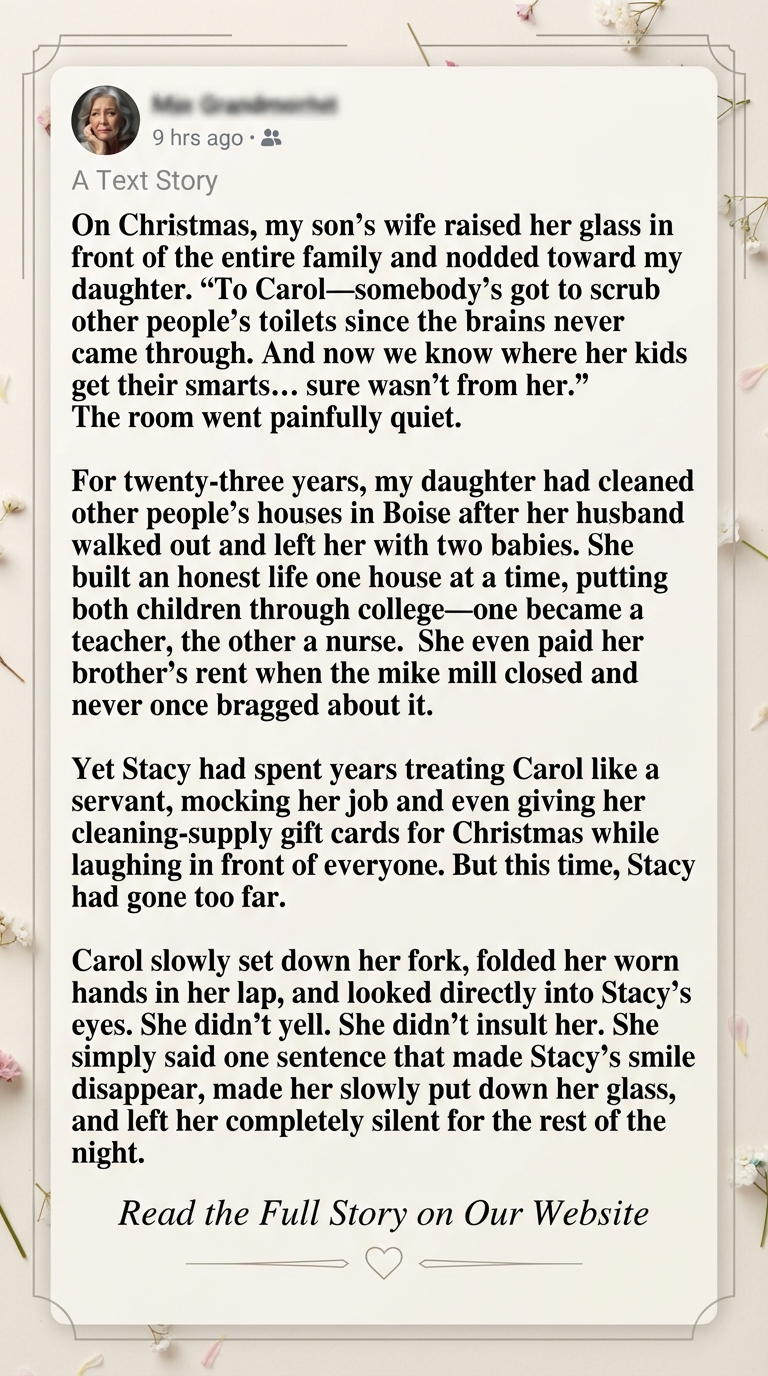
On Christmas, my son’s wife raised her glass in front of the entire family.
She smiled toward my daughter.
“To Carol,” Stacy said loudly. “Somebody’s got to scrub other people’s toilets since the brains never came through.”
A few people shifted uncomfortably.
Stacy wasn’t finished.
“And now we know where her kids get their smarts.”
She laughed.
“Sure wasn’t from her.”
The room went painfully quiet.
My daughter Carol sat across the table.
She didn’t move.
She didn’t look angry.
She simply lowered her eyes toward her plate.
I felt something inside me break.
Because I knew exactly what Stacy was mocking.
For twenty-three years, Carol had cleaned other people’s houses in Boise.
Not because she was lazy.
Not because she lacked ambition.
Because her husband had walked out when their children were babies.
Two children.
Two diapers.
Two college funds.
One exhausted mother.
Carol had taken whatever work she could find.
She cleaned kitchens.
Scrubbed bathrooms.
Washed windows.
Vacuumed carpets.
She worked weekends.
She worked holidays.
Sometimes she cleaned six houses in one day.
And she never complained.
When her son graduated from college, he became a teacher.
When her daughter graduated, she became a nurse.
Carol paid for both.
She didn’t inherit money.
She didn’t have a wealthy boyfriend.
She didn’t marry someone who could support her.
She simply worked.
One house at a time.
One paycheck at a time.
One sacrifice at a time.
And when my son’s job disappeared during the mill closure, Carol quietly paid his rent for four months.
She never told anyone.
I only knew because I accidentally saw the receipts.
Stacy knew too.
But instead of being grateful, she had spent years treating Carol like a servant.
Every Christmas, she’d give Carol cleaning-supply gift cards.
Not as a thoughtful present.
As a joke.
She would laugh and say,
“Here. I know you’ll actually use these.”
Everyone knew what she meant.
Everyone except Stacy’s own sense of shame.
Carol always smiled politely.
Until that Christmas.
Stacy took another sip of wine.
“Well?”
She looked around the table.
“Aren’t you all going to laugh?”
Nobody did.
My son stared at his plate.
Carol’s children looked furious.
Her son finally said,
“That’s enough.”
Stacy rolled her eyes.
“Oh, please. Everyone knows it’s a joke.”
Carol slowly set down her fork.
She folded her worn hands in her lap.
Then she looked directly at Stacy.
Her voice was calm.
Almost gentle.
She said,
“If cleaning toilets makes me less intelligent, Stacy, what does needing the woman who cleans them make you?”
Stacy’s smile disappeared.
Her glass stopped halfway to her mouth.
Nobody moved.
Carol continued.
“I’ve never been ashamed of the work that fed my children.”
She looked around the table.
“I’ve been ashamed only once.”
Her eyes returned to Stacy.
“Tonight.”
Stacy’s face turned red.
My son finally looked up.
“Mom’s right.”
Stacy stared at him.
“What?”
He shook his head.
“I said Mom’s right.”
Carol’s son leaned back in his chair.
“My mother paid my rent when the mill closed.”
Stacy looked at him.
“I didn’t know that.”
“You knew.”
“I didn’t.”
“You did.”
He reached into his pocket and pulled out his phone.
“I have the messages.”
Stacy’s face changed.
My daughter looked at her son.
“Don’t.”
He lowered the phone.
Carol shook her head.
“We don’t need to embarrass her.”
Her son looked confused.
“Mom, after what she said—”
“That’s exactly why.”
Carol turned toward Stacy.
“I don’t need to make you feel small to prove that I’m worth something.”
That silenced the room again.
Then Carol’s daughter spoke.
“Mom, you paid for my nursing degree.”
Carol smiled.
“You earned that degree.”
“You worked for it.”
“So did you.”
Her son smiled.
“And mine.”
Carol laughed softly.
“I suppose I worked a little on that one.”
Everyone smiled.
Everyone except Stacy.
Then something unexpected happened.
My son stood up.
He looked at his wife.
“Apologize.”
Stacy stared at him.
“Seriously?”
“Yes.”
“You’re taking her side?”
He looked at Carol.
“No.”
Then he looked back at Stacy.
“I’m taking the side of basic decency.”
Stacy crossed her arms.
“I was joking.”
“You’ve been making that joke for years.”
Silence.
My son continued.
“You mocked her job.”
He pointed toward the gift bag beside Stacy’s chair.
“You gave her cleaning supplies for Christmas and laughed about it.”
Carol’s daughter whispered,
“I remember.”
Her brother nodded.
“So do I.”
Stacy looked around the table.
Suddenly she realized something.
Nobody was laughing.
Not one person.
She looked at Carol.
“Fine.”
She swallowed.
“I’m sorry.”
Carol nodded.
“Thank you.”
Stacy seemed surprised.
“That’s it?”
Carol smiled.
“What else would you like?”
Stacy didn’t answer.
Dinner continued.
But something had changed.
Not because Carol had humiliated Stacy.
She hadn’t.
Carol had simply refused to accept the humiliation anymore.
Later that evening, I found Carol standing alone in the kitchen.
She was washing dishes.
I walked over and took the towel from her.
“You don’t have to do that.”
She smiled.
“Old habits.”
I looked at my daughter.
“Are you okay?”
She nodded.
Then she said something I’ll never forget.
“Mom, for years I thought people looked down on me because I cleaned houses.”
I waited.
She dried her hands.
“But tonight I realized something.”
“What?”
She looked toward the dining room.
“Some people spend their whole lives trying to convince everyone they’re important.”
She smiled.
“Some of us just spend ours being useful.”
I hugged her.
And for the first time, I realized something I should have understood years earlier.
My daughter hadn’t failed at life.
She had succeeded at something much harder.
She had raised two children alone.
She had worked honestly.
She had kept her promises.
She had helped her family when she had every reason to say no.
And she had done all of it without needing applause.
The following spring, Carol’s son bought her a small house.
Not a mansion.
Not anything extravagant.
Just a comfortable little place with a backyard and a porch.
On moving day, he gave her the keys.
Carol started crying.
“You didn’t have to do this.”
He smiled.
“You spent twenty-three years giving us everything.”
His sister hugged her.
“Now it’s our turn.”
Carol looked at both of her children.
Then she laughed through her tears.
“I guess I raised you two pretty well.”
Her son smiled.
“You did.”
Then he added,
“And Mom?”
“Yes?”
“You’ll never have to scrub another toilet again.”
Carol laughed.
“Don’t make promises you can’t keep.”
We all laughed.
And that Christmas became something none of us forgot.
Not because Stacy insulted Carol.
But because Carol finally reminded everyone at the table of something simple:
There is no shame in honest work.
The shame belongs to the person who looks down on someone else for doing it.
And sometimes the strongest response isn’t shouting.
It isn’t revenge.
It isn’t making someone hurt the way they hurt you.
Sometimes it’s simply standing up, looking someone in the eyes, and reminding them that the work they mocked is the very thing that helped build a family they could never have built themselves.