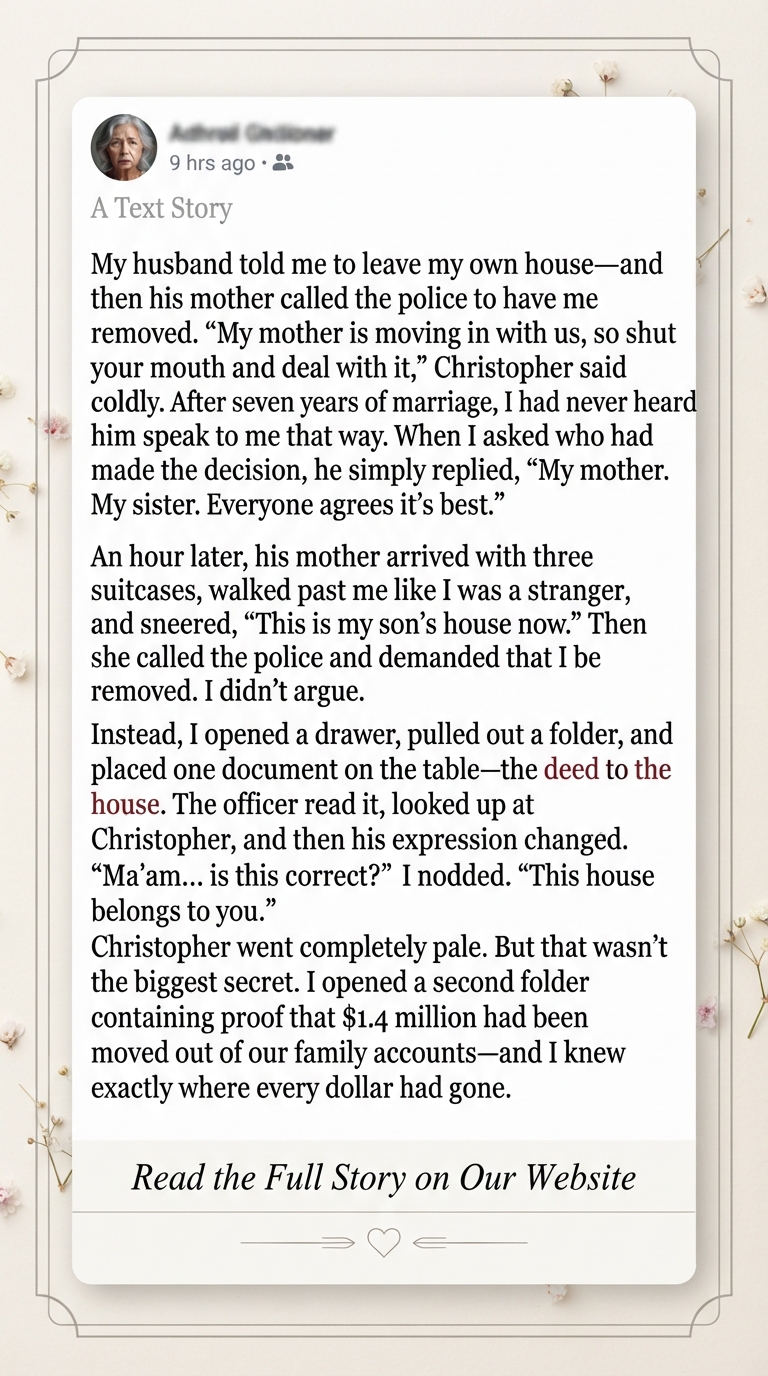
The officer read the deed twice.
Then he looked at Christopher.
“Sir, this document lists your wife as the sole owner.”
Christopher’s face went white.
His mother, Eleanor, stepped forward.
“That can’t be right.”
The officer held up a hand.
“Ma’am, I need you to step back.”
Eleanor stared at me.
“You lied to my son.”
I almost laughed.
“I didn’t lie to anyone.”
Christopher looked at me.
“Where did you get that?”
“It’s been in the house since before we got married.”
His expression changed.
“You knew?”
“I’ve always known.”
The house had belonged to my grandmother.
When she died, she left it to me.
I had moved into it before my wedding.
Christopher knew that.
But over seven years, he’d slowly started talking about it as though it belonged to both of us.
He called it our house.
His mother called it the family house.
And eventually, Christopher apparently convinced himself that repeating a lie long enough could turn it into the truth.
The officer examined the deed again.
“There’s no basis for removing her from this property.”
Eleanor’s face reddened.
“This is ridiculous!”
“No,” I said quietly.
“What’s ridiculous is calling the police because the homeowner won’t leave her own house.”
Christopher stared at me.
“Why didn’t you tell me?”
I looked at him.
“I did.”
“When?”
“Every time you asked me to refinance it.”
His mouth opened.
Then closed.
Because suddenly, I knew he remembered.
The refinance requests.
The home-equity loan.
The conversations about using the property as collateral.
I’d refused every time.
Not because I didn’t trust him.
At least, not then.
Because my grandmother had left me one instruction.
Never let anyone turn your home into someone else’s leverage.
I had followed it.
Christopher hadn’t.
The officer handed me the deed.
“Ma’am, you should probably speak with an attorney about the financial issues you’ve mentioned.”
“I already have.”
Christopher’s eyes narrowed.
“You already have an attorney?”
“Yes.”
“When?”
“Two weeks ago.”
His mother looked at him.
“What is she talking about?”
I opened the second folder.
“Your son knows.”
Christopher shook his head.
“No.”
I placed a bank statement on the table.
“Account ending in 4412.”
He stared at it.
Then another.
“Account ending in 9821.”
His face became even paler.
Then another.
“Investment account.”
Eleanor looked confused.
“What are these?”
I turned the papers toward her.
“Your son transferred $1.4 million from our family accounts.”
Christopher snapped.
“That’s not what happened.”
“Then explain it.”
“I was investing.”
“For whom?”
He said nothing.
I placed another document on the table.
“This is the company that received the first transfer.”
Then another.
“And this is the company that received the second.”
Eleanor stared at the names.
“Those are your sister’s companies.”
I nodded.
Christopher looked at his mother.
“Mom—”
She turned toward him.
“You told me that money was from your business.”
Christopher didn’t answer.
I felt something inside me finally go still.
For years, I had defended him.
Explained his mistakes.
Covered his late payments.
Believed his excuses.
But the numbers had eventually become too large to ignore.
The $1.4 million hadn’t disappeared.
It had been deliberately moved.
And I knew exactly where it went.
Christopher’s sister, Melissa, had been struggling with a restaurant business.
Apparently, Christopher had been secretly financing it.
But the restaurant wasn’t the real problem.
The real problem was what Melissa had done with the money.
She had used part of it to pay off personal debts.
Another portion had gone toward a luxury condo.
And nearly $300,000 had been transferred into an account controlled by Eleanor.
My mother-in-law’s account.
I looked at her.
“That’s why you wanted to move into my house.”
She froze.
Christopher stepped forward.
“Don’t accuse my mother.”
“I’m not accusing her.”
I slid the bank records across the table.
“I’m showing her.”
Eleanor picked them up.
Her hands began shaking.
“This isn’t mine.”
I pointed to the transfer.
“It went into your account.”
“I didn’t know.”
“Then ask your son.”
She turned toward Christopher.
“Did you transfer this money?”
He said nothing.
“Christopher?”
Finally, he whispered,
“Yes.”
Eleanor stared at him.
“Why?”
He rubbed his forehead.
“Because we needed somewhere to keep it.”
I looked at him.
“Who is we?”
He didn’t answer.
The officer had already stepped outside.
But before leaving, he had quietly told me something.
“If you believe there’s financial fraud involved, document everything and speak to your attorney.”
I had been doing exactly that.
For weeks.
I had hired a forensic accountant.
The accountant had traced every transfer.
Every withdrawal.
Every shell company.
Every payment.
And then we discovered something even worse.
Christopher hadn’t started moving the money recently.
He had started almost three years earlier.
Small amounts at first.
$8,000.
$12,000.
$25,000.
Then larger transfers.
He had assumed I would never notice because our accounts were complicated.
But I had built my career in finance.
I knew exactly how to read a ledger.
And once I stopped trusting his explanations, the pattern became obvious.
I looked at him.
“You didn’t just steal from our family.”
His eyes dropped.
“You were preparing to leave.”
Silence.
Christopher finally looked up.
“What?”
I opened the last document.
It was a copy of an agreement.
A purchase agreement.
For a house in another state.
Purchased through a company connected to Christopher.
The down payment was $420,000.
Paid with money from our joint accounts.
Christopher stared at it.
“You weren’t supposed to find that.”
“I know.”
His mother whispered,
“You were buying another house?”
He didn’t answer.
“For who?” I asked.
He looked away.
And then I saw something that hurt more than the money.
There was another name on the document.
Jessica Morgan.
I knew the name.
His coworker.
The woman he had always insisted was “just part of the management team.”
I looked at him.
“Was she going to move in with you?”
Christopher closed his eyes.
That was the answer.
Eleanor stepped backward.
“You were planning to leave your wife?”
Christopher finally spoke.
“I was going to fix everything.”
I laughed softly.
“By taking $1.4 million, buying another house, and leaving me with the debts?”
“No.”
“Then what was the plan?”
He couldn’t answer.
I closed the folder.
“You know what the worst part is?”
Christopher looked at me.
“I could have forgiven financial mistakes.”
His eyes filled with tears.
“I could have forgiven fear.”
I swallowed.
“But you didn’t make one mistake.”
I pointed toward the folders.
“You made hundreds of decisions.”
The room went silent.
Then Eleanor surprised me.
She turned toward her son.
“You used me.”
Christopher looked at her.
“I was trying to protect you.”
“No.”
Her voice shook.
“You were hiding money in my account.”
She looked at me.
“I didn’t know what he was doing.”
“I believe you.”
Christopher stared at both of us.
For the first time, he looked completely alone.
The divorce proceedings began two weeks later.
The financial investigation took months.
Some of the money was recovered.
Some wasn’t.
The restaurant eventually closed.
Melissa had to sell the condo.
Eleanor moved into a small apartment of her own.
And Christopher?
He lost the house.
He lost access to the accounts.
And eventually, he lost the marriage he had spent years taking for granted.
As for me, I stayed.
In the house my grandmother left me.
I changed the locks.
Updated the security system.
Replaced the furniture Christopher had chosen.
And painted the living room a completely different color.
Not because I needed to erase him.
Because I wanted the house to feel like mine again.
Six months after that night, I stood in the kitchen drinking coffee when my phone rang.
It was Christopher.
I almost didn’t answer.
But I did.
“What do you want?”
There was a long pause.
“I just wanted to say I’m sorry.”
I looked around the kitchen.
Sunlight came through the windows.
The house was quiet.
Peaceful.
“I believe you’re sorry,” I said.
He sounded surprised.
“You do?”
“Yes.”
Then I added,
“But being sorry doesn’t undo what you chose to do.”
“I know.”
“I hope you learn from it.”
“I will.”
We hung up.
I never heard from him again.
Sometimes people think losing a marriage is the worst thing that can happen.
It isn’t.
Sometimes the worst thing is realizing you spent years defending someone who was quietly planning a life without you.
But the best thing can happen afterward.
You stop defending them.
You stop explaining them.
You stop shrinking yourself to keep their world comfortable.
And you finally start protecting your own.
My husband once told me to leave my own house.
His mother called the police to make it happen.
But when the officer read the deed, everything changed.
Because the house had never belonged to Christopher.
Neither did the money.
And neither did my future.
Those were mine.
And this time, I wasn’t asking anyone’s permission to keep them.