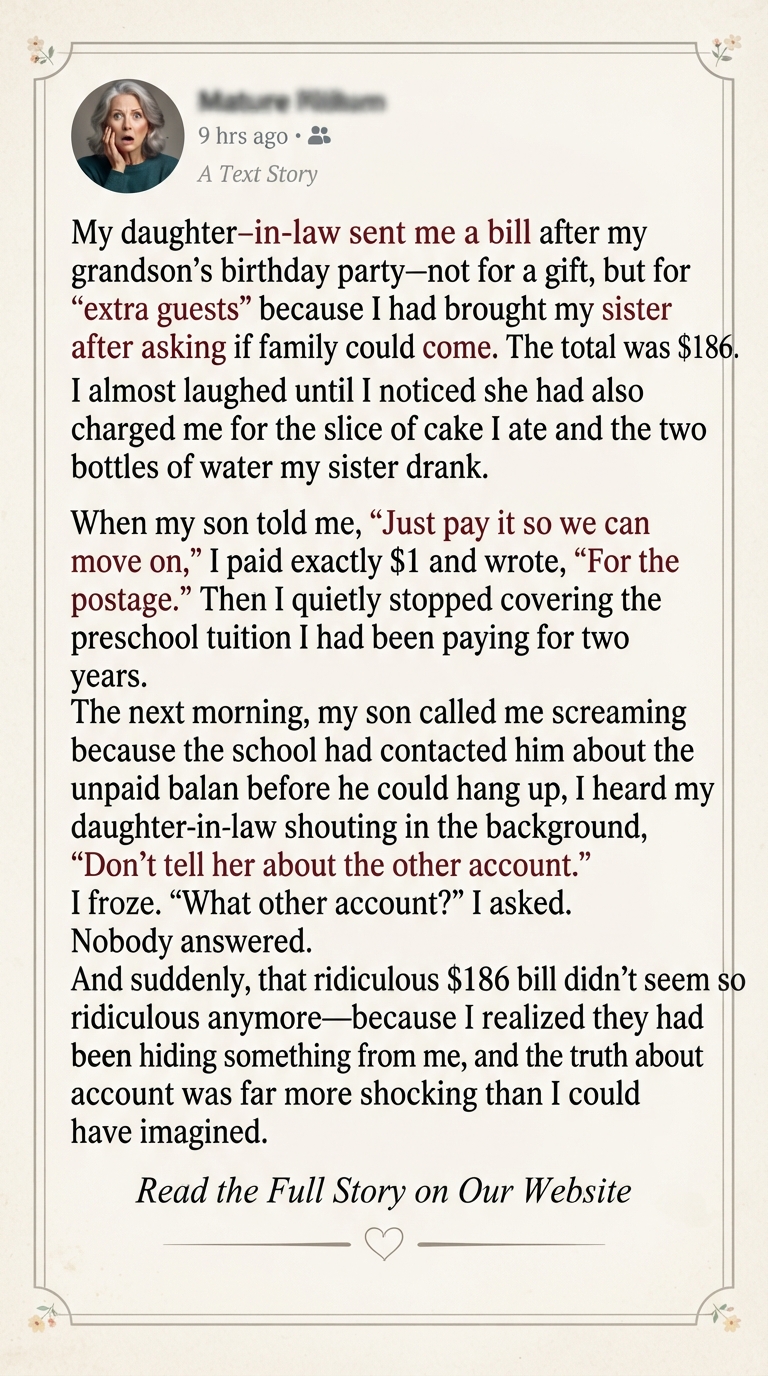
My daughter-in-law sent me a bill after my grandson’s birthday party.
Not a thank-you note.
Not a picture of the cake.
A bill.
$186.00
The subject line read:
“Birthday Party Expense Reimbursement.”
I stared at it for several seconds.
Then I opened the attachment.
I almost laughed.
Almost.
She had charged me $75 for “additional guests.”
That part was strange enough.
I had brought my sister because I had specifically asked if family could come.
My daughter-in-law had replied:
“Of course. The more, the merrier.”
Apparently, she had meant the merrier—at $75 per person.
Then there was a $28 charge for “additional food.”
$12 for “cake consumption.”
And $18 for “beverages.”
Two bottles of water.
My sister had drunk both.
I kept scrolling.
There was even a $9 charge labeled:
“Extended use of party space.”
The party had ended twenty minutes later than planned.
At the bottom was:
TOTAL: $186.00
I called my son.
“Did you know your wife sent me this?”
He sighed.
“Mom, please.”
“Please what?”
“Just pay it so we can move on.”
I couldn’t believe what I was hearing.
“Your wife charged me for eating a slice of my grandson’s birthday cake.”
“I know.”
“And for water.”
“I know.”
“And for bringing my sister after she said it was okay.”
“I said I know, Mom.”
He sounded exhausted.
Not angry.
Just tired.
Then he said,
“It’s easier if you just pay it.”
I looked at the bill again.
“All right.”
I sent exactly one dollar.
In the payment note, I wrote:
“For the postage.”
Then I closed my laptop.
I didn’t argue.
I didn’t complain.
And I didn’t tell them what I had decided next.
For two years, I had been paying my grandson’s preschool tuition.
Every month.
$1,250.
I had never been asked to.
I offered.
My son had been struggling financially after his business slowed down, and I wanted my grandson to have stability.
I never considered it a burden.
But if my own family had reached the point where they were charging me for birthday cake and bottled water, I realized something important.
I needed to stop confusing helping with being responsible for everything.
So I canceled the automatic tuition payment.
I didn’t tell anyone.
The next morning, my phone rang.
It was my son.
“Mom!”
He was furious.
“The school just called me!”
I sat down.
“What happened?”
“They said the tuition hasn’t been paid!”
“I know.”
“You know?”
“Yes.”
“You can’t just do that!”
I was stunned.
“Excuse me?”
“You know how much this costs!”
“Yes,” I said. “I’ve paid it for two years.”
“You’re putting your grandson in the middle of this!”
“No. I’m stepping out of something that was never supposed to be my responsibility.”
He started yelling.
Then I heard my daughter-in-law in the background.
Her voice was sharp.
“Don’t tell her about the other account!”
Everything inside me went still.
My son stopped talking.
I stared at the phone.
“What other account?”
Silence.
“Mark?”
Nothing.
“What other account?”
My daughter-in-law shouted again from somewhere behind him.
“Hang up!”
My son finally said,
“Mom, we have to go.”
The call ended.
I sat there staring at my phone.
The $186 suddenly didn’t seem ridiculous anymore.
It was evidence.
A clue.
I called my son again.
No answer.
So I waited.
Two hours later, he called back.
His voice was different.
Quieter.
“Mom, I owe you an explanation.”
I didn’t say anything.
He continued.
“There is another account.”
My heart sank.
“What kind?”
“A savings account.”
“Whose name is on it?”
Another pause.
“Yours.”
I froze.
“My name?”
“Yes.”
I immediately knew something was wrong.
“I don’t have another account.”
“I know.”
“Then why is my name on one?”
He took a breath.
“Because Emily opened it using the information from your tuition payments.”
I felt cold.
“What?”
My daughter-in-law had apparently discovered that I had been paying the preschool directly.
She had access to the payment records.
Then, according to my son, she had begun transferring small amounts into a separate account connected to my name.
At first, the amounts were tiny.
$40.
$75.
$100.
But over two years, they had added up.
Nearly $14,000.
I couldn’t understand.
“Where did that money come from?”
My son didn’t answer immediately.
Finally, he said,
“Some of it came from the tuition account.”
“What tuition account?”
“Our household account.”
I felt my stomach tighten.
“What does that have to do with me?”
“Mom…”
“Tell me.”
He finally admitted that Emily had been telling him for nearly two years that I was giving them more money than I actually was.
She had been inflating expenses.
School fees.
Activities.
Registration costs.
Books.
Uniforms.
Transportation.
And she had been using my payments as cover.
If I paid $1,250 directly to the preschool, she would sometimes tell my son that I had sent them $1,500.
The difference went into the secret account.
But that wasn’t the worst part.
The account wasn’t just holding money.
It had been used to make purchases.
Designer clothing.
Hotel stays.
Online shopping.
A weekend trip.
And a credit-card payment.
All connected to the account that carried my name.
I felt sick.
“Why would she put my name on it?”
My son whispered,
“Because she thought if anyone ever questioned the money, she could say it was yours.”
There it was.
The real reason behind the strange birthday bill.
It wasn’t about $186.
It wasn’t about cake.
It wasn’t even about water.
It was about creating a paper trail.
They had been turning my generosity into financial cover.
And then, when I stopped paying, they panicked.
I asked my son one question.
“How long have you known?”
He was silent.
“Mark?”
“Three days.”
I closed my eyes.
“You knew for three days and didn’t tell me?”
“I was trying to figure out what to do.”
“You were trying to protect her.”
He didn’t deny it.
I told him I wouldn’t fight with him over the phone.
I contacted my attorney.
We obtained the relevant financial records and documentation.
What we found was even more complicated than my son had admitted.
The account had been opened with information that should never have been used without my authorization.
There were transfers that appeared to originate from family funds.
There were purchases Emily couldn’t explain.
And there were messages between her and my son discussing how to make the account appear to be a gift from me.
I didn’t accuse anyone of a crime.
I didn’t need to.
The records could speak for themselves.
But I did something else.
I called the preschool.
I explained that I would no longer be making tuition payments directly.
Then I paid the remaining balance for the month so my grandson wouldn’t suffer because of his parents’ choices.
After that, I stepped back.
Completely.
A few weeks later, my son came to my house alone.
He looked exhausted.
“Mom,” he said, “I’m sorry.”
I invited him inside.
He sat at the kitchen table.
“I should have told you immediately.”
“Yes.”
“I thought I could fix it.”
“You couldn’t fix something you weren’t willing to admit existed.”
He looked down.
“I know.”
Then he handed me an envelope.
Inside were copies of the account records.
And a handwritten letter from Emily.
She admitted she had created the account because she was embarrassed about how much debt they had accumulated.
She said she planned to replace everything before I discovered it.
But months became years.
And eventually, the lie became easier than the truth.
I read the letter twice.
Then I folded it.
“Where is the money now?”
“Most of it is gone.”
I nodded.
“I want every transaction documented.”
My son agreed.
The legal process took months.
Some money was recovered.
Some wasn’t.
The account was closed, and the financial institutions were notified that I had not authorized the use of my information.
I never demanded that my son abandon his wife.
That wasn’t my decision.
But I did establish boundaries.
No more hidden accounts.
No more unexplained money.
No more pretending that my generosity was an unlimited family obligation.
And no more bills for birthday cake.
Months later, my grandson had another birthday.
This time, there was no elaborate party.
Just a small gathering at my house.
My sister brought a cake.
My son brought balloons.
And my grandson ran through the kitchen laughing.
At one point, he looked at me and said,
“Grandma, can I have another piece?”
I smiled.
“Of course.”
My son laughed.
Then he looked at me.
“I guess this cake is free.”
I raised an eyebrow.
“Don’t push your luck.”
We all laughed.
It was the first time in a long time that being together didn’t feel like a transaction.
And I learned something I wish I’d understood years earlier:
Generosity should come from love—not fear, guilt, or obligation.
That ridiculous $186 bill didn’t cost me $186.
It cost me something much more valuable.
The illusion that the people I loved would always be honest with me.
But in the end, it also gave me something back.
The truth.
And sometimes, the truth is the first thing you need before you can decide what kind of family you want to be.