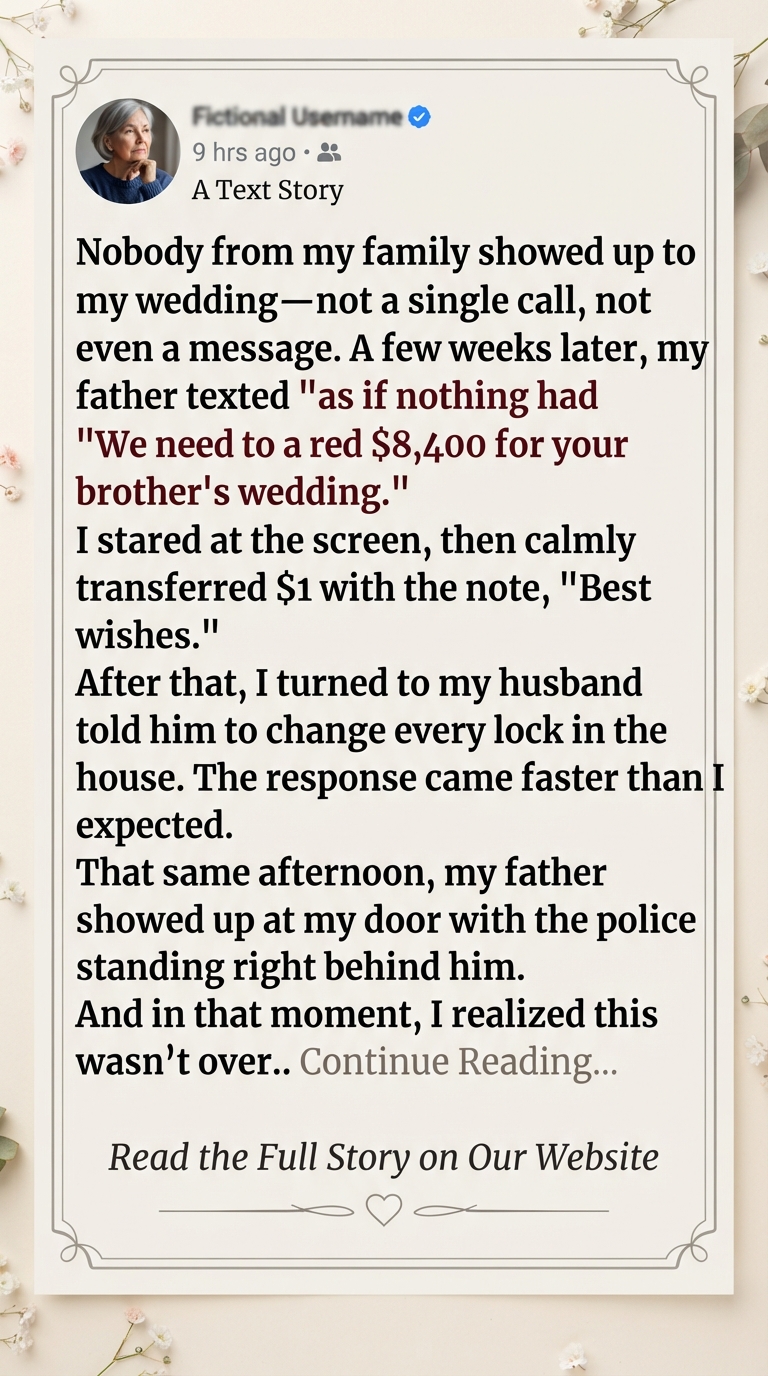
Nobody from my family showed up to my wedding.
Not my parents.
Not my brother.
Not one cousin.
Not even a distant aunt who usually sent birthday cards.
There wasn’t a single phone call.
Not one text.
Nothing.
I walked down the aisle knowing the front row reserved for my family would remain empty.
My husband, Ethan, noticed.
He squeezed my hand.
“You okay?”
I smiled through the tears.
“I am now.”
I had spent my entire life trying to earn my family’s approval.
That day, I finally stopped.
The wedding was beautiful anyway.
We had thirty-two people there.
Friends.
Coworkers.
Ethan’s parents.
People who actually wanted to see us get married.
Three weeks later, I received a text from my father.
No apology.
No explanation.
Not even congratulations.
Just:
We need to raise $8,400 for your brother’s wedding.
I stared at the screen.
Then I read it again.
My brother’s wedding.
The same brother whose wedding had been planned for months.
The same brother whose wedding my parents had prioritized so completely that they couldn’t even attend mine.
I typed nothing.
I transferred $1.
In the note, I wrote:
Best wishes.
Then I put my phone down.
Ethan looked at me.
“What did you do?”
“Paid my share.”
He laughed.
Then his expression changed.
“Wait. Did you just send him one dollar?”
“Yes.”
“That is honestly the most expensive dollar you’ve ever spent.”
I smiled.
Then I looked toward the front door.
“Change every lock.”
Ethan stopped laughing.
“Why?”
“Because I don’t trust them anymore.”
He didn’t argue.
That afternoon, a locksmith came.
We changed every exterior lock.
Front door.
Back door.
Garage.
Side entrance.
Even the keypad.
By four o’clock, everything was different.
For the first time since moving into the house, I felt like it was actually mine.
Then someone knocked.
Three hard knocks.
Ethan looked through the window.
His face changed.
“It’s your father.”
I walked over.
Behind my father stood two police officers.
My stomach dropped.
Dad pointed toward the house.
“There she is.”
One of the officers stepped forward.
“Ma’am, we’d like to speak with you.”
“About what?”
Your father answered before the officer could.
“You can’t lock us out.”
I stared at him.
“I’m sorry?”
“This is a family property.”
“No.”
He looked confused.
“What?”
“This is my house.”
My father laughed.
“You really think changing the locks changes anything?”
One of the officers looked at him.
“Sir, let her answer.”
Dad pulled out a folder.
“We have documentation.”
I looked at the folder.
Then at the officers.
Then back at my father.
“What documentation?”
Dad held it up.
“Your mother and I paid the down payment.”
My stomach tightened.
I remembered.
Seven years earlier, when I bought the house, my parents had helped with the initial deposit.
But I had repaid every dollar.
Every single one.
My father knew that.
“So?”
“So this isn’t entirely yours.”
Ethan stepped beside me.
“Do you have a lien?”
My father didn’t answer.
“Do you have a recorded ownership interest?”
Silence.
The older officer looked at the papers.
Then he asked my father:
“Is there a deed showing you as an owner?”
Dad hesitated.
“No.”
“A lien?”
“No.”
“A court order?”
“No.”
The officer handed the papers back.
“Then this appears to be a civil dispute.”
Dad’s face turned red.
“This woman stole money from us.”
I looked at him.
“Which money?”
He didn’t answer.
“The $8,400?”
“No.”
“Then what?”
Dad’s eyes shifted.
That was when I understood.
The $8,400 wasn’t really about my brother’s wedding.
It was a test.
They wanted to know whether I was still available.
Whether I would still pay.
Whether I still felt guilty enough to obey.
And when I sent one dollar, they realized I was done.
Dad wasn’t there because of the wedding.
He was there because he thought he could force his way back into my life.
But there was something I hadn’t known.
The officer looked at me.
“Your father has made another allegation.”
“What allegation?”
“He claims you removed property belonging to the family from this house.”
I stared at Dad.
“What property?”
He pointed toward the garage.
“A safe.”
My heart stopped.
“What safe?”
“The one your grandfather gave us.”
I almost laughed.
Then I remembered.
A small steel safe had been in the basement when I bought the house.
My grandfather had left it to me.
I had forgotten about it.
My father knew exactly what was inside.
Family documents.
Old photographs.
A collection of letters.
And something else.
The original family trust documents.
My grandfather had created the trust decades earlier.
I had never fully understood why my father was so interested in those papers.
Until that moment.
“Dad,” I said quietly.
“What?”
“Why do you want the safe?”
His face changed.
Just slightly.
But I saw it.
“You don’t know what’s in it.”
“I know enough.”
He stepped forward.
“Give me the safe.”
“No.”
His voice hardened.
“You don’t understand what you’re doing.”
“I think I finally do.”
Ethan looked at me.
“What is he talking about?”
I turned toward my father.
“Tell him.”
Dad said nothing.
So I continued.
“The trust.”
His face went pale.
The officer looked between us.
“What trust?”
My father finally spoke.
“It’s family business.”
“No,” I said.
“It was my grandfather’s business.”
Then I told Ethan what I knew.
Years ago, my grandfather had created a family trust.
The trust held several investments and a small commercial property.
The beneficiaries included my father, my uncle, and eventually me.
But the documents had disappeared after my grandfather died.
My father always told me the trust had been dissolved.
I believed him.
Until six months before my wedding.
That’s when I found an old letter in the basement.
My grandfather had written it to me.
It said:
If they tell you the trust no longer exists, ask for the accounting.
I had thought it was an old man’s paranoia.
Apparently, it wasn’t.
My father stepped toward me.
“Where are the documents?”
I stared at him.
“You already know.”
“Where?”
“Safe.”
His face changed again.
The police officers were listening now.
I walked to the garage.
Ethan followed.
I opened the door.
The safe was still there.
My father stared at it.
“You haven’t opened it?”
“No.”
He exhaled.
For the first time since arriving, he looked afraid.
I called my attorney.
Twenty minutes later, she arrived.
She opened the documents carefully.
Then she looked at my father.
“You told her the trust was dissolved?”
He didn’t answer.
My attorney turned to me.
“It wasn’t.”
I felt the room tilt.
“How much is in it?”
She looked through the records.
“Approximately $312,000 in current assets, plus the commercial property.”
I stared at my father.
He had spent years telling me there was nothing.
Nothing left.
Nothing owed.
Nothing belonging to me.
But there had been money.
All along.
My attorney continued.
“And according to these documents, your father was appointed trustee.”
My father looked at her.
“That’s private.”
She shook her head.
“Not anymore.”
Then she found something else.
A series of withdrawals.
Hundreds of them.
Some small.
Some enormous.
Money had been taken from the trust over nearly a decade.
The total was staggering.
More than $190,000.
My father had been using trust assets for personal expenses.
My brother’s tuition.
Credit-card payments.
Vacations.
A down payment on a car.
Even part of my brother’s wedding expenses.
The $8,400 my father had demanded from me?
He was asking me to contribute to a wedding partly funded by money that should have belonged to the trust beneficiaries.
I looked at him.
“That’s why you needed the money.”
He said nothing.
“That’s why you needed the safe.”
Still nothing.
“And that’s why you couldn’t afford for me to know.”
My father finally looked at me.
“I did what I had to do for this family.”
“No.”
My voice was calm.
“You did what benefited you.”
He looked toward the officers.
“You can’t let her keep those documents.”
One officer shook his head.
“Sir, this is a civil matter. You need to speak with an attorney.”
My father looked at me one last time.
“You’re destroying this family.”
I almost smiled.
“No, Dad.”
I held the trust documents against my chest.
“You destroyed the part of the family that trusted you.”
He left.
The police followed him outside.
And for several minutes, neither Ethan nor I spoke.
Finally, Ethan took my hand.
“You know what I keep thinking?”
“What?”
“They didn’t miss your wedding because they forgot.”
I looked at him.
“They missed it because they expected you to come crawling back afterward.”
He was right.
They expected guilt to work.
They expected loneliness to work.
They expected family obligation to work.
And when none of it did, they came with police.
Not because I had done something wrong.
Because they had run out of ways to control me.
The legal process took months.
The trust was placed under independent administration.
The withdrawals were investigated.
My father was removed as trustee.
My brother’s wedding still happened.
But I didn’t attend.
I didn’t send money.
I didn’t send flowers.
I didn’t send a card.
Not out of revenge.
Because I had finally learned the difference between forgiveness and surrender.
My father eventually sent me a letter.
It contained one sentence I never expected:
I should have come to your wedding.
I read it several times.
Then I put it in a drawer.
I didn’t forgive him that day.
I didn’t hate him either.
I simply stopped letting his choices determine my life.
Months later, Ethan and I sat on our porch one evening.
The house was quiet.
Our locks were new.
Our future was ours.
He looked at me.
“Do you ever wish you’d handled things differently?”
I thought about the empty front row at my wedding.
The $1 transfer.
The police at my door.
The safe.
The trust.
The $190,000.
Then I shook my head.
“No.”
“Not even once?”
I smiled.
“The dollar was perfect.”
Ethan laughed.
And for the first time, I realized something.
My family had spent years teaching me that love meant giving until there was nothing left.
My husband taught me something different.
Love can also mean protecting the life you built.
Sometimes the strongest boundary isn’t a screaming match.
Sometimes it’s one dollar.
A changed lock.
And the courage to finally ask:
What have you been hiding from me?