My husband died on a rainy Thursday morning.
His name was Terence.
For twenty-seven years, he had been my husband, my best friend, and the one person who knew the truth about my family fortune.
Or so I thought.
The funeral was held three days later.
Hundreds of people attended.
Business partners.
Friends.
Employees.
People who had known Terence for decades.
His family sat in the front row.
His mother, Margaret.
His younger brother, Howard.
His sister, Vanessa.
They cried when people were watching.
They hugged me when cameras were nearby.
But when the funeral ended, something changed.
The cars disappeared.
The flowers started wilting.
And twenty-four hours later, Margaret arrived at my house with a suitcase.
She didn’t knock.
She walked through the front door.
Vanessa followed her, holding up her phone.
She was recording.
Margaret dropped the suitcase onto the lawn.
“You need to leave.”
I stared at her.
“Excuse me?”
She crossed her arms.
“Terence is gone. This house belongs to the family.”
“No.”
She smiled coldly.
“You don’t understand.”
Vanessa laughed behind her phone.
“Mom, tell her.”
Margaret looked directly at me.
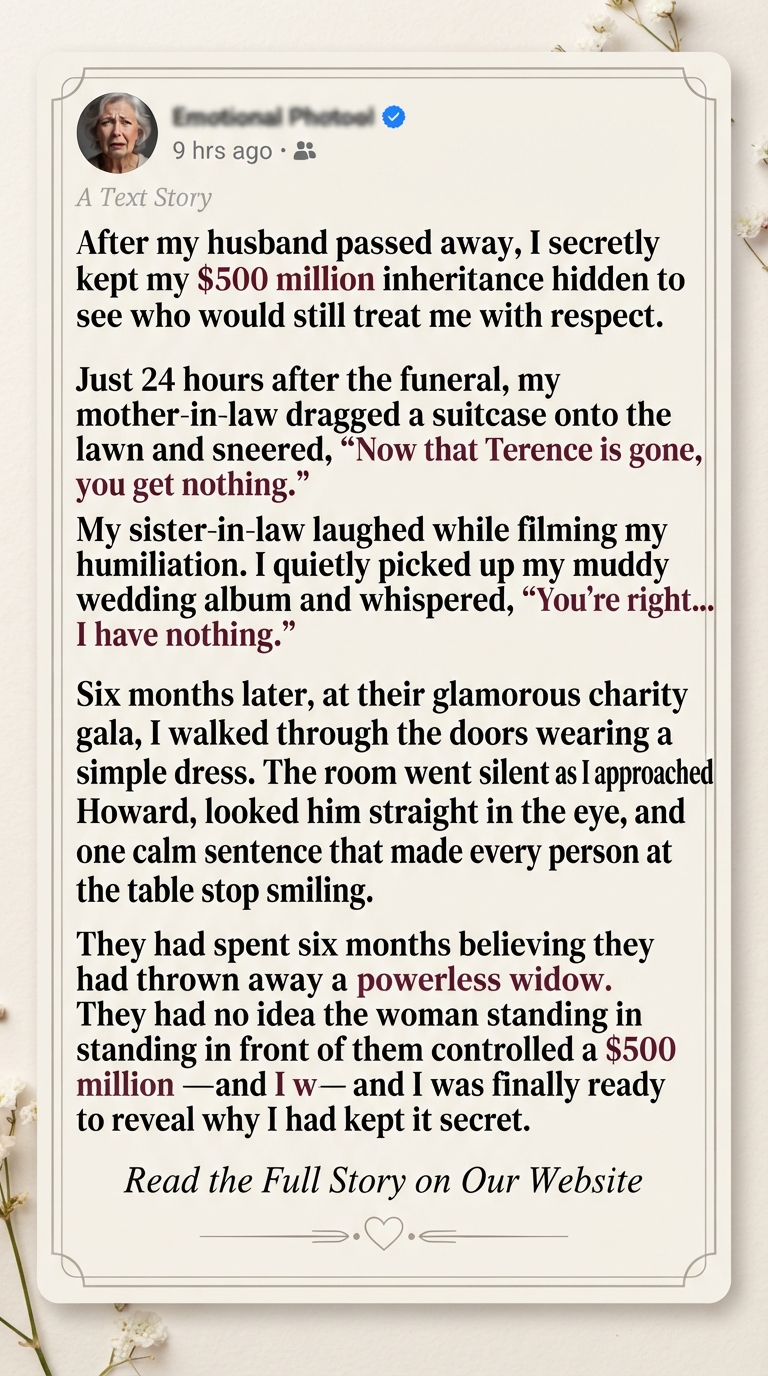
“Now that Terence is gone, you get nothing.”
I looked around.
At the house.
At the wedding photographs.
At the flowers still sitting by the staircase.
At the muddy ground where my wedding album had fallen.
Then I bent down and picked it up.
The cover was covered in dirt.
I wiped it with my sleeve.
“You’re right,” I whispered.
“I have nothing.”
Vanessa laughed.
“Exactly.”
Margaret nodded.
“Good. Then you understand.”
I didn’t argue.
I didn’t call a lawyer.
I didn’t tell them about the inheritance.
I didn’t tell them about the trust.
I didn’t tell them about the accounts.
I simply packed a small bag and left.
Because there was something they didn’t know.
Terence hadn’t left me with nothing.
He had left me $500 million.
But the money wasn’t in my name.
Not publicly.
My grandfather had created a private family trust decades earlier.
When he died, I became the primary beneficiary.
The assets had been structured so that my wealth would remain private unless I chose to disclose it.
Terence knew.
His family didn’t.
And after he died, I made a decision.
I wouldn’t tell anyone.
Not yet.
I wanted to know who would still treat me with respect if they believed I had nothing.
So I rented a small apartment.
I drove an old car.
I wore simple clothes.
And I watched.
The first month, Margaret called.
Not to ask how I was doing.
She wanted the house keys.
I told her I’d already returned them through the attorney handling the estate.
She hung up.
The second month, Vanessa sent me a message.
Still struggling?
I didn’t respond.
The third month, Howard called.
“Look, I don’t want any hard feelings.”
“What do you want?”
“Terence had business interests.”
“I know.”
“We need to know where everything is.”
I almost laughed.
“You mean you need to know where everything is.”
He became defensive.
“We’re family.”
“Were you family when your mother put my suitcase on the lawn?”
Silence.
Then he said:
“You’re being emotional.”
I hung up.
Six months passed.
During those six months, I learned everything I needed to know.
Margaret told relatives I had “taken advantage” of Terence.
Vanessa posted vague social-media messages about “people who pretend to love wealthy men.”
Howard told business contacts that I had probably been removed from the estate.
They were wrong.
But I let them believe it.
Then came the invitation.
The Howard Family Foundation Charity Gala.
The largest event their family hosted every year.
Terence had attended for decades.
This year, Howard was taking his place.
I almost didn’t go.
Then I saw the guest list.
Howard.
Margaret.
Vanessa.
And several of the people who had watched me get thrown out.
I decided to attend.
Not to embarrass them.
Not to make a scene.
I simply wanted to finish what I had started.
The night of the gala, I put on a simple black dress.
No designer jewelry.
No expensive handbag.
No security detail.
I arrived alone.
When I entered the ballroom, conversations continued for a few seconds.
Then someone recognized me.
The room went quiet.
Vanessa was the first to see me.
Her smile disappeared.
“Mom.”
Margaret turned.
She nearly dropped her glass.
Howard looked over.
His face changed completely.
I walked across the ballroom.
Slowly.
Calmly.
I stopped beside his table.
Howard stared at me.
“What are you doing here?”
I smiled.
Then I said one sentence.
“I’m here because the woman you threw away six months ago is the woman who owns the foundation you’re celebrating tonight.”
The table went silent.
Howard’s face went pale.
“What?”
I placed a folder on the table.
He opened it.
His hands started shaking.
Inside were documents showing the truth.
My grandfather’s trust controlled a significant portion of the foundation’s endowment.
Terence had served as chairman.
But after his death, the controlling beneficiary rights had passed to me.
Howard had spent six months acting as though he owned the family legacy.
He didn’t.
He was only an administrator.
I was the controlling beneficiary.
Margaret stood.
“This is impossible.”
“No.”
I looked at her.
“This is exactly what you were afraid of.”
Vanessa lowered her phone.
For the first time, she wasn’t recording me.
She was recording herself.
Howard looked at the documents again.
“You’ve been hiding this?”
“Yes.”
“Why?”
I looked around the room.
At the donors.
The executives.
The family members.
The people who had smiled at me when they thought I was wealthy.
And the people who had ignored me when they thought I was broke.
“Because I wanted to know who would respect me without knowing what I owned.”
Nobody spoke.
Then Howard asked:
“Are you really worth $500 million?”
I looked at him.
“That’s not the question.”
“What is?”
“The question is why you treated me like I was worthless when you thought I had nothing.”
His face fell.
I opened the folder again.
“There is something else.”
Howard looked nervous.
“Six months ago, after Terence died, you filed documents claiming that I had voluntarily relinquished certain beneficiary rights.”
“I was told that was standard.”
“You signed them.”
He looked at the papers.
“I didn’t know what they meant.”
“You didn’t ask.”
He had no answer.
Then I turned to Margaret.
“You told me I would get nothing.”
She stared at me.
“I was angry.”
“You weren’t angry.”
I shook my head.
“You were calculating.”
The room became completely silent.
I continued.
“You wanted the house.”
“You wanted Terence’s investments.”
“You wanted his position.”
“And you wanted me gone before I could understand what he had actually left behind.”
Margaret began crying.
“I was grieving.”
“So was I.”
My voice softened.
“But I didn’t use my grief as an excuse to hurt you.”
Then I turned toward Vanessa.
“You filmed me when my wedding album was lying in the mud.”
Her eyes filled with tears.
“I was stupid.”
“Yes.”
I didn’t say it cruelly.
Just honestly.
“You were.”
She looked down.
I could have destroyed them that night.
I had the money.
The legal authority.
The evidence.
The influence.
But I didn’t.
Instead, I told them what would happen next.
“The foundation will continue.”
Howard looked up.
“You’re not shutting it down?”
“No.”
“Why?”
“Because it was created to help people.”
I paused.
“But you will no longer control it.”
Howard’s face turned white.
“I’ll appoint an independent board.”
Margaret whispered:
“You’re taking everything.”
I looked at her.
“No.”
“You’re taking the family legacy.”
I shook my head.
“I’m protecting it from the family.”
Nobody spoke.
Then something unexpected happened.
An elderly man near the back of the room stood.
He had been one of Terence’s oldest business associates.
“I knew,” he said.
Everyone turned.
Howard stared at him.
“Knew what?”
“That your wife was the beneficiary.”
I looked at him.
He smiled sadly.
“Terence told me years ago.”
My eyes filled with tears.
“Why didn’t you tell anyone?”
“Because he asked me not to.”
The man looked at Howard.
“He knew exactly what would happen if something happened to him.”
I closed my eyes.
Suddenly, I understood why Terence had always insisted that I keep certain things private.
He hadn’t been hiding my fortune from me.
He had been protecting me from people who believed money gave them a right to control someone.
And then I realized something even more painful.
Terence had probably known exactly what his family was capable of.
He had simply hoped they would prove him wrong.
They didn’t.
After the gala, I went home alone.
I took the wedding album out of the box.
The muddy cover was still stained.
I could have replaced it.
Instead, I kept it.
Because it reminded me of the day I learned the truth.
Money doesn’t reveal people’s character.
Sometimes it simply removes their excuse for hiding it.
Margaret eventually apologized.
Vanessa did too.
Howard never did.
He said I had embarrassed him.
I told him:
“You embarrassed yourself six months ago.”
He never answered.
I continued running the foundation.
I funded hospitals.
Scholarships.
Shelters.
Programs for widows.
And one small project that meant more to me than all the others.
A housing program for women who had suddenly found themselves alone after losing a spouse.
I named it after Terence.
Not because his family deserved the credit.
Because he had been the person who taught me that love should never depend on what someone can give you.
Six months earlier, his family had looked at me and seen a powerless widow.
At the gala, they looked at me and saw $500 million.
But neither version was the truth.
I was the same woman.
The only thing that changed was what they believed I could do for them.
And that was the lesson I carried with me.
I didn’t reveal my fortune to prove that I was powerful.
I revealed it to prove that their treatment of me had never been about my worth.
It had always been about what they thought I was worth to them.
And once I understood that, I didn’t need their respect anymore.
I had already learned how to respect myself.