My Family Expected Me to Pay My Brother’s Van Loan—Then I Found the Signature That Changed Everything
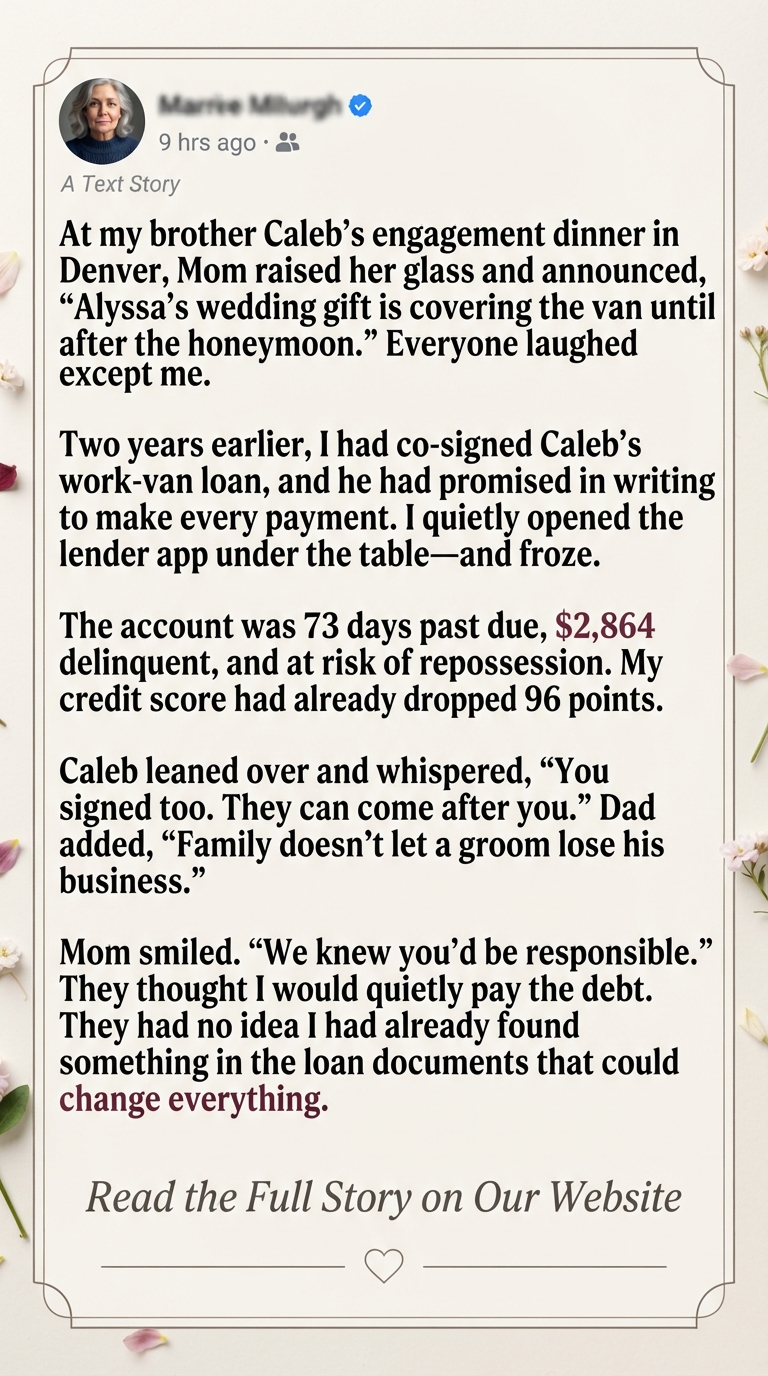
At my brother Caleb’s engagement dinner in Denver, my mother raised her champagne glass and smiled across the table.
“To Alyssa,” she announced.
Everyone looked at me.
My mother continued.
“Her wedding gift is covering Caleb’s van payments until after the honeymoon.”
The table erupted in laughter.
Everyone except me.
I slowly put down my fork.
“Excuse me?”
Mom laughed.
“Oh, don’t look so serious.”
Dad leaned back in his chair.
“It’s family.”
Caleb’s fiancée, Madison, smiled awkwardly.
“That’s really generous, Alyssa.”
I stared at Caleb.
He wouldn’t look at me.
Two years earlier, I had co-signed a loan for his work van.
He had promised me, in writing, that he would make every payment.
Every single one.
I hadn’t thought about the loan in months.
Until that moment.
I pulled out my phone under the table.
Opened the lender’s app.
Entered my information.
And froze.
73 days past due.
Amount delinquent: $2,864.17.
Account status: At risk of repossession.
I stared at the screen.
Then another number caught my attention.
My credit score had dropped ninety-six points.
I felt my stomach tighten.
Caleb leaned toward me.
“You signed too,” he whispered.
“They can come after you.”
Dad heard him.
“Exactly.”
He lifted his glass.
“Family doesn’t let a groom lose his business.”
Mom smiled.
“We knew you’d be responsible.”
I looked around the table.
Nobody was asking me.
They had already decided.
I would pay.
Quietly.
Because I was the responsible daughter.
The reliable sister.
The one who always fixed things.
But there was something they didn’t know.
Three days earlier, I had downloaded the original loan documents.
And there was something in them that had been bothering me ever since.
I excused myself from dinner.
In the restaurant bathroom, I opened the PDF.
I had originally signed the co-signer paperwork electronically.
Caleb had sent me a link.
He said it was standard.
“Just help me get the van,” he’d told me.
“I’ll make every payment.”
I trusted him.
That was my mistake.
But now I opened the documents again.
Page after page.
Loan amount.
Interest rate.
Vehicle identification number.
Payment schedule.
My signature.
Caleb’s signature.
Then I reached page fourteen.
I stopped.
There it was.
A section titled:
Co-Signer Acknowledgment and Notice Requirements.
I read it twice.
Then a third time.
The lender was required to send certain notices to me separately if the account became delinquent and before taking specified collection or repossession actions against the vehicle.
I searched my email.
Nothing.
My mailbox.
Nothing.
My physical mail.
Nothing.
For seventy-three days, I hadn’t received a single delinquency notice.
Not one.
I called the lender’s customer-service number.
After twenty minutes on hold, a representative answered.
“Can I have the account number?”
I gave it to her.
Then I asked:
“Can you tell me what notices were sent to the co-signer?”
There was a pause.
“I can see notices to the primary borrower.”
“What about the co-signer?”
Another pause.
“I don’t see any separate notices.”
My heart started pounding.
“Can you confirm that?”
“Yes.”
“Could you email me the account history?”
“We can send a copy of the payment history and correspondence.”
“Please do.”
I hung up.
Then I stared at my reflection.
For the first time that night, I smiled.
Not because I was happy.
Because I finally knew why something about the situation felt wrong.
I went back to the dinner.
Mom was talking about wedding flowers.
Dad was discussing the honeymoon.
Caleb was laughing with his future in-laws.
I sat down.
Mom looked at me.
“So?”
“So what?”
“The van.”
I took a sip of water.
“I’ll take care of it.”
Her smile widened.
“I knew you would.”
Caleb reached over and squeezed my shoulder.
“Thanks, sis.”
I looked at him.
“You’re welcome.”
He didn’t notice anything unusual.
Neither did Mom.
They thought the problem was solved.
They had no idea I wasn’t going to make a payment.
I was going to find out exactly what happened.
The next morning, I met with an attorney named Rachel Bennett.
I brought the original loan agreement, the account history, my credit report, and every message Caleb had sent me.
Rachel read everything carefully.
Finally, she looked up.
“Did you receive any separate delinquency notices?”
“No.”
“Any certified letters?”
“No.”
“Any email notifications?”
“No.”
“Did the lender ever contact you directly?”
“Not until I called yesterday.”
She leaned back.
“This doesn’t automatically erase your obligations under the loan.”
“I know.”
“But it could matter.”
She explained that a co-signer can still have significant liability even when a lender fails to follow a contractual notice provision.
The exact legal consequences depended on the agreement, applicable law, and what the lender had actually done.
But there was another problem.
Rachel pointed to the signature page.
“Did you sign this document?”
“Yes.”
“Did you personally receive the entire agreement before signing?”
I hesitated.
“Caleb sent me a link.”
“Did you review it?”
“Not completely.”
She turned the page.
“Look at the timestamp.”
I did.
My electronic signature appeared at 9:42 p.m.
Caleb’s signature appeared at 9:47 p.m.
I frowned.
“So?”
Rachel pointed lower.
“The loan officer’s certification says both signatures were witnessed during an in-person signing.”
I stared at the page.
“That never happened.”
“You never met the loan officer?”
“No.”
“You never signed anything in person?”
“No.”
She looked at me.
“Then we need to find out who certified this.”
I called Caleb.
He answered immediately.
“Hey, sis.”
“Where did you sign the van loan?”
“At the dealership.”
“Were you with me?”
Silence.
“No.”
“Did I sign anything at the dealership?”
Another pause.
“I don’t remember.”
I lowered my voice.
“Caleb.”
“What?”
“Did you send me the documents before or after you signed?”
“I don’t know.”
“You know.”
He sighed.
“Why are you asking?”
“Because the lender’s documents say I signed in person with a witness.”
Silence.
Then he said:
“Look, Alyssa, don’t make this into something bigger than it is.”
“Who was the witness?”
“I don’t know.”
“Caleb.”
“I said I don’t know!”
He hung up.
I stared at the phone.
Then Rachel called me.
“I found something else.”
“What?”
“The witness signature.”
She sent me a copy.
I opened it.
My heart stopped.
The witness wasn’t a dealership employee.
It wasn’t a notary.
It wasn’t even someone whose name I recognized.
It was Caleb’s former business partner.
A man named Trevor.
I remembered him.
He had been fired from Caleb’s company six months before I signed the loan.
I called Rachel.
“Could Trevor have signed this without being there?”
“He could have.”
“Could someone have used his name?”
“That’s something investigators would need to determine.”
Then she said:
“And there’s one more issue.”
“What?”
“The lender’s records show that the application was modified twice after your signature.”
I sat completely still.
“Modified how?”
“Income information.”
My stomach dropped.
“What income information?”
“Yours.”
Caleb had listed an annual income almost twice what I actually earned.
My employment history had also been altered.
Rachel told me not to speculate about who changed the application.
Instead, we requested the original electronic records.
The metadata told a different story.
My signature hadn’t been forged.
But portions of the application had been changed after I signed.
And the changes were made from a computer associated with Caleb’s business.
Now the situation wasn’t simply:
My brother stopped paying his loan.
It was:
My brother may have submitted materially altered information after obtaining my signature.
That changed everything.
Two weeks later, Rachel contacted the lender’s legal department.
We provided the documentation.
The lender temporarily suspended collection activity against me while it investigated the account.
The repossession process was also placed on hold.
Caleb was furious.
He called me seventeen times in one afternoon.
On the eighteenth call, I answered.
“What did you do?”
“I asked questions.”
“You’re destroying my business!”
“No.”
“You know I can’t afford the payments!”
“You told me you could.”
“You’re my sister!”
I closed my eyes.
“You used that sentence a lot when you needed something from me.”
He went silent.
Then he said:
“Mom said you’d help.”
“I know.”
“She said you always do.”
“That was before I learned what you were willing to let me lose.”
He hung up.
A month later, the family gathered again.
This time, it wasn’t an engagement dinner.
It was Caleb and Madison’s wedding rehearsal dinner.
Mom approached me immediately.
“You could have handled this privately.”
“I tried.”
“You embarrassed your brother.”
“No.”
I looked at her.
“Caleb’s choices embarrassed him.”
Dad stepped closer.
“Enough. The loan is being handled.”
“By whom?”
He didn’t answer.
I already knew.
They expected me to pay.
I pulled a folder from my purse.
“I brought something.”
Mom’s face tightened.
“What?”
I placed copies of the loan documents on the table.
“Your son signed a payment agreement promising to make every payment.”
Caleb looked away.
I continued.
“Then the application was modified after my signature.”
Dad frowned.
“And?”
“And my attorney has notified the lender.”
Mom looked at me.
“You’re threatening your own brother.”
“No.”
I looked directly at Caleb.
“I’m finally holding him to his own signature.”
Then I placed one more document on the table.
It was a letter from the lender.
The investigation had concluded that the post-signature alterations were not attributable to me.
The lender was reviewing its options regarding the account and had confirmed that my credit reporting would be corrected where warranted by its investigation.
It didn’t erase the entire loan.
It didn’t magically make Caleb debt-free.
But it meant I was no longer quietly absorbing the consequences of something I hadn’t done.
Mom picked up the letter.
Her hands were shaking.
“You could still pay the balance.”
I looked at her.
“You’re right.”
She smiled slightly.
Then I finished.
“But I won’t.”
Her smile disappeared.
Caleb eventually sold the van.
He downsized his business.
He negotiated directly with the lender.
And he entered a repayment arrangement for the remaining balance.
It took him almost a year.
But he paid it.
Every dollar.
Not because I rescued him.
Because he finally understood that consequences don’t disappear simply because you call something “family.”
My credit recovered gradually after the reporting errors were corrected.
I never co-signed another loan.
Not for Caleb.
Not for my parents.
Not for anyone.
And when I got married eighteen months later, my brother was invited.
He came.
He stood beside me.
And before the ceremony, he pulled me aside.
“I owe you an apology.”
I waited.
“I thought because you loved me, you’d always fix things.”
I looked at him.
“I do love you.”
He nodded.
“But that’s exactly why I needed to stop fixing them.”
He looked down.
“You were right.”
“No.”
I smiled.
“I wasn’t right because I refused to pay.”
I handed him a copy of the original payment agreement.
“You were right when you signed this.”
He read the first line.
Borrower agrees to make all scheduled payments.
He nodded.
“I should have kept my word.”
“Yes.”
That was all I said.
Because sometimes family isn’t about protecting someone from every consequence.
Sometimes it’s about refusing to let love become an excuse for irresponsibility.
My mother once raised a glass and announced that my brother’s wedding gift would be my money.
She thought I was the responsible one.
She was right.
I was responsible.
Responsible for my own life.
My own credit.
My own future.
And finally…
my own boundaries.