My Brother Fired Me at the Christmas Party—Then the Bookkeeper Whispered Two Words
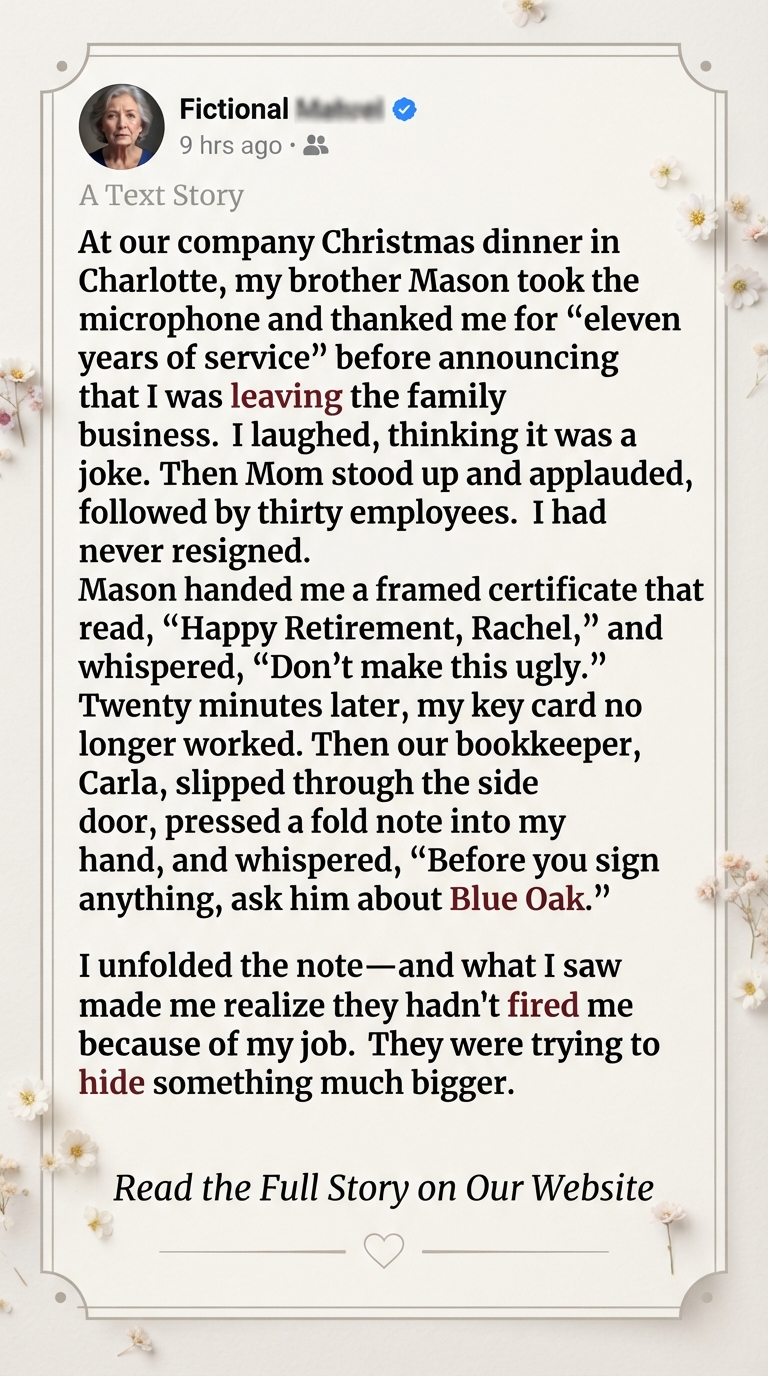
At our company Christmas dinner in Charlotte, my brother Mason took the microphone.
He tapped the glass.
“Before we continue,” he said, “I want to recognize someone special.”
Everyone turned toward me.
I smiled.
Mason grinned.
“Rachel has given this company eleven years of incredible service.”
People started clapping.
I laughed.
“Okay, Mason. What are you doing?”
He raised his glass.
“To Rachel.”
Thirty employees stood.
Mom stood too.
Then everyone applauded.
I looked around the room, confused.
Mason walked toward me carrying a large framed certificate.
He handed it to me.
I looked down.
HAPPY RETIREMENT, RACHEL
My smile disappeared.
“What is this?”
Mason leaned close.
“Don’t make this ugly.”
I stared at him.
“I don’t understand.”
“You’re leaving the company.”
“I never said that.”
He straightened his jacket.
“You don’t have to.”
Then he walked back to the microphone.
“Rachel has decided to step away from the family business and enjoy a well-earned retirement.”
The room applauded again.
I didn’t.
I couldn’t.
Because I had never resigned.
Never discussed retirement.
Never signed anything.
And somehow, everyone in the room had been told that I had.
Twenty minutes later, my key card stopped working.
That was when I realized this wasn’t a joke.
It was a setup.
And I had no idea how deep it went.
I walked outside into the cold Charlotte night.
My phone buzzed.
I tried my company email.
Account disabled.
I tried the employee portal.
Access denied.
I called IT.
“Hi, this is Rachel Bennett.”
“I’m sorry,” the technician said. “Your access has been terminated.”
“By whom?”
There was a pause.
“Management.”
“Which management?”
Another pause.
“I can’t discuss that.”
He hung up.
I stood in the parking lot staring at the building where I had worked for eleven years.
My family’s company.
The company my father had started.
The company I’d helped build.
And my own brother had just erased me in front of thirty employees.
Then my phone buzzed again.
A message from an unknown number.
Don’t go home yet.
I stared at it.
A second message appeared.
Find Carla.
Carla was our bookkeeper.
She had worked for my father before Mason and I joined the company.
I looked back at the building.
Then I saw a side door open.
Carla stepped outside.
She looked terrified.
“Rachel.”
“What happened?”
She looked around.
“Not here.”
She reached into her coat.
Pulled out a folded piece of paper.
Pressed it into my hand.
“Before you sign anything,” she whispered, “ask him about Blue Oak.”
Then she disappeared back inside.
I unfolded the note.
There were four words written in blue ink.
BLUE OAK — $4,860,000
Underneath was a bank account number.
I stared at it.
Four million eight hundred sixty thousand dollars.
My heart started pounding.
Because I knew that account number.
It wasn’t the company’s.
It belonged to an entity I’d never heard of.
Blue Oak Holdings, LLC.
I drove straight to my attorney’s office.
She was still working.
When I placed the note on her desk, she read it twice.
“Do you know what Blue Oak is?”
“No.”
“Does your brother?”
“I don’t know.”
She opened her laptop.
“Don’t call him yet.”
“Why?”
“Because if someone just locked you out of the company, they probably don’t want you looking at something.”
She looked at the bank account number.
“And whatever this is, it appears to be important.”
We spent the next three hours reconstructing what we could from my personal records.
Invoices.
Annual reports.
Old tax documents.
Corporate filings.
Vendor agreements.
Then my attorney found it.
Blue Oak Holdings had been registered eighteen months earlier.
Its registered agent was a company in South Carolina.
Its mailing address was a private mailbox.
And one of the authorized managers was…
Mason Bennett.
My brother.
I stared at the screen.
“What did he use it for?”
“We need more records.”
“Can we get them?”
“Some of them.”
She looked at me.
“But don’t contact Mason.”
“Why?”
“Because right now, you know something he doesn’t know you know.”
The next morning, I received an email.
It was from Mason.
Rachel,
As discussed, attached is your separation agreement. Please sign by Friday.
I laughed.
As discussed?
We had never discussed it.
I opened the attachment.
There it was.
A resignation agreement.
It stated that I had voluntarily resigned from my position as Chief Operating Officer.
It also contained a release.
I would give up any claims against the company.
Any claims against its officers.
Any claims regarding company finances.
In exchange, I would receive a severance payment.
$25,000.
My attorney read it.
Then she looked at me.
“Do not sign this.”
“I wasn’t planning to.”
“Good.”
She pointed at the release.
“Look at what they’re asking you to waive.”
I read it.
Then I saw a sentence that made my blood run cold.
The agreement said I acknowledged that I had no knowledge of “any unauthorized transactions, undisclosed liabilities, or related-party financial arrangements.”
I looked at my attorney.
“They want me to sign that?”
“Yes.”
“Why?”
She looked at me.
“Because someone wants a document saying you knew nothing.”
I thought about Carla.
Before you sign anything, ask him about Blue Oak.
I finally understood.
They weren’t firing me because they wanted me gone.
They were trying to make me officially disappear from the company’s records.
I spent the next two days investigating everything I could legally access.
The company’s public filings showed revenue had increased.
Profits looked healthy.
But there was something strange.
Cash reserves had fallen sharply.
Almost five million dollars.
At the same time, the company had started paying a consulting company called Blue Oak Advisory.
I pulled every invoice I could find.
$380,000.
$620,000.
$450,000.
$900,000.
Millions of dollars.
For “strategic consulting.”
But nobody in operations had ever seen a consultant.
There were no reports.
No meetings.
No deliverables.
No employees.
Just invoices.
And payments.
My attorney brought in a forensic accountant.
His name was Daniel Price.
He spent four days examining the records Carla had provided.
On the fifth day, he called me.
“You should sit down.”
I was already sitting.
“What did you find?”
“Blue Oak Advisory and Blue Oak Holdings are connected.”
“How?”
“The same registered agent.”
“Who owns them?”
He hesitated.
“Mason isn’t the only person connected.”
“Who else?”
He slid a document across the table.
My mother’s name was on it.
I stared at the page.
“No.”
“She owns thirty-five percent.”
“What about Mason?”
“Forty-five percent.”
“And the remaining twenty?”
Daniel looked at me.
“Your father’s old business partner.”
I felt sick.
“So my family created a company and moved money from our business into it?”
“We’re still verifying the transactions.”
“Do you know how much?”
“Approximately $4.86 million so far.”
I thought about the number on Carla’s note.
Then Daniel continued.
“There is more.”
He opened another file.
“Some of the payments were authorized using a digital approval token assigned to you.”
I froze.
“My token?”
“Yes.”
“I didn’t authorize those payments.”
“I know.”
“How?”
“Because your login records show your credentials were used while you were out of the country.”
I stared at him.
“I was in Paris.”
He nodded.
“The transaction approvals were made from Charlotte.”
Someone had used my credentials.
And someone had made sure the paperwork looked like I had approved the transfers.
Suddenly, my brother’s Christmas speech made sense.
He wasn’t firing me because I was inconvenient.
He was creating a story.
Rachel resigned.
Rachel left voluntarily.
Rachel approved the transactions.
Rachel knew about Blue Oak.
Rachel signed the separation agreement.
And if anyone later discovered the missing money…
Rachel would be the easiest person to blame.
Because she would no longer be inside the company to defend herself.
I called Carla.
She didn’t answer.
I called again.
Nothing.
Then, late that evening, she finally returned my call.
Her voice was barely a whisper.
“They know I talked to you.”
“Are you safe?”
“I think so.”
“What happened?”
“I found something in the old accounting archive.”
“What?”
“The original bank authorization forms.”
“What about them?”
“They show who approved the transfers before the electronic system was changed.”
“Who?”
Silence.
“Carla?”
She whispered:
“Your mother.”
The next morning, I went to the company’s headquarters with my attorney.
Mason was waiting.
So was Mom.
Mason looked annoyed.
Mom looked disappointed.
“Rachel,” she said, “you are making this much harder than it needs to be.”
I placed the separation agreement on the table.
“I haven’t signed it.”
Mason sighed.
“You’ve already left the company.”
“No.”
I looked at him.
“You removed me.”
“You were going to leave.”
“No.”
I placed another document on the table.
“You used my credentials to authorize payments.”
Mason’s face changed.
Mom went still.
I continued.
“$4.86 million was transferred through Blue Oak.”
Mason stood.
“You have no idea what you’re talking about.”
“I have bank records.”
He looked at Mom.
Then back at me.
“You’re going to destroy your own family over accounting?”
I almost laughed.
“You destroyed the family when you decided I’d be your scapegoat.”
Mom stood.
“You don’t understand the business.”
“I understand enough.”
I placed the final document on the table.
The original authorization forms.
My mother’s signature.
Mason’s signature.
And the account information.
The room went silent.
Mom stared at the papers.
“Where did you get those?”
I looked at her.
“Carla.”
Her expression collapsed.
The investigation lasted months.
The company hired independent counsel.
Bank records were subpoenaed.
The forensic accounting expanded.
What began as $4.86 million eventually turned into a larger investigation involving years of related-party payments, inflated consulting invoices, and transfers that had never been properly disclosed to the company’s board.
I was cleared of involvement.
My credentials had been misused.
The supposed resignation was never accepted because I had never signed it.
And the separation agreement became one of the most important pieces of evidence showing what Mason had been trying to accomplish.
He hadn’t simply wanted me gone.
He wanted me gone on paper.
My mother eventually admitted that she had known about Blue Oak.
Mason admitted authorizing some payments but claimed they were legitimate business arrangements.
The remaining disputes were handled through the company’s attorneys and the appropriate legal process.
The family business survived.
But our family didn’t look the same afterward.
A year later, I started my own company.
No family partners.
No secret accounts.
No handshake agreements.
No assumptions that loyalty meant silence.
Carla came with me.
So did six former employees who had watched what happened and decided they wanted to work somewhere transparency mattered more than family politics.
One afternoon, Carla handed me a coffee.
“You know what still bothers me?”
“What?”
“You almost signed that agreement.”
I smiled.
“I know.”
“What made you stop?”
I thought about the folded note.
Four words.
Ask him about Blue Oak.
“Someone finally gave me the truth before I signed away my right to find it.”
Carla smiled.
“Your father would have been proud.”
I looked out the window.
My father had built the company believing family meant trust.
Mason had believed family meant leverage.
Mom had believed family meant obedience.
I learned something different.
Family doesn’t mean you surrender your judgment.
It doesn’t mean you accept humiliation.
And it certainly doesn’t mean you sign documents you don’t understand just because someone you love puts them in front of you.
At Christmas dinner, my brother had handed me a certificate that said I was retired.
He thought he was ending my career.
Instead, he accidentally gave me the first clue.
Because the moment he told everyone I had resigned…
I knew I had to find out what he was so desperate to hide.
And the two words that saved me weren’t complicated.
They were simply:
Blue Oak.
The next morning, I walked into the company headquarters with my attorney.
Mason was waiting in the conference room.
So was Mom.
But they weren’t alone.
The company’s board chair was there.
Our outside accountant was there.
Two attorneys were sitting at the far end of the table.
Mason smiled when I entered.
“You really didn’t have to turn this into a production.”
I placed my purse on the table.
“You made it a production when you fired me in front of thirty employees.”
Mom shook her head.
“Rachel, we’re still your family.”
I looked at her.
“Then why did you try to make me sign a document saying I voluntarily resigned?”
Mason folded his arms.
“Because you were leaving.”
“I never resigned.”
“You were going to.”
“No.”
I slid the separation agreement across the table.
“I was fired.”
Mason’s smile disappeared.
Then I placed another folder beside it.
“And now I’d like to discuss Blue Oak.”
Nobody spoke.
Mom’s face went pale.
Mason looked at the board chair.
“This is ridiculous.”
I opened the folder.
“Blue Oak Holdings.”
Then another document.
“Blue Oak Advisory.”
Then another.
“Four million, eight hundred sixty thousand dollars transferred from this company.”
I looked directly at my brother.
“Where did it go?”
Mason leaned forward.
“Those were legitimate consulting expenses.”
“Then show me the work.”
Silence.
“Show me the reports.”
Nothing.
“The employees?”
Nothing.
“The meetings?”
Nothing.
“The deliverables?”
Mason’s jaw tightened.
“You don’t understand how the business works.”
I smiled.
“I understand invoices.”
I opened another folder.
“And I understand bank statements.”
I pushed copies across the table.
“Here is a $900,000 payment to Blue Oak.”
Another.
“Here’s $620,000.”
Another.
“Here’s $450,000.”
I looked at him.
“Now tell me why a company that supposedly provided millions of dollars in consulting services has no employees, no office, no reports, and the same registered agent as a company owned by you.”
Mason stood.
“Enough.”
“No.”
My voice was calm.
“For eleven years, I kept this company running while you took credit for the work.”
He pointed at me.
“You’re bitter because you lost your position.”
“I lost my position twenty minutes after you announced a retirement I never agreed to.”
I opened one final folder.
“And you made one mistake.”
Mason stopped.
“You used my credentials.”
His expression changed.
The board chair looked up.
I continued.
“You approved transactions under my login while I was in Paris.”
Mason said nothing.
“I have the login records.”
Silence.
“I have the bank records.”
Silence.
“I have the original authorization documents.”
I slid them across the table.
“And I have the copy showing Mom’s signature.”
Mom’s hand flew to her mouth.
Mason looked at her.
Then at me.
“You don’t have the right to accuse us.”
“I haven’t accused anyone.”
I looked toward the board chair.
“I’ve brought evidence.”
The room became completely silent.
Then I heard the conference-room door open.
Carla walked in.
Mason turned.
“You?”
Carla didn’t look at him.
She walked to the table and placed a banker’s box in front of the board chair.
“The original accounting records,” she said.
Mason stared at the box.
“Carla, think very carefully about what you’re doing.”
She finally looked at him.
“I did.”
Then she turned to me.
“And I’m done being afraid.”
The board chair opened the box.
Inside were the original bank authorization forms, correspondence, invoices, and handwritten accounting notes.
He looked through them for several minutes.
Then he looked at Mason.
“Why was Rachel’s signature authority used after she left the country?”
Mason didn’t answer.
“Why were these payments made to an entity controlled by your family?”
Nothing.
“Why was Rachel’s access terminated immediately after she questioned the accounts?”
Still nothing.
Finally, Mason slammed his hand against the table.
“Because she was going to ruin everything!”
The room froze.
I looked at him.
Mason realized what he had just said.
His face changed.
The board chair slowly closed the folder.
“Thank you,” he said quietly.
Mason stared at him.
“For what?”
“For answering the question.”
Mom began crying.
“Mason…”
He turned toward her.
“You told me this would work.”
She looked at him in horror.
“You said she’d sign.”
I stood perfectly still.
There it was.
The truth.
Not from a bank statement.
Not from an audit.
From their own mouths.
Mason looked at me.
“You were supposed to take the money and leave.”
I shook my head.
“You still don’t understand.”
“What?”
“You thought the company was yours.”
I picked up the framed retirement certificate he’d given me at Christmas.
The words HAPPY RETIREMENT, RACHEL were still printed across the glass.
I placed it in front of him.
“You were wrong.”
Then I turned to the board chair.
“I don’t want his job.”
Mason looked shocked.
“What?”
“I don’t want Mom’s approval.”
I looked at her.
“And I don’t want revenge.”
Then I looked back at Mason.
“I want the truth on the record.”
The board chair nodded.
“It will be.”
My attorney gathered the documents.
“We’ll let the independent investigation proceed.”
Mason sank into his chair.
For the first time since Christmas, he looked less like the man who had taken control of the family business…
and more like someone who had finally realized he had lost control of the story.
As I walked toward the door, Mom called after me.
“Rachel.”
I stopped.
She was crying.
“Can’t you forgive us?”
I turned around.
“Maybe someday.”
She looked relieved.
Then I finished:
“But forgiveness doesn’t mean giving you another opportunity to do it.”
I walked out.
Carla followed me.
Outside, the morning air felt different.
Lighter.
Behind us was the company my father built.
Ahead of me was the company I was going to build myself.
Mason had tried to erase eleven years of my work with a microphone, a fake retirement certificate, and a locked door.
But he had forgotten one thing.
You can lock someone out of a building.
You can’t lock them out of the truth.
And once the truth walks into the room…
everyone has to decide what they’re willing to lose to keep lying.