My Mom Took $36,000 From My House Fund—Then She Said Her Name Was Still on the Account
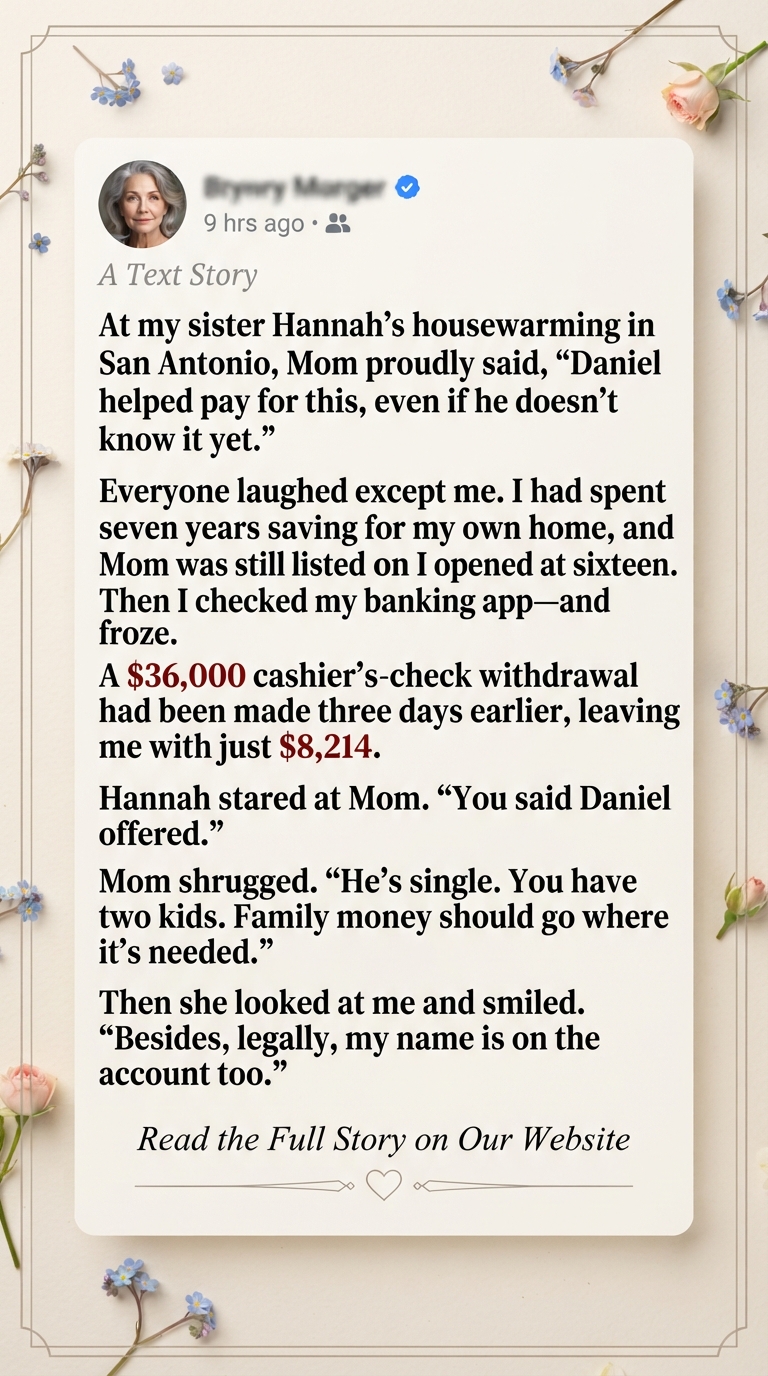
At my sister Hannah’s housewarming in San Antonio, Mom raised her glass and smiled proudly.
“Daniel helped pay for this,” she announced, “even if he doesn’t know it yet.”
Everyone laughed.
Everyone except me.
I stared at her.
Daniel was my younger brother.
He was single.
He didn’t have children.
And he had absolutely no idea what she was talking about.
Hannah laughed nervously.
“Mom…”
“What?” Mom said. “He’ll understand eventually.”
I didn’t laugh.
For seven years, I had been saving for my own home.
Every paycheck, I transferred money into one account.
I skipped vacations.
I drove an old car.
I said no to expensive dinners.
I had two children and wanted to give them a stable home.
That account had started when I was sixteen.
Mom had helped me open it.
Her name was still listed on the account.
I’d never thought much about it.
She was my mother.
I trusted her.
That night, while everyone was celebrating Hannah’s new house, I quietly opened my banking app.
Then I froze.
There was a withdrawal.
$36,000.00
Cashier’s check.
Three days earlier.
My remaining balance was:
$8,214.17
I stared at the screen.
I checked the transaction again.
Then again.
My hands started shaking.
I walked into the kitchen.
“Mom.”
She turned around.
“What?”
“Did you withdraw money from my account?”
Her smile disappeared.
Hannah looked over.
“What money?”
I turned the phone toward them.
“The house fund.”
Mom didn’t even look surprised.
“Oh.”
Just one word.
“Oh.”
I couldn’t believe it.
“You took thirty-six thousand dollars.”
Mom sighed.
“I didn’t take it.”
“Then what do you call this?”
“I moved it.”
“Where?”
“To Hannah.”
Hannah’s face went white.
“Mom!”
“You said Daniel offered to help,” Mom replied.
Hannah stared at her.
“I never said that.”
Mom shrugged.
“You needed the house.”
I looked at my sister.
“Did you know about this?”
“No.”
Hannah looked horrified.
“Mom told me Daniel was helping with the closing costs.”
Mom waved her hand.
“It doesn’t matter who paid.”
“It matters to me,” I said.
Mom looked directly at me.
“He’s single.”
I said nothing.
“You have two kids,” she continued. “You have a husband. You have a household. Hannah needed help getting started.”
“She bought a house with my money.”
“Family money,” Mom corrected.
I felt something inside me snap.
“It wasn’t family money.”
“It was sitting in a joint account.”
Mom smiled.
“Exactly.”
Then she said the sentence that changed everything.
“Legally, my name is on the account too.”
The room went silent.
I looked at Hannah.
She looked at Mom.
Then back at me.
“I didn’t know,” she whispered.
“I believe you.”
Mom crossed her arms.
“You’re acting like I stole from a stranger.”
“You stole from me.”
“I helped you when you were sixteen.”
“And I was grateful.”
“You wouldn’t even have that account if it weren’t for me.”
“That doesn’t mean you can empty it eighteen years later.”
Mom rolled her eyes.
“You’ll make the money back.”
I laughed.
Not because anything was funny.
Because I couldn’t believe my own mother was saying it.
“I’m not asking you to explain why you think Hannah deserves a house.”
I held up my phone.
“I’m asking you to explain why you thought you had the right to take mine.”
Mom’s expression hardened.
“Because I am your mother.”
“That isn’t an answer.”
“It is in this family.”
I looked around the room.
Then I looked at Hannah.
“Did you know Mom had access to my account?”
“No.”
“Did you ask her for thirty-six thousand dollars?”
“No.”
“Then this isn’t about you.”
Hannah started crying.
“I swear I didn’t know.”
I nodded.
“I know.”
Then I looked back at Mom.
“I’m giving you until tomorrow morning.”
“For what?”
“To tell me exactly where the money went.”
Mom laughed.
“Or what?”
I looked her straight in the eye.
“Or I’ll let the bank and an attorney ask.”
Her smile disappeared.
The next morning, I called the bank.
Because Mom was a joint account holder, the situation was more complicated than simply reporting an unauthorized transaction.
But the bank gave me something important.
Documentation.
The cashier’s check had been purchased from the account.
The payee was a contractor involved in Hannah’s home purchase.
And the check had been deposited into an escrow account connected to the closing.
I gave everything to an attorney.
She reviewed the account history.
Then she found something I hadn’t known.
When I was eighteen, Mom had been removed from the account after I opened a new account in my own name.
But eight years later, when I refinanced a car, Mom had been added back as a joint holder after helping me update my banking information.
I had completely forgotten.
My attorney looked at me.
“Your mother may have had authority under the account agreement.”
My stomach dropped.
“So she can keep the money?”
“Not necessarily.”
She explained that account authority and ownership of the underlying funds were not always the same question.
If the money was demonstrably mine and Mom had used it for someone else’s benefit without my agreement, there could still be civil claims and other remedies.
But it would need to be handled properly.
No screaming.
No threats.
Documentation.
So I documented everything.
My deposits.
My transfers.
My paychecks.
Seven years of statements.
Every dollar going into that account had come from me.
Not Mom.
Not Hannah.
Me.
Then I found something even more disturbing.
The cashier’s check wasn’t the only withdrawal.
There had been smaller transfers over the previous year.
$1,200.
$850.
$2,400.
$700.
None of them had been authorized by me.
Together, they totaled more than $7,000.
My attorney looked at the records.
“Your mother may have been using this account for longer than you realized.”
I felt sick.
I called Mom.
“I know about the other withdrawals.”
Silence.
“What other withdrawals?”
“The ones you made before the thirty-six thousand.”
She finally answered.
“I was borrowing it.”
“You never asked.”
“I was going to put it back.”
“When?”
“Eventually.”
I closed my eyes.
“You weren’t borrowing my money.”
“What do you want me to say?”
“The truth.”
She sighed.
“I thought you’d understand.”
“I do understand.”
My voice was quiet.
“You decided my sacrifices were available to you because you thought you could justify spending them.”
She hung up.
The next week, my attorney contacted Hannah.
She had no idea what was happening.
When she learned that the $36,000 had come from my account, she immediately offered to return it.
But the money was already tied up in the house closing.
Hannah looked devastated.
“I’ll sell it if I have to.”
“No.”
She looked at me.
“You don’t have to lose your house because Mom made this decision.”
“What do you want me to do?”
“Tell the truth.”
She did.
She provided the closing records, messages from Mom, and the information she had received about the source of the money.
That documentation became critical.
Mom had told Hannah that Daniel had agreed to contribute.
He hadn’t.
Mom had told Hannah the money was family money.
It wasn’t.
And she had never told Hannah that she was taking it from an account I had spent seven years building.
Eventually, we reached a legal resolution.
The $36,000 was returned to me through an agreed repayment arrangement tied to the property and other assets.
The additional withdrawals were also accounted for.
It took months.
There were uncomfortable conversations.
There were documents.
There were attorneys.
There were moments when I wondered if protecting the relationship with my mother would have been easier than fighting for the money.
Then I looked at my children.
And I remembered what those seven years had meant.
I wasn’t fighting over a number.
I was fighting for the life that number represented.
Six months later, I stood inside my own new house.
It wasn’t enormous.
It wasn’t luxurious.
But it was mine.
My children ran through the empty living room while I stood near the front door holding the keys.
Hannah came over that afternoon.
She hugged me.
“I still feel guilty.”
“You shouldn’t.”
“But if Mom hadn’t taken your money…”
“I know.”
She looked around.
“You really did this yourself.”
I smiled.
“Yes.”
She started crying.
“I wish Mom had never put us against each other.”
“She didn’t win.”
Hannah looked at me.
“What do you mean?”
I looked at my children playing in the hallway.
“She wanted family money to go where she thought it was needed.”
I smiled.
“But she forgot something.”
“What?”
“Family isn’t supposed to decide who deserves what by taking it.”
I never added Mom back to another account.
I never let anyone else control my financial life simply because they shared my last name.
Mom eventually apologized.
It wasn’t perfect.
It didn’t erase what happened.
But I accepted the apology without reopening the door to my finances.
Because forgiveness and access are two completely different things.
Years later, when my daughter asked why I kept the old bank statements in a locked file, I told her:
“Because money isn’t just money when you’ve worked for it.”
She looked confused.
So I smiled.
“Sometimes, protecting what you’ve built is how you teach people to respect you.”
My mother thought her name on an account gave her the right to decide where my money belonged.
She was wrong about one thing.
She thought the $36,000 was the most valuable thing she could take from me.
It wasn’t.
The most valuable thing she gave me was the lesson that trust should never require you to surrender control of your own life.