My Husband Made Me Sign “A Tax Document”—Then the Judge Read What My Father Left Me
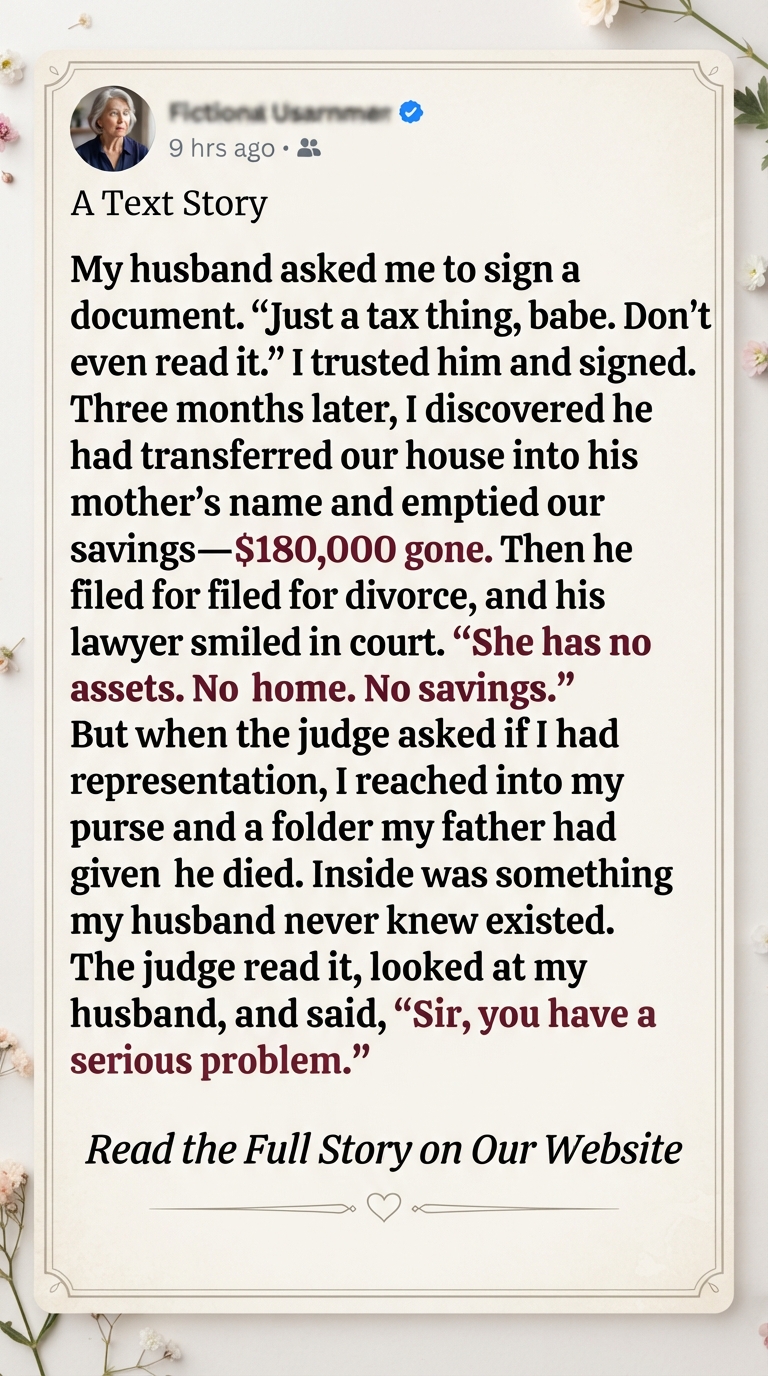
“Just a tax thing, babe.”
My husband, Daniel, slid a document across the kitchen counter.
I glanced at the first page.
“What is it?”
“Nothing important.”
He smiled.
“Just sign it. Don’t even read it.”
I laughed.
“You’re really bad at making things sound trustworthy.”
He kissed my forehead.
“Trust me.”
And I did.
I signed.
I didn’t know I had just signed away the home I thought we owned together.
Three months later, I found out.
I was sitting at the kitchen table when I opened a letter from the county.
The first sentence made my stomach drop.
NOTICE OF CHANGE IN PROPERTY OWNERSHIP
I read it twice.
Then a third time.
The property owner wasn’t listed as Daniel and me.
It was his mother.
I called Daniel.
“What is this?”
Silence.
“Daniel?”
He finally answered.
“You weren’t supposed to see that yet.”
My hands went cold.
“Why is your mother’s name on our house?”
“It’s temporary.”
“Why?”
“It’s complicated.”
“No. It’s actually very simple.”
I stared at the document.
“You transferred our house.”
He sighed.
“It was for tax purposes.”
“Without telling me?”
“You signed the paperwork.”
I couldn’t breathe.
“You told me it was a tax document.”
“It was.”
“Daniel, you transferred our home.”
“Stop being dramatic.”
That was when I knew something was seriously wrong.
I checked our bank accounts.
Our joint savings account had $180,000 in it.
Or at least it should have.
The balance was:
$412.76
I stared at the screen.
I checked again.
Then I opened the transaction history.
The money had been transferred in several installments.
$40,000.
$55,000.
$35,000.
$50,000.
Most of it went to an account I didn’t recognize.
I called the bank.
They told me the transfers had been authorized using my online banking credentials.
My credentials.
The same credentials Daniel had access to.
I sat there shaking.
When Daniel came home, I confronted him.
“Where is our money?”
He put his keys on the counter.
“You signed the documents.”
“That doesn’t answer my question.”
He looked annoyed.
“You’re making this bigger than it is.”
“Where is the $180,000?”
He stared at me.
Then he said something I’ll never forget.
“You won’t need it.”
“Why?”
“Because we’re getting divorced.”
The room went silent.
I thought I had misheard him.
“What?”
“I’ve already spoken to an attorney.”
He pulled an envelope from his briefcase.
Divorce papers.
I stared at him.
“You’ve been planning this?”
“For months.”
“And the house?”
“Not yours anymore.”
“The savings?”
“Not yours either.”
I looked at him.
“You planned all of this before you asked me to sign.”
He didn’t deny it.
“You trusted me.”
I felt something break inside me.
“Yes,” I whispered.
“I did.”
The next morning, I called my father.
Then I remembered.
He had been dead for almost two years.
Before he died, he had given me a folder.
He had looked strangely serious that day.
“If you ever need this,” he had told me, “don’t open it because you’re angry.”
“Then when?”
“When someone tries to convince you that you have no options.”
At the time, I had laughed.
I thought he was being dramatic.
I found the folder in the back of my closet.
My hands were shaking when I opened it.
Inside was a letter.
Then another document.
Then a copy of a trust agreement.
I read the first page.
Then the second.
My heart started pounding.
My father had established a family trust years before his death.
I was the beneficiary.
But that wasn’t the part that shocked me.
The trust contained a substantial investment account and several properties.
One clause specifically addressed marriage.
My inheritance was to remain separate property unless I voluntarily converted it into marital property.
I kept reading.
Then I found the document that changed everything.
My father had also established a separate secured interest connected to the down payment used to purchase our house.
The money he had given me before the marriage had never been a simple gift.
It had been documented as an inheritance advance and protected through a recorded agreement.
Daniel didn’t know.
His mother didn’t know.
Apparently, even their attorney didn’t know.
My father had anticipated something I never imagined would happen.
He had protected me from it.
I took the folder to an attorney.
She read everything carefully.
Then she looked at me.
“Do you have the original documents?”
“Yes.”
“Don’t lose them.”
“Can they help me get the house back?”
“They may.”
“And the $180,000?”
“That depends on where it went and whether we can establish how it was transferred.”
She paused.
“But your husband may have made a serious mistake.”
“What mistake?”
“He assumed that because you signed something, you understood what you were signing.”
She tapped the document.
“That’s not always how the law works.”
We filed the appropriate objections and requests with the court.
Then came the hearing.
Daniel arrived with his attorney.
His lawyer looked confident.
Almost amused.
He presented the story exactly as Daniel had planned it.
My husband owned the house.
My husband controlled the savings.
I had signed the transfer documents.
I had no meaningful assets.
Then his attorney said:
“She has no home, no savings, and no significant assets to divide.”
The judge looked at me.
“Ma’am, do you have representation?”
“Yes, Your Honor.”
My attorney stood beside me.
The judge nodded.
“And do you have documentation?”
I reached into my purse.
I pulled out my father’s folder.
Daniel looked confused.
“What is that?”
I didn’t answer.
The judge reviewed the first document.
Then the second.
His expression changed.
He read silently for several seconds.
Then he looked at Daniel.
“Mr. Carter, were you aware of this trust?”
Daniel shook his head.
“No.”
“Were you aware of the recorded agreement concerning the funds used in the acquisition of the marital residence?”
“No.”
The judge looked at Daniel’s attorney.
“Were you?”
The attorney slowly shook his head.
“No, Your Honor.”
The judge turned another page.
Then another.
Finally, he looked directly at Daniel.
“Sir, you have a very serious problem.”
Daniel’s face went pale.
The judge explained that the court would need to determine the ownership and characterization of the property, including the effect of the recorded agreement and the trust documents.
Then my attorney presented the banking records.
The $180,000 hadn’t disappeared.
It had been transferred to an account controlled by Daniel’s mother.
Then to another entity.
Then partially used to pay debts and purchase an investment property.
Daniel’s attorney tried to argue that the transfers were legitimate.
But the records told a different story.
There were messages between Daniel and his mother.
One said:
Once she signs, move the rest before she notices.
Another said:
The house will be safe in your name.
My attorney placed copies before the judge.
Daniel looked at me.
“You went through my phone?”
“No.”
I pointed toward the documents.
“Your attorney produced the messages during discovery.”
His face turned red.
The judge ordered additional financial disclosure and temporary restrictions on further transfers while the property and funds were being traced.
The case lasted months.
It wasn’t a movie ending.
There was no magical courtroom speech that instantly returned everything.
There were hearings.
Accountings.
Bank records.
Depositions.
Arguments over separate and marital property.
But the documents my father had left me changed the entire case.
The house could no longer simply be treated as an asset Daniel had secretly transferred away.
The $180,000 could no longer simply be described as money that had vanished.
Every transfer had to be accounted for.
Eventually, the court ruled that the property transfer was subject to challenge and that the disputed funds had to be addressed in the property division and financial recovery process.
Daniel’s mother was required to participate in the proceedings concerning the transferred property.
The money he had moved was traced.
Some of it had already been spent, but a substantial portion was recovered or credited against his financial obligations.
Daniel’s lawyer stopped smiling.
I never did.
Not because I enjoyed watching him lose.
Because for the first time in months, I wasn’t afraid.
During the final hearing, Daniel asked to speak with me privately.
“I never thought you’d fight.”
I looked at him.
“That was your mistake.”
“I thought you had nothing.”
I shook my head.
“No.”
I held my father’s folder against my chest.
“You just never bothered to find out what I had.”
He looked down.
“I loved you.”
I answered quietly.
“You loved what you thought you could control.”
He didn’t respond.
Our divorce was finalized.
The house issue was resolved through the court’s property orders and the recorded interests.
The money was accounted for.
And Daniel’s carefully constructed story—that I was a woman with no assets, no home, and no options—collapsed under documents he had never known existed.
Months later, I sat alone in the house.
My house.
I opened my father’s folder one last time.
His handwriting was on the final page.
I’d never noticed it before.
It said:
“A person can lose money. A person can lose property. But never let someone convince you that losing those things means you’ve lost your ability to stand up for yourself.”
I cried when I read it.
Not because I had lost my marriage.
Because I finally understood why my father had given me that folder.
He knew that someday I might need proof that I wasn’t powerless.
Daniel thought the signature he tricked me into giving him would erase my future.
Instead, it became the beginning of the paper trail that exposed everything.
He thought I had nothing.
He was wrong.
I had the documents.
I had the truth.
And most importantly, I had finally learned that trusting someone doesn’t mean surrendering your right to protect yourself.