My Mom Stole $51,000 From Grandpa’s Account—Then I Found Out Where Every Dollar Went
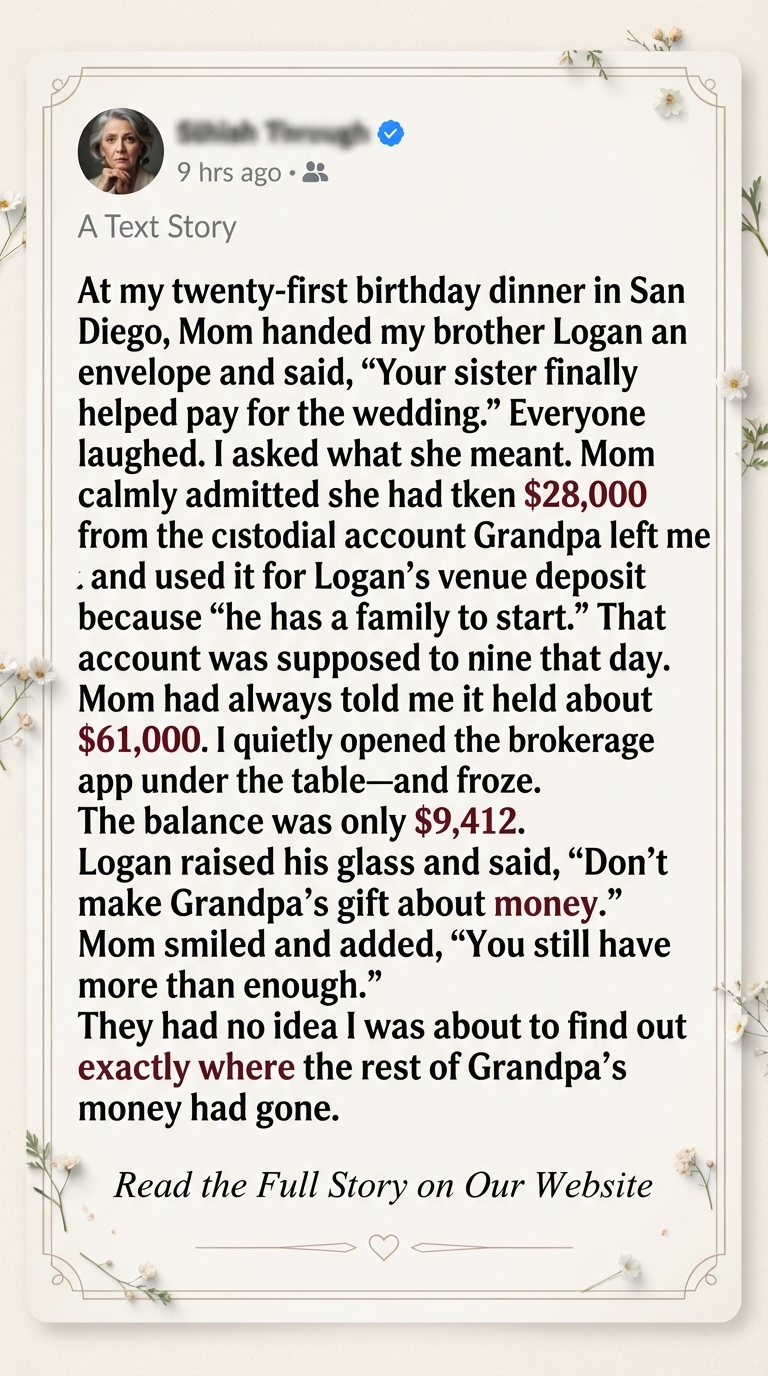
At my twenty-first birthday dinner in San Diego, Mom handed my brother Logan an envelope.
She smiled proudly.
“Your sister finally helped pay for the wedding.”
Everyone laughed.
I didn’t.
I looked at Mom.
“What are you talking about?”
She waved her hand.
“Oh, honey. Don’t make it dramatic.”
“I don’t understand.”
Mom looked around the table.
Then she calmly said:
“I took $28,000 from the custodial account Grandpa left you.”
My stomach dropped.
“You what?”
She continued eating as if she’d just told me she’d borrowed a sweater.
“Logan needed the venue deposit.”
Logan raised his glass.
“Thanks, sis.”
I stared at him.
“You knew?”
He shrugged.
“Mom said it was family money.”
“It wasn’t.”
Mom sighed.
“Your grandfather wanted his grandchildren taken care of.”
“He specifically left it to me.”
“And you still have plenty.”
I looked at her.
“How much?”
She smiled.
“About sixty-one thousand.”
That number had been repeated my entire life.
Grandpa left you about $61,000.
Mom had told me that every year.
When I turned eighteen.
When I graduated high school.
When I started college.
It was always:
“Your grandfather left you about sixty-one thousand. It’s growing.”
But today was my twenty-first birthday.
The custodial account was supposed to become mine.
I quietly pulled out my phone beneath the table.
I opened the brokerage app.
I expected to see roughly $61,000.
Instead:
$9,412.63
I stared at the screen.
I refreshed it.
Still $9,412.
My hands went cold.
Mom noticed my expression.
“What?”
I locked my phone.
“Nothing.”
Logan smiled.
“See? You still have money.”
I looked at him.
“You’re right.”
Then I raised my glass.
“To family.”
Everyone drank.
I didn’t.
Because I had already decided I was going to find out exactly where Grandpa’s money had gone.
The next morning, I called the brokerage company.
I explained that I had reached the age at which the custodial account should transfer to me.
The representative asked for identification.
Then she said something that made my heart stop.
“There’s been substantial activity on the account.”
“How much?”
“Would you like the transaction history?”
“Yes.”
She emailed it to me.
I opened the file.
The first withdrawal was from when I was seventeen.
$4,800.
Then $7,200.
Then $3,600.
Then $11,000.
Then $28,000.
I stared at the screen.
The transactions weren’t random.
They came in patterns.
Several were sent to the same checking account.
My mother’s.
Others went directly to businesses.
A wedding venue.
A jewelry store.
A luxury resort.
A contractor.
A furniture company.
I felt sick.
I called Mom.
“Can we talk?”
“Of course.”
“About Grandpa’s account.”
She became quiet.
“What about it?”
“I have the transaction history.”
Silence.
“Mom?”
“What are you accusing me of?”
“Nothing yet.”
I paused.
“I’m asking you to explain it.”
She sighed.
“I used some of the money.”
“How much?”
“You already know.”
“No.”
I looked at the spreadsheet.
“I know about the $28,000.”
“What else?”
She didn’t answer.
“Mom?”
“I was your guardian.”
“So?”
“I was allowed to manage the account.”
“Manage it for me.”
“Yes.”
“Not spend it on yourself.”
She became defensive.
“I was taking care of the family.”
I closed my eyes.
“The resort?”
“For Logan’s engagement.”
“The jewelry store?”
“Your aunt’s anniversary gift.”
“The contractor?”
“Repairs.”
“To whose house?”
Silence.
“Mom?”
She finally said:
“You’re being ungrateful.”
I laughed.
Not because it was funny.
Because I suddenly understood why she’d always avoided showing me the statements.
She had never intended for me to look.
I hired an attorney.
Her name was Rachel Bennett.
She reviewed the account records carefully.
Then she looked at me.
“Did you authorize any of these withdrawals?”
“No.”
“Did you receive any benefit from them?”
“No.”
“Did your mother provide you with annual statements?”
“No.”
She nodded.
“This needs to be investigated.”
Over the next several weeks, we reconstructed the account.
The original balance Grandpa left was just over $61,000.
By the time I reached twenty-one, the account should have been significantly higher.
Instead, there was $9,412.
The missing amount wasn’t simply $28,000.
More than $51,000 had been withdrawn or transferred over several years.
And then we found something even worse.
Some of the money had been transferred into accounts connected to Logan.
One payment had been made toward his wedding venue.
Another covered a credit-card balance.
Another went toward a down payment on a vehicle.
I confronted Logan.
“You knew.”
He shook his head.
“I didn’t know it was your money.”
“What did Mom tell you?”
“That Grandpa left family money.”
“It was my account.”
He looked uncomfortable.
“I didn’t understand.”
“You didn’t ask?”
“No.”
“You should have.”
He lowered his eyes.
“You’re right.”
For the first time, I saw regret on his face.
Then he said something unexpected.
“I’m going to give it back.”
I stared at him.
“The wedding deposit?”
“All of it.”
“Logan…”
“I should have known.”
He returned the money he had personally received or benefited from where he could, and he provided documentation to my attorney.
But Mom still refused to admit wrongdoing.
Until we found the final document.
It was an old email.
Sent from Mom’s account.
The subject line was:
“Using the girl’s money.”
I opened it.
The email was to Logan.
It said:
“She won’t know until she’s older. By then, she’ll have plenty anyway. Don’t worry about it.”
I stared at the screen.
My attorney was silent.
Then she said:
“This is important.”
I nodded.
It wasn’t just proof that Mom knew the money belonged to me.
It showed she had planned around the assumption that I wouldn’t discover what she’d done.
The matter went into formal proceedings.
The court required an accounting of the custodial funds.
Mom had to produce records.
Receipts.
Bank statements.
Transfers.
Explanations.
Some expenses were legitimate administrative costs.
Others were not.
The $28,000 wedding deposit was clearly not a necessary expense for my benefit.
Neither were the luxury purchases.
Neither were the transfers to family members.
Eventually, the court ordered repayment of the improperly used funds, along with applicable interest and costs.
It took time.
It wasn’t glamorous.
There were no dramatic courtroom screams.
Just paperwork.
Records.
Questions.
And uncomfortable truths.
But I got something more valuable than the money.
I got the truth.
A few months later, Mom asked to meet me.
We sat at a café.
She looked older.
“I never meant to hurt you.”
I nodded.
“I believe you didn’t think about me.”
She looked down.
“I thought you had more than enough.”
“That was never the point.”
“What was the point?”
I looked at her.
“Grandpa trusted you with something that belonged to me.”
She didn’t answer.
“And you taught me that being family doesn’t give someone permission to decide what belongs to you.”
Tears filled her eyes.
“I was trying to help Logan.”
“I know.”
“He needed it.”
“I know.”
She looked at me.
“Would you have helped him?”
I thought about it.
“Maybe.”
She looked surprised.
“Then why are you so angry?”
“Because you never asked.”
That silenced her.
“If you had asked me, I could have decided what I wanted to give.”
I stood.
“But you didn’t want my decision.”
She wiped her eyes.
“You wanted my money.”
I walked away.
A year later, I bought my first home.
Not a mansion.
Not anything extravagant.
Just a small place near the coast.
The down payment came from the money that had been recovered and the investments that remained in the account.
On moving day, I found an old photograph of Grandpa.
He was sitting in his garden, smiling at the camera.
On the back, he had written:
“For my granddaughter. Build something that belongs to you.”
I sat on the floor and cried.
Not because of the money.
Because I finally understood what he’d meant.
He hadn’t given me a number.
He’d given me a chance.
And for years, other people had treated that chance as if it belonged to them.
They were wrong.
That $61,000 had never been just an inheritance.
It was Grandpa’s final reminder that I was capable of building a life of my own.
And on my twenty-second birthday, I stood in the kitchen of the home I had bought with my own restored inheritance.
I raised a glass.
“To Grandpa.”
Then I smiled.
“To knowing exactly what is mine.”
Because sometimes the hardest lesson isn’t learning how to protect your money.
It’s learning that loving your family doesn’t mean giving them permission to spend your future.