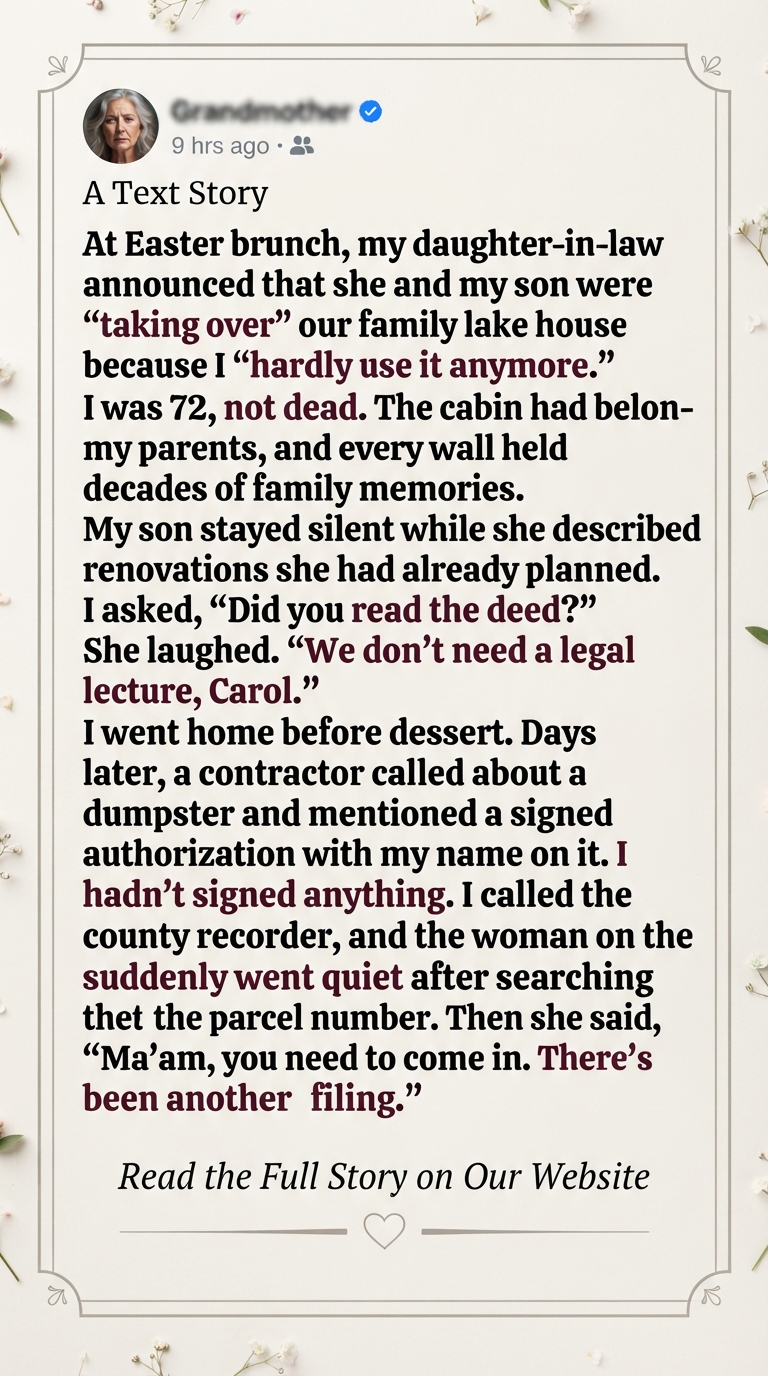
At Easter brunch, my daughter-in-law announced that she and my son were “taking over” our family lake house because I “hardly use it anymore.”
I was seventy-two.
Not dead.
I stared at her across the table.
The lake house had belonged to my parents before it became mine. Every wall held something: my father’s fishing photographs, my mother’s quilt hanging above the fireplace, pencil marks showing my son’s height from age six to seventeen.
It wasn’t just a property.
It was our family history.
My daughter-in-law, Jenna, took another sip of iced tea and continued as if she were presenting a business proposal.
“We’ve already talked to a contractor,” she said. “We’re thinking open-concept kitchen, new flooring, maybe turning the upstairs bedroom into a kids’ suite.”
My son, Mark, sat beside her.
Silent.
I looked at him.
“Is that true?”
He rubbed the back of his neck.
“Mom, we just thought… since you don’t go up there much anymore—”
“I went last month.”
Jenna waved her hand.
“You know what I mean.”
“No,” I said quietly. “I don’t.”
She sighed.
“Carol, we’re family. We’re not trying to steal your house.”
“Then what are you trying to do?”
She smiled.
“Take over.”
She said it like the answer was obvious.
I put my fork down.
“Did you read the deed?”
She laughed.
“We don’t need a legal lecture, Carol.”
That was the moment I stood up.
“I think we’re finished here.”
Mark finally looked at me.
“Mom—”
“I said we’re finished.”
I drove home before dessert.
That night, I sat at my kitchen table and pulled out the folder containing my parents’ original paperwork.
The deed was exactly where I remembered it.
My father’s name.
My mother’s name.
Then mine.
Sole owner.
There was no co-owner.
No life estate.
No transfer.
No family-use agreement.
Nothing.
I should have felt relieved.
Instead, I felt uneasy.
Because Jenna hadn’t sounded like someone making a casual suggestion.
She had sounded like someone who already believed the house belonged to her.
Three days later, my phone rang.
“Mrs. Bennett?”
“Yes?”
“This is David from Lakeside Disposal. I’m calling about the dumpster scheduled for the lake property.”
My stomach tightened.
“What dumpster?”
There was a pause.
“The one authorized for demolition debris.”
“I didn’t authorize a dumpster.”
He sounded confused.
“Well… I have a signed authorization here.”
“Whose signature?”
Another pause.
“Yours.”
My hand went cold.
“That isn’t my signature.”
David became very quiet.
“I can send you a copy.”
“Please do.”
Five minutes later, the document arrived by email.
I opened it.
There was my name.
Carol Bennett.
Underneath it was a signature that looked enough like mine to fool someone who didn’t know me.
But I knew my handwriting.
I had signed my name for seventy-two years.
That wasn’t it.
I immediately called the county recorder’s office.
After giving the clerk the parcel number, I heard typing.
Then silence.
“Ma’am?”
“Yes?”
“I’m looking at the property records.”
“And?”
Another pause.
Her voice changed.
“There’s been another filing.”
My heart began pounding.
“What kind of filing?”
“I don’t want to discuss this over the phone.”
“Why not?”
“Because I think you need to come in.”
I drove to the county office the next morning.
The clerk met me at the counter.
She printed several documents.
The first one was a contractor authorization.
The second was a notarized document claiming I had transferred certain property rights to a newly created family holding company.
The third was even worse.
A quitclaim deed.
My name appeared as the grantor.
Mark’s name appeared on the receiving side.
And the signature was mine.
Except it wasn’t.
I stared at the page.
“I never signed this.”
The clerk nodded.
“I believe you.”
I looked up.
“You do?”
She lowered her voice.
“Because the notary stamp on this document doesn’t match the notary record we have for that date.”
My mouth went dry.
“What does that mean?”
“It means someone may have filed a document containing a false notarization.”
I took photographs of every page.
Then I called an attorney.
Her name was Rachel Bennett.
She wasn’t related to me, despite the coincidence.
After reviewing the documents, she looked across her desk at me.
“Carol, this isn’t a family misunderstanding anymore.”
“I know.”
“Someone attempted to create a paper trail suggesting you transferred an interest in your property.”
“Can they take my house?”
“Not simply because they filed something.”
She turned the documents toward herself.
“But we need to move quickly.”
That afternoon, Rachel filed the appropriate notices challenging the questionable documents and began the process of getting the county records corrected or flagged pending review.
Then she asked me a question.
“Did your son ever have access to your personal documents?”
I thought about it.
“Last Christmas.”
“What did he have access to?”
“My filing cabinet.”
Rachel looked at me.
“Why?”
I remembered something.
Mark had helped me organize my father’s old papers after my basement flooded.
He had asked me where the original deed was.
I had told him.
At the time, I hadn’t thought twice about it.
Now I did.
Rachel asked me to search my house for anything missing.
I went home and opened the filing cabinet.
The original deed was still there.
But a photocopy was gone.
So was an old copy of my driver’s license.
My stomach dropped.
Rachel stared at the list.
“That’s enough for me to understand how someone could have attempted this.”
“Mark?”
“We don’t know yet.”
“But you think he did.”
“I think you shouldn’t accuse anyone until we have evidence.”
So I waited.
Two days later, the evidence arrived.
The county investigator had contacted the notary listed on the quitclaim deed.
The notary had never met me.
She had notarized a document presented by a man who identified himself as “Mark Bennett.”
He had shown her a copy of my identification.
But there was another problem.
The notary’s appointment log showed that the document had been presented nearly two weeks before Easter.
That meant Jenna’s announcement at brunch wasn’t the beginning.
It was the end of a plan that had already been underway.
Rachel requested records connected to the new holding company.
Its name was Bennett Family Lakeside LLC.
Mark was the manager.
Jenna was listed as the registered agent.
And the mailing address was their house.
I sat silently in Rachel’s office.
“They created a company,” I whispered.
“Yes.”
“Why?”
Rachel looked at the paperwork.
“Possibly to make the transfer appear more legitimate. We need to determine exactly what they intended to do.”
Then she showed me something else.
A contractor’s proposal.
It included $186,000 worth of renovations.
The document said:
OWNER APPROVAL RECEIVED.
My name was typed underneath.
I had never seen it.
But the last page contained something that made my hands shake.
A planned listing agreement.
They weren’t just renovating my lake house.
They intended to refinance or sell it.
Rachel leaned back.
“Carol, there’s one more thing.”
“What?”
“The LLC had already contacted a lender.”
“For how much?”
“$420,000.”
I closed my eyes.
They had been planning to borrow against a house they didn’t own.
That evening, Mark called.
“Mom, we need to talk.”
“I agree.”
“Jenna told me you hired a lawyer.”
“I did.”
He exhaled.
“Mom, you’re making this bigger than it needs to be.”
“Did you sign documents using my name?”
Silence.
“Mom—”
“Did you?”
“I didn’t mean for it to go this far.”
My heart broke.
Not because of the house.
Because of how easily he said it.
Like the problem was that I had discovered it.
“Why, Mark?”
He finally answered.
“Jenna thought you’d eventually give us the property anyway.”
“So you forged documents because you thought I might say yes?”
“We weren’t trying to hurt you.”
“You tried to transfer my property without my permission.”
“I know.”
His voice cracked.
“I know.”
I asked the question I had been afraid to ask.
“Were you going to sell it?”
Another silence.
“Yes.”
I closed my eyes.
“How much?”
“About $1.8 million.”
I almost laughed.
Not because it was funny.
Because I suddenly understood the Easter brunch.
They hadn’t been talking about family memories.
They had been talking about an asset.
My son had looked at the place where his childhood was preserved and seen a number.
I said quietly:
“You should have just asked me.”
“I know.”
“No. You don’t.”
The next morning, Mark came to my house alone.
He looked exhausted.
He sat across from me at the kitchen table.
“I was stupid.”
“Yes.”
“Jenna said the house was sitting there unused.”
“It wasn’t unused.”
“I know.”
“It was waiting for me.”
He looked down.
“I thought you were getting older.”
That sentence hurt more than everything else.
I stared at him.
“So that’s what this was?”
“No.”
“Yes.”
He began crying.
“I thought you should be somewhere easier. I thought we could take care of it.”
“You don’t take care of someone by taking what belongs to them.”
He had no answer.
The legal process took months.
The questionable filings were challenged.
The lender withdrew after being notified of the disputed ownership.
The contractor confirmed that the authorization he received had not come directly from me.
The county investigated the false notarization.
And the attempted transfer was ultimately invalidated.
I never had to sell the lake house.
I never had to give it to Mark.
And I never let anyone convince me that protecting what belonged to me was selfish.
But I did something unexpected.
That summer, I invited Mark to the lake house.
Just him.
No Jenna.
No contractors.
No paperwork.
He stood on the dock looking out at the water.
“Remember when Dad taught me to fish here?”
“I remember.”
“You used to sit right there.”
“I still do.”
He smiled sadly.
“I really messed up.”
“Yes.”
“I don’t expect you to forgive me.”
“I haven’t decided.”
He nodded.
That was the first honest conversation we’d had in months.
Eventually, I did forgive him.
But forgiveness came with conditions.
He would never have access to my financial documents again.
He would never make decisions about my property without my written permission.
And if he wanted something from me, he would ask.
Not assume.
Not manipulate.
Not take.
Ask.
The following spring, I made my own decision about the lake house.
I didn’t sell it.
I didn’t give it away.
I created a family trust that would preserve the property for future generations, with clear rules about ownership, maintenance, and who could use it.
And I added one sentence that Rachel helped me word carefully:
No beneficiary has authority to sell, mortgage, transfer, or encumber the property merely because they are family.
The first weekend after the paperwork was finalized, I invited everyone to the lake.
My grandson ran down the dock.
Someone started a fire.
My mother’s quilt still hung above the fireplace.
My father’s fishing photographs were still on the wall.
And for the first time in months, the house felt like a home again.
Mark stood beside me on the porch.
“Mom?”
“Yes?”
“Thank you for not selling it.”
I looked at him.
“I didn’t keep it because you wanted it.”
He nodded.
“I kept it because I wanted it.”
He smiled.
“I understand.”
I looked out across the lake.
At seventy-two, I had learned something I wish I had understood much earlier:
Being a mother doesn’t mean your children inherit the right to make your decisions.
Being generous doesn’t mean you’re obligated to surrender what you built.
And being old doesn’t mean you’re finished having a life.
My daughter-in-law had laughed when I asked if she had read the deed.
She thought I was protecting a piece of paper.
I wasn’t.
I was protecting the life behind it.
And the next time someone tells me I’m “hardly using” something that belongs to me, I’ll remember the county clerk’s quiet voice:
“Ma’am, you need to come in.”
Because sometimes the most important words aren’t the ones that announce what someone has taken.
They’re the ones that warn you just in time to stop them.
The lake house stayed mine.
And so did the right to decide what happened to it.