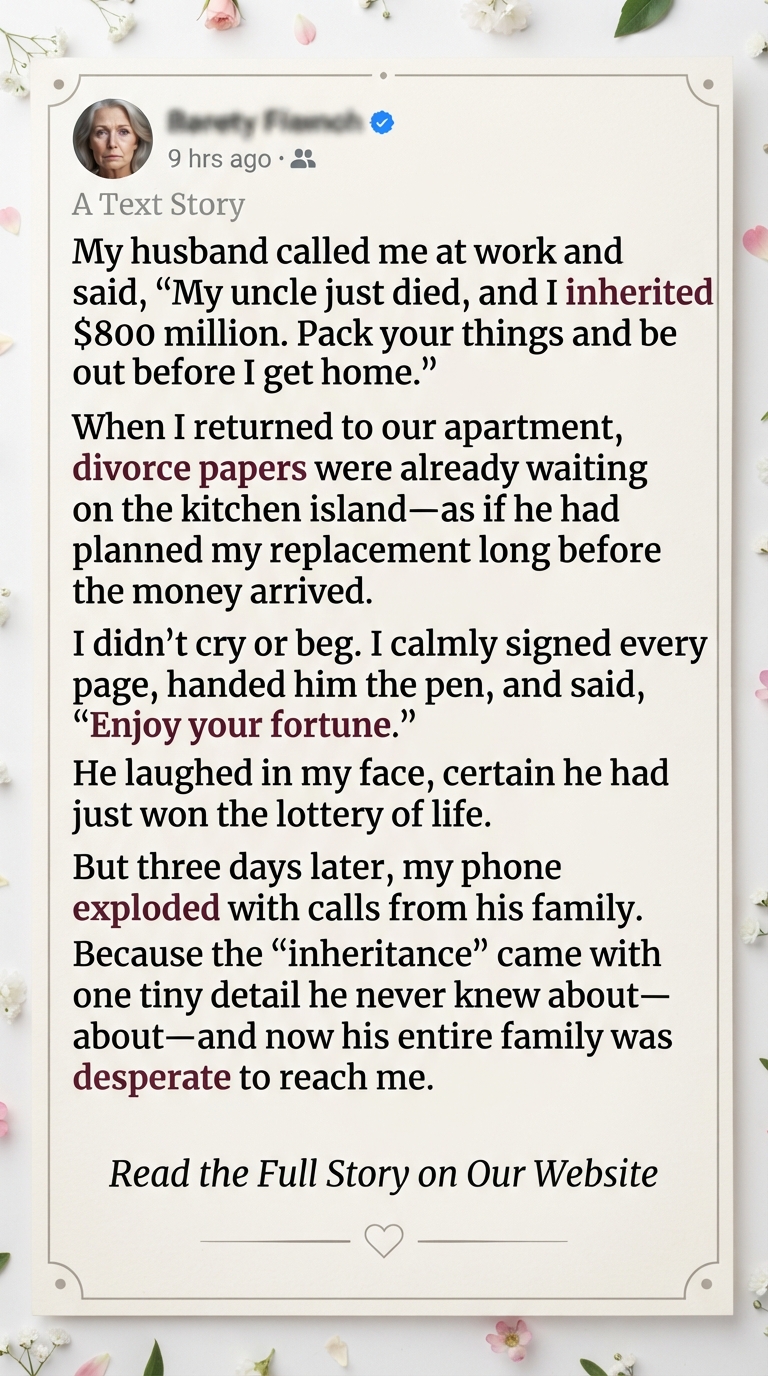
My husband called me at work and said, “My uncle just died, and I inherited $800 million. Pack your things and be out before I get home.”
For a few seconds, I thought I had misheard him.
“What?”
“You heard me.”
His voice wasn’t shaking.
He sounded almost amused.
“My uncle left me everything. Eight hundred million dollars.”
I sat frozen at my desk.
Then he added the part that made my stomach turn.
“I’ve already filed for divorce. The papers are on the kitchen island. Sign them before I get home.”
I stared at the wall in front of me.
“You’re serious?”
“Completely.”
“After twenty-one years?”
He laughed.
“Don’t make this emotional. You’re not entitled to my inheritance.”
Then he hung up.
I didn’t cry.
I didn’t call him back.
I didn’t beg.
I simply finished my workday.
On the drive home, I stopped at a coffee shop and sat in my car for twenty minutes.
I thought about our marriage.
The small apartment we’d started in.
The nights we’d eaten cheap takeout because money was tight.
The years I had supported him while he built his career.
The surgeries I drove him to.
The business trips where I packed his suitcase.
The holidays I spent with his family.
And now, apparently, I was disposable.
Because his uncle had died.
And money had arrived.
When I opened our apartment door, divorce papers were waiting on the kitchen island.
They were already marked with sticky notes.
Sign here.
Initial here.
Return by Friday.
Someone had even placed a pen beside them.
I almost smiled.
He hadn’t decided to leave me that afternoon.
He had planned this.
The inheritance had simply given him the courage to execute the plan.
I sat down.
I read every page.
Then I signed.
Every single one.
When he came home three hours later, he walked through the door carrying champagne.
He stopped when he saw me.
“You actually signed?”
I slid the papers across the counter.
“Yes.”
He picked them up.
“You’re not going to fight me?”
“No.”
He laughed.
“I knew you’d understand eventually.”
I looked at him.
“You wanted freedom.”
“I did.”
“You have it.”
He poured himself a glass.
“To my new life.”
I stood up.
“I hope you enjoy it.”
He raised his glass.
“Oh, I will.”
I picked up my suitcase.
At the door, I turned around.
“You know what?”
“What?”
“You should read everything you inherited.”
He laughed.
“It’s eight hundred million dollars. I think I’ll manage.”
I smiled.
“Maybe.”
Then I walked out.
Three days later, my phone started exploding.
First came a call from his mother.
Then his sister.
Then his attorney.
Then his uncle’s longtime estate manager.
Then three numbers I didn’t recognize.
I ignored them all.
Finally, his mother left a voicemail.
Her voice was trembling.
“Please call me. This is extremely important.”
I deleted it.
Five minutes later, she called again.
I answered.
“What?”
“Where are you?”
“Why?”
“You need to come back.”
I laughed.
“Back where?”
“To the family office.”
“I don’t have anything to do with your family anymore.”
“You don’t understand.”
“No. I think I understand perfectly.”
She began crying.
“Please, Carol. Your husband made a terrible mistake.”
I went silent.
“My husband?”
“Yes.”
“What kind of mistake?”
She hesitated.
Then whispered:
“He wasn’t supposed to receive the money yet.”
I sat down.
“What do you mean?”
“The inheritance came with conditions.”
I stared at the wall.
“What conditions?”
She wouldn’t answer.
“Tell me.”
“The trust requires a surviving spouse.”
I almost laughed.
“I was his wife when his uncle died.”
“Yes.”
“And I’m divorced now.”
Another pause.
“Yes.”
“Then I guess that’s your problem.”
Her voice became desperate.
“No, Carol.”
She took a breath.
“The trust defines ‘surviving spouse’ as the spouse who remains married to the beneficiary through the date of distribution.”
I slowly understood.
“You’re saying—”
“He filed for divorce before the estate distributed the assets.”
“Yes.”
“And because he voluntarily initiated the divorce immediately after learning about the inheritance…”
She began crying.
“The trustees have frozen the entire estate.”
I said nothing.
“He doesn’t control the $800 million.”
“No.”
“He doesn’t own it yet.”
“No.”
“And because he filed for divorce…”
“Yes.”
“He may have disqualified himself.”
There was silence.
Then she said the words that changed everything.
“Unless you withdraw the divorce filing.”
I stood up.
“No.”
“Carol, please.”
“No.”
“You don’t understand what this means for our family.”
“I understand exactly what it means.”
My voice was calm.
“He chose $800 million over me.”
“That isn’t fair.”
“He told me to pack my things.”
“He was confused.”
“He told me he had already planned my replacement.”
Silence.
That part apparently hadn’t been shared with the family.
I continued.
“And he put divorce papers on the kitchen island before he even came home.”
Her voice broke.
“I know.”
That surprised me.
“You know?”
“Yes.”
“How?”
“Because he told his brother he had already found someone else.”
I closed my eyes.
There it was.
The part that hurt most.
The inheritance hadn’t created the betrayal.
It had simply revealed it.
That afternoon, I received a formal letter from the estate’s trustee.
It explained everything.
My husband’s uncle had built a private family trust decades earlier.
The $800 million wasn’t a simple inheritance handed over in one check.
It was held in trust.
The beneficiary could receive distributions only after satisfying several conditions.
One of those conditions was designed to prevent exactly what my husband had attempted.
The beneficiary had to remain married to his spouse through the date of the initial distribution.
The trustee’s letter explained that my husband’s divorce filing had triggered a review.
Until the matter was resolved, the assets remained under the trustee’s control.
My husband had assumed “inherited” meant “already mine.”
It didn’t.
He had celebrated money he didn’t yet control.
And he had destroyed his marriage trying to get it faster.
Two days later, I agreed to meet the trustee.
Not because I wanted his money.
Because I wanted the truth.
The trustee was an older man named Richard Hale.
He placed a thick folder on the table.
“Your husband wasn’t the only beneficiary considered.”
“What does that mean?”
“His uncle created a succession structure.”
He opened the folder.
“If the primary beneficiary voluntarily ends the marriage before distribution, the trust doesn’t automatically pass to the former spouse.”
“Then who gets it?”
Richard looked directly at me.
“You.”
I stared at him.
“What?”
“Your uncle-in-law amended the trust twelve years ago.”
“Why?”
“He believed your husband had become increasingly obsessed with wealth.”
I shook my head.
“He knew?”
Richard nodded.
“He received reports from the family’s advisors.”
I opened the folder.
There were letters.
Financial reports.
Notes from family meetings.
And one handwritten letter.
The handwriting was unfamiliar.
But the words stopped me.
Carol,
If you’re reading this, something has gone very wrong.
I looked up.
Richard said quietly, “Your husband’s uncle wrote that shortly before his death.”
I continued reading.
I have watched my nephew become increasingly convinced that money gives a person permission to treat others however they wish.
I don’t agree.
If he ever chooses wealth over loyalty, I don’t want him rewarded for it.
My hands began shaking.
Then I reached the final paragraph.
I have known you for twenty-one years. You stayed when he had nothing. You helped him build the life he now thinks he is entitled to. If the day comes when he throws you away because he believes money makes him untouchable, remember this: you were never the disposable part of this family.
I couldn’t breathe for a moment.
Richard closed the folder.
“He wanted the inheritance to follow character, not blood.”
I whispered:
“Why didn’t he tell my husband?”
“Because he believed telling him would defeat the purpose.”
Three days later, my husband called.
I almost didn’t answer.
“Where are you?”
“Why?”
“We need to talk.”
“No, we don’t.”
“You know what’s happening?”
“Yes.”
“You have to fix this.”
I laughed quietly.
“I have to fix this?”
“You know what I mean.”
“You divorced me.”
“I didn’t think the trustees would interpret it this way.”
“You didn’t read the trust.”
“I thought I owned the inheritance.”
“You thought wrong.”
His voice became angry.
“Listen to me. We can still fix this.”
“No.”
“Carol.”
“No.”
“You don’t understand how much money we’re talking about.”
“I understand exactly.”
“Eight hundred million dollars!”
I looked out the window.
Then said:
“You’re still talking about the money.”
He went silent.
“You haven’t asked how I’m doing.”
Nothing.
“You haven’t apologized.”
Silence.
“You haven’t said you regret hurting me.”
He finally whispered:
“I do regret it.”
“For what?”
“For losing the money.”
I closed my eyes.
“That’s what I thought.”
I ended the call.
The following week, his family requested a formal meeting.
I agreed.
Everyone was there.
His mother.
His sister.
His attorney.
The trustee.
And my husband.
He looked different.
Not richer.
Not powerful.
Just scared.
The trustee placed a document on the table.
“Mr. Bennett, the trust does not reward a beneficiary who voluntarily terminates the qualifying marriage before distribution.”
My husband’s attorney spoke quickly.
“We are seeking reconsideration.”
Richard shook his head.
“There is nothing to reconsider. The trust language is clear.”
My husband looked at me.
“Carol.”
I didn’t answer.
His mother started crying.
“Please.”
I looked at her.
“You all knew he was leaving me.”
Nobody spoke.
“You knew he had planned it.”
His sister looked down.
“I knew he was unhappy.”
“He wasn’t unhappy.”
I looked at my husband.
“He was ambitious.”
My husband swallowed.
“And now?”
He didn’t answer.
The trustee turned toward me.
“Mrs. Bennett, under the trust’s succession provision, you are the designated alternate beneficiary.”
My husband stood abruptly.
“No.”
Richard remained calm.
“Yes.”
“That can’t be right.”
“It is.”
“You can’t give her my inheritance!”
Richard looked at him.
“It’s not your inheritance.”
The room went silent.
That sentence finally broke him.
He sat down.
For the first time since his uncle died, he looked like the man I had married twenty-one years earlier.
Not the man who had called me disposable.
Just a frightened man who had made a decision he couldn’t undo.
I didn’t take the $800 million that day.
I didn’t even know whether I wanted it.
What I knew was that I no longer wanted anything from my husband.
Not an apology.
Not reconciliation.
Not his family’s approval.
And certainly not a marriage rebuilt because a trust document forced him to value me.
The divorce proceeded.
Months later, the court finalized it.
The trust remained separate from the marital estate under its governing terms, and the trustees completed their review before making any distribution.
I eventually became the trust’s designated beneficiary under the succession provisions.
But I did something my former husband never expected.
I didn’t use the money to punish him.
I didn’t buy a mansion.
I didn’t flaunt it.
I created a foundation.
Its first program helped women rebuild their lives after financial abuse and sudden divorce.
The first grant recipient was a woman who had spent twenty-seven years believing she couldn’t survive without her husband.
I understood her.
Because I had once believed something similar.
At the foundation’s opening ceremony, a reporter asked me:
“Do you ever wish your husband hadn’t left you?”
I thought about that question for a long time.
Then I smiled.
“No.”
“Why?”
“Because if he hadn’t left, I might never have learned that I was capable of leaving, too.”
She asked:
“And the money?”
I looked across the room.
“The money was never the point.”
“What was?”
I thought about the divorce papers on the kitchen island.
The pen.
His laughter.
The suitcase.
Then I remembered the handwritten letter from the man who had known my husband better than I realized.
I answered:
“The point was finding out that someone had believed I was worth protecting before I even knew I needed protection.”
My former husband walked away from our marriage believing he had won $800 million.
He thought he had traded an ordinary wife for an extraordinary fortune.
What he never understood was that the fortune wasn’t waiting for him.
It was waiting for the version of me he had been too arrogant to see.
And the greatest irony of all?
He didn’t lose $800 million because he divorced me.
He lost the right to inherit it because he believed $800 million made him more valuable than the woman who had stood beside him when he had nothing.
He chose the fortune.
The fortune chose me.
And I finally chose myself.