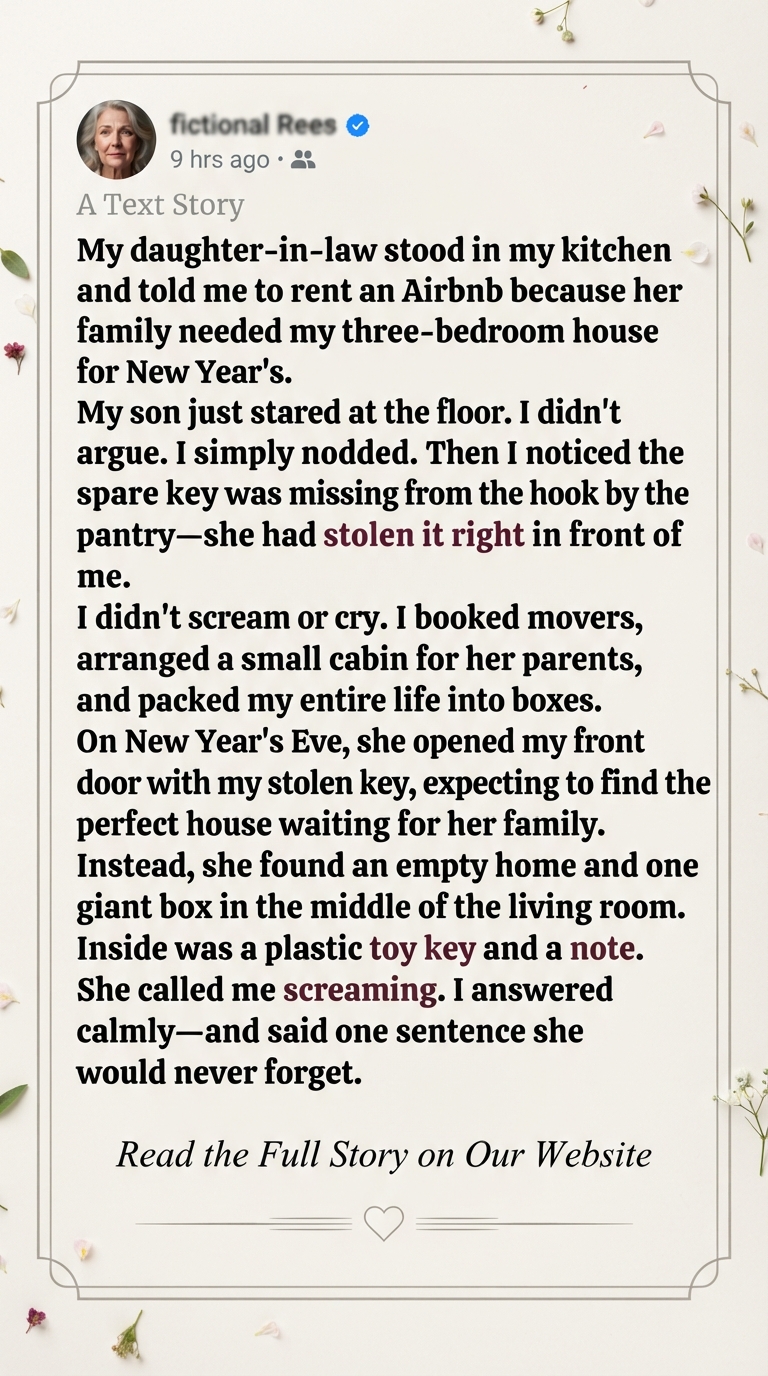
My daughter-in-law stood in my kitchen and told me to rent an Airbnb because her family needed my three-bedroom house for New Year’s.
Not asked.
Told.
She stood beside the refrigerator with her arms folded while my son stared at the floor.
“We’ve got twelve people coming,” Jenna said. “My parents, my brother, his wife, their kids… there’s just no way everyone can stay at our place.”
I looked at my son.
“Mark?”
He wouldn’t meet my eyes.
“Mom, it’s only for a few days.”
I looked around my kitchen.
The kitchen I had remodeled after my husband died.
The kitchen where my son had eaten cereal before school.
The kitchen where I’d spent twenty-seven Christmases and eighteen New Year’s Eves.
And now my daughter-in-law was telling me to leave it.
“Where exactly am I supposed to go?”
Jenna shrugged.
“There’s an Airbnb downtown. You can get something for yourself.”
I almost laughed.
“It’s my house.”
“I know.”
“Then why are you telling me to leave?”
She sighed like I was being difficult.
“Because family is coming.”
I looked at Mark again.
He finally whispered:
“Mom, please don’t make this a thing.”
That sentence told me everything.
It wasn’t about the holidays.
It was about entitlement.
They believed that because I was his mother, my house was automatically available to them.
I nodded.
“Okay.”
Jenna blinked.
“Okay?”
“Yes.”
Her face relaxed.
“Thank you.”
She smiled as though she’d just won an argument.
I walked toward the pantry.
That’s when I noticed something.
The spare key wasn’t on the hook.
I had kept that key in the same place for eleven years.
Behind the pantry door.
On a small brass hook.
It was gone.
I looked at Jenna.
“Where’s the spare key?”
She hesitated.
Then she smiled.
“Oh. I took it.”
“You took it?”
“For New Year’s.”
“You didn’t ask.”
“I knew you’d say yes.”
I stared at her.
She actually believed that explained everything.
I looked at my son.
“You knew?”
He nodded.
“Mom, Jenna just wanted to make sure we could get in if you’re not here.”
I slowly nodded.
“Right.”
I didn’t scream.
I didn’t cry.
I didn’t tell them what I was thinking.
I simply said:
“Enjoy New Year’s.”
Then I walked upstairs.
I closed my bedroom door.
And I started packing.
Not a suitcase.
Everything.
I called a moving company.
Then another.
I called my attorney.
Then my insurance company.
Then the storage company.
By midnight, I had made a decision.
I wasn’t renting an Airbnb.
I was leaving.
Permanently.
The house was too full of memories to remain a battleground.
Two days later, movers arrived.
Jenna texted me.
Don’t forget to leave the Wi-Fi password.
I stared at the message.
Then I laughed.
She still thought I was preparing the house for her.
I packed my mother’s china.
My husband’s photographs.
My son’s childhood trophies.
The quilt my grandmother had made.
Every photograph.
Every piece of furniture that mattered to me.
I left behind only what was permanently attached to the house.
And one box.
I arranged for my belongings to be moved into a small cabin I had rented outside town.
It wasn’t luxurious.
It wasn’t large.
But it was mine.
I also made one phone call to a real-estate attorney.
The house wasn’t going to my son.
Not now.
Not ever.
I wasn’t going to punish him.
I was simply going to stop allowing my generosity to be treated like ownership.
On New Year’s Eve, I stayed in my little cabin.
There was snow outside.
I made tea.
I put on an old movie.
And for the first time in years, I wasn’t worrying about whether everyone else was comfortable.
At 8:43 p.m., my phone rang.
Jenna.
I ignored it.
She called again.
Then again.
Finally, I answered.
“Hello?”
Her voice was furious.
“Where are you?”
“At the cabin.”
“What cabin?”
“The one I rented.”
“Why?”
I smiled.
“You told me to.”
She went silent.
Then:
“We’re at the house.”
“I know.”
“The house is empty.”
“Yes.”
“You moved everything?”
“Yes.”
She started shouting.
“Where is the furniture?”
“Somewhere safe.”
“Where are the Christmas decorations?”
“Packed.”
“Where’s the TV?”
“Gone.”
“You can’t do this!”
I looked out the window.
“It’s my house.”
“You said we could use it!”
“I said okay.”
“You knew what we meant!”
“Yes.”
She screamed:
“My family is standing in an EMPTY HOUSE!”
I smiled.
“I imagine that’s uncomfortable.”
Then she said something that made me laugh.
“You ruined our New Year’s!”
“No, Jenna.”
I looked around my little cabin.
“You tried to take mine.”
Silence.
Then I heard my son in the background.
“Mom?”
“Hi, Mark.”
“Why did you move everything?”
“Because your wife told me to leave my own home.”
“We didn’t mean permanently.”
“You took my spare key.”
He didn’t answer.
I continued.
“You didn’t ask for permission to use my house. You assumed it.”
Then Jenna came back on the phone.
“You’re being ridiculous!”
I let her finish.
Then I said the sentence she would never forget.
“You didn’t need my house for New Year’s—you needed my permission, and you took my key because you knew you didn’t have it.”
Silence.
Complete silence.
Then she hung up.
I thought that was the end.
It wasn’t.
Twenty minutes later, Mark called.
“Mom.”
“Yes?”
“Can we talk?”
“We’re talking.”
“I messed up.”
“Yes.”
“I should’ve stopped her.”
“Yes.”
“I didn’t think she’d actually take the key.”
I looked down at my tea.
“You watched her take it.”
“I know.”
“And you said nothing.”
“I know.”
His voice broke.
“Are you really never coming back?”
I thought about that.
“I’ll come back when I choose to.”
“To the house?”
“No.”
“To visit?”
“Maybe.”
He was quiet.
Then he asked:
“Are you selling it?”
I didn’t answer immediately.
“Why?”
“Because… because it’s our family home.”
I smiled sadly.
“No, Mark.”
“It was your childhood home.”
“Yes.”
“But it’s still our family’s home.”
“No.”
I heard the hurt in his voice.
“It’s my home.”
He finally understood.
The next morning, I received an email from Jenna.
It wasn’t an apology.
It was an accusation.
She claimed I had embarrassed her family.
She said my behavior was selfish.
She said I had “weaponized” the house.
I forwarded the email to my attorney.
Then I wrote one sentence back.
Please do not use the word “our” when referring to property you never owned.
I didn’t hear from her for two weeks.
Then Mark came to the cabin alone.
He sat on the porch for almost an hour before speaking.
“Mom?”
“Yes?”
“I told Jenna she wasn’t allowed to use the house without your permission.”
I nodded.
“She says you ruined everything.”
“I didn’t.”
“I know.”
He looked at the ground.
“She also says you hate her.”
“I don’t hate her.”
“Then what do you feel?”
I thought about it.
“Disappointed.”
He nodded.
“That hurts her more.”
“It should.”
He looked at me.
“Can we fix this?”
“Maybe.”
“How?”
I looked directly at him.
“You stop confusing access with entitlement.”
He nodded.
“And you stop letting your wife make decisions about things that belong to other people.”
Another nod.
“And if you ever want something from me, you ask.”
“I will.”
I believed him.
Not completely.
But enough.
A month later, I went back to the house.
It looked strangely different without my things.
Empty walls.
Empty rooms.
No photographs.
No furniture.
No memories sitting on shelves.
Just space.
I walked into the living room.
And there it was.
The box.
The one I had left behind.
The plastic toy key was still inside.
And beneath it was my note.
Jenna had left it there.
She hadn’t thrown it away.
Maybe she couldn’t.
I picked it up.
On the note, I had written:
A key opens a door. It doesn’t give you ownership of what’s behind it.
I stood there for a long time.
Then I placed the toy key in a drawer.
I didn’t need it anymore.
A year later, I sold the house.
Not because Jenna had won.
Because I had finally stopped treating the house as a test of whether my family loved me.
The sale gave me enough money to buy a smaller home near the lake.
A place with two bedrooms.
A little garden.
A porch.
And one very important rule:
No one gets a key without asking.
I invited Mark over for the first New Year’s Eve.
He brought a bottle of champagne.
He stood at my front door.
Then he stopped.
“Mom?”
“Yes?”
“Can I come in?”
I smiled.
“Now you’re learning.”
He laughed.
I opened the door.
And for the first time in years, he didn’t walk into my home like he was entitled to be there.
He walked in as my son.
And somehow, that felt like getting my house back wasn’t really about a house at all.
It was about finally teaching the people I loved the difference between being family and being entitled to someone else’s life.