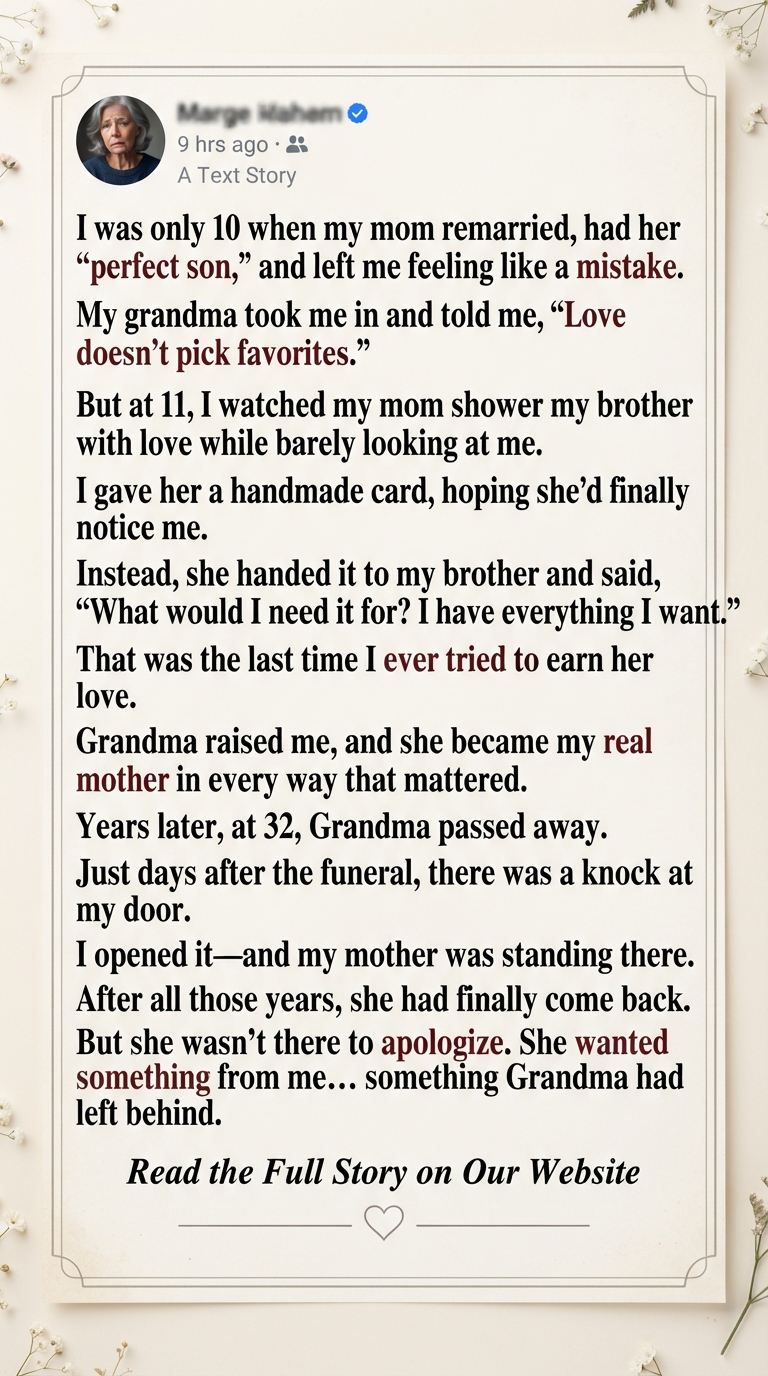
I was only ten when my mother remarried, had her “perfect son,” and slowly made me feel like a mistake.
My grandmother was the one who noticed.
She took me into her home and told me something I’ll never forget.
“Love doesn’t pick favorites.”
At eleven, I still believed my mother might change.
I believed that if I tried hard enough, maybe she’d look at me the way she looked at my little brother.
So I made her a card.
It was construction paper folded in half, covered in crooked hearts and little flowers I’d drawn with crayons.
Inside, I’d written:
I love you, Mom.
I waited until my brother was sitting beside her.
Then I handed it to her.
She barely glanced at it.
“What would I need it for?” she said.
Then she handed the card to my brother.
“I have everything I want.”
My brother laughed.
I didn’t.
I took the card back and walked upstairs.
That was the last time I ever tried to earn my mother’s love.
Grandma raised me after that.
She packed my lunches.
She sat in the front row at school plays.
She helped me with algebra.
She taught me how to drive.
She was there when I graduated.
When I got my first apartment, she gave me an old wooden kitchen table that had belonged to her mother.
“You’ll need a place to eat,” she said.
When I got my first real job, she took me out for dinner.
When I got my heart broken, she didn’t tell me there were plenty of other people.
She simply made tea and said,
“Some people leave because they were never meant to stay.”
I never told her how much I needed to hear that.
Because Grandma already knew.
She always knew.
My mother, meanwhile, built her perfect little family.
She posted photographs of my brother everywhere.
His birthdays.
His graduations.
His college acceptance.
His first apartment.
His wedding.
I was never completely erased.
That would’ve been easier.
Instead, I was occasionally mentioned.
“Your sister lives across town.”
“Your sister is doing fine.”
“Your sister has always been independent.”
As if abandoning me had somehow become proof that I was strong.
I stopped expecting anything from her.
And eventually, I stopped being angry.
Then, when I was thirty-two, Grandma died.
She had been sick for several months, but I still wasn’t prepared.
She died in her sleep.
Peacefully.
With me holding her hand.
At her funeral, I stood beside the casket and remembered being eleven years old, sitting on the floor of her kitchen while she brushed my hair.
“You don’t have to make people love you,” she’d told me.
I had asked why.
“Because the right people already will.”
I cried harder at the funeral than I had cried since I was a child.
Three days later, there was a knock at my door.
I wasn’t expecting anyone.
When I opened it, my mother was standing there.
She looked older.
Tired.
But not sad enough.
She didn’t hug me.
She didn’t say she was sorry.
She didn’t even say she missed Grandma.
She looked past me into the house.
Then she said,
“We need to talk about what your grandmother left.”
I stared at her.
“Excuse me?”
“The estate.”
My stomach tightened.
“What about it?”
“She told me she was leaving something to me.”
I almost laughed.
“She didn’t mention you.”
My mother frowned.
“I’m still her daughter.”
“So was I.”
She went quiet.
Then she said,
“I know she had money.”
There it was.
Not grief.
Not regret.
Money.
I stepped away from the doorway.
“What exactly do you want?”
“The house.”
I stared at her.
“You want Grandma’s house?”
“She promised it would stay in the family.”
“It is in the family.”
“It’s supposed to be mine.”
I shook my head.
“No.”
Her face hardened.
“You don’t understand how complicated the estate is.”
“I understand perfectly.”
She stepped closer.
“You were always jealous of your brother.”
I actually laughed.
“No. I was eleven.”
“What does that mean?”
“It means I wasn’t jealous of him.”
I looked directly at her.
“I was waiting for my mother.”
She didn’t answer.
I closed the door.
Two weeks later, the attorney called.
“Your grandmother left a letter for you.”
I drove to his office.
He handed me a thick envelope.
My name was written on it in Grandma’s handwriting.
I couldn’t open it at first.
I just traced the letters with my finger.
Finally, I opened it.
Inside was a short letter.
My hands shook as I read.
My darling girl,
If you’re reading this, then I am no longer there to tell you what I should have told you every day.
You were never a mistake.
I stopped reading.
Tears blurred the page.
Your mother gave birth to you. But motherhood is not simply giving birth. It is showing up. It is protecting. It is listening. It is loving a child when nobody is watching.
I watched you grow up believing you had to earn love. I hope I taught you better.
I pressed the letter against my chest.
Then I continued.
I am leaving you my house, my savings, and the family trust I created years ago. Not because you are my favorite.
But because you are my granddaughter, and because I trust you to understand that an inheritance is not a reward. It is a responsibility.
There was another page.
The attorney looked at me.
“You should read the rest.”
I turned it over.
And my heart stopped.
There is one more thing.
I know your mother will come.
I looked up.
The attorney nodded.
“She knew?”
“Yes.”
I continued.
She will probably tell you that she deserves something because she is my daughter.
If she does, remember this:
Blood can explain where someone came from. It does not determine how they treated you.
You don’t owe anyone access to what I worked my whole life to protect for you.
But if your mother ever comes to you because she genuinely needs help, help her if you can do so without harming yourself.
Kindness is not the same as surrender.
That sentence stayed with me.
Kindness is not the same as surrender.
The attorney explained that Grandma had placed the property and much of her financial assets into a properly documented estate plan years earlier.
My mother had no automatic right to the house simply because she was Grandma’s daughter.
And Grandma had made her wishes extremely clear.
My mother eventually challenged the estate.
She claimed Grandma had been influenced.
She claimed I had manipulated her.
She even suggested that Grandma hadn’t been mentally competent when she updated her estate plan.
But Grandma had planned carefully.
There were medical records.
Attorney notes.
Witness statements.
Years of financial documents.
And a handwritten journal Grandma had kept.
In one entry, written five years before her death, she had documented a conversation with my mother.
My mother had asked why Grandma spent so much time raising me.
Grandma’s response was simple:
“Because someone had to.”
My mother had written back:
“You’re ruining her. She’ll never learn to stand on her own.”
Grandma wrote underneath:
“Then why has she become the most responsible adult in this family?”
The challenge eventually collapsed.
The house became mine.
But I didn’t sell it.
I couldn’t.
I turned Grandma’s old kitchen into my favorite room in the house.
I kept the wooden table she had given me.
And I framed the letter.
A year passed.
Then my mother called.
I almost didn’t answer.
“Hello?”
There was a long silence.
Then she said,
“Can I see you?”
I almost said no.
Instead, I said,
“Why?”
“I want to apologize.”
Those were words I had waited twenty-one years to hear.
But when she came over, I realized something.
I didn’t need them anymore.
She sat at Grandma’s kitchen table.
The same table where Grandma had helped me with homework.
My mother looked around.
“She really left everything to you.”
“Yes.”
“She never forgave me.”
I shook my head.
“She didn’t spend her life hating you.”
My mother looked confused.
“She just stopped waiting for you.”
That broke something in her.
She began crying.
“I didn’t know how to be your mother.”
I looked at her.
“You were my mother.”
“I know.”
“You just weren’t there.”
She nodded.
“I was selfish.”
“Yes.”
“I thought your brother needed me more.”
“He did.”
She looked surprised.
“You don’t hate him?”
“No.”
“Why?”
“Because he was a child.”
She covered her face.
“I treated you like you were the problem.”
“Yes.”
“I thought you’d come back someday.”
I looked at her.
“I did.”
She lowered her hands.
“When?”
“The day Grandma died.”
Her eyes filled with tears.
“You were already gone by then.”
She nodded.
“I know.”
For the first time, I felt something inside me finally become quiet.
Not forgiveness.
Not yet.
Something else.
Acceptance.
My mother hadn’t come back because I had finally become worthy of her love.
She had come back because she finally understood what she had lost.
And I didn’t need to become a different person to deserve it.
I had never needed to.
Grandma had taught me that when I was eleven.
Years later, I finally understood.
My mother gave birth to me.
But Grandma gave me a life.
She taught me that love wasn’t something you begged for.
It wasn’t something you earned by being perfect.
And it certainly wasn’t something another person could take away because they preferred someone else.
Sometimes the family you’re born into isn’t the family that saves you.
Sometimes the person who becomes your mother is the woman who simply stays.
And when I looked around Grandma’s house that night, I realized she had left me much more than money.
She had left me proof.
Proof that I had been loved all along.
I just hadn’t been loved by the person I spent my childhood begging to love me.
And somehow, that no longer hurt the way it used to.
Because Grandma had been right.
Love doesn’t pick favorites.
Real love simply shows up.
And Grandma had shown up for me every single time.