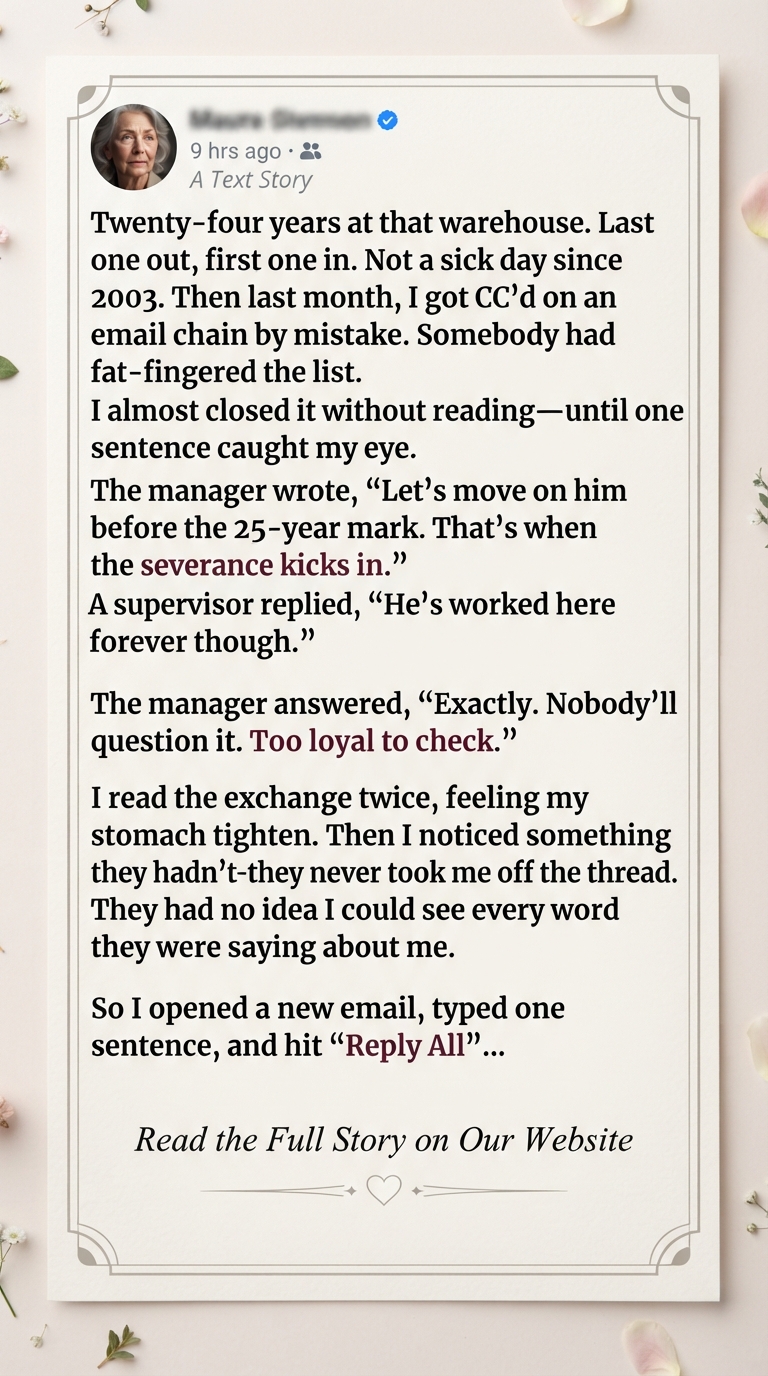
They Tried to Fire Me Before My 25-Year Anniversary—Then I Hit Reply All
Twenty-four years at that warehouse.
Last one out.
First one in.
Not a sick day since 2003.
I knew every loading dock, every inventory aisle, every broken pallet jack, and every machine that made a strange noise five seconds before it failed.
I had trained people who eventually became supervisors.
I had watched managers come and go.
I had stayed.
Then last month, I got CC’d on an email chain by mistake.
Somebody had fat-fingered the list.
I almost closed it without reading.
Until one sentence caught my eye.
The manager wrote:
“Let’s move on him before the 25-year mark. That’s when the severance kicks in.”
A supervisor replied:
“He’s worked here forever though.”
The manager answered:
“Exactly. Nobody’ll question it. Too loyal to check.”
I read the exchange twice.
My stomach tightened.
Then I noticed something they hadn’t.
They never took me off the thread.
They had no idea I could see every word they were saying about me.
I didn’t respond immediately.
I didn’t call HR.
I didn’t confront the manager.
I didn’t even tell my wife.
Instead, I opened a new email.
Typed one sentence.
And hit Reply All.
“Since we’re discussing my termination, I assume you won’t mind if I forward this entire conversation to HR and our legal department.”
Then I clicked Send.
For thirty seconds, nothing happened.
Then my screen exploded.
Manager: Please delete that email.
Supervisor: Wait.
Manager: Call me immediately.
Manager: This was an internal discussion.
Manager: Do not forward anything.
I stared at the screen.
Then another message appeared.
From HR.
“Please do not delete or alter any correspondence related to this matter. We would like to speak with you privately.”
That was when I knew this wasn’t going to disappear.
I printed the entire thread.
Not because I wanted revenge.
Because I had spent twenty-four years learning something important.
When people think you’re too loyal to protect yourself, documentation becomes your best friend.
The next morning, I walked into HR.
The director closed the door.
There were two other people in the room.
She gestured toward the chair.
“Please sit down.”
I sat.
She placed a folder on the table.
“We need to discuss the email you received.”
“I’d like to hear what you have to say.”
She took a breath.
“The company had been discussing your position.”
“I know.”
“More specifically, there was a proposal to terminate your employment before your twenty-fifth anniversary.”
I nodded.
“Because of the severance provision?”
She looked surprised.
“Yes.”
I slid a copy of the employee handbook across the table.
“I read the policy last night.”
The severance policy was clear.
Employees who completed twenty-five years of continuous service received a substantially larger separation benefit.
I had twenty-four years and eleven months.
They wanted me gone before the date.
But there was another problem.
The manager had written:
“Nobody’ll question it.”
I pointed at the sentence.
“Were you aware of this?”
The HR director shook her head.
“No.”
“Were you aware that my manager had been discussing termination without involving HR?”
“No.”
“Were you aware that my performance reviews have been consistently positive?”
She opened the folder.
“Yes.”
She turned several pages.
“Actually, your most recent review rated you above expectations.”
I almost laughed.
“So I’m an above-expectations employee being targeted because I’m close to qualifying for a benefit?”
She didn’t answer.
She didn’t have to.
The company began an internal investigation.
My manager was placed on administrative leave.
The supervisor who had objected to the plan voluntarily gave HR additional emails.
Those emails revealed the manager had been doing something similar to other long-term employees.
Not everyone had been terminated.
Some had been pushed into resigning.
Some had been transferred into positions with impossible schedules.
One employee had been told his role was “being eliminated” two weeks before his twenty-fifth anniversary.
Another had accepted a reduced settlement without realizing what the employee handbook provided.
The investigation found a pattern.
The manager had been treating long-service employees as expenses rather than people.
And he believed most of them wouldn’t fight back.
Then the company discovered something even worse.
He had been keeping his own spreadsheet.
It listed employees approaching major benefit milestones.
Beside each name were notes.
25 years — review.
30 years — possible restructuring.
Retirement eligible — monitor.
My name was highlighted.
Beside it was one word.
“Loyal.”
I stared at that word for a long time.
Not “reliable.”
Not “valuable.”
Not “experienced.”
Loyal.
As though loyalty meant stupidity.
As though staying somewhere for twenty-four years meant I had surrendered the right to protect myself.
The investigation lasted six weeks.
During that time, I kept doing my job.
I arrived at 5:42 every morning.
I checked inventory.
I trained the new hires.
I worked the same loading dock I had worked for years.
But something had changed.
I no longer believed that being a good employee meant keeping my head down.
I documented everything.
I saved copies of my performance reviews.
I reviewed my benefits.
I learned exactly what my employment agreement said.
And I stopped assuming someone else would look out for me.
Three days before my twenty-fifth anniversary, HR called me back into the office.
The director smiled.
“I have good news.”
I waited.
“The company has completed its investigation.”
“And?”
“Your manager is no longer employed here.”
I nodded.
“And your employment record remains in good standing.”
She slid a document toward me.
“Your twenty-fifth anniversary benefits will remain fully intact.”
I looked at the document.
Then she added something unexpected.
“The company would also like to recognize your service.”
I raised an eyebrow.
“What does that mean?”
“Twenty-five years. We’d like you to choose.”
“Choose what?”
“A paid extended leave, a promotion into operations training, or a separation package that includes the full twenty-five-year benefit.”
I stared at her.
For the first time in weeks, I felt calm.
I had spent twenty-four years thinking my value came from showing up.
But that wasn’t what twenty-five years had taught me.
It had taught me that loyalty should never mean surrendering your dignity.
I chose the separation package.
Not because I was angry.
Because I was ready.
I wanted to leave on my own terms.
My final day arrived on a Friday.
The warehouse held a small lunch for me.
People I had trained came.
One former supervisor drove two hours to attend.
The maintenance crew gave me a framed photograph of the loading dock.
Someone had written on the back:
“You taught us how to keep things moving.”
I kept that.
Then, just before I left, the new operations director shook my hand.
“I read the email chain.”
I smiled.
“So did half the company.”
He laughed.
Then he said,
“You know what impressed me?”
“What?”
“You didn’t threaten anyone.”
“No.”
“You just made sure everyone could see what they had written.”
I nodded.
“Sometimes people tell the truth when they think you’re not listening.”
I walked out of the warehouse at 4:17 p.m.
For the first time in twenty-five years, I wasn’t going back Monday morning.
And strangely, I wasn’t sad.
I was relieved.
I had spent years believing loyalty meant staying no matter what.
Now I understood something different.
Loyalty is something you give.
Respect is something you deserve.
And if a company is willing to quietly push you out because you’ve earned what they promised you, you’re allowed to protect yourself.
I didn’t ruin their plan.
I simply refused to let them make my future without me.
And the email they accidentally sent me?
I still have it.
Printed.
Framed.
Hanging above my desk.
Not as a reminder of what they tried to take from me.
As a reminder that sometimes the most powerful thing you can do is simply read the fine print—and make sure everyone sees the truth.