I Opened a Wall Because of a Terrible Smell—What I Found Had Been Hidden for Years
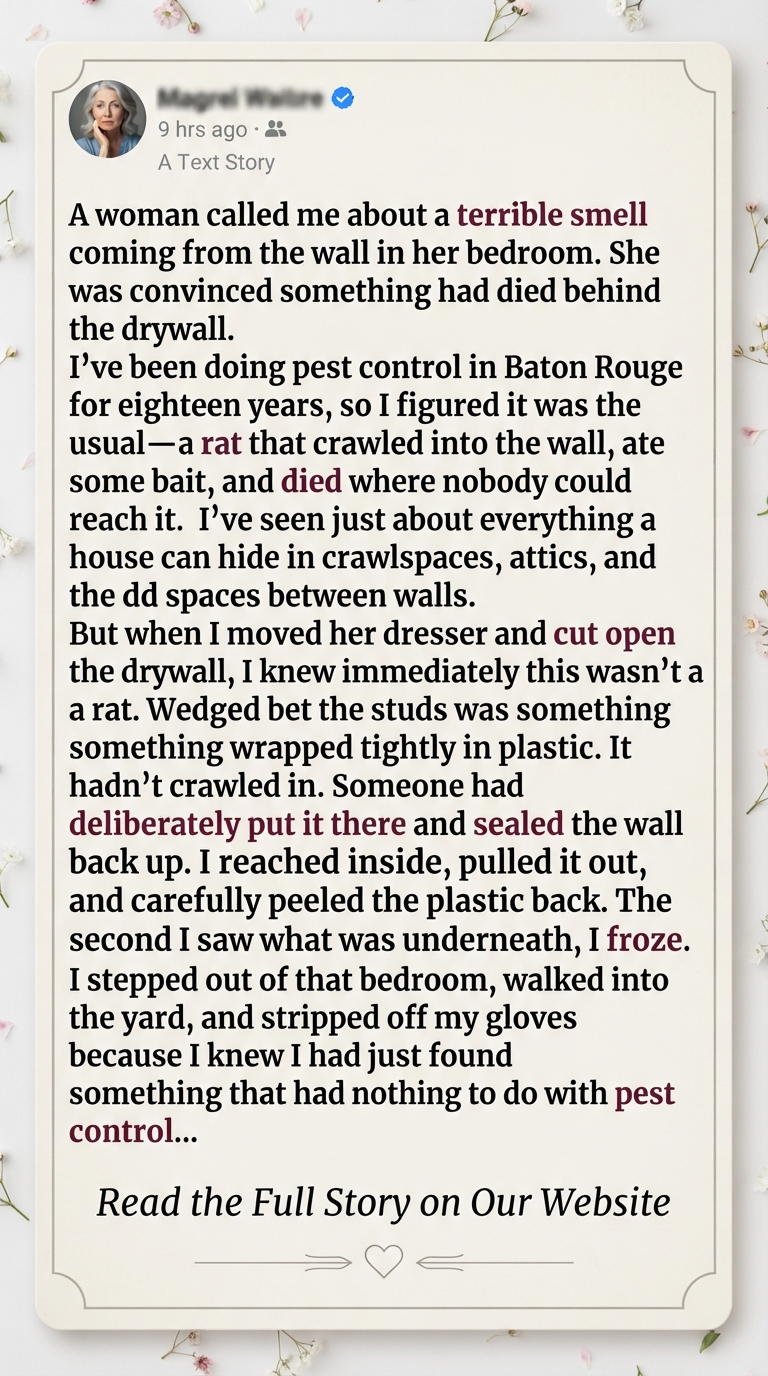
A woman called me about a terrible smell coming from the wall in her bedroom.
She was convinced something had died behind the drywall.
I had been doing pest control in Baton Rouge for eighteen years, so I figured it was the usual—a rat that crawled into the wall, ate some bait, and died where nobody could reach it.
I had seen just about everything a house could hide in crawlspaces, attics, and the dead spaces between walls.
But when I moved her dresser and cut open the drywall, I knew immediately this wasn’t a rat.
Wedged between the studs was something wrapped tightly in plastic.
It hadn’t crawled in.
Someone had deliberately put it there and sealed the wall back up.
I reached inside, pulled it out, and carefully peeled the plastic back.
The second I saw what was underneath, I froze.
I stepped out of that bedroom, walked into the yard, and stripped off my gloves.
Because I knew I had just found something that had nothing to do with pest control.
Inside the plastic was a small metal box.
Not a safe.
Not a toolbox.
A weathered document box.
There was no smell coming from it.
The smell was coming from something else farther inside the wall.
But the box immediately caught my attention.
The homeowner, a woman named Denise, came outside.
“What is it?”
“I don’t know yet.”
She looked at my face.
“You look scared.”
“I’m not scared.”
I paused.
“I’m confused.”
I had seen enough strange things in eighteen years to know the difference.
I carried the box to my truck and called her back outside.
Before opening it, I told her we should document everything.
She agreed.
I photographed the wall.
The opening.
The plastic.
The box.
Then I carefully opened the lid.
Inside were papers.
Dozens of them.
Old photographs.
A child’s hospital bracelet.
A faded newspaper clipping.
And several envelopes.
Denise picked up the first photograph.
She stared at it.
Then dropped it.
“That’s my father.”
I looked at her.
“You’re sure?”
She nodded.
Her father had died eleven years earlier.
According to Denise, he had worked construction most of his life.
He had owned the house before she inherited it.
He had also been a private man.
Very private.
She picked up another photograph.
It showed her father standing beside a young woman.
Denise frowned.
“Who’s that?”
I turned the photograph over.
There was handwriting on the back.
“May 1979.”
Nothing else.
Then she opened one of the envelopes.
Inside was a letter.
She read the first few lines.
Her face changed.
“What?”
She looked at me.
“My father wrote this.”
“What does it say?”
She shook her head.
“I don’t understand.”
The letter mentioned a woman named Elaine.
It said she had left Baton Rouge in 1980.
It also said:
“I promised her I would keep the truth safe until you were old enough.”
Denise stared at the sentence.
“Old enough for what?”
There was no answer in that letter.
But the next envelope contained one.
Inside was an old birth certificate.
The mother’s name was Elaine Carter.
The father’s name was blank.
The child’s name was Denise.
She stopped breathing.
“No.”
She looked at me.
“No, that’s impossible.”
I stepped back.
This wasn’t my business anymore.
She called her aunt.
The oldest surviving member of the family.
When Denise asked about Elaine, there was a long silence on the phone.
Then her aunt said,
“Where did you find that name?”
Denise told her about the wall.
Her aunt began crying.
And finally, after forty-six years, she told Denise the truth.
Elaine was Denise’s biological mother.
Not her father’s wife.
Not a relative.
Her mother.
Denise had been told her entire life that her mother died shortly after giving birth.
That wasn’t true.
Elaine had survived.
She had left Louisiana shortly after Denise was born.
According to the letters, she had been trying to escape an abusive relationship and believed that taking an infant across state lines would put both of them at greater risk.
So she made an impossible decision.
She left Denise with her father.
She promised she would return when it was safe.
But she never did.
For decades, Denise believed she had been abandoned by a woman who didn’t love her.
The box told a different story.
There were letters Elaine had written over the years.
Birthday letters.
Christmas letters.
Letters addressed to Denise at ages five, ten, fifteen, and eighteen.
None had ever been delivered.
Her father had kept them.
The first letter said:
“I hope one day you understand that leaving you was not the same as leaving you behind.”
Denise sat down on the porch.
She began crying.
“I spent my whole life hating her.”
She held the letter against her chest.
“I thought she didn’t want me.”
There was one final envelope.
It was addressed:
“For Denise, when I am finally brave enough.”
But her father had never given it to her.
Inside was a photograph.
Elaine was holding a newborn baby.
Denise.
On the back, Elaine had written:
“I will come back for you.”
She never did.
But the letters explained why.
Elaine had eventually remarried.
She had another family.
She had spent years trying to locate Denise.
Then, according to the final letter, she had become seriously ill.
She wrote:
“I don’t know if I will ever have the courage to knock on that door.”
She never got the chance.
She died in 2004.
Denise had never known.
Her father had kept everything hidden.
Not in a safe.
Not in a filing cabinet.
Inside the wall.
The wall Denise had slept beside for most of her life.
But there was still one question.
Why had the box been sealed there?
The answer was in her father’s final letter.
He wrote that he had intended to tell Denise everything after Elaine died.
But every time he tried, he became afraid.
He feared Denise would hate him for keeping the truth.
He feared she would leave him.
So he made one terrible decision.
He hid the evidence.
He told himself he would explain someday.
Someday never came.
The smell that brought me to that bedroom had nothing to do with the box.
It turned out to be an old plumbing leak behind another section of the wall.
But without that smell, nobody would have opened the wall.
Nobody would have moved the dresser.
Nobody would have found the box.
Denise spent the next several months piecing together the life her father had hidden.
She found Elaine’s grave.
She contacted relatives.
She found an old address in Mississippi.
And eventually, she found something else.
A photograph of Elaine from the year before she died.
Denise had the photograph framed.
She placed it beside a photograph of her father.
For years, she had believed one parent had abandoned her and the other had protected her.
The truth was more complicated.
Her mother had loved her from a distance.
Her father had loved her in a way that became tangled with fear and secrecy.
Neither decision had been simple.
Neither had been painless.
But now Denise finally knew the truth.
A few months later, she called me.
She said she wanted to thank me.
I told her I hadn’t done anything special.
“I was just looking for the source of a smell.”
She laughed.
“No.”
Then she said something I’ll never forget.
“You opened a wall, but you gave me back my mother.”
I still think about that whenever I cut into drywall.
Most walls are just walls.
Wood.
Insulation.
Wiring.
Pipes.
But sometimes a house holds something much more important.
A secret.
A photograph.
A letter someone was too afraid to deliver.
Or an entire piece of someone’s life that was waiting for the right person to finally uncover it.
I went to that house expecting to find a dead rat.
Instead, I found a story that had been trapped inside a wall for nearly fifty years.
And when I left that morning, I realized something I hadn’t understood before:
Sometimes the things people hide aren’t buried because they’re worthless.
They’re buried because they’re too painful to face.
And sometimes, finding them is the first step toward finally healing.