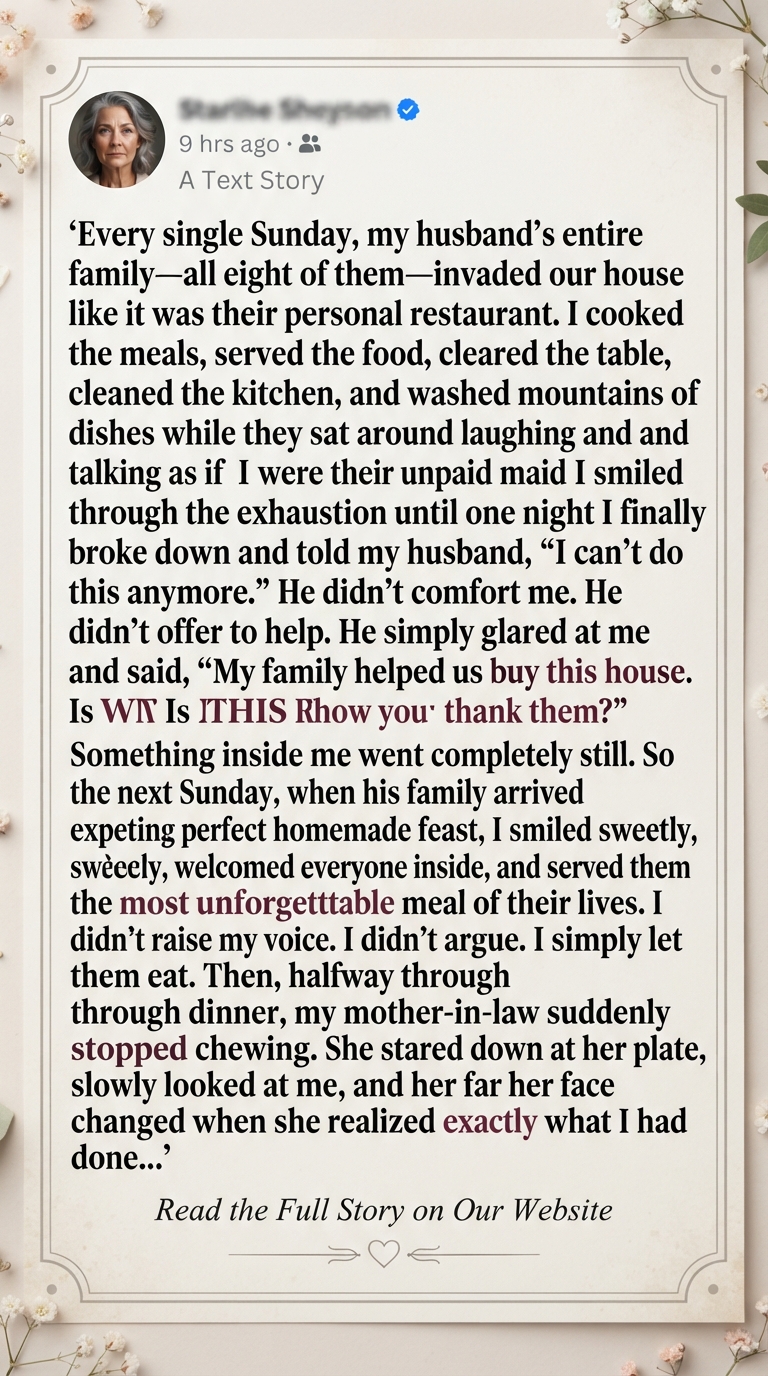
Every Sunday, my husband’s entire family—eight people in total—showed up at our house like it was their personal restaurant.
And every Sunday, I cooked.
I planned the menu.
I bought the groceries.
I spent hours preparing everything.
Then I served the food, cleared the plates, cleaned the kitchen, and washed mountains of dishes while everyone else sat around the table laughing and talking.
Nobody asked if I was tired.
Nobody offered to help.
They simply expected it.
At first, I told myself it was family.
Then it became a routine.
Then it became an obligation.
And eventually, it became something everyone believed I owed them.
One Sunday night, after everyone had finally left, I stood alone in the kitchen staring at a sink overflowing with dishes.
My hands were sore.
My back hurt.
I hadn’t even eaten a full meal.
I walked into the living room where my husband, Mark, was watching television.
“I can’t do this anymore.”
He didn’t look away from the screen.
“Do what?”
“Every Sunday. Your entire family comes here, and I spend the whole day cooking and cleaning for everyone.”
He finally looked at me.
Instead of sympathy, I saw irritation.
Then he said something I’ll never forget.
“My family helped us buy this house.”
I stared at him.
“So?”
His expression hardened.
“Is this how you thank them?”
Something inside me went completely still.
I didn’t argue.
I didn’t cry.
I simply said:
“Okay.”
Mark thought the conversation was over.
He had no idea it had just begun.
The following week, I made one small change.
I didn’t grocery shop.
I didn’t spend Saturday preparing food.
I didn’t spend Sunday morning cooking.
Instead, I went to the grocery store and bought eight identical frozen dinners.
Nothing fancy.
Nothing homemade.
Nothing requiring hours of preparation.
Then I set the table.
At noon, the doorbell rang.
Mark’s mother walked in first.
Behind her came his two sisters, his brother, his aunt, his uncle, and two cousins.
Eight people.
Right on schedule.
They walked into the dining room expecting the usual feast.
His mother looked at the table.
Then she looked at me.
“Is that dinner?”
I smiled.
“Yes.”
Everyone sat down.
Nobody said anything.
For once, I sat with them.
I didn’t serve anyone.
I didn’t jump up to refill glasses.
I didn’t clear a single plate.
Mark looked at me.
“What’s going on?”
“You said your family helped us buy this house.”
I smiled.
“So I thought they could enjoy dinner without me working for them.”
His mother frowned.
“This isn’t what we usually have.”
“No,” I said. “It isn’t.”
Everyone began eating.
For several minutes, the only sound was forks against plates.
Then Mark’s mother suddenly stopped chewing.
She stared down at her plate.
Then she slowly looked at me.
Her face changed.
Because underneath the frozen dinner was a small card.
She picked it up.
On the front, I had written:
“What your Sunday dinner has cost me.”
Inside was a list.
Groceries.
Electricity.
Water.
Cleaning supplies.
And, most importantly, the number of hours I had spent preparing, serving, and cleaning for them over the previous year.
More than 300 hours.
His mother looked stunned.
Mark picked up his own card.
His sisters did too.
One of them whispered:
“Three hundred hours?”
I nodded.
“And that’s only the time I tracked.”
Mark looked uncomfortable.
“You made a list?”
“Yes.”
His mother put the card down.
“You’re making us feel guilty.”
I shook my head.
“No. I’m showing you what you couldn’t see because you never had to do it.”
The room went silent.
Then I said something I had rehearsed all week.
“I don’t mind having family over.”
I looked around the table.
“But family dinner means everyone participates.”
“If eight people come to my house, eight people can help.”
Mark’s mother looked at her son.
“Did you know she was doing all this?”
He didn’t answer.
She looked back at me.
Then something unexpected happened.
She stood up.
“I’ll do the dishes.”
I almost laughed.
“That’s okay.”
“No.”
She walked into the kitchen.
“I should have been doing them a long time ago.”
One by one, the others followed.
Mark stayed at the table.
For the first time since I had known him, he looked embarrassed.
Later that night, after everyone had gone home, he came into the kitchen.
“You really meant it.”
“Yes.”
“You were going to stop hosting us?”
“I wasn’t going to stop having family over.”
I dried my hands.
“I was going to stop being everyone’s unpaid staff.”
He looked down.
Then he said:
“I was wrong.”
It wasn’t enough to erase the years of resentment.
But it was the first time he had actually acknowledged it.
The next Sunday, his family came over again.
But this time, nobody arrived empty-handed.
His mother brought the main dish.
His sister brought dessert.
His brother brought drinks.
Two cousins helped set the table.
And after dinner, everyone helped clean.
I sat down with my husband and actually ate my meal while it was still hot.
For the first time, Sunday dinner felt like a family gathering instead of a shift at a restaurant.
I learned something that year.
Sometimes people don’t realize how much you’re doing for them because you’ve made it look effortless.
And the moment you stop doing everything silently, they finally see the work that was holding everything together.
I didn’t punish my husband’s family.
I didn’t scream at them.
I didn’t throw anyone out.
I simply stopped pretending that love meant doing everything alone.
And strangely enough, that was the Sunday our family finally started acting like a family.