THE BOY IN ROOM 4B
In 1985, I cleaned rooms on the night shift at County General.
I was 27 years old, recently divorced, and working two jobs to keep my little apartment and my daughter’s daycare paid for.
Hospital cleaning wasn’t glamorous.
Most nights, nobody noticed me.
But I didn’t mind.
I knew my work mattered.
There was one room, however, that I always took a little longer to clean.
Room 4B.
A 16-year-old boy had been lying there in a coma after a terrible car wreck.
His name was Daniel.
For three months, not a single visitor came.
No mother.
No father.
No friends.
No flowers.
No cards.
Nothing.
The nurses told me he’d been transferred between hospitals before the accident and that his family couldn’t be located.
Every night, I would enter his room with my mop and cleaning cart.
I’d wipe the floor.
Empty the trash.
Clean the windows.
Then I’d sit beside his bed for a few minutes.
I didn’t know why.
Maybe because I couldn’t stand the thought of someone being completely alone.
One night, I pulled a paperback from my bag.
It was an old Western.
I opened it.
“I’m going to read this to you,” I told him.
“You don’t have to listen.”
Of course, he couldn’t answer.
So I started reading.
The next night, I brought another book.
Then another.
Mostly old Westerns.
I read about cowboys, horses, dusty towns, gunfights, and men who always seemed to find their way home.
Sometimes I talked to him after I finished reading.
I told him about my daughter.
I told him about the annoying nurse who kept stealing my coffee.
I told him about my plans to someday quit cleaning hospitals.
He never moved.
But I kept talking.
For three months.
Then one morning, I walked into Room 4B.
The bed was empty.
I stopped.
I thought something had happened.
I found the nurse.
“Where’s Daniel?”
She checked the chart.
“Transferred.”
“Where?”
She shook her head.
“I don’t know.”
I asked again.
“Did he wake up?”
She didn’t know.
“Is he alive?”
She looked at me sadly.
“I don’t know.”
That was the last time I heard his name.
Life moved on.
My daughter grew up.
I remarried.
I eventually left hospital cleaning and worked in a school cafeteria.
Then my knees got bad.
By the time I was 67, I couldn’t stand for long periods anymore.
Forty years passed.
Then one afternoon, I received an invitation.
County General was celebrating its anniversary.
Former employees were invited.
I almost threw the invitation away.
Then I saw the hospital’s name.
I thought about Room 4B.
And I decided to go.
The anniversary dinner was held in a ballroom attached to the hospital.
There were hundreds of people.
Doctors.
Nurses.
Administrators.
Former employees.
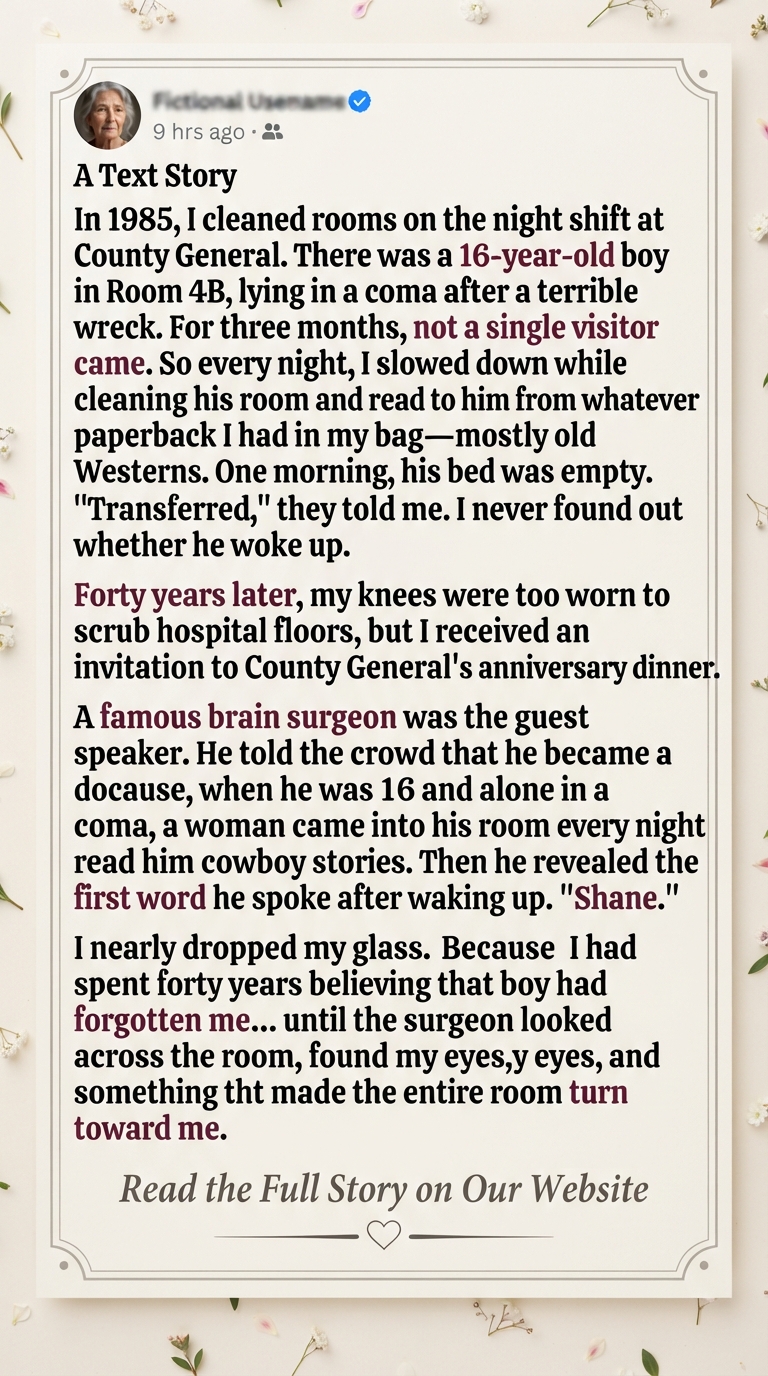
The guest speaker was a famous brain surgeon.
I’d seen him on television.
He was known for pioneering several complicated neurological procedures.
When he walked onto the stage, everyone applauded.
He smiled and adjusted the microphone.
Then he began telling a story.
“When I was sixteen,” he said, “I was involved in a terrible car accident.”
My glass stopped halfway to my mouth.
“I spent three months in a coma.”
My heart began pounding.
The room disappeared around me.
I stared at him.
He continued.
“I had no visitors.”
I whispered:
“No.”
He talked about waking up in a hospital.
He said his parents had died years earlier.
His relatives couldn’t be located.
He had been completely alone.
Then he smiled.
“But someone came into my room every night.”
I couldn’t breathe.
“A woman who worked in the hospital.”
He paused.
“She wasn’t a doctor.”
“She wasn’t a nurse.”
“She cleaned my room.”
My hands started shaking.
“She would sit beside my bed and read to me.”
The surgeon laughed softly.
“Mostly cowboy stories.”
Someone at my table gasped.
The surgeon continued.
“I don’t know why she did it.”
“I couldn’t respond.”
“I couldn’t even open my eyes.”
“But somehow, I heard her.”
My vision blurred.
He reached into his pocket.
Then he pulled out a small, battered paperback.
An old Western.
The cover was faded.
The pages were yellow.
“I kept this book for forty years.”
He opened it.
“This was the first book she ever read to me.”
I recognized it.
I had bought it from a secondhand store for fifty cents.
I knew that book.
I had read it to Daniel more than twenty times.
The surgeon looked down.
Then he said:
“When I woke up, the doctors asked me if I knew where I was.”
He smiled.
“I couldn’t speak.”
“They asked me my name.”
“Nothing.”
“They asked me who they should call.”
“Nothing.”
Then he said:
“But there was one word I could say.”
The ballroom became completely silent.
The surgeon looked at the audience.
“Shane.”
I nearly dropped my glass.
Shane.
The name of the cowboy in the book I had been reading.
The room suddenly felt very small.
I pressed my hand against my mouth.
The surgeon looked down at the old paperback.
Then he said:
“I didn’t know the woman’s name.”
“I didn’t know where she went.”
“But I never forgot her voice.”
My eyes filled with tears.
For forty years, I had believed Daniel had forgotten me.
I had wondered whether any of those nights had mattered.
Then the surgeon looked across the room.
His eyes moved over the crowd.
And stopped.
On me.
He stared.
I stared back.
He slowly stepped away from the podium.
“Is that you?”
I couldn’t speak.
He walked toward me.
People began turning in their chairs.
He stopped directly in front of me.
“Room 4B?”
I nodded.
His eyes filled with tears.
“You read to me.”
I whispered:
“You’re Daniel?”
He laughed through his tears.
“My name is Dr. Daniel Carter.”
Then he hugged me.
The entire room stood silent.
He held me for several seconds.
“I waited forty years to find you.”
I started crying.
“I thought you forgot.”
He pulled back and shook his head.
“I remembered everything.”
He told me that when he finally woke up, the hospital had transferred him to a rehabilitation facility.
His original records were eventually lost during a hospital system change.
He had no way to contact me.
But he never forgot the woman who read to him.
He became obsessed with medicine.
Especially the brain.
He wanted to understand what had happened to him.
And eventually, he became a neurosurgeon.
“I became a doctor because you taught me something before I could even open my eyes,” he said.
“What?”
“That being unconscious doesn’t mean you’re alone.”
I cried harder.
He took my hands.
“You treated me like I was still a person when everyone else thought I was just a patient in a bed.”
I shook my head.
“You were always a person.”
He smiled.
Then he reached into his jacket.
He pulled out another envelope.
“I’ve been looking for you for six years.”
He handed it to me.
Inside was a photograph.
It was Daniel at sixteen.
Then another.
Daniel graduating medical school.
Then another.
Daniel standing in an operating room.
Then another.
Daniel with his own children.
On the back of the final photograph, he had written:
“She read to me when I couldn’t speak. I spent my life trying to become someone worthy of hearing her voice again.”
I couldn’t stop crying.
Then Daniel did something that surprised me.
He turned toward the audience.
“This woman wasn’t a doctor.”
“She didn’t have a medical degree.”
“She didn’t save me with surgery.”
“She didn’t perform some miracle.”
“She simply showed up.”
He looked at me.
“Every night.”
The room erupted in applause.
But Daniel wasn’t finished.
He announced that he had established a small foundation at County General.
Its purpose was to provide books and bedside companionship for long-term patients who had few or no visitors.
He named it after the room where our story began.
The Room 4B Foundation.
I stared at him.
“You did that?”
He nodded.
“I wanted other people to have what you gave me.”
That night, I went home with the old paperback in my hands.
The same book I had carried into Room 4B forty years earlier.
The same book Daniel had somehow kept all these years.
I placed it on my nightstand.
For forty years, I had wondered whether those nights mattered.
I finally had my answer.
Sometimes you don’t get to see the effect of a kindness.
Sometimes you don’t know whether anyone remembers.
Sometimes you walk away believing you were forgotten.
But somewhere, in a hospital room, in a memory, or in a life you helped change without knowing it, your kindness may still be living.
And sometimes, forty years later, that person finds you.
Daniel never forgot the woman who read him cowboy stories.
And I never forgot the boy in Room 4B.
Neither of us knew that one day, the story would bring us back to the same room.
Not as cleaner and patient.
But as two people who finally understood what those nights had meant.