The Night I Locked My Daughter Out
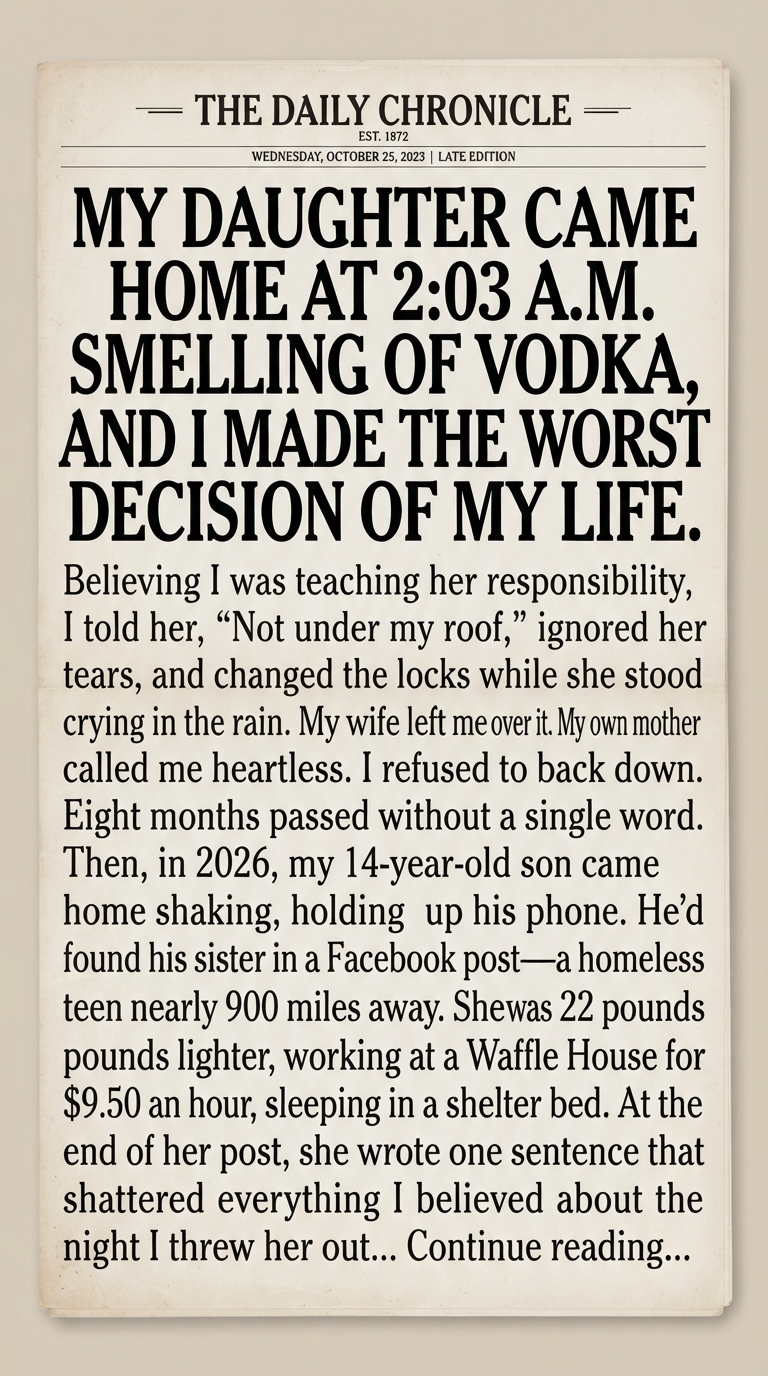
My seventeen-year-old daughter came home at 2:03 a.m. smelling of vodka, and I made the worst decision of my life.
I thought I was teaching her responsibility.
Instead, I taught her what it felt like to be abandoned by the person who was supposed to protect her.
“Not under my roof,” I told her.
She was crying.
“Dad, please. I’m sorry.”
But I was furious. Angry at the drinking. Angry at the lies. Angry at myself for feeling like I had lost control of my own child.
So I made a decision that felt powerful in that moment.
I told her to leave.
She thought I meant for the night.
I didn’t correct her.
I watched her walk down the driveway in the rain.
Then I changed the locks.
My wife came home an hour later and found me sitting silently in the kitchen.
“Where’s Emily?”
“I threw her out.”
She stared at me.
Then she whispered, “You did what?”
“She needs to learn.”
“She is seventeen!”
“She came home drunk.”
“She came home alive!”
Those words should have stopped me.
They should have shattered every excuse I had built around my anger.
Instead, I crossed my arms.
“She made her choice.”
My wife looked at me as if she didn’t recognize me.
“No,” she said. “You made one for her.”
She left three days later.
My mother called me heartless.
My friends stopped defending me.
Even my fourteen-year-old son barely spoke to me.
But I refused to back down.
Because admitting I was wrong would mean admitting that my daughter had been out there alone while I sat in a warm house convincing myself I was a good father.
So I waited for her to call.
She didn’t.
Eight months passed without a single word.
Then, in 2026, my son came home shaking.
He was holding his phone.
“Dad,” he said.
I had never heard fear in his voice like that before.
“What happened?”
He couldn’t answer.
He just held out the phone.
“I found Emily.”
My heart stopped.
On the screen was a Facebook post from a homeless shelter nearly nine hundred miles away.
At first, I didn’t recognize her.
She was twenty-two pounds lighter.
Her long hair had been cut short.
There were dark circles beneath her eyes.
She was standing beside another woman in a shelter cafeteria, wearing a faded uniform from Waffle House.
Under the photo, she had written about working twelve-hour shifts for $9.50 an hour.
About sleeping in a shelter bed.
About pretending she was fine.
Then I reached the last sentence.
And everything I had believed about that night shattered.
“The worst part wasn’t sleeping outside. The worst part was realizing my dad knew exactly where I was and still didn’t come looking for me.”
I dropped the phone.
For eight months, I had told myself that she was stubborn.
That she would come back when she was ready.
That I couldn’t chase her forever.
But suddenly, I saw the truth.
She hadn’t been waiting for me to punish her less.
She had been waiting for me to be her father again.
I called the shelter.
The woman who answered wouldn’t give me any information.
I didn’t blame her.
“Please,” I said. “I’m her father.”
There was silence.
Then the woman replied, “If you’re the man who threw her out, you’re going to have to understand something.”
My throat tightened.
“I’m listening.”
“She doesn’t want to talk to you.”
I closed my eyes.
“I understand.”
But I didn’t.
Not completely.
Not until she told me that Emily had spent the first few months sleeping wherever she could.
A friend’s couch.
A bus station.
An abandoned motel lobby.
Eventually, someone had helped her reach the shelter.
She found work.
She survived.
But every time the shelter asked for an emergency contact, she left the space blank.
That hurt more than anything.
I had spent seventeen years being the first person she called.
And now, if something happened to her, there was no one.
Because I had taught her that her own father was not safe to call.
I drove nine hundred miles the next morning.
I didn’t know if she would see me.
I didn’t know if I deserved to see her.
When I arrived, the shelter director met me outside.
“She agreed to five minutes.”
Five minutes.
That was all my daughter could give me after seventeen years of me having her entire childhood.
Then the door opened.
Emily walked into the room.
For several seconds, neither of us moved.
She looked so thin.
So tired.
So much older than seventeen.
“Hi, Dad.”
That word almost destroyed me.
I had expected anger.
I deserved anger.
Instead, she sounded polite.
Like I was a stranger.
I began crying before I could stop myself.
“Emily, I’m sorry.”
She looked at the floor.
“I know.”
“No.” My voice shook. “You don’t understand. I thought I was teaching you a lesson.”
She gave a small, painful laugh.
“I learned it.”
I couldn’t breathe.
“What lesson?”
She finally looked at me.
“That I could make one mistake and lose my family.”
I covered my face.
She continued.
“I wasn’t asking you to approve of what I did. I knew coming home drunk was wrong.”
“Emily—”
“But I was scared.”
Those two words silenced me.
“I had been drinking,” she said. “I knew I shouldn’t drive, so I called someone to bring me home.”
She wiped her eyes.
“I thought coming home was the responsible thing.”
My entire body went cold.
She had made the safer choice.
She hadn’t driven.
She had come home.
And I had punished her for it by taking away the one place she believed she could always return to.
“I sat outside that house until almost morning,” she whispered.
I remembered.
I remembered hearing something outside.
A faint knocking.
But I had turned up the television.
I had told myself she needed to understand consequences.
“Oh God,” I whispered.
“I thought you would come outside eventually.”
She looked away.
“But you never did.”
I asked her to come home.
She said no.
And for the first time, I understood that I had no right to be angry about her answer.
“I’ll help you,” I said. “With anything you need.”
“I don’t want your money.”
“I know.”
“Then what do you want?”
I swallowed.
“To earn back your trust.”
She looked at me for a long time.
“You can’t earn eight months back.”
“I know.”
“You can’t make me forget sleeping outside.”
“I know.”
“You can’t make me forget thinking that you hated me.”
Each word was something I deserved to hear.
So I nodded.
“I know.”
Finally, she asked me a question.
“Then why are you here?”
I thought about every excuse I had ever used.
Responsibility.
Discipline.
Tough love.
Respect.
None of them mattered anymore.
“Because I’m your dad,” I said. “And I forgot what that was supposed to mean.”
For the first time, her expression changed.
Not forgiveness.
Not yet.
But something softer.
Something that looked like grief.
She began crying.
So did I.
But I didn’t reach for her.
Not until she stepped forward first.
Then she put her arms around me.
And I held my daughter like I should have held her eight months earlier.
Emily didn’t come home with me that day.
She stayed at the shelter.
But before I left, she gave me her new phone number.
“Don’t call all the time,” she said.
“I won’t.”
“And don’t show up without asking.”
“I promise.”
That night, I drove halfway home and pulled into a motel.
For the first time in my life, I understood what it meant to live with regret.
Not the kind you fix with an apology.
The kind you carry because you know your choices changed someone else’s life.
My wife eventually spoke to me again.
Not because she forgave me.
But because Emily asked her to.
My son started talking to me more too.
Slowly.
Carefully.
As if he was waiting to see whether I had really changed.
And I had to accept that.
Trust doesn’t return because you demand it.
It returns when people see you behaving differently, again and again.
Months later, Emily moved into a small apartment with two roommates.
She kept working.
She started taking classes at a community college.
I helped when she allowed me to.
But I never pushed.
Then, almost a year after I found her, my phone rang.
It was 2:03 a.m.
The same time she had come home that night.
My heart raced.
“Emily?”
“Dad.”
“Yes?”
“I messed up.”
Every instinct in me wanted to ask what she had done.
Instead, I took a breath.
“Are you safe?”
There was silence.
Then I heard her crying.
“Yes.”
“Okay.”
“I don’t know what to do.”
And this time, I knew exactly what to say.
“Then come home.”
She was quiet for a moment.
Then she asked, “Are you sure?”
I looked around the kitchen.
At the new locks I had installed after throwing her out.
Locks I had hated every day since.
“Yes,” I said. “I’m sure.”
She began crying harder.
“I’ll be there in twenty minutes.”
“I’ll leave the door open.”
And when she arrived, I didn’t ask her where she had been.
I didn’t lecture her.
I didn’t punish her.
I simply opened my arms.
She ran into them.
For a long time, neither of us said anything.
Because some lessons come too late.
And some mistakes never completely disappear.
But that night, at 2:03 a.m., I finally understood the difference between teaching a child responsibility and abandoning them when they need you most.
A parent can set boundaries.
A parent can give consequences.
But a child should never have to wonder whether one mistake means they have lost their home.
I learned that lesson eight months and nine hundred miles too late.
But when my daughter called me again, afraid she had disappointed me, I made sure she heard the words I should have said the first time.
“You can make mistakes, Emily. You can disappoint me. You can come home scared, angry, or ashamed. But you will never have to earn your way back into being my daughter.”