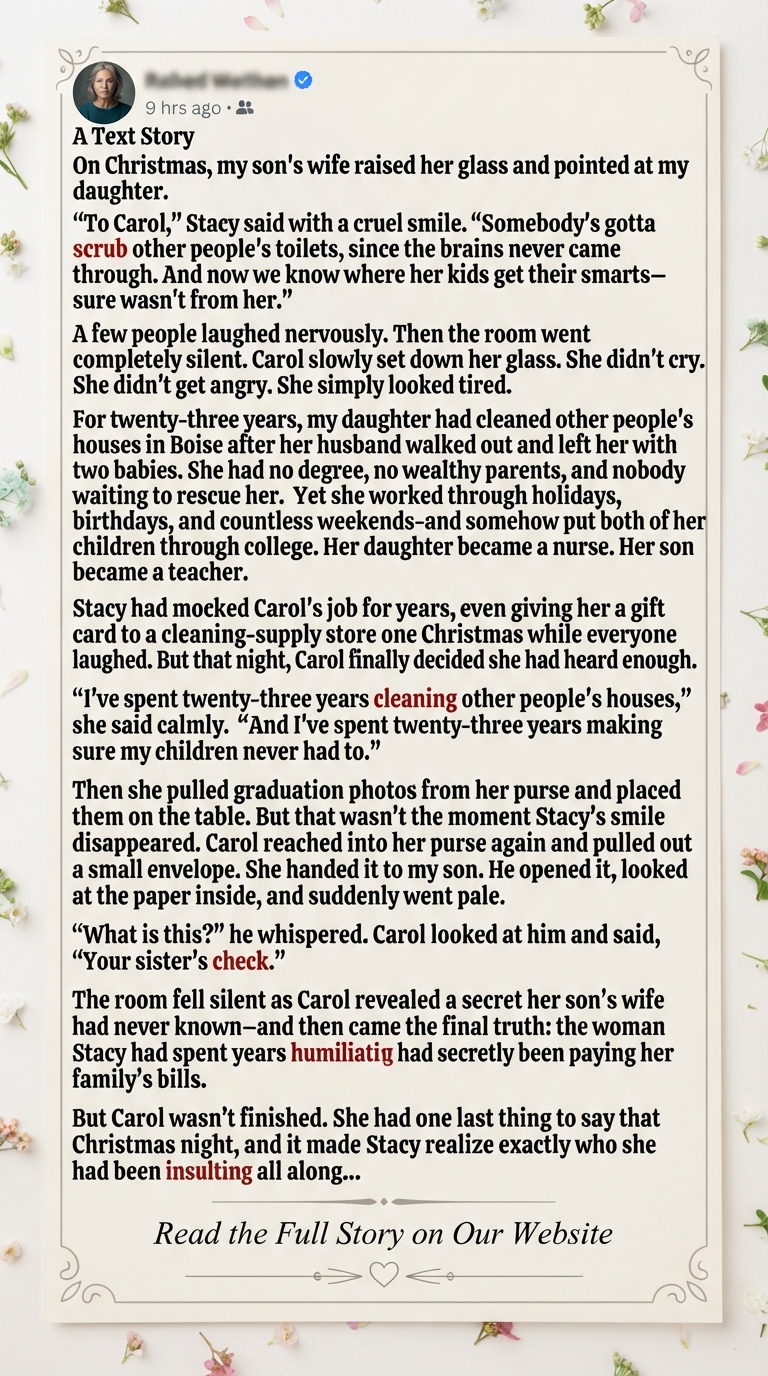
On Christmas, my son’s wife raised her glass and, in front of the whole family, nodded at my daughter.
“To Carol,” Stacy said with a smile. “Somebody’s gotta scrub other people’s toilets, since the brains never came through. And now we know where her kids get their smarts—sure wasn’t from her.”
A few people laughed nervously.
Then the room went completely silent.
Carol set her glass down.
She didn’t look embarrassed.
She didn’t look angry.
She simply looked tired.
For twenty-three years, my daughter had cleaned other people’s houses to put her own two children through college.
She started cleaning houses in her twenties, here in Boise, after her husband walked out and left her with two babies.
She didn’t have a degree.
She didn’t have wealthy parents.
She didn’t have someone waiting to rescue her.
So she built an honest living one house at a time.
House after house.
Year after year.
She cleaned bathrooms.
Scrubbed floors.
Washed windows.
Carried vacuum cleaners up stairs.
She worked through holidays, birthdays, and more weekends than I could count.
And somehow, she put both of her children through college.
Her daughter became a nurse.
Her son became a teacher.
Carol never asked them for a dime.
She never bragged about what she’d done.
She simply smiled whenever someone called her children successful and said, “They’re good kids. That’s all I ever wanted.”
But Stacy never saw it that way.
Stacy married my son and came from a family that had always measured success by job titles, houses, and expensive cars.
From the beginning, she treated Carol like someone who had accidentally wandered into the wrong family.
“Still on your knees for a living?” Stacy once asked her.
Another Christmas, she gave Carol a gift card to a cleaning-supply store.
Everyone laughed.
Carol thanked her anyway.
At another family dinner, Carol had barely sat down when Stacy snapped her fingers.
“Could you refill my wine?”
Carol got up.
She always got up.
Not because she was beneath anyone.
Because she had spent her entire life taking care of people.
She was the kind of woman who noticed when someone needed something before they asked.
She was also the woman who had quietly paid her brother’s rent for six months when the local mill closed.
Nobody knew.
Except me.
Carol had made me promise never to tell.
“It’s family,” she had said.
That was Carol.
She gave without keeping score.
Stacy kept score without giving anything.
And then came Christmas night.
The entire family was gathered around the dining table.
There were candles in the windows.
Christmas music played softly in the background.
Carol had cooked half the meal herself.
She had spent most of the afternoon preparing food while Stacy sat on the couch scrolling through her phone.
After dinner, everyone raised their glasses.
Stacy stood.
She looked directly at Carol.
“To Carol,” she said.
Carol smiled politely.
Then Stacy delivered her joke.
“Somebody’s gotta scrub other people’s toilets, since the brains never came through.”
A few uncomfortable laughs escaped.
Stacy continued.
“And now we know where her kids get their smarts—sure wasn’t from her.”
This time, nobody laughed.
Carol slowly put down her glass.
She folded her worn hands in her lap.
Then she looked directly at Stacy.
“I’ve spent twenty-three years cleaning other people’s houses,” Carol said quietly.
Stacy smiled.
“Yes, you have.”
Carol nodded.
“And I’ve spent twenty-three years making sure my children never had to.”
The smile disappeared from Stacy’s face.
Carol continued.
“You think cleaning someone’s bathroom makes a person less intelligent.”
She paused.
“But you know what I think is embarrassing?”
Nobody moved.
Carol’s voice remained calm.
“I think it’s embarrassing to have a college degree and still not understand the difference between honest work and humiliation.”
Stacy’s fingers tightened around her glass.
Carol didn’t stop.
“You’ve spent twenty-three years trying to make me feel small.”
She looked around the table.
“But you never bothered to ask what I actually accomplished.”
She pulled her phone from her purse.
“I have the graduation photos.”
She placed one on the table.
Her daughter in a nursing uniform.
Then another.
Her son standing in front of his elementary school classroom.
Then another.
Carol standing between them, smiling.
“I paid every tuition bill.”
She looked at Stacy.
“Every textbook.”
“Every apartment deposit.”
“Every emergency.”
“And I did it by cleaning houses.”
Silence.
Then Carol reached into her purse again.
This time, she pulled out a small envelope.
She handed it to my son.
He opened it.
His face changed.
“What is this?” he whispered.
Carol looked at him.
“Your sister’s check.”
He stared at the paper.
Then at Carol.
“What check?”
“The one she wrote me twenty years ago.”
He looked confused.
Carol explained.
“When your father was sick and you were struggling with your mortgage, I gave you money.”
My son looked stunned.
“You told me you borrowed it from the bank.”
“I know.”
He stared at the check.
Carol smiled sadly.
“I didn’t want you to feel like your little sister had rescued you.”
Nobody spoke.
Then Carol looked at Stacy.
“And that’s something else you never knew.”
Stacy swallowed.
“Your husband has told me more than once that he didn’t know how he would have made it through certain years without his sister.”
My son lowered his head.
I watched Stacy’s expression change.
For the first time, she looked uncertain.
Carol picked up her glass.
“I never needed you to respect my job.”
She looked directly at Stacy.
“I only needed you to respect me.”
Stacy opened her mouth.
Nothing came out.
Carol continued.
“You laughed at my hands.”
She looked down at them.
“These hands paid for two college degrees.”
“You laughed at my clothes.”
She glanced at her simple Christmas sweater.
“These clothes were paid for with money earned honestly.”
“You laughed when I cleaned your house.”
She paused.
“And I never told you something.”
Stacy stared at her.
Carol leaned forward slightly.
“I stopped cleaning your house six months ago.”
Stacy froze.
“What?”
Carol smiled.
“I wasn’t cleaning it for you.”
She looked at my son.
“I was helping him.”
My son looked at his wife.
“What does she mean?”
Carol sighed.
“When Stacy lost her job last spring, I quietly covered the mortgage payment for three months.”
Stacy’s face went white.
“I never asked you to.”
“No,” Carol said. “You didn’t.”
She stood.
“And you never knew.”
Carol picked up her coat.
“I don’t want your apology tonight.”
Stacy remained completely silent.
“I don’t want your guilt.”
Carol looked around the table.
“And I don’t want anyone here feeling sorry for me.”
She smiled.
“I just want everyone to understand something.”
She turned toward the door.
“There is no shame in cleaning someone’s house.”
Then she looked back at Stacy.
“The shame is needing someone else’s hard work to feel important.”
And with that, Carol walked out.
Nobody followed her.
Not because they didn’t care.
Because every person at that table knew she had said exactly what needed to be said.
Stacy didn’t speak for the rest of the night.
Neither did my son.
The following morning, he drove to Carol’s house.
He apologized.
Not for Stacy.
For himself.
He told his sister he should have defended her years ago.
Carol hugged him.
“It’s okay,” she said.
“No,” he replied. “It wasn’t.”
A week later, something unexpected happened.
Stacy showed up at Carol’s front door.
She wasn’t wearing designer clothes.
She wasn’t carrying a joke.
She wasn’t holding her phone.
She was carrying a box.
She handed it to Carol.
Inside were every Christmas card and every gift Carol had received from Stacy over the years.
Even the cleaning-supply gift card.
“I was cruel,” Stacy said.
Carol didn’t answer.
“I thought being educated made me better than you.”
Still silence.
Stacy took a breath.
“I was wrong.”
Carol finally looked at her.
“You don’t owe me anything.”
“I know.”
Stacy’s eyes filled with tears.
“But I owe you an apology.”
Carol nodded.
It wasn’t forgiveness.
Not yet.
But it was a beginning.
Months later, Carol’s daughter graduated from nursing school with honors.
Her son gave the graduation speech.
And when he finished, he looked at his mother.
“My mom taught me that intelligence isn’t what you know,” he said.
“It’s what you do with what you know.”
The entire room stood and applauded.
Carol cried.
I did too.
And when we left the ceremony, Carol squeezed my hand.
“You know,” she said, smiling, “I think cleaning houses turned out pretty well.”
I laughed.
“It did.”
She looked at her two children walking ahead of us.
“Twenty-three years,” she whispered.
Then she smiled.
“Worth every bathroom.”
And that was the moment I realized something.
Some people spend their whole lives trying to look successful.
Carol spent hers becoming someone her children could be proud of.
And on Christmas night, she didn’t need to raise her voice, insult anyone, or prove herself.
She simply told the truth.
And sometimes, the truth is the loudest thing in the room.