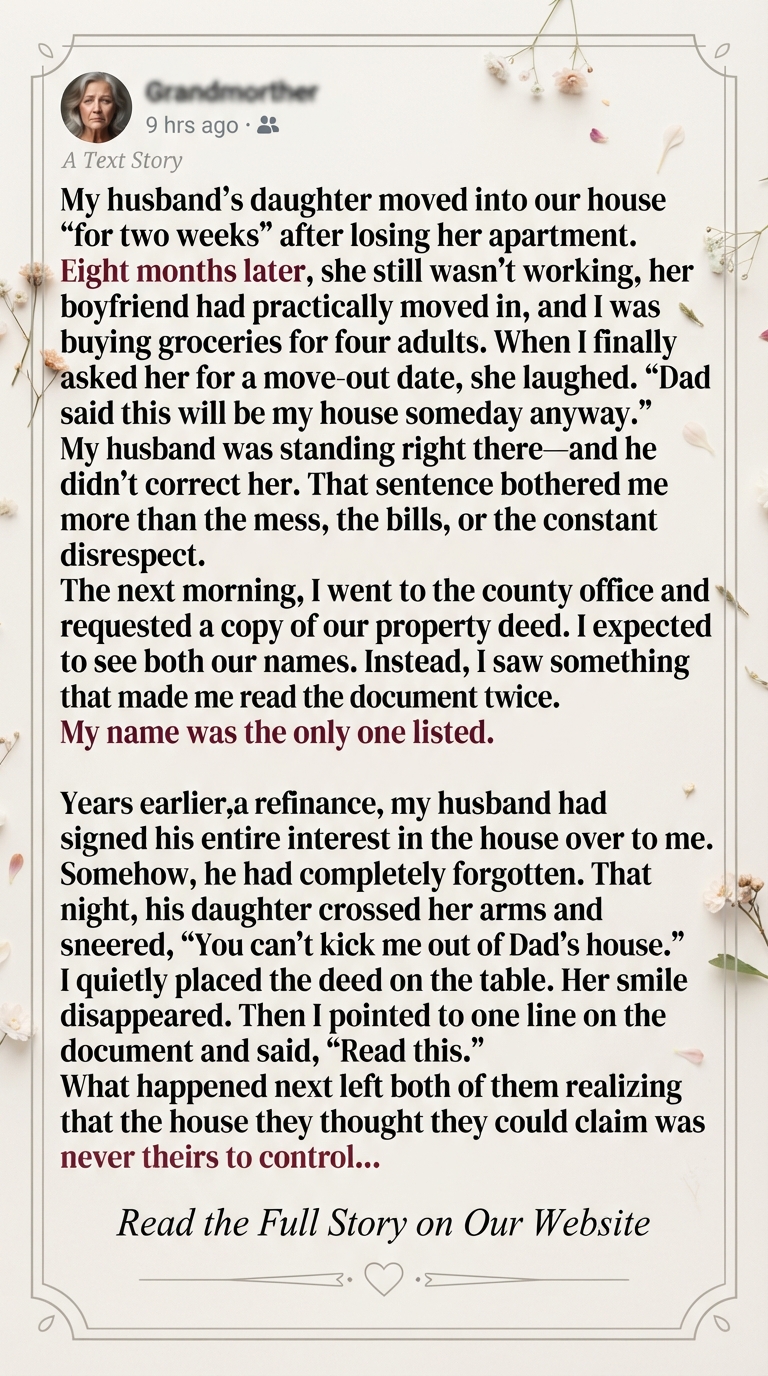
My husband’s daughter moved into our house “for two weeks” after losing her apartment.
Eight months later, she was still there.
She wasn’t working.
Her boyfriend had practically moved in.
And somehow, I had become the person buying groceries for four adults.
At first, I tried to be patient.
“It’s temporary,” my husband, David, kept telling me.
“She’ll get back on her feet.”
So I gave her time.
Then more time.
I paid the electric bill.
I bought extra groceries.
I cleaned the kitchen after her boyfriend left dishes everywhere.
I even paid for a plumber when they clogged the upstairs bathroom.
But the gratitude never came.
Instead, the entitlement grew.
Her boyfriend started parking in my spot.
She began using my office as a storage room.
Packages arrived every day.
And whenever I mentioned that the arrangement was supposed to be temporary, she rolled her eyes.
Finally, one Saturday morning, I sat across from her at the kitchen table.
“I need you to give me a move-out date.”
She laughed.
“Seriously?”
“Yes.”
She leaned back in her chair.
“Dad said this will be my house someday anyway.”
I looked at my husband.
He was standing beside the refrigerator.
He said nothing.
Not one word.
That silence bothered me more than anything else.
I looked at him.
“David?”
He avoided my eyes.
His daughter smiled.
“See? Dad agrees.”
I didn’t argue.
I simply stood up.
“All right.”
Then I walked upstairs.
The next morning, I drove to the county records office.
I requested a copy of our property deed.
I had always assumed both our names were on it.
We had bought the house together.
We had lived there together for seventeen years.
So when the clerk handed me the document, I barely looked at it.
Then I saw the name.
Mine.
Only mine.
I read it again.
And again.
David’s name wasn’t listed as an owner.
I turned the page.
There it was.
A transfer document from years earlier.
During a refinance, David had signed his entire interest in the property over to me.
I remembered the refinance.
Barely.
David had handled most of the paperwork.
He had told me it was routine.
Apparently, it had been much more than that.
The house was legally mine.
Completely.
I sat in my car holding the document.
And suddenly, something clicked.
David had never once mentioned the transfer.
Not once.
I drove home.
That evening, his daughter was sitting on the couch with her boyfriend.
David was watching television.
I placed the deed on the coffee table.
His daughter glanced at it.
“What is that?”
“The property deed.”
She laughed.
“Okay?”
I opened it.
“Read the owner.”
She leaned forward.
Then her smile disappeared.
She looked at David.
“Dad?”
He picked up the document.
His face changed.
“What is this?”
“You signed it.”
“I didn’t.”
“You did.”
He kept staring at the page.
“I don’t remember this.”
“I know.”
His daughter snatched the document.
She read the transfer section.
Then she looked at me.
“You can’t kick me out of Dad’s house.”
I pointed to one line.
“Read this.”
She did.
The line stated that David had transferred all of his ownership interest in the property to me.
Her face went completely blank.
Her boyfriend stood up.
“That’s not possible.”
“It is,” I said.
David finally looked at me.
“Why didn’t you ever tell me this?”
I stared at him.
“Why would I? I thought you knew.”
He shook his head.
“I thought the house was still ours.”
“It isn’t.”
His daughter crossed her arms.
“Dad would never give this house away.”
“He didn’t give it away.”
I turned the document toward her.
“He transferred his interest to his wife.”
Silence.
Then she laughed nervously.
“Okay, so maybe the paperwork says that. But Dad lives here.”
“Yes.”
“And I’m his daughter.”
“Yes.”
“So you’re not just going to throw me out.”
I looked at her.
“Actually, that’s exactly what I’m going to do.”
She stared at me.
“You can’t.”
“I can.”
Then I pulled another paper from my folder.
A formal notice giving her and her boyfriend fourteen days to vacate the property.
Her mouth dropped open.
David looked at me.
“You already prepared that?”
“I prepared it after I got the deed.”
He stood up.
“You’re making a huge mistake.”
I shook my head.
“No. I made the mistake eight months ago when I allowed two adults to move into my home without a deadline.”
His daughter began crying.
“Where am I supposed to go?”
“That isn’t my responsibility anymore.”
She looked at her father.
“Dad!”
David rubbed his forehead.
For the first time, he looked uncomfortable.
Not angry.
Not confident.
Trapped.
Then I asked him a question.
“Why did you sign the house over to me?”
He looked away.
“I don’t remember.”
I didn’t believe him.
So I investigated.
And three days later, I found the answer.
The transfer hadn’t been accidental.
Years earlier, David had been facing serious financial problems from a failed business venture.
Our attorney had advised him that putting the house solely in my name would protect it from certain claims against him.
David had signed the transfer voluntarily.
He had even initialed every page.
The document wasn’t a mistake.
He had simply forgotten.
Or perhaps he’d assumed I would never check.
I showed him the paperwork.
He sat at the kitchen table for nearly an hour without speaking.
Then he finally said:
“I never thought you’d use it against me.”
I stared at him.
“I’m not using anything against you.”
“You’re taking my home.”
“No.”
I pointed toward the walls around us.
“I’m enforcing the ownership you gave me.”
He looked down.
His daughter interrupted.
“So you’re really kicking me out?”
I looked at her.
“Yes.”
She began yelling.
She called me selfish.
Greedy.
Heartless.
She said I’d destroyed her life.
I let her finish.
Then I said quietly:
“You moved into my home for two weeks.”
She stopped.
“You stayed eight months.”
Silence.
“You contributed almost nothing.”
More silence.
“You told me I had no right to ask you to leave because you believed this house belonged to your father.”
I picked up the deed.
“But you were wrong.”
Her eyes filled with tears.
“You’re really doing this?”
“Yes.”
Her boyfriend grabbed his jacket.
“Come on.”
She followed him upstairs.
Within two weeks, they were gone.
The house became quiet again.
But the bigger problem remained.
David.
Because the deed had exposed something far more important than ownership.
It had exposed how little he had actually paid attention to our life together.
He had allowed his daughter to believe the house would someday be hers.
He had allowed her to disrespect me.
And when she said, “Dad said this will be my house someday,” he had stood there and said nothing.
A month later, David and I sat at the same kitchen table.
He looked exhausted.
“I was wrong,” he said.
I didn’t answer.
“I should have corrected her.”
“Yes.”
“I should have told her the truth.”
“Yes.”
“I should have protected you.”
I looked at him.
“That is what bothered me most.”
He swallowed.
“You weren’t angry because she wanted the house.”
“No.”
“You were angry because I didn’t defend you.”
“Yes.”
He nodded slowly.
“I understand now.”
I looked around the kitchen.
The same kitchen where his daughter had laughed at me.
The same kitchen where I’d held that deed.
The same kitchen where I’d realized that owning a house and having a home weren’t the same thing.
“I don’t know if I can trust you the same way again,” I said.
He nodded.
“I understand.”
For the first time, he didn’t argue.
He didn’t defend himself.
He simply accepted what his silence had cost him.
We eventually began counseling.
His daughter eventually found another apartment.
She didn’t apologize immediately.
But months later, she sent me a message.
It was short.
I was wrong about the house. And I was wrong about you. I’m sorry.
I stared at the message for a long time.
Then I replied:
Thank you for saying that.
Nothing more.
Because forgiveness didn’t mean pretending those eight months hadn’t happened.
And owning the house didn’t make me powerful.
What mattered was that I had finally understood something I’d forgotten myself:
A home isn’t defined by who expects to inherit it.
It’s defined by who respects the people living inside it.
They thought my house was their future.
They thought my husband would eventually give it to them.
They thought I was merely standing in their way.
But one quiet trip to the county records office revealed the truth.
The house wasn’t theirs to claim.
It never had been.
And sometimes the most powerful sentence you can say isn’t shouted in anger.
It’s simply:
“Read the deed.”