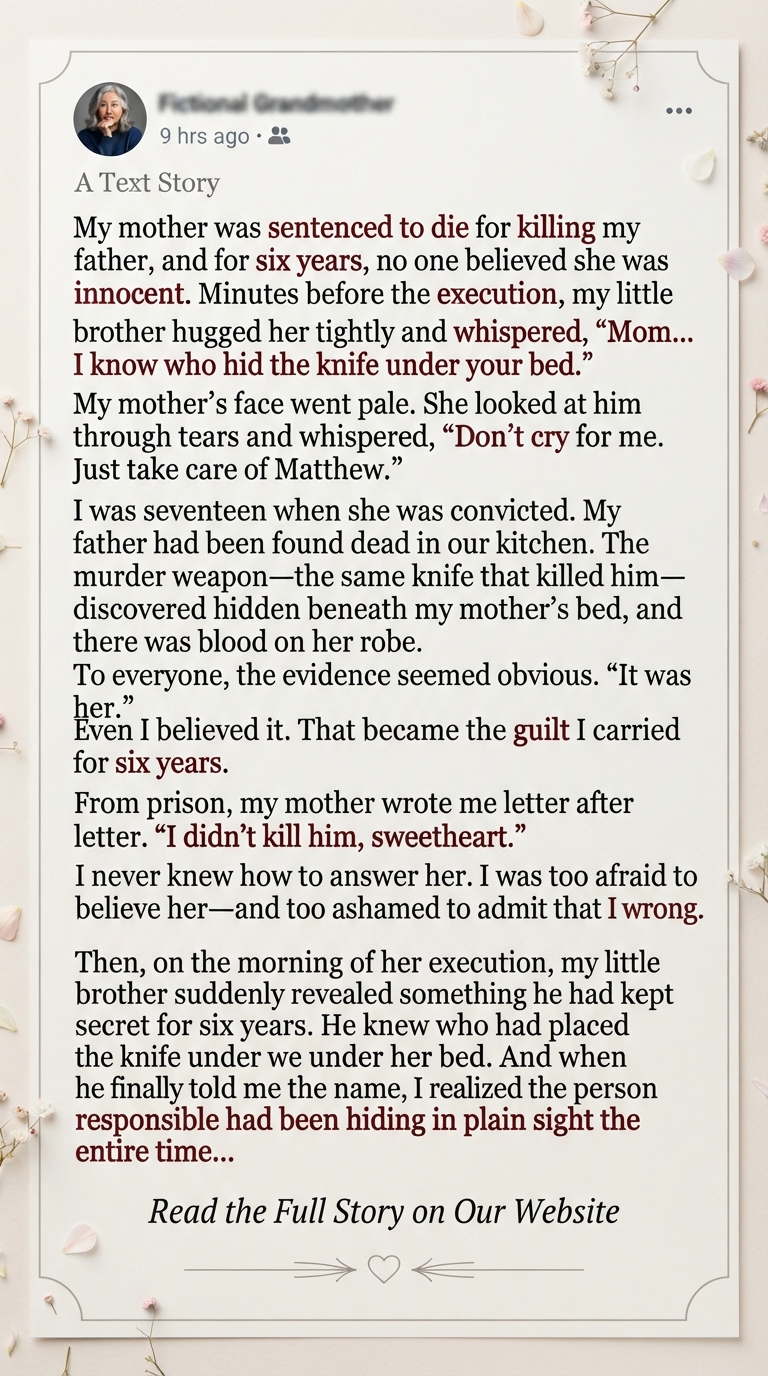
My mother was sentenced to die for killing my father.
For six years, I believed she had done it.
That was the part I hated admitting.
I was seventeen when my father was murdered.
My little brother, Matthew, was eleven.
We were home that night.
I remembered the screaming.
I remembered the police lights filling our windows.
And I remembered seeing my mother sitting on the kitchen floor, covered in blood.
My father was lying a few feet away.
The murder weapon was a kitchen knife.
And somehow, it was later found hidden beneath my mother’s bed.
There was blood on her robe.
There were no signs of forced entry.
No broken windows.
No missing valuables.
To everyone, the evidence looked obvious.
My mother had killed my father.
The newspapers called it a domestic murder.
Neighbors whispered that she must have finally snapped.
At school, people stopped talking to me.
Some parents wouldn’t let their children visit our house.
And I couldn’t defend my mother.
Because every time I looked at her, I saw the blood.
At the trial, the prosecutor held up photographs of the knife.
“This weapon was found beneath the defendant’s bed.”
Then came the blood evidence.
Then the robe.
Then the timeline.
One piece after another.
My mother kept saying the same thing.
“I didn’t kill him.”
Nobody believed her.
Not the jury.
Not the neighbors.
And eventually…
Not me.
She was convicted.
Sentenced to death.
I remember the last time I saw her before she was transferred to prison.
She held my face between her hands.
“You have to believe me someday.”
I couldn’t look at her.
“I don’t know what to believe.”
She started crying.
“I didn’t do this.”
I walked away.
That moment haunted me for six years.
Because my mother never stopped writing.
Every few weeks, another letter arrived.
Sometimes it was only one page.
Sometimes five.
She wrote about ordinary things.
Matthew’s birthday.
The weather.
A book she had read.
A memory from when I was little.
And always, somewhere near the end, she wrote the same sentence.
I didn’t kill your father, sweetheart.
I never answered that sentence.
I couldn’t.
Then, six years later, everything changed.
The execution was scheduled for a Tuesday morning.
By then, I was twenty-three.
Matthew was seventeen.
We had grown up without her.
He had become quiet.
Almost painfully quiet.
He rarely talked about the murder.
But on the morning of the execution, he called me.
“Come to the prison.”
“Why?”
“I need you here.”
His voice sounded strange.
I drove there immediately.
We were allowed one final visit.
My mother walked into the room wearing prison clothes.
She looked older.
Much older.
Her hair was almost completely gray.
But when she saw us, she smiled.
Matthew ran into her arms.
He held her so tightly that she could barely breathe.
Then he whispered something into her ear.
My mother’s expression changed.
She went completely pale.
She looked at him.
“What did you say?”
Matthew was crying.
“Mom…”
She grabbed his shoulders.
“No.”
“I know who hid the knife under your bed.”
My mother stared at him.
Then she looked at me.
For six years, I had never seen hope in her eyes.
But suddenly it was there.
Terrifying.
Fragile.
Alive.
She pulled Matthew close again.
“Don’t cry for me,” she whispered.
“Just take care of your brother.”
Then she looked directly at me.
“Please.”
I couldn’t speak.
I grabbed Matthew’s arm.
“What do you know?”
He wouldn’t answer.
Not there.
Not with the guards watching.
We were escorted out.
And in the parking lot, Matthew finally broke down.
“I saw him.”
“Who?”
“The night Dad died.”
My heart stopped.
“Who did you see?”
Matthew wiped his face.
“Uncle David.”
Our father’s younger brother.
David had always been around.
He attended the trial.
He visited my mother in prison.
He helped pay for our expenses after her conviction.
He even spoke publicly about how devastated he was that his brother had been murdered.
He had been the person I trusted most after my mother went to prison.
“What did you see?” I asked.
Matthew stared at me.
“I was hiding in the upstairs hallway.”
“Why?”
“Dad and Uncle David were arguing.”
I felt cold.
“What were they arguing about?”
“Money.”
Matthew told me that our father had discovered David had been stealing from the family construction company.
My father had confronted him.
David begged him not to tell anyone.
Then the argument became physical.
Matthew saw David shove our father.
Our father fell.
David panicked.
He grabbed a knife.
Matthew watched from the hallway as David stabbed him.
Then David stood there, staring at the blood on his hands.
He looked toward the stairs.
Matthew was terrified.
He ran back into his bedroom and hid inside the closet.
Minutes later, David came upstairs.
He had the knife.
He had my mother’s robe.
And he knew exactly what he was doing.
He wiped the knife with my mother’s robe.
Then he carried it into my mother’s bedroom.
He hid it beneath her bed.
Matthew said he watched the entire thing through a crack in the closet door.
“Why didn’t you tell anyone?”
He started sobbing.
“Because he found me afterward.”
I froze.
“He knew you saw him?”
Matthew nodded.
“He opened the closet.”
He told me David had crouched down beside him.
Then he said:
“If you tell anyone what you saw, your mother dies.”
Matthew had believed him.
He was eleven years old.
He thought David had the power to make his mother disappear forever.
So he stayed silent.
For six years.
But there was one thing David hadn’t known.
Matthew had taken something from the bedroom that night.
A small digital camera my father used for work.
Matthew had grabbed it because he thought it could help.
He didn’t know whether it had recorded anything.
He hid it inside an old toy box.
And forgot about it.
Until recently.
A few weeks before the execution, Matthew found the camera while cleaning out the attic.
There was still a memory card inside.
And there was one video file.
Only twenty-eight seconds long.
It showed our father and David arguing.
The camera had apparently been recording accidentally when our father had placed it on a nearby counter.
The video didn’t capture the stabbing.
But it captured something far more important.
David’s voice.
“You’re not telling them about the money.”
Then my father’s voice:
“You stole from me, David.”
And finally:
“You’ll regret this.”
The video ended.
Matthew immediately contacted a lawyer.
The lawyer sent the recording to investigators.
They reopened the case.
And suddenly, everything the original investigation had considered “obvious” began looking different.
The blood on my mother’s robe wasn’t proof she killed my father.
It was evidence someone had deliberately used her clothing.
The knife beneath her bed wasn’t proof of guilt.
It was proof someone had planted it there.
And David’s fingerprints weren’t on the knife because he had wiped it clean.
But the forensic team discovered microscopic traces from the robe’s fabric inside the knife’s handle.
The original investigation had never tested for that.
Then investigators found something else.
Financial records showed David had been transferring money from the family company into accounts he controlled for years.
My father had discovered it.
He had planned to expose him.
David had motive.
He had opportunity.
And now there was evidence.
When investigators confronted him, David denied everything.
Until they played the recording.
His face changed.
Then he asked one question.
“Where did you get that?”
That was enough.
He was arrested.
My mother’s execution was stopped less than an hour before it was scheduled.
Her conviction was eventually overturned.
Six years after being sent to prison for a murder she didn’t commit, my mother walked out of that prison a free woman.
I was waiting outside.
I didn’t know what to say.
So I simply walked toward her.
She opened her arms.
I collapsed against her.
“I’m sorry,” I whispered.
She held me.
“You were seventeen.”
“I should have believed you.”
“You were scared.”
“I abandoned you.”
She pulled back and looked into my eyes.
“You came back.”
Then Matthew joined us.
The three of us stood there in the sunlight.
For years, I had believed the worst thing my family had lost was my father.
I was wrong.
We had almost lost my mother too.
And we had nearly lost Matthew to a secret he was far too young to carry.
David was eventually convicted for my father’s murder and financial crimes.
But the conviction couldn’t give us back the six years he stole.
It couldn’t erase the letters my mother wrote from prison.
It couldn’t erase the birthdays she missed.
Or the years Matthew spent afraid to speak.
Or the guilt I carried for believing she was guilty.
But my mother never blamed us.
Years later, I found one of those old letters in a box.
I opened it.
The final paragraph read:
If you ever doubt me, remember this: I loved your father. But love does not mean I would never have argued with him, or been angry with him. It means I know what I did and didn’t do. And someday, I hope you will know me well enough to believe my heart even when the world tells you otherwise.
I cried for a long time.
Then I called my mother.
She answered on the second ring.
“Hi, sweetheart.”
Just two words.
But after six years of believing she was a murderer…
Hearing her say them felt like being given my childhood back.
The person responsible had been hiding in plain sight the entire time.
But the truth had been hiding too.
It had been sitting inside a seventeen-year-old boy who was terrified, grieving, and brave enough to finally speak before it was too late.