I drove School Bus Route 6 for thirty years.
For most people, it was just a bus route.
For me, it was three decades of watching children grow up.
I knew who liked to sit in the back, who always forgot their homework, who cried on the first day of kindergarten, and who pretended they weren’t scared when their parents weren’t waiting at the bus stop.
But there was one child I never forgot.
His name was Daniel.
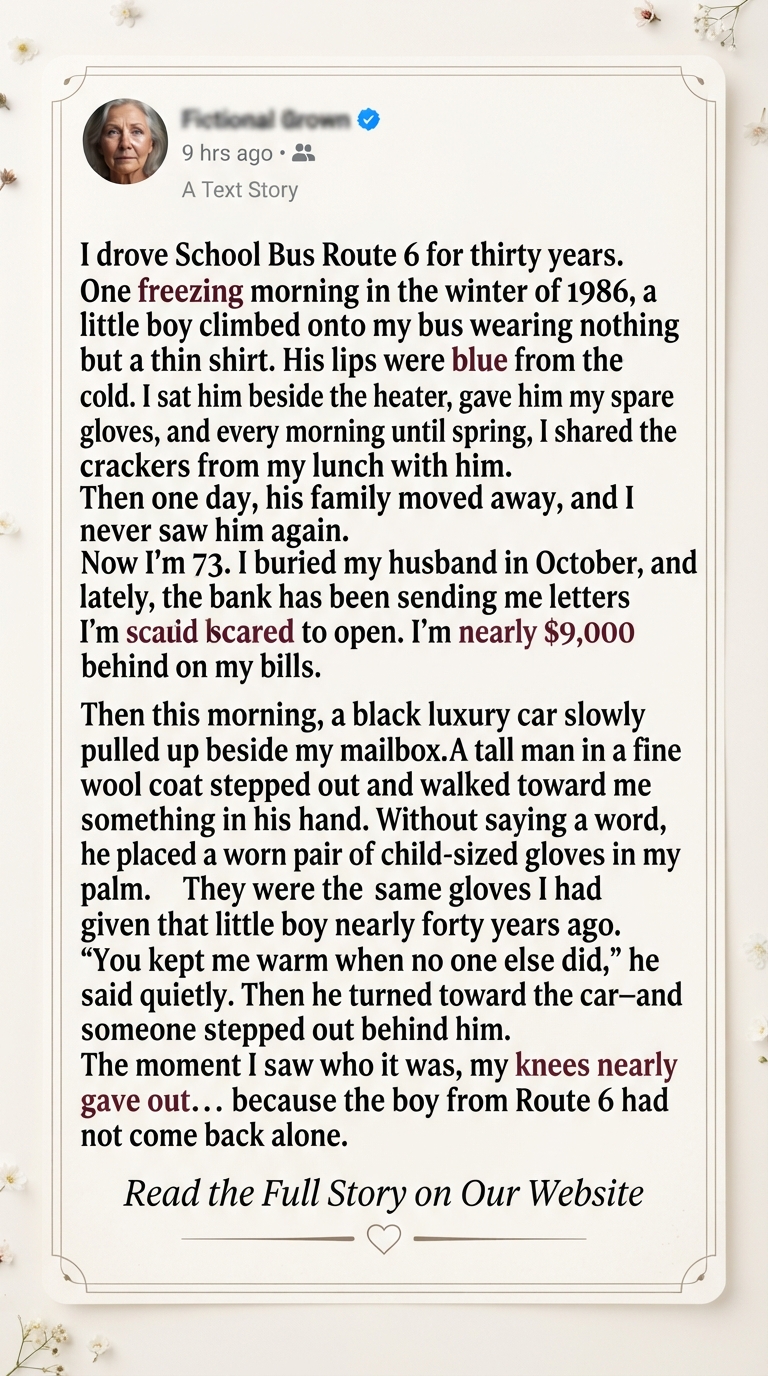
It was a freezing morning in January 1986.
The temperature had dropped below zero overnight, and frost covered every windshield in town.
When I opened the bus doors at the first stop, a little boy climbed aboard.
He couldn’t have been more than seven.
He was wearing a thin shirt, worn jeans, and sneakers that were soaked through.
No coat.
No hat.
No gloves.
His lips were blue.
I immediately turned off the radio.
“Come sit up front, sweetheart.”
He hesitated.
Then he quietly walked toward me.
I moved him into the seat beside the heater and wrapped my spare scarf around his shoulders.
“Where’s your coat?” I asked gently.
He looked down.
“I don’t have one.”
Something inside me broke.
I took off my own gloves and put them into his hands.
“These are yours.”
He stared at them.
“But you’ll be cold.”
I smiled.
“I’m the driver. I’m allowed to be tough.”
He smiled for the first time.
That morning, I also gave him half of my crackers.
The next morning, he was waiting at the same stop.
Still wearing the same thin shirt.
So I gave him the rest of the crackers.
After that, it became our little routine.
Every morning, Daniel sat beside the heater.
Every morning, I made sure he had something to eat.
Sometimes crackers.
Sometimes an apple.
Once, I brought him a peanut-butter sandwich.
He always thanked me.
But he never complained.
Not once.
One morning, I asked him why he didn’t have a coat.
He shrugged.
“Mom says we’ll get one when Dad gets paid.”
I didn’t ask anything else.
Some things a child shouldn’t have to explain.
I quietly bought him a secondhand winter coat.
I told him it had been left on the bus.
He knew I was lying.
But he accepted it anyway.
For the rest of that winter, I watched him slowly regain color in his cheeks.
He started laughing.
He started talking.
He told me he wanted to become a teacher someday.
“Then you better stay in school,” I told him.
“I will.”
And he did.
Then spring came.
One Monday morning, Daniel wasn’t at the bus stop.
Neither was his mother.
The next morning, they were gone.
His house stood empty.
I asked around, but nobody knew where the family had moved.
And that was it.
No goodbye.
No final morning.
Just an empty bus stop.
Years passed.
I drove Route 6 until retirement.
Children who once sat in my seats grew up, got married, had children of their own.
Some recognized me in grocery stores.
Some still called me “Mrs. Evelyn.”
Daniel never came back.
But I never forgot him.
Not once.
Then, forty years later, everything in my life seemed to collapse at once.
My husband, Frank, died in October.
We had been married for forty-six years.
After the funeral, the house felt impossibly quiet.
Then the bills began arriving.
Medical expenses.
Property taxes.
Utilities.
Credit cards.
Insurance.
I tried to keep up.
But eventually, I couldn’t.
By January, I was nearly $9,000 behind.
Every time I saw a letter from the bank, I put it unopened on the kitchen counter.
I was seventy-three years old.
I had spent my entire life taking care of other people.
And suddenly, I was terrified that I might lose the home my husband and I had built together.
That morning, I walked outside to get the mail.
That’s when I heard a car.
A long black luxury sedan slowly pulled beside the mailbox.
I frowned.
I didn’t recognize it.
The driver’s door opened.
A tall man stepped out.
He looked to be in his forties.
He wore a dark wool coat and polished shoes.
He walked toward me holding something in his hand.
I didn’t know him.
At least, I didn’t think I did.
He stopped a few feet away.
For several seconds, he simply stared at me.
Then he opened his hand.
A pair of tiny, worn gloves rested in his palm.
My breath caught.
I knew those gloves.
I had given them to a little boy nearly forty years earlier.
I looked up at him.
His eyes were wet.
“You kept me warm when no one else did,” he said.
My hands began trembling.
“Daniel?”
He nodded.
“Mrs. Evelyn.”
I couldn’t speak.
He stepped closer and placed the gloves in my palm.
“I kept them all these years.”
I touched the worn fabric.
There were tiny holes near the fingertips.
The elastic was nearly gone.
But I remembered them.
I remembered those little blue hands.
I remembered the boy sitting beside the heater.
I remembered crackers.
I remembered his quiet voice saying he wanted to become a teacher.
Then Daniel turned toward the car.
And another person stepped out.
An older woman.
Gray hair.
A familiar face.
My knees nearly gave out.
I whispered one word.
“Margaret?”
Daniel’s mother covered her mouth.
She began crying.
“I’ve wanted to find you for thirty-nine years.”
I stared at her.
She walked toward me slowly.
“I owe you an apology.”
She told me what had happened.
Daniel’s father had lost his job that winter.
He began drinking.
Then he disappeared.
Margaret had been working two jobs just to keep food on the table.
They weren’t simply struggling.
They were drowning.
When she couldn’t afford the rent anymore, she moved Daniel and his younger sister across the state to live with her brother.
She had planned to come back.
She never could.
“I was ashamed,” she said.
“I thought you’d think I was a terrible mother.”
I shook my head.
“I never thought that.”
She cried harder.
Then Daniel spoke.
“I’ve been looking for you for twelve years.”
He explained that after his mother finally told him about the woman who had cared for him on Route 6, he began searching.
He found old school records.
He contacted the school district.
He found retired bus drivers.
Eventually, he found an old newspaper article about my retirement.
But that wasn’t why he had come that morning.
He reached into his coat and handed me an envelope.
My name was written across the front.
I opened it with shaking hands.
Inside was a cashier’s check.
I stared at the amount.
$18,750.
I looked up immediately.
“No.”
Daniel smiled.
“Yes.”
“I can’t take this.”
“You can.”
“But I don’t even understand—”
He interrupted gently.
“Mrs. Evelyn, I became a teacher.”
I froze.
He laughed softly.
“Just like I told you I would.”
He explained that he had spent thirty years teaching elementary school.
And every winter, whenever he saw a child arrive at school without a proper coat, he remembered me.
So he started something of his own.
A small charity called Route 6 Kids.
Every year, the organization provided winter coats, gloves, shoes, and food to children whose families couldn’t afford them.
“Last year,” he said, “we helped 612 kids.”
I covered my mouth.
Daniel continued.
“You gave me gloves.”
“You gave me crackers.”
“But more than that, you made me believe somebody noticed me.”
I started crying.
He took another envelope from his coat.
“This is from the charity.”
I opened it.
Inside was a letter.
The charity had voted unanimously to pay my overdue bills and cover my property taxes for the next year.
I stared at Daniel.
“You did all this?”
He shook his head.
“No.”
Then he pointed toward the car.
“All of us did.”
The back door opened.
Three people stepped out.
A woman.
A teenage boy.
And a little girl wearing a bright red winter coat.
Daniel’s wife.
His son.
And his granddaughter.
The little girl walked toward me holding a small paper bag.
She pulled out a package of crackers.
I laughed through my tears.
Daniel smiled.
“She insisted.”
His granddaughter looked up at me.
“My grandpa says you’re the reason he became a teacher.”
I knelt slowly.
“Your grandpa was always going to be something wonderful.”
Daniel shook his head.
“No, Mrs. Evelyn.”
He looked at the old gloves in my hand.
“That winter, I thought nobody cared whether I was warm.”
He swallowed.
“Then you opened that bus door.”
For a moment, nobody spoke.
Then he hugged me.
I held him like the seven-year-old boy I remembered.
And somehow, for just a few seconds, I could still feel the little boy sitting beside the heater.
Before they left, Daniel asked me one more question.
“Can I show you something?”
He opened his phone.
It was a photograph.
A classroom filled with children.
On the wall was a framed pair of child-sized gloves.
Underneath them was a handwritten sign:
“Sometimes the smallest kindness becomes someone’s entire future.”
Daniel had kept the gloves on display in his classroom for years.
I cried again.
But this time, they were happy tears.
Before getting back into the car, Daniel turned around.
“Mrs. Evelyn?”
“Yes?”
“You saved me.”
I shook my head.
“I only gave you a pair of gloves.”
He smiled.
“Exactly.”
Then he looked at his wife, his children, and his mother.
“And look what grew from them.”
The car disappeared down the road.
I stood beside my mailbox holding those old gloves.
For nearly forty years, I had believed I was the one who remembered that little boy.
I was wrong.
He had remembered me, too.
And I realized something that morning:
Sometimes we never know which small kindness will become a permanent part of someone’s life.
A sandwich.
A warm seat.
A pair of gloves.
A few minutes of attention.
To us, it may be nothing.
To someone who desperately needs it, it can become hope.
And sometimes, decades later, that hope finds its way back to your doorstep.
That night, I finally opened the bank letters.
For the first time in months, I wasn’t afraid.
Because the little boy from Route 6 had come home.
And he had brought an entire lifetime of gratitude with him.