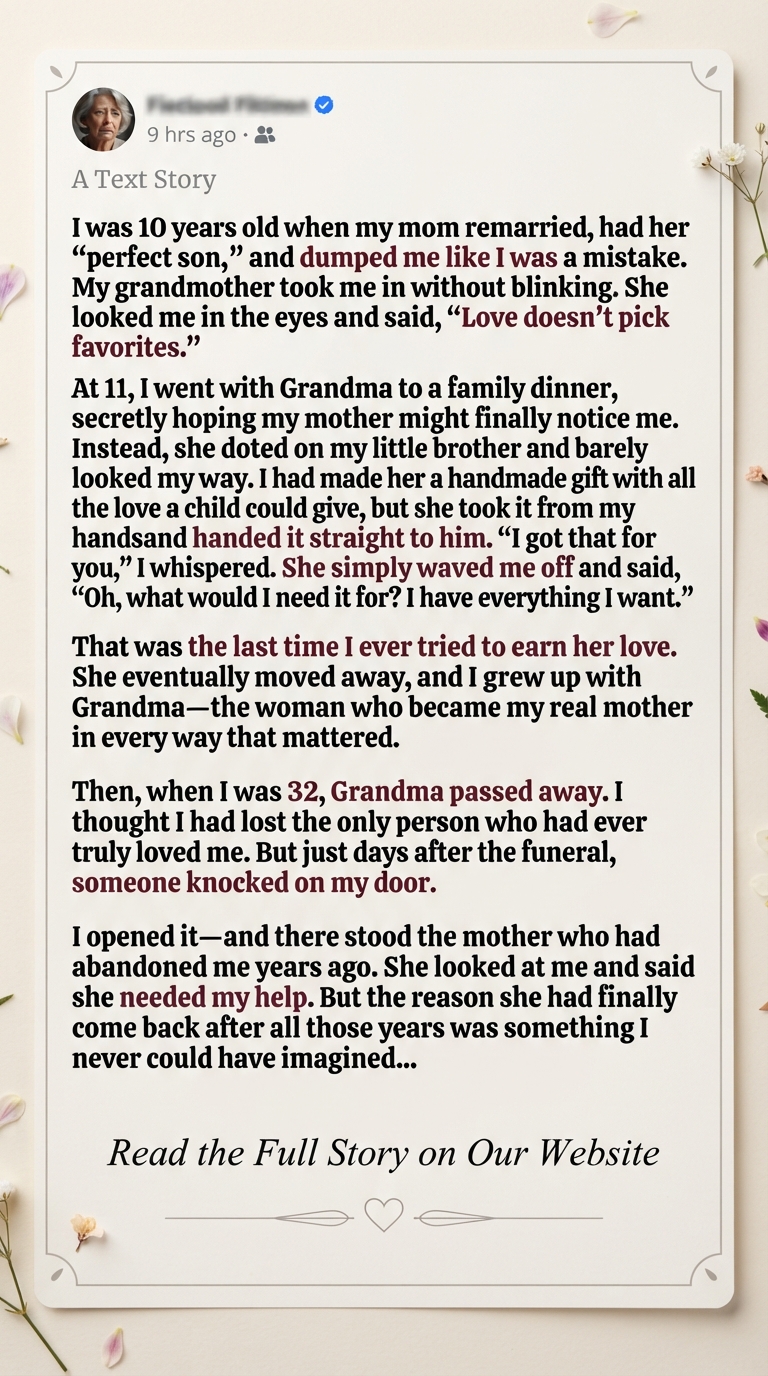
I was ten years old when my mother remarried, had her “perfect son,” and dumped me like I was a mistake.
I still remember the day she told me I was going to live with Grandma.
She didn’t cry.
She didn’t hug me.
She didn’t even sit beside me.
She stood in the kitchen folding tiny blue baby clothes while my stepfather carried my baby brother upstairs.
“Grandma has more room,” she said.
I stared at her.
“But I live here.”
She sighed.
“Things are different now.”
I was ten.
I didn’t understand what that meant.
I only understood that my mother had chosen someone else.
My grandmother took me in without blinking.
She didn’t ask how long I’d stay.
She didn’t ask my mother for money.
She simply opened her bedroom closet, pulled out an extra blanket, and said:
“You can put your clothes here.”
That night, I cried into my pillow.
Grandma sat beside me.
I whispered, “Does Mom love him more because he’s a boy?”
Grandma looked directly into my eyes.
“No.”
“Then why doesn’t she love me?”
Grandma took my hand.
“Sometimes adults make selfish choices, sweetheart. That doesn’t mean there’s anything wrong with the child they hurt.”
I cried harder.
Then she said the sentence I would remember for the rest of my life.
“Love doesn’t pick favorites.”
I didn’t understand it completely then.
I do now.
At eleven, Grandma took me to a family dinner.
I spent the entire afternoon making a little handmade picture frame for my mother.
It wasn’t beautiful.
The corners weren’t even straight.
I had painted tiny flowers around the edge and written:
For Mom, because I love you.
I carried it carefully into the restaurant.
When my mother saw me, she barely looked up.
Then my little brother came running toward her.
She immediately stood.
“My baby!”
She hugged him.
She kissed his cheeks.
She asked about his school.
She told him how handsome he looked.
I stood there holding my gift.
Eventually, I walked over.
“Mom?”
She glanced at me.
“What?”
I held out the frame.
“I made this for you.”
She took it.
For one second, I thought maybe everything had changed.
Then she looked at it.
She turned.
And handed it straight to my little brother.
He smiled.
I froze.
“I got that for you,” I whispered.
My mother waved me off.
“Oh, what would I need it for? I have everything I want.”
Those words hurt more than I could explain.
I remember sitting at the table that night and pretending I wasn’t crying.
On the ride home, Grandma didn’t ask what happened.
She just held my hand.
I finally whispered:
“I’m never trying again.”
Grandma squeezed my fingers.
“You don’t have to.”
And I didn’t.
My mother moved away a few years later.
I heard about her occasionally through relatives.
She had another child.
She bought a bigger house.
She traveled.
She posted photographs of family vacations.
But I stopped looking.
Grandma became my mother in every way that mattered.
She came to my graduation.
She helped me move into my first apartment.
She taught me how to balance a checkbook.
She sat beside me when I had my first heartbreak.
When I got my first real job, she bought me a tiny cake and wrote:
I’m proud of you.
When I turned thirty, she gave me her mother’s necklace.
“Keep this,” she said.
“Why?”
“Because some things should be passed down to someone who knows what they mean.”
I hugged her.
I didn’t know it would be one of the last birthdays we’d celebrate together.
Two years later, Grandma died.
I was thirty-two.
Cancer took her quickly.
The house that had once felt warm suddenly felt enormous.
After the funeral, I returned home and sat on the kitchen floor.
Her coffee mug was still beside the sink.
Her glasses were still on the counter.
A cardigan was still hanging over the back of her chair.
I picked it up and held it against my chest.
For the first time since I was ten, I felt completely alone.
Then someone knocked on my door.
I wasn’t expecting anyone.
I opened it.
And there she was.
My mother.
She looked older.
Her hair was streaked with gray.
Her face looked tired.
For a moment, neither of us spoke.
Then she said:
“I need your help.”
I almost laughed.
After twenty-two years, those were her first words.
Not “I’m sorry.”
Not “How are you?”
Not “I missed you.”
“I need your help.”
I stared at her.
“What kind of help?”
She looked down.
“It’s about your brother.”
My stomach tightened.
“Is he okay?”
She shook her head.
“He’s sick.”
I stepped aside.
She came in.
My mother sat at Grandma’s kitchen table.
The same table where Grandma had helped me with homework.
The same table where she’d wrapped my scraped knees.
The same table where she’d told me that love didn’t pick favorites.
My mother folded her hands.
“Your brother has been struggling for years.”
“With what?”
“Everything.”
She told me that after she moved away, she had spent years trying to create the perfect life.
The perfect house.
The perfect marriage.
The perfect son.
But her husband eventually left.
Her finances collapsed.
And my brother, now twenty-two, had struggled badly after losing his job.
He had accumulated debt.
He had withdrawn from everyone.
And eventually, he became seriously ill.
My mother had been caring for him alone.
Until she couldn’t anymore.
“I don’t have anyone,” she whispered.
I looked at her.
“You have him.”
She shook her head.
“He’s the reason I came to you.”
“Why?”
She reached into her purse.
And pulled out something wrapped in an old cloth.
She placed it on the table.
My heart stopped.
It was the handmade picture frame.
The one I had made when I was eleven.
The one she had handed to my brother.
The one I thought she had forgotten.
I stared at it.
The paint was faded.
One corner was cracked.
But my childish handwriting was still there.
For Mom, because I love you.
My mother began crying.
“I kept it.”
I couldn’t speak.
“Why?”
She wiped her eyes.
“Because after that dinner, I took it back.”
I stared at her.
“I don’t understand.”
She explained.
My brother had never wanted it.
He had thrown it in his room.
That night, my mother found it.
She said she sat on the floor holding it for hours.
She knew what she’d done.
She knew she’d broken something in me.
But instead of fixing it, she ran from the guilt.
“Every year,” she said, “I told myself I would call you.”
“Every year, I found an excuse.”
I felt anger rising inside me.
“You could have called.”
“I know.”
“You could have come.”
“I know.”
“You were my mother.”
She lowered her head.
“I know.”
Then she said something I wasn’t expecting.
“Your grandmother knew.”
I froze.
“Knew what?”
My mother pulled another envelope from her purse.
It had my name on it.
My grandmother’s handwriting.
My hands began shaking.
“She gave this to me six months ago,” my mother said.
“She told me not to give it to you unless I was finally ready to tell you the truth.”
I opened it.
Inside was a letter.
My grandmother had written:
My sweet girl,
If you’re reading this, your mother has finally come back.
I don’t know whether you will forgive her. You don’t owe her forgiveness.
But there is something you should know.
Your mother has carried guilt for the way she treated you for more than twenty years. She told me once that the day you stopped trying to earn her love was the day she realized she had lost something she could never buy back.
I had to stop reading.
My vision blurred.
I continued.
She asked me many times to let her see you. I told her that she couldn’t come back simply because she was lonely. If she ever returned, she had to come because she was ready to take responsibility.
Then came the sentence that broke me.
She didn’t abandon you because you weren’t lovable. She abandoned you because she was too selfish and frightened to be the mother you deserved. Never confuse those two things.
I folded the letter against my chest.
My mother was crying silently across the table.
“I should have protected you,” she whispered.
“You should have.”
“I can’t change what I did.”
“No.”
“But I want to stop running from it.”
For the first time, I saw something different in her face.
Not excuses.
Not defensiveness.
Just regret.
I asked about my brother.
“Does he know why you came?”
She shook her head.
“He knows about you.”
“Does he know what happened?”
“No.”
I thought about the little boy she had once called her perfect son.
The boy who had unknowingly received the gift I had made for our mother.
He hadn’t been responsible for what she did.
So I agreed to meet him.
A week later, I sat across from my younger brother in a hospital cafeteria.
He looked nothing like the perfect little boy I remembered.
He looked tired.
Scared.
Human.
He stared at me for a long time.
Then he said:
“Mom told me what she did.”
I didn’t answer.
“I’m sorry.”
“You were five.”
“I know.”
“You didn’t choose any of it.”
He looked down.
“I still feel guilty.”
“You shouldn’t.”
He looked at me.
“Why?”
“Because she chose.”
He nodded slowly.
Then he reached into his pocket.
He pulled out something small.
A photograph.
It was a picture of me at eleven years old.
Holding the handmade frame.
I stared at it.
“Where did you get this?”
“My mom kept it.”
He swallowed.
“She told me she had everything she wanted.”
Then he gave me a sad smile.
“I think she finally realized she didn’t.”
I didn’t forgive my mother that day.
I didn’t forget either.
But I started talking to her.
Slowly.
She began visiting.
She apologized without asking me to make her feel better.
She never said, “But I was young.”
She never said, “I did my best.”
She simply said:
“I hurt you.”
And when I told her how much it hurt, she listened.
Months passed.
Then one afternoon, she asked if she could see Grandma’s house.
I took her there.
She stood in the doorway of the bedroom where I had slept as a child.
She touched the old dresser.
Then she began crying.
“She really raised you.”
“Yes.”
My mother nodded.
“She did the job I should have done.”
I didn’t correct her.
Because it was true.
Before she left, she looked at me.
“I don’t expect you to call me Mom.”
“I know.”
“I don’t expect you to forgive me.”
“I know.”
“But if you’ll let me…”
She paused.
“I’d like to spend whatever time I have left earning the right to be in your life.”
I looked at her.
For years, I had imagined forgiveness as something dramatic.
A hug.
A tearful reunion.
Everything suddenly made sense.
But forgiveness wasn’t forgetting.
It wasn’t pretending my childhood didn’t happen.
It wasn’t giving her back the place she had abandoned.
It was simply deciding that what she did would no longer control the rest of my life.
So I said:
“You can start by showing up.”
She nodded.
“I will.”
And she did.
Not perfectly.
Not quickly.
But consistently.
She called on my birthday.
She remembered my favorite coffee.
She brought flowers to Grandma’s grave.
She apologized to my brother too.
And over time, we built something I never thought we’d have.
Not the mother-daughter relationship I should have had.
Something different.
Something slower.
Something earned.
One year after Grandma’s death, my mother and I stood beside her grave.
My mother placed the old handmade frame against the headstone.
I looked at it.
The same crooked flowers.
The same childish words.
For Mom, because I love you.
My mother touched the glass.
“I should have treasured this.”
I looked at her.
“You weren’t ready then.”
She nodded.
“And you were.”
I smiled sadly.
“Grandma was.”
My mother took my hand.
For the first time in my life, I didn’t pull away.
Grandma had been right all those years ago.
Love doesn’t pick favorites.
Real love shows up.
Real love stays.
Real love doesn’t make a child compete for a place at the table.
And sometimes, the people who fail us spend the rest of their lives trying to understand what they lost.
I couldn’t give my mother back the twenty-two years she had missed.
But I could choose what happened next.
And that was enough.
Because Grandma had taught me something even more important than how to be loved.
She taught me that I never had to earn it in the first place.