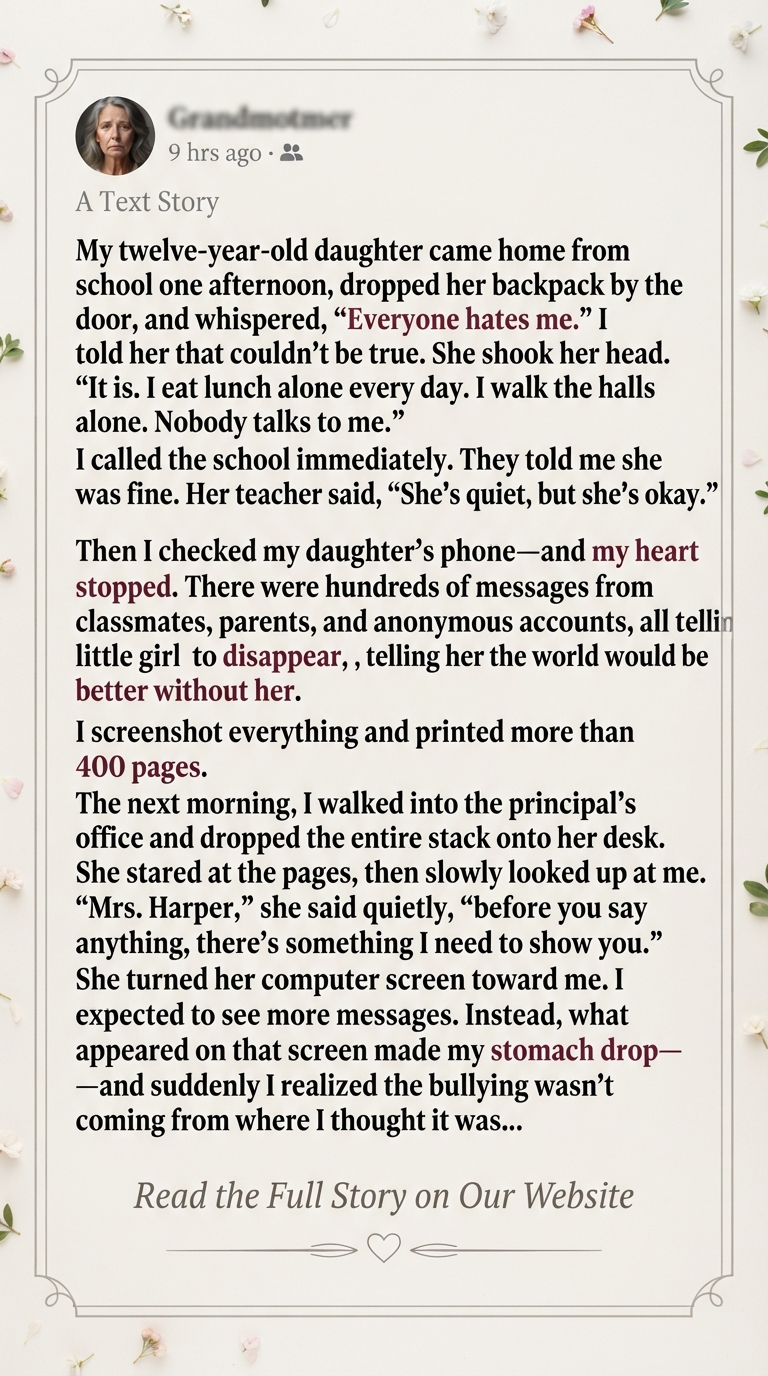
My twelve-year-old daughter came home from school one afternoon, dropped her backpack by the door, and whispered:
“Everyone hates me.”
I looked up from the kitchen table.
“What?”
She stood there with her eyes fixed on the floor.
“Everyone hates me.”
I walked over and knelt in front of her.
“Sweetheart, that can’t be true.”
She shook her head.
“It is.”
Her voice cracked.
“I eat lunch alone every day. I walk the halls alone. Nobody talks to me.”
I pulled her into my arms.
“Did someone say something to you?”
She didn’t answer.
That scared me more than anything.
I called the school immediately.
The assistant principal assured me everything was fine.
Her teacher said:
“She’s quiet, but she’s okay.”
I hung up feeling uneasy.
My daughter had never been the loudest kid in the room.
She was shy.
Sensitive.
The kind of child who apologized when someone else bumped into her.
But this wasn’t normal quiet.
This was fear.
That night, after she went to bed, I picked up her phone.
I almost didn’t look.
I knew twelve-year-olds deserved privacy.
But something in me said I needed to understand what my daughter wasn’t telling me.
I opened her messages.
My heart stopped.
There were hundreds.
Messages from classmates.
Parents.
Anonymous accounts.
Some were short.
Nobody wants you here.
Just disappear.
You make everyone uncomfortable.
Your parents would be better off without you.
Then I saw one that made my hands shake.
The world would be better without you.
I kept scrolling.
There were hundreds.
Some had been sent late at night.
Some during school.
Some from accounts I didn’t recognize.
I sat on the edge of my daughter’s bed and stared at the screen.
She had been carrying this alone.
I spent the next four hours taking screenshots.
Then I printed everything.
Page after page.
By morning, I had more than 400 pages.
I put them into a large cardboard box.
Then I drove to the school.
I walked into the principal’s office and placed the box on her desk.
She stared at it.
“What is this?”
“Everything my daughter has received.”
Her expression changed as she opened the first few pages.
She read silently.
Then she looked at me.
“Mrs. Harper…”
I waited.
“Before you say anything, there’s something I need to show you.”
She turned her computer screen toward me.
I expected to see more messages.
Instead, I saw a spreadsheet.
Hundreds of student names.
Dozens of parent names.
And beside each name was a date, a time, and a series of strange codes.
My stomach dropped.
“What am I looking at?”
The principal swallowed.
“This is from our student safety system.”
I stared at the screen.
“What does it have to do with my daughter?”
She clicked on a file.
It contained every bullying report submitted by students over the previous six months.
There were dozens.
Not just about my daughter.
About other children too.
And they all had one thing in common.
The reports had been marked resolved.
But the students hadn’t stopped being bullied.
The principal leaned closer.
“We’ve been investigating something for three weeks.”
“What?”
“Someone has been using student accounts to report bullying against other students, then deleting or altering the reports before they reach our counselors.”
I looked at her.
“You’re saying someone inside the school has been hiding reports?”
“We think so.”
I felt cold.
“Why?”
“We don’t know yet.”
She clicked another file.
Then I saw my daughter’s name.
Beside it was a note:
High-risk target. Keep social isolation intact.
I stood up so quickly my chair moved backward.
“What does that mean?”
The principal looked at me.
“We believe someone has been deliberately isolating her.”
I shook my head.
“But why?”
She didn’t answer.
Instead, she opened a video file.
It was security footage from the school cafeteria.
My daughter was sitting alone.
A few minutes later, another girl approached her.
The girl sat down.
They talked.
Then a student walked past their table and whispered something.
The girl immediately stood up and left.
Another student did the same thing.
Then another.
Within ten minutes, everyone had left my daughter alone.
I felt tears burn my eyes.
“That was staged.”
The principal nodded.
“We think so.”
Then she showed me another video.
A student was standing outside the library.
It was my daughter’s best friend from elementary school.
Emily.
I hadn’t seen her at our house in months.
On the video, Emily was talking to an older student.
The older student handed her a phone.
Emily looked frightened.
Then she walked away.
“What’s happening?” I whispered.
The principal paused.
“We finally found the person behind the anonymous accounts.”
She clicked another file.
A name appeared.
Emily Carter.
My heart sank.
“No.”
The principal nodded.
“She’s involved.”
I couldn’t believe it.
Emily had known my daughter since kindergarten.
They had shared birthday parties.
Sleepovers.
Christmas presents.
They used to call each other sisters.
“Why would she do this?”
The principal didn’t know.
But there was more.
Emily had not created the entire campaign.
She had been recruited.
The person who recruited her was another student.
A fourteen-year-old boy named Tyler.
And Tyler had been getting help from an adult.
The principal opened the final file.
A payment history.
Gift cards.
Online transfers.
Small amounts.
$20.
$35.
$50.
Over several months.
All connected to an adult account.
I stared at the name.
Then my stomach turned.
It was my daughter’s teacher.
Mrs. Dawson.
The teacher who had told me:
“She’s quiet, but she’s okay.”
I couldn’t speak.
The principal explained what investigators had uncovered.
Mrs. Dawson had been manipulating students for months.
She would identify children who were socially vulnerable.
Then she would convince other students that those children were “trouble.”
She encouraged rumors.
She supplied screenshots.
She created anonymous accounts.
She even contacted some parents, pretending to be another concerned parent, spreading false stories about targeted children.
But why?
The answer was even more disturbing.
Mrs. Dawson had been trying to build a case that several students were “emotionally unstable” and “unsafe influences.”
She wanted the school to remove them from certain programs.
Then she planned to recommend a private counseling program operated by a company owned by her brother.
The school had been unknowingly referring families to that company.
My daughter had become a target after she refused to participate in a group chat where students were humiliating another girl.
Mrs. Dawson had apparently told several students that my daughter was “causing problems.”
Then the campaign began.
The anonymous messages.
The rumors.
The isolation.
The fake reports.
The goal wasn’t simply to hurt my daughter.
It was to make her believe nobody wanted her around.
So that when she finally broke down, adults would describe her as unstable.
The principal looked at me.
“We should have caught this sooner.”
I looked at the 400 pages sitting on her desk.
“Yes.”
She nodded.
“You’re right.”
For once, nobody tried to defend the school.
The district immediately contacted law enforcement and suspended Mrs. Dawson pending investigation.
Emily’s parents were called.
Emily admitted what she had done.
She had been threatened.
Tyler had told her that if she didn’t participate, he would release private photographs she had sent him.
That didn’t excuse what she had done.
But it explained why she had been terrified.
Emily eventually gave investigators access to her phone.
That evidence connected the student accounts to Mrs. Dawson.
And then came the hardest part.
I had to tell my daughter.
We sat together on the couch.
I held her hand.
“You were right.”
She looked at me.
“About what?”
“When you said everyone hated you.”
Her eyes filled with tears.
“I told you.”
“I know.”
“But they didn’t hate you.”
She looked confused.
“Then why did everyone act like they did?”
“Because someone wanted you to believe that.”
She was silent.
Then she asked:
“Why?”
I didn’t have a perfect answer.
“Sometimes people manipulate others because they want control.”
She looked down at her hands.
“Was there something wrong with me?”
I immediately shook my head.
“No.”
“Then why me?”
“Because you did something brave.”
She looked at me.
“You stood up for another kid when you could have stayed quiet.”
Her eyes filled with tears.
“And someone didn’t like that.”
She leaned against me.
For the first time in weeks, she cried.
Not the silent crying she had been doing alone.
Real crying.
The kind that finally lets some of the weight out.
I held her until she fell asleep.
The following months were difficult.
She changed schools.
She began seeing a counselor who specialized in childhood trauma and bullying.
She didn’t suddenly become confident.
Healing wasn’t that simple.
Some mornings, she still asked:
“Do you think people hate me?”
And every time, I answered:
“I think there are people who don’t know you yet.”
Slowly, things changed.
She joined an art club.
Made two new friends.
Started eating lunch with other students.
And eventually, she laughed again.
One year later, she came home carrying a school project.
She placed it on the kitchen table.
It was a painting.
A little girl standing alone in a dark hallway.
But at the end of the hallway was an open door filled with sunlight.
Across the top, my daughter had written:
“Being alone doesn’t mean nobody sees you.”
I stared at it.
“Did you make this?”
She smiled.
“Yes.”
Then she hugged me.
“Mom?”
“Yes?”
“Thank you for checking my phone.”
I smiled.
“I almost didn’t.”
“I know.”
She pulled away.
“But you did.”
And that’s what I will remember.
Not the 400 pages.
Not the school investigation.
Not the people who tried to destroy my daughter’s confidence.
I’ll remember the little girl who finally came home and told me the truth.
Because sometimes a child doesn’t need you to tell them everything is fine.
Sometimes they need you to believe them when they say it isn’t.
And sometimes the most important thing a parent can do is stop asking, “Are you okay?”
And start asking:
“Show me what you’re afraid to tell me.”