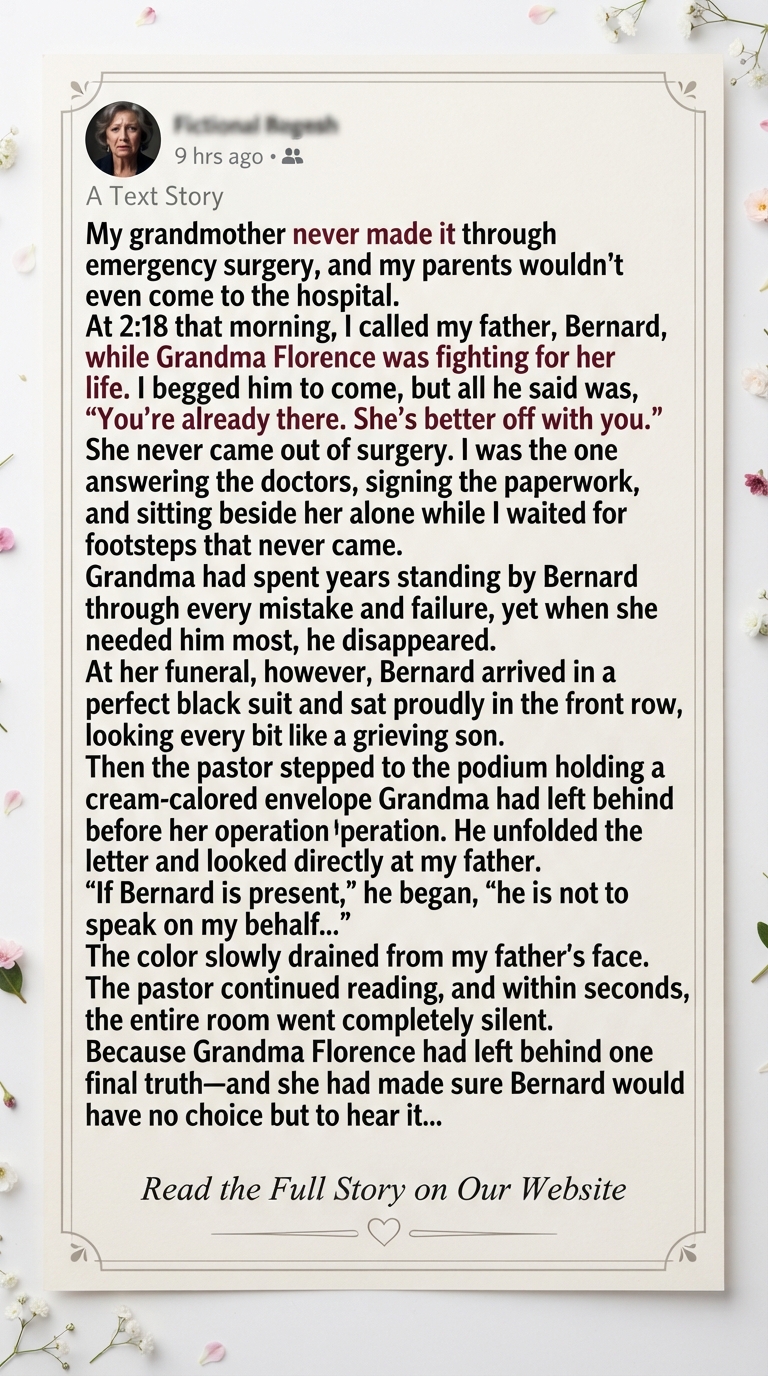
My grandmother never made it through emergency surgery.
And my parents wouldn’t even come to the hospital.
At 2:18 that morning, I called my father, Bernard, while Grandma Florence was fighting for her life.
I was sitting in a plastic chair outside the operating room.
My hands were shaking.
My phone was pressed against my ear.
“Dad, please come.”
There was a long silence.
Then he said:
“You’re already there.”
I swallowed.
“She asked for you.”
He sighed.
“She’s better off with you.”
I couldn’t believe what I was hearing.
“She’s your mother.”
Another pause.
Then he said:
“I can’t deal with hospitals.”
And he hung up.
I stared at the phone.
My mother didn’t answer my calls either.
I called again.
Nothing.
So I went back to the waiting room alone.
Grandma Florence had raised me in many ways.
When I was eight and my parents were going through one of their worst periods, Grandma took me in for almost a year.
When my father lost his job, she helped him.
When he started his business, she lent him money.
When his first marriage before my mother collapsed, Grandma paid his rent.
When he made another bad decision, she was there.
When he failed, she helped him stand.
She had spent her life believing her son could still become the man she knew he could be.
Even when he disappointed her.
Even when he borrowed money and never repaid it.
Even when he disappeared for months.
She never stopped calling him her boy.
And now, when she was fighting for her life, he couldn’t even drive to the hospital.
At 4:41 a.m., the surgeon came out.
I knew from his face.
He sat beside me.
“I’m very sorry.”
I covered my mouth.
“No.”
He gently explained that complications had become too severe.
Grandma Florence was gone.
I was the one who signed the paperwork.
I was the one who called the funeral home.
I was the one who chose her clothes.
I was the one who sat beside her afterward.
My parents never came.
Not that morning.
Not that afternoon.
Not even that night.
Three days later, at Grandma’s funeral, my father finally appeared.
He arrived in a perfect black suit.
His hair was neatly combed.
His shoes were polished.
He shook hands with relatives.
He accepted condolences.
Then he walked to the front row and sat down.
He looked every bit like a grieving son.
I stared at him from across the church.
He didn’t look at me.
The pastor began speaking about Grandma’s life.
He talked about her generosity.
Her faith.
Her stubbornness.
Her ability to forgive.
Then he paused.
He reached beneath the podium.
And pulled out a cream-colored envelope.
“I was asked to read something today,” he said.
The church became quiet.
“This letter was left by Florence before her surgery.”
My father shifted in his seat.
The pastor opened the envelope.
He looked directly at Bernard.
“If Bernard is present,” he began, “he is not to speak on my behalf.”
My father’s face changed immediately.
The pastor continued.
“Bernard has spent most of his life believing that being my son was enough to guarantee my forgiveness.”
My father stared at the floor.
The pastor turned the page.
“It was not.”
Someone in the back of the church gasped.
I felt my heart pounding.
The pastor continued.
“I loved my son more than I can explain. That love made me excuse things I should have confronted.”
He read slowly.
“When Bernard lost his job, I helped him.”
“When he failed at his business, I helped him.”
“When he needed money, I gave him money.”
“When he needed a place to stay, I opened my door.”
“When he made mistakes, I told myself he would learn.”
“But every time I rescued him, I accidentally taught him that someone else would always carry the consequences.”
My father looked up.
His face had gone pale.
The pastor continued.
“Last month, Bernard asked me for money again.”
I looked at my father.
He didn’t move.
“He said he needed $40,000 to pay off a business debt.”
The room became even quieter.
“I refused.”
My father closed his eyes.
The pastor continued.
“He told me that if I didn’t help him, he would lose everything.”
“I told him that perhaps losing everything was finally the consequence he needed to become responsible for his own life.”
My father’s hands began trembling.
Then the pastor reached the part that changed everything.
“Bernard became angry.”
“He told me I had spent my entire life choosing everyone else over him.”
“He told me I was a terrible mother.”
My father’s face was now completely drained of color.
I remembered something.
Two weeks before Grandma’s surgery, she had called me.
She sounded frightened.
I had asked her what was wrong.
She said:
“I think Bernard is angry because I’m finally saying no.”
I hadn’t understood then.
Now I did.
The pastor continued.
“I want my family to understand something.”
“Bernard did not abandon me at the hospital because he was unable to come.”
“He chose not to come.”
My father suddenly stood.
“That’s not fair.”
The pastor stopped reading.
The entire church turned toward him.
My father looked around.
“I loved my mother.”
Nobody spoke.
The pastor calmly said:
“Florence anticipated that you might say that.”
He looked down at the letter.
Then read:
“If Bernard says he loved me, let him remember that love is not measured by what we feel when it is convenient.”
“It is measured by what we do when someone needs us.”
My father’s mouth opened.
No words came out.
The pastor continued.
“When I needed him, he sent my granddaughter.”
“When I needed his voice, he gave me silence.”
“When I needed my son, he gave me an excuse.”
Then came the sentence that made my father sit down.
“And still, I loved him.”
I started crying.
The pastor’s voice softened.
“That is the tragedy of a mother’s love. Sometimes it survives even when trust does not.”
My father lowered his head.
But the letter wasn’t finished.
The pastor reached the final page.
“I have changed my will.”
A murmur moved through the church.
My father looked up.
“I leave my house to my granddaughter.”
My heart stopped.
“The savings account is divided between my grandchildren.”
“The small investment account is to be used to establish a scholarship in my name for students who have lost a parent or guardian and are struggling to stay in school.”
My father stared at the pastor.
“And Bernard?”
The pastor looked directly at him.
“Bernard receives nothing.”
My father stood again.
“You can’t do that.”
The pastor folded the letter.
“She already did.”
My father looked at me.
“You knew about this?”
“No.”
He seemed stunned.
Then the pastor added:
“There is one final instruction.”
Everyone became silent again.
“If Bernard attends my funeral, I want him to hear this.”
He unfolded the final paragraph.
“Bernard, I am not leaving you without anything.”
My father looked up.
“I am leaving you the one thing you have avoided your entire life.”
“Responsibility.”
My father’s face crumpled.
The pastor continued.
“You are no longer my little boy.”
“You are a grown man.”
“And for the first time, nobody is coming to rescue you.”
My father sat down.
He covered his face with both hands.
I had expected to feel satisfaction.
Instead, I felt something else.
Sadness.
Because Grandma hadn’t written the letter to punish him.
She had written it because she wanted the truth spoken when she no longer had the chance to say it herself.
After the service, people gathered outside.
My father remained inside.
I found him sitting alone in the front row.
He looked older than he had that morning.
“I didn’t know she was going to leave you anything,” he said.
“I didn’t either.”
He looked at me.
“She really meant all of that?”
“Yes.”
He stared at the floor.
Then he whispered:
“I should have gone to the hospital.”
I didn’t answer.
“I should have gone.”
Still, I said nothing.
He wiped his face.
“Did she suffer?”
I swallowed.
“No.”
He nodded.
Then he asked:
“Was she alone?”
I looked directly at him.
“No.”
He looked relieved for half a second.
Then I continued.
“I was there.”
His face fell.
He understood.
Months passed.
My father didn’t suddenly become a different person.
There was no magical transformation.
He still had debts.
His business still failed.
He had to sell his house.
He had to face the consequences Grandma had warned him about.
But something changed.
He stopped asking everyone to save him.
He got a job.
He started paying back people he owed.
And six months later, he came to Grandma’s grave.
I happened to be there.
He stood several feet away.
“I didn’t know you were here,” he said.
“I come every month.”
He nodded.
Then he placed a small bouquet beside her grave.
“I don’t know if she would forgive me.”
I looked at the headstone.
“She already did.”
He looked at me.
“But that doesn’t mean she trusted you.”
He nodded slowly.
“I know.”
That was the first time I heard him say it without arguing.
He sat beside the grave.
“I thought she would always be there.”
“I know.”
“I thought I had more time.”
I looked at him.
“So did I.”
He wiped his eyes.
Then he said:
“I should have been there.”
This time, I answered.
“Yes.”
He didn’t defend himself.
He didn’t make excuses.
He simply nodded.
And for the first time in my life, I saw my father begin to understand what Grandma had tried to teach him for decades.
Love can forgive.
But love cannot erase consequences.
And being someone’s child doesn’t mean you are entitled to their sacrifice forever.
A year after Grandma died, the first Florence Harper Memorial Scholarship was awarded.
The first recipient was a seventeen-year-old girl whose mother had died unexpectedly.
She was working two jobs while trying to finish high school.
I handed her the scholarship certificate.
She started crying.
“So someone believed in me?”
I smiled.
“Someone believed in you before she ever met you.”
That night, I went home and opened Grandma’s old box of photographs.
At the bottom was a picture of my father as a little boy.
Grandma was standing behind him with her hands on his shoulders.
He was smiling.
She was smiling too.
I turned the photograph over.
On the back, Grandma had written:
“My boy. I hope one day you understand that loving you does not mean protecting you from every consequence.”
I sat there for a long time.
Then I finally understood her last lesson.
Grandma had spent her whole life trying to save my father.
But her final act of love was refusing to save him one more time.
Not because she stopped loving him.
Because she finally understood that sometimes the most loving thing you can do for someone is stop carrying what belongs to them.
And that was the truth she made sure he could never avoid hearing.
Even after she was gone.