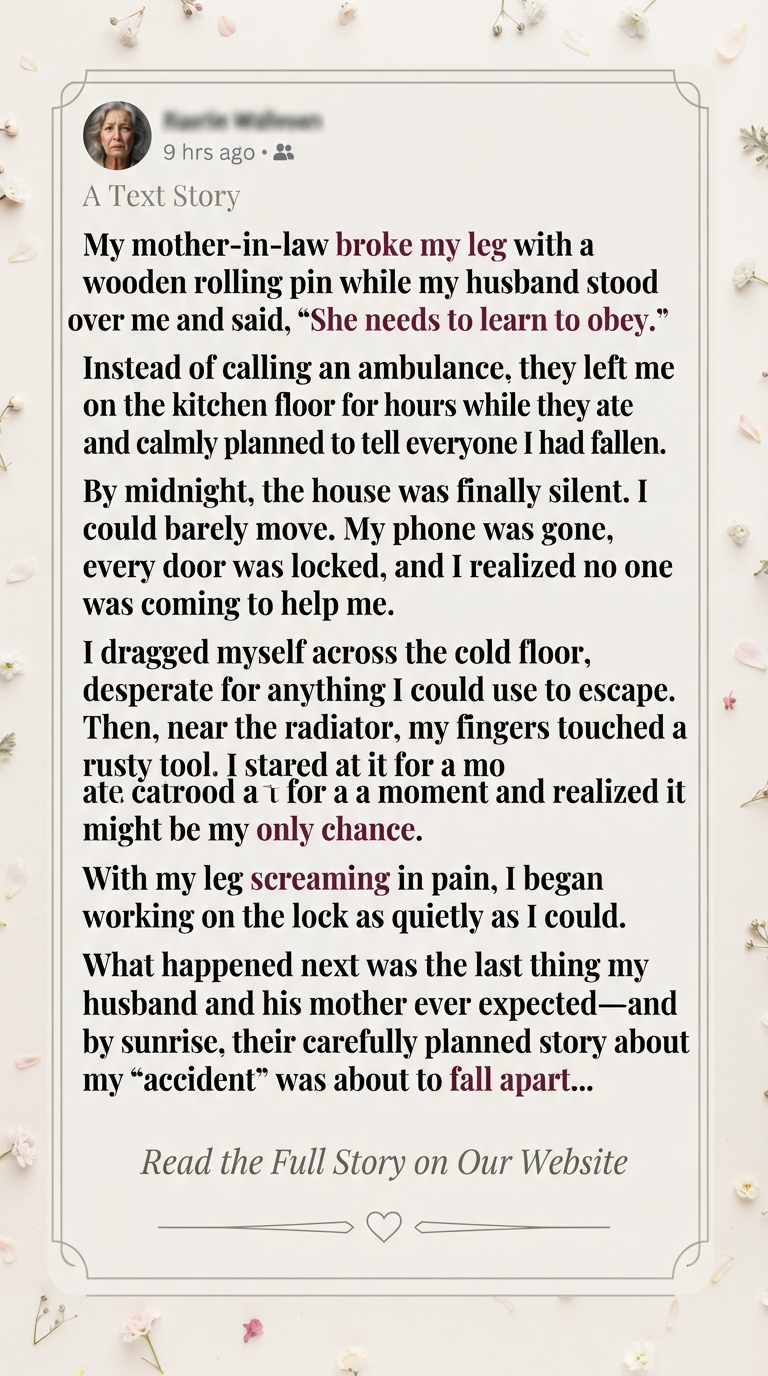
My mother-in-law broke my leg with a wooden rolling pin while my husband stood over me and said:
“She needs to learn to obey.”
I will never forget those words.
Not because they were cruel.
Because they were calm.
There was no anger in my husband’s voice.
No hesitation.
He said them as if he were discussing something ordinary.
Something that happened every day.
My mother-in-law had been furious with me because I had refused to sign a document transferring my savings into a joint account with my husband.
She called me selfish.
My husband called me disrespectful.
I told them I wasn’t giving anyone control over money I’d spent years saving.
Then my mother-in-law picked up the rolling pin.
The next thing I remember was the unbearable pain.
I screamed.
My husband didn’t help me.
He simply stood there.
“She needs to learn,” he said.
I begged them to call an ambulance.
My mother-in-law looked at me.
“You’ll tell everyone you fell.”
Then they left me on the kitchen floor.
They ate dinner.
I could hear their voices from the dining room.
They discussed what they would say.
She fell.
She was careless.
She had been drinking.
She slipped.
They rehearsed my “accident” while I lay on the floor unable to stand.
Hours passed.
Eventually, the house became silent.
I tried reaching for my phone.
It was gone.
Every door was locked.
My husband had taken the keys.
I screamed until my throat hurt.
Nobody came.
For the first time, I understood something terrifying.
They weren’t waiting for me to recover.
They were waiting for me to become quiet.
I looked around the kitchen.
The room was dark except for the faint light from the hallway.
I tried moving.
Pain shot through my leg.
I almost passed out.
But I kept going.
I dragged myself across the floor inch by inch.
Near the radiator, my fingers touched something cold.
A rusty old tool.
I stared at it.
Then at the kitchen door.
I didn’t know if it would work.
I only knew I had to try.
I pulled myself toward the lock.
My hands shook so badly that I dropped the tool twice.
Every movement sent pain through my leg.
I bit down on my sleeve to keep from crying out.
Finally, something inside the lock shifted.
The door opened.
I froze.
Nothing.
The hallway was empty.
I dragged myself toward the back entrance.
It was locked too.
But the old tool was enough to force the latch.
Cold air rushed inside.
I crawled onto the porch.
Then I screamed.
“HELP!”
A light came on in the house next door.
I screamed again.
“PLEASE!”
A window opened.
Then another.
A voice shouted:
“Are you okay?”
“No!”
That one word probably saved my life.
My neighbor, Mrs. Collins, ran outside.
She saw me on the ground and immediately called 911.
I remember her kneeling beside me.
“Who did this?”
I couldn’t answer at first.
Then I whispered:
“My husband.”
She looked toward the house.
“And his mother.”
Within minutes, police and paramedics arrived.
The paramedics stabilized my leg and took me to the hospital.
I underwent surgery that morning.
When I woke up, there was a police detective sitting beside my bed.
Her name was Detective Harris.
She spoke gently.
“Your husband says you fell.”
I stared at her.
“That’s not what happened.”
“I know.”
I looked at her.
“What?”
She placed a plastic evidence bag on the table.
Inside was my phone.
“We found it in your husband’s car.”
My heart sank.
Then she showed me something else.
A recording.
My husband had accidentally left his phone recording on the kitchen counter.
The recording captured his voice.
It captured my mother-in-law shouting.
It captured me begging for help.
And most importantly, it captured my husband saying:
“She needs to learn to obey.”
Detective Harris looked at me.
“You don’t have to convince us.”
I started crying.
For the first time since that night, I felt safe enough to stop pretending I was strong.
The investigation uncovered even more.
My husband had searched online for how long a broken leg could go untreated.
My mother-in-law had sent messages to relatives explaining that I had “fallen.”
They had even discussed removing the rolling pin before police arrived.
But they hadn’t known about the neighbor.
They hadn’t known about the recording.
And they hadn’t known that my phone had automatically backed up photographs and messages to the cloud.
The evidence told a very different story.
The story they had planned fell apart within forty-eight hours.
My husband was arrested.
His mother was arrested later that week.
The prosecutor told me the evidence was unusually strong because their own messages contradicted the accident story.
Months later, I stood in court with a brace on my leg.
My husband looked at me.
For the first time since the attack, he didn’t look powerful.
He looked small.
He asked if I would speak with him privately.
I refused.
I had spent too many years believing that keeping the peace was more important than protecting myself.
I wasn’t making that mistake again.
Eventually, both were convicted of charges related to the assault and confinement.
I spent months recovering.
Physical therapy was exhausting.
Some days, I could barely walk across the room.
Other days, I cried because I remembered what had happened.
But slowly, I got stronger.
I moved into a small apartment of my own.
I changed my phone number.
I opened a new bank account.
I replaced every lock.
And I started therapy.
Not because there was something wrong with me.
Because something terrible had happened to me.
There is a difference.
A year later, I returned to that old house with a police escort to collect the last of my belongings.
I stood in the kitchen for a moment.
The radiator was still there.
So was the spot where I had crawled across the floor.
I looked at it.
Once, I had thought that room was where my life ended.
I was wrong.
It was where my life changed.
My neighbor Mrs. Collins had saved me that night.
But I had also saved myself.
I had refused to lie.
I had refused to disappear.
I had refused to let them write the ending for me.
Before I left, I looked at the kitchen one final time.
The rolling pin was gone.
The rusty tool was gone.
The locks had been changed.
And the story they had planned to tell was gone too.
Because by sunrise, the truth had already escaped through the door they thought they had locked forever.
And sometimes survival begins with one simple decision:
You don’t have to stay where someone is hurting you just because they tell you that you have nowhere else to go.