The Night I Changed the Locks
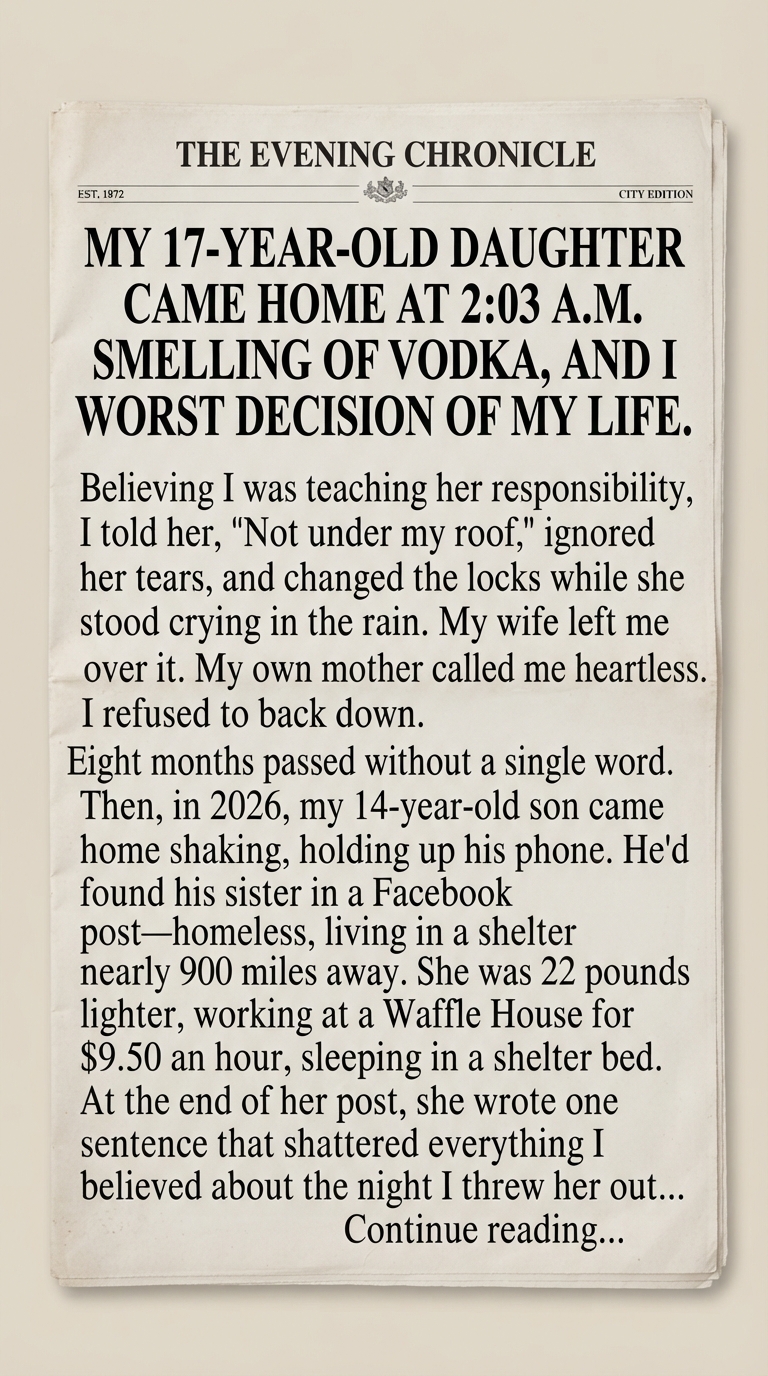
My daughter came home at 2:03 in the morning smelling like vodka, and I made the worst decision of my life.
At the time, I thought I was being a good father.
I thought I was teaching her responsibility.
I thought consequences were supposed to hurt.
Her name was Emily. She was seventeen, stubborn, brilliant, and at that age where every conversation between us somehow turned into an argument. She had been testing boundaries for months—missing curfew, ignoring calls, coming home with excuses that grew thinner every time.
My wife, Sarah, always told me I was too hard on her.
And I always told Sarah she was too soft.
That night, when Emily stumbled through the front door at 2:03 a.m., I had been waiting in the living room for nearly three hours.
The porch light was on.
My phone was on the coffee table.
I had called her eleven times.
No answer.
When the door opened, I stood.
Emily froze.
She looked at me, then at the clock.
“Dad—”
“Where have you been?”
She swallowed.
“I was with friends.”
“It’s two in the morning.”
“I know.”
“You smell like alcohol.”
Her eyes dropped to the floor.
“I didn’t—”
“Don’t lie to me.”
That was when everything changed.
Maybe it was the fear I had been carrying for hours.
Maybe it was anger.
Maybe I was tired of feeling like my daughter no longer respected me.
Whatever it was, I let it take control.
“You want to live like an adult?” I shouted. “Then live somewhere else.”
Her face went pale.
“Dad…”
“Not under my roof.”
She started crying.
Real tears.
Not teenage anger. Not manipulation.
Fear.
“Please,” she whispered. “I’m sorry.”
Sarah came running down the hallway.
“What is going on?”
“She came home drunk.”
“So we talk about it,” Sarah said. “We ground her. We deal with it in the morning.”
“I’m done.”
Emily grabbed my arm.
“Dad, please. I don’t have anywhere to go.”
“You should have thought about that before you walked through that door.”
Sarah stared at me as if she didn’t recognize me.
“Mark,” she said quietly, “don’t do this.”
But I was already moving toward the door.
Emily stood on the porch in the rain, crying.
I handed her a small bag with a few clothes.
Then I closed the door.
She knocked for almost twenty minutes.
At first, I stood on the other side.
I could hear her.
“Dad, please!”
Then her voice became quieter.
Then desperate.
Then exhausted.
Eventually, the knocking stopped.
I told myself she had called a friend.
I told myself she was safe.
I told myself this was what tough love looked like.
By sunrise, I had changed the locks.
When Sarah saw the new deadbolt, she packed a suitcase.
“You didn’t teach her responsibility,” she said.
I stared at her.
“She broke the rules.”
“She’s seventeen.”
“She needs to learn.”
Sarah zipped her bag.
“No,” she said, tears filling her eyes. “You need to learn that being her father doesn’t mean making her afraid of coming home.”
She left that afternoon.
My mother called two days later.
“What were you thinking?”
“She came home drunk.”
“And you threw your child into the street?”
“I gave her consequences.”
“No,” my mother said. “You abandoned her.”
I refused to listen.
I refused to apologize.
And worst of all, I refused to look for Emily.
Because looking for her would have meant admitting that maybe I had been wrong.
Days became weeks.
Weeks became months.
I sent messages.
At least, that’s what I told myself.
A few texts.
A few calls.
Nothing serious.
Nothing that required me to admit what I had done.
Emily never answered.
Eight months passed without a single word.
Then one evening in 2026, my fourteen-year-old son, Noah, came home from school shaking.
He was holding his phone so tightly that his knuckles were white.
“Dad.”
I looked up from the kitchen table.
“What happened?”
He didn’t answer.
He just held out his phone.
“I found Emily.”
For a moment, I couldn’t breathe.
The screen showed a Facebook post.
It had been shared by a homeless shelter nearly nine hundred miles away.
There was a photograph.
A group of volunteers standing outside the shelter.
And near the edge of the picture was a girl I almost didn’t recognize.
My daughter.
Her hair was shorter.
Her face was thinner.
Painfully thin.
Later, I would learn she had lost twenty-two pounds.
She was working shifts at a Waffle House for $9.50 an hour, trying to save enough money to leave the shelter.
But in that photograph, none of that mattered.
All I could see was Emily.
My little girl.
The girl who used to fall asleep on my chest during thunderstorms.
The girl I taught to ride a bicycle.
The girl who once made me a Father’s Day card with the words:
MY DAD WILL ALWAYS KEEP ME SAFE.
My hands started shaking.
Noah had found her profile.
He scrolled down to a long post Emily had written a few weeks earlier.
I read every word.
She wrote about sleeping on friends’ couches after I threw her out.
About friends whose parents eventually asked her to leave.
About spending nights in places she was afraid to describe.
About taking whatever jobs she could find.
About being hungry.
About learning not to trust anyone who promised they would always be there.
I couldn’t stop reading.
Then I reached the final sentence.
The sentence that shattered everything I had believed about the night I changed the locks.
Emily had written:
“The hardest part wasn’t that my father threw me out that night—it was realizing that when I stood outside his door crying and begging to come back, I was still young enough to believe he would open it.”
I dropped the phone.
Noah started crying.
“So you really did it?”
I couldn’t answer.
He backed away from me.
“You left her out there?”
I covered my face.
For eight months, I had defended myself.
I had called it discipline.
Tough love.
Responsibility.
But suddenly, all I could hear was her voice on the other side of that door.
Dad, please.
And I had heard her.
I just hadn’t cared enough to open it.
That night, I didn’t sleep.
At sunrise, I called the shelter.
The woman who answered was careful.
“I’m her father.”
There was a long silence.
Then she said, “She doesn’t want to talk to you.”
“I understand.”
“No,” the woman replied. “I don’t think you do.”
I closed my eyes.
“You’re right.”
Another silence.
Then I said the words I should have said eight months earlier.
“I was wrong.”
I drove nine hundred miles.
Not because I believed I deserved forgiveness.
I didn’t.
Not because I thought showing up would magically fix what I had destroyed.
It wouldn’t.
I drove because for the first time, I understood what being a father actually required of me.
Showing up.
Even when it was too late.
Even when I was ashamed.
Even when the person I had hurt wanted nothing to do with me.
I found Emily sitting outside the Waffle House after her shift.
She was still wearing her uniform.
When she saw me, she stood.
For a second, neither of us spoke.
Then she crossed her arms.
“You found me.”
“Yes.”
“Why?”
Because I was sorry.
Because I missed her.
Because I had spent nine hundred miles rehearsing a speech.
But when I looked at her, none of those words felt big enough.
So I told her the truth.
“Because I finally understand what I did to you.”
She laughed once.
There was no happiness in it.
“You understand now?”
“I think I’m starting to.”
“You threw me away, Dad.”
My eyes filled with tears.
“I know.”
“You didn’t know where I was.”
“I know.”
“You didn’t look.”
That one hurt the most because it was true.
“I know.”
Emily looked away.
Cars passed on the highway.
The Waffle House sign buzzed above us.
Finally, she asked, “So what do you want?”
I took a breath.
“Nothing.”
She looked back at me.
“I don’t expect you to forgive me. I don’t expect you to come home with me. I don’t expect you to call me Dad.”
My voice broke.
“But I will spend the rest of my life making sure you know that if you ever need a door opened, you can call me.”
She stared at me for a long time.
Then she whispered, “Why should I believe you?”
I had no answer.
Because trust isn’t rebuilt with a speech.
It isn’t repaired with tears.
And it certainly isn’t restored because the person who broke it finally feels guilty.
So I didn’t ask her to believe me.
“I don’t know,” I said. “You shouldn’t have to. I’ll just have to prove it.”
Emily didn’t come home with me that night.
She didn’t hug me.
She didn’t forgive me.
But before I left, she handed me a piece of paper.
It had a phone number written on it.
“This is my number,” she said. “Don’t call every five minutes.”
I laughed through my tears.
“I promise.”
“Dad?”
I looked up.
She hesitated.
Then she said, “I’m still angry.”
“You have every right to be.”
“And I’m not ready to forgive you.”
“I understand.”
She nodded.
Then, for the first time in eight months, she said:
“Okay.”
It wasn’t forgiveness.
It wasn’t healing.
But it was a beginning.
Over the next few months, I helped Emily get an apartment.
Not because I wanted to buy my way back into her life.
Because she needed help, and for once, I didn’t confuse punishment with parenting.
I helped her find a better job.
I paid for therapy when she agreed to go.
Eventually, Sarah agreed to meet me for coffee.
She didn’t come back.
I didn’t ask her to.
I had destroyed more than one relationship with my pride.
But she told me something I will never forget.
“Maybe you can’t change what kind of father you were that night,” she said. “But you can decide what kind of father you will be tomorrow.”
Emily is twenty now.
We still have difficult days.
Sometimes she doesn’t answer my calls.
Sometimes she brings up that night, and I don’t defend myself anymore.
I listen.
Because that is the consequence I earned.
Last Father’s Day, a card arrived in my mailbox.
There was no return address, but I recognized her handwriting immediately.
Inside, she had written:
“I’m not ready to say everything is okay. But I’m trying to remember the good parts. Thank you for trying to become the father I needed you to be.”
I sat alone at the kitchen table and cried.
Then I looked toward the front door.
The same door I had once closed in my daughter’s face.
The same door whose locks I had changed because I thought fear could teach a child a lesson.
The locks are still there.
But now, every night before I go to bed, I check them only to make sure one thing is true.
If my daughter ever comes home—
The door will open.