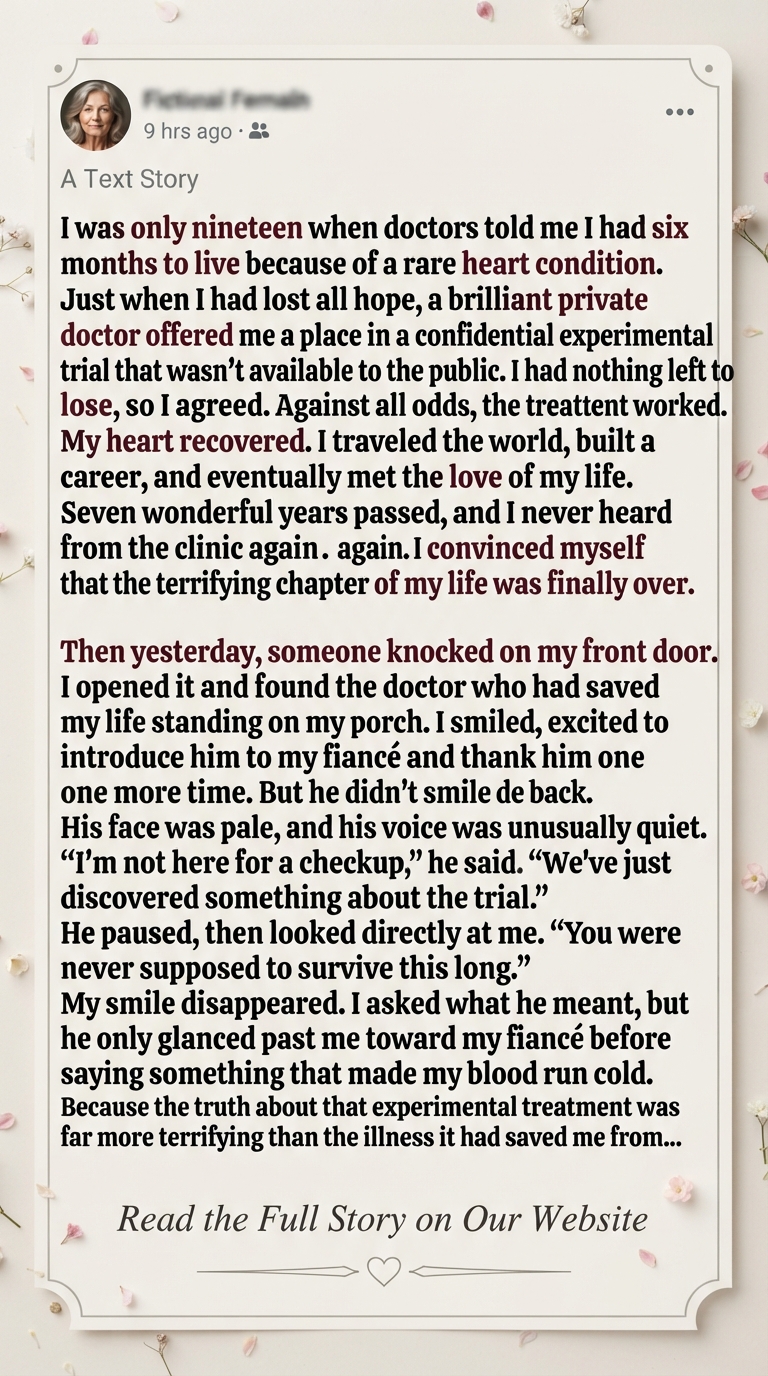
I was only nineteen when doctors told me I had six months to live.
My heart was failing.
Not slowly.
Not eventually.
It was already deteriorating so rapidly that the doctors were afraid I wouldn’t make it through the year.
They called my condition exceptionally rare.
My parents tried every specialist they could find.
We traveled from hospital to hospital.
Every answer was the same.
There was no established treatment.
A transplant might eventually be possible, but I wasn’t considered a strong candidate.
Then, just when I had stopped imagining a future, a private doctor named Dr. Adrian Vale approached my family.
He said he was working on an experimental treatment.
It wasn’t approved for public use.
It wasn’t even being offered through normal clinical trials.
But he believed I could qualify.
“There are risks,” he told me.
I remember laughing bitterly.
“What risks could possibly be worse than dying?”
He didn’t answer.
I signed the papers.
Three weeks later, I received the treatment.
For the first few days, nothing happened.
Then something incredible occurred.
My heart function began improving.
Slowly.
Then rapidly.
Doctors repeated the tests.
They couldn’t explain it.
Within months, my heart had recovered enough that I was removed from the transplant list.
Dr. Vale called it a miracle.
I called it a second chance.
I promised myself I’d never waste it.
And I didn’t.
I traveled.
I finished college.
I built a career.
I learned three languages.
I climbed mountains.
I learned to dance badly and laugh loudly.
And eventually, I met Daniel.
He made me feel safe.
Normal.
Human.
Seven wonderful years passed.
I barely thought about the clinic anymore.
Until yesterday.
Someone knocked on my front door.
I opened it expecting a delivery.
Instead, Dr. Adrian Vale stood on my porch.
He looked nothing like the man I remembered.
He looked exhausted.
Older.
Afraid.
I smiled.
“Doctor?”
He stared at me.
Then he looked past me.
“Is Daniel here?”
“Yes.”
I stepped aside.
“Come in.”
He didn’t move.
“Emma, I need you to listen carefully.”
My smile disappeared.
“What happened?”
He swallowed.
“We’ve just discovered something about the trial.”
My heart suddenly seemed to pound harder.
He lowered his voice.
“You were never supposed to survive this long.”
I stared at him.
“What does that mean?”
He looked over my shoulder again.
At Daniel.
Then back at me.
“Your treatment wasn’t designed to cure you.”
I felt the blood drain from my face.
“What?”
He stepped inside.
“Seven years ago, we believed the treatment would temporarily replace damaged cardiac cells with laboratory-grown cells.”
“That sounds like what happened.”
“No.”
He shook his head.
“The treatment changed something else.”
He opened his briefcase.
Inside was a folder.
“Your original trial records disappeared three years ago.”
“What?”
“They weren’t lost.”
He handed me several pages.
“They were removed.”
I looked down.
My name was on the first page.
Then I saw a line highlighted in red.
Subject demonstrates unexpected cellular persistence.
I looked at him.
“What does that mean?”
“It means the cells we implanted didn’t behave like ordinary replacement tissue.”
My throat tightened.
“What did they do?”
“They changed.”
“How?”
He hesitated.
“We don’t know.”
That answer terrified me more than anything else.
Dr. Vale continued.
“For years, we believed the treatment had simply regenerated your heart.”
“But?”
“We discovered something last month.”
He turned another page.
“The same cellular signature found in your heart was detected in samples from another patient.”
My stomach dropped.
“Another survivor?”
“No.”
He looked at Daniel.
“A deceased patient.”
Silence.
Daniel stepped closer.
“What does that have to do with Emma?”
Dr. Vale looked at him.
“Everything.”
Daniel’s expression changed.
The doctor reached into his briefcase again.
This time, he pulled out a photograph.
He placed it on the table.
It showed a woman in a hospital bed.
I didn’t recognize her.
Then I looked at the name printed underneath.
Sarah Mercer.
Daniel went completely still.
I turned toward him.
“Daniel?”
He didn’t answer.
Dr. Vale whispered,
“Sarah Mercer was your mother.”
The room seemed to tilt.
Daniel stared at the photograph.
“My mother died when I was twelve.”
“I know.”
“Heart failure.”
Dr. Vale nodded.
“That’s what the records said.”
Daniel looked at him.
“What are you saying?”
Dr. Vale opened another file.
“Your mother was treated at the same private facility seventeen years ago.”
Daniel’s face went pale.
“But the trial didn’t exist then.”
“Not publicly.”
I felt a chill move through me.
“What does this have to do with my treatment?”
Dr. Vale looked directly at me.
“Your treatment wasn’t the beginning of the research.”
He paused.
“It was the final version.”
Daniel stared at him.
“My mother was one of the original subjects?”
“Yes.”
“And she died.”
“Yes.”
“Then why did Emma survive?”
Dr. Vale’s eyes filled with something that looked like guilt.
“Because the researchers changed the treatment after your mother’s death.”
I felt my hands trembling.
“What did they change?”
“They added a genetic targeting component.”
My stomach twisted.
“What kind of targeting?”
He didn’t answer immediately.
Then he said,
“Family markers.”
I stared at him.
Daniel stepped forward.
“Are you telling me Emma was chosen because of my mother?”
“No.”
Dr. Vale looked at him.
“She was chosen because she carried something your mother carried.”
Daniel went silent.
I couldn’t breathe.
“What?”
“A genetic mutation.”
He looked at me.
“Your heart condition wasn’t random.”
My knees weakened.
“What are you saying?”
“Your father had the mutation.”
I shook my head.
“My father died when I was eight.”
“I know.”
“And my mother?”
“Didn’t carry it.”
Daniel stared at me.
“Then how did she get it?”
Dr. Vale slowly turned toward him.
“Because Sarah wasn’t Emma’s biological mother.”
The room went silent.
I felt as though the entire world had stopped.
“My mother?”
Dr. Vale nodded.
“Your biological mother was Sarah Mercer.”
Daniel stared at me.
“No.”
I backed away.
“No. That’s impossible.”
Dr. Vale pulled another document from the folder.
A sealed adoption record.
My name.
My birth date.
Sarah Mercer’s name.
And beside it—
Biological mother.
Daniel grabbed the document.
His hands were shaking.
“My mother had a daughter?”
Dr. Vale nodded.
“You.”
I couldn’t speak.
For nineteen years, I had believed my parents were my biological parents.
For seven years, I had believed my heart had simply been sick.
And now I was learning that the treatment that saved my life had been developed from research conducted on my biological mother.
But there was still one question.
“Why didn’t anyone tell me?”
Dr. Vale looked ashamed.
“Because the trial was never supposed to be public.”
“Why?”
“Because it wasn’t just a treatment study.”
“What was it?”
He closed his eyes.
“It was an attempt to determine whether the modified cells could permanently alter the progression of inherited disease.”
I stared at him.
“So I was an experiment.”
“Yes.”
The word hit harder than any diagnosis I’d ever received.
I looked at Daniel.
He looked devastated.
Then Dr. Vale said something that changed everything again.
“There is one more problem.”
I almost laughed.
“One more?”
He nodded.
“The cells in your heart are still changing.”
I froze.
“What does that mean?”
“We don’t know.”
“Then why are you here?”
He looked toward Daniel.
“Because we recently discovered that the same biological marker has appeared in another person.”
Daniel’s eyes narrowed.
“Who?”
Dr. Vale hesitated.
Then he said,
“You.”
Daniel went completely still.
“What?”
“Your bloodwork shows the same marker.”
I looked at him.
“But he’s never had heart problems.”
“Exactly.”
Dr. Vale opened the final report.
“The marker appears to be transferring between people who share prolonged biological exposure.”
Daniel frowned.
“What kind of exposure?”
Dr. Vale looked at me.
Then at him.
“Pregnancy.”
My heart stopped.
I stared at him.
“What?”
He swallowed.
“We believe the modified cells can cross the placenta.”
Daniel looked at me.
I instinctively placed a hand over my stomach.
I had been feeling unusually tired for weeks.
I’d blamed work.
Stress.
Planning our wedding.
But suddenly I remembered something.
The appointment I had scheduled for next week.
The pregnancy test sitting unopened in my bathroom drawer.
I hadn’t told Daniel.
Because I hadn’t been completely sure.
Dr. Vale’s voice became very quiet.
“Emma, are you pregnant?”
I looked at Daniel.
His eyes filled with fear.
Then I nodded.
“Yes.”
Nobody spoke.
For seven years, I had believed the treatment gave me my life back.
Now I understood.
It had changed my life in ways no one had ever warned me about.
But there was something Dr. Vale hadn’t expected.
I didn’t panic.
I didn’t run.
I looked at him and asked,
“Can you help my baby?”
He hesitated.
Then nodded.
“Yes.”
“Then that’s what we’re going to do.”
For the next several months, I underwent careful monitoring at a major research hospital.
The original private clinic was investigated.
The records were subpoenaed.
The researchers involved were forced to disclose everything they knew.
And eventually, we discovered the most important fact.
The treatment hadn’t created some mysterious disease.
It had actually corrected the genetic defect responsible for my heart condition.
The danger came from the researchers not understanding how the modified cells behaved over time.
They had been afraid because they didn’t know what they had created.
But my doctors discovered that the cells were stable.
And the pregnancy did not develop the complication they feared.
My baby was healthy.
Nine months after that terrifying night, I gave birth to a little girl.
We named her Sarah.
After the woman who had given me life twice.
Once by bringing me into the world.
And once through the research that eventually saved me.
Daniel stood beside me in the hospital room, holding our daughter.
He looked at me.
“You realize our lives are completely different now.”
I smiled.
“They already were.”
He kissed my forehead.
Dr. Vale visited us one final time before leaving the hospital.
He stood beside the doorway.
“I owe you an apology.”
I looked at him.
“For what?”
“For not understanding what we were doing.”
I shook my head.
“You saved my life.”
“Yes.”
He looked at Sarah.
“But I should have told you the truth.”
I nodded.
“That matters.”
He left quietly.
Years later, I became an advocate for patients involved in experimental medical research.
I spoke about informed consent.
Transparency.
Long-term monitoring.
And the importance of treating patients as human beings rather than data points.
I never regretted taking the treatment.
It gave me seven years I was never supposed to have.
Then it gave me a husband.
A daughter.
A career.
A life.
But I also learned something I wish someone had told me when I was nineteen:
A miracle doesn’t excuse a secret.
The treatment saved my heart.
But the truth saved something else.
My ability to choose what happened next.
And every night, when I watch Sarah sleeping, I think about the doctor standing on my porch seven years after saving my life.
He came believing he was bringing me terrible news.
Instead, he brought me the truth.
And the truth wasn’t that I was never supposed to survive.
It was that I had been given a second chance before anyone understood what that second chance would become.
I was supposed to die at nineteen.
Instead, I became a wife.
A mother.
And the person who finally forced the people behind the experiment to tell the world what they had really done.