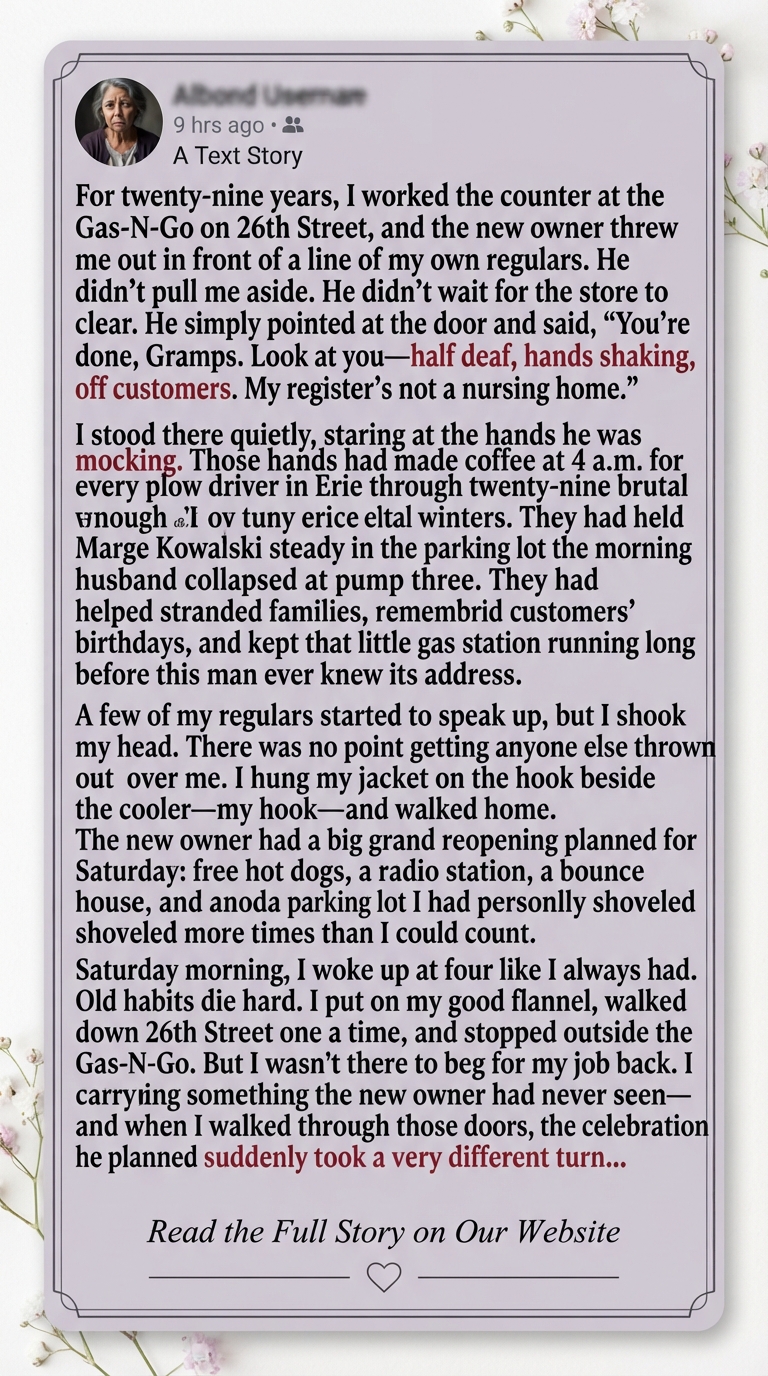
For twenty-nine years, I worked the counter at the Gas-N-Go on 26th Street.
I knew every squeaky floorboard.
Every stubborn coffee machine.
Every customer who wanted two sugars without having to ask.
I knew which truckers came through before dawn, which nurses stopped after night shifts, and which kids bought the same grape soda every Friday.
Most importantly, I knew that little store.
So when the new owner threw me out, he didn’t just fire an employee.
He erased twenty-nine years of history with one sentence.
“You’re done, Gramps.”
His name was Derek Walsh.
He was thirty-four years old and had bought the Gas-N-Go three months earlier.
He had never worked behind that counter.
He had never opened the store at four in the morning.
He had never shoveled snow from the pumps while the wind came screaming down 26th Street.
But he owned the place now.
Apparently, that was enough.
Derek pointed toward the front door.
“Look at you. Half deaf. Hands shaking. Scaring off customers. My register’s not a nursing home.”
The store went silent.
I looked down at my hands.
They were shaking.
He was right about that.
Age had made them less steady than they used to be.
But those hands had made coffee at four in the morning for every plow driver in Erie through twenty-nine brutal winters.
They had held Marge Kowalski steady in the parking lot the morning her husband collapsed at pump three.
They had changed flat tires for teenagers who didn’t know how.
They had carried groceries to elderly customers who couldn’t walk easily.
They had counted thousands of dollars without losing a penny.
They had opened that store when storms shut down half the city.
And now Derek was embarrassed by them.
A few of my regulars started speaking.
“Hey, Derek—”
“This isn’t right.”
“You can’t talk to him like that.”
I raised my hand.
“It’s all right.”
It wasn’t.
But I didn’t want anyone else losing their job because of me.
I took my jacket off the hook beside the cooler.
My hook.
I’d hung that jacket there for nearly three decades.
Then I walked out.
No argument.
No begging.
No shouting.
Just an old man walking home.
Saturday was Derek’s grand reopening.
He had spent weeks advertising it.
Free hot dogs.
A local radio station.
A bounce house.
Prize drawings.
Music in the parking lot.
He had even put up a giant banner:
THE NEW GAS-N-GO — A NEW ERA!
I saw it from halfway down the block.
I stood there for a moment.
Then I kept walking.
Because I wasn’t there to beg for my job back.
I was carrying something Derek had never seen.
Something I had kept locked away for years.
And when I walked through those doors, his grand reopening took a very different turn.
I arrived at eight in the morning.
The parking lot was packed.
The radio station was broadcasting live.
Children were jumping in the bounce house.
Derek stood near the entrance wearing a brand-new Gas-N-Go polo shirt.
He was smiling for photographs.
I walked inside.
Several customers saw me immediately.
“Frank!”
“Mr. Miller!”
“Look who’s here!”
Derek turned.
His smile disappeared.
“What are you doing here?”
I held up the folder in my hand.
“I’m here to finish something.”
He laughed.
“You don’t work here anymore.”
“I know.”
“Then you need to leave.”
I shook my head.
“Not yet.”
A crowd began forming.
Marge Kowalski was standing near the coffee counter.
She looked at me.
Then at the folder.
“What have you got there, Frank?”
I looked around the store.
“Something I should have shown people a long time ago.”
Derek crossed his arms.
“I’m not interested in your complaints.”
“This isn’t a complaint.”
I placed the folder on the counter.
“It’s a contract.”
Derek frowned.
“What contract?”
I opened it.
And slid the first page toward him.
His expression changed.
Then I said six words.
“Your purchase agreement isn’t what you think.”
Twenty-nine years earlier, the Gas-N-Go wasn’t called Gas-N-Go.
It was called Miller’s Market & Fuel.
My wife, Evelyn, and I bought it in 1997.
We were forty-seven years old.
We had two children.
And we had almost no money.
But we had a dream.
We wanted a little place where people knew each other’s names.
We worked seven days a week.
Then, in 2008, Evelyn got sick.
Cancer.
She fought for four years.
During those years, the store kept us going.
When she died, I almost sold it.
But the customers wouldn’t let me.
They brought casseroles.
Flowers.
Cards.
One morning, Marge showed up with thirty-seven customers behind her.
She put an envelope on the counter.
“What is this?”
“Money,” she said.
“For what?”
“To keep the store open.”
Inside were checks from customers.
Some were for twenty dollars.
Some for fifty.
One was for five.
They had collected money because they didn’t want me to leave.
I never cashed those checks.
I kept them.
Not because of the money.
Because they reminded me that the store wasn’t just mine.
It belonged to everyone who had walked through those doors.
Eventually, I realized I couldn’t work forever.
My children had careers in other states.
Neither wanted to take over the business.
So I decided to sell.
But I wanted the right person.
Someone who understood what the place meant.
That’s when Derek appeared.
He wasn’t a stranger.
He had worked for a regional convenience-store company.
He told me he wanted to modernize the business.
New pumps.
New refrigeration.
Better inventory.
He said he respected the store’s history.
I believed him.
That was my mistake.
Or so I thought.
I turned another page.
Derek stared at it.
“This is a private agreement.”
“Yes.”
“You can’t just—”
“I can.”
I pointed to the signature.
“My signature.”
Then I pointed to another paragraph.
“Your signature.”
His face tightened.
“What does that have to do with anything?”
“Everything.”
The original purchase agreement contained a condition.
I retained a small ownership interest in the property for five years.
Derek had agreed that if he sold the property, changed the business substantially, or terminated my employment during that period, I retained certain contractual rights.
But there was something else.
A clause I’d added after speaking with my attorney.
The store’s community programs had to continue.
The senior discount.
The free coffee for overnight emergency workers.
The winter assistance program.
The annual food drive.
Derek had agreed to maintain them.
He hadn’t.
Instead, he had quietly canceled almost everything.
And the property itself?
That was where things became interesting.
Derek hadn’t simply bought the business.
He had financed the purchase using the store’s future revenue.
But according to the documents in my folder, he had also made representations about the store’s customer base and operating history.
The numbers he presented to the lender included projected revenue based partly on the customer loyalty and community programs I had built.
In other words, the very reputation he was destroying was part of what made his purchase possible.
And now he was planning to demolish the old building and turn the property into a larger commercial development.
He thought nobody knew.
But someone did.
Me.
Derek looked furious.
“You’ve been spying on me?”
“No.”
“Then how did you get these documents?”
I smiled.
“Because you forgot something.”
“What?”
“You bought the business.”
He frowned.
“I did.”
“You didn’t buy my memory.”
The room went quiet.
I pulled out another document.
“This is a copy of the original property agreement.”
Then another.
“This is the amendment.”
Then another.
“And this is the letter from the attorney representing the property trust.”
Derek’s face went pale.
“You can’t stop the sale.”
“I don’t have to.”
I pointed toward the door.
“You already violated the agreement.”
The radio outside was still playing music.
Children were laughing.
But inside the store, nobody moved.
Derek stared at me.
“What do you want?”
That question surprised me.
For three months, I had asked myself the same thing.
Did I want my job back?
No.
Did I want Derek humiliated?
Maybe a little.
But that wasn’t the real answer.
I wanted the store protected.
I wanted the things that made it special to survive.
So I told him.
“I want the community agreement honored.”
Derek laughed bitterly.
“You think I’m going to run this place like you did?”
“No.”
I looked at him.
“I’m saying you don’t get to erase everything simply because you think you’re smarter than the old man who built it.”
Then Marge stepped forward.
“You should listen to him.”
Derek looked at her.
She was seventy-three years old.
She had been coming to the store since the day we opened.
“You weren’t here when my husband died,” she said.
Derek said nothing.
“You didn’t know his name.”
She pointed at me.
“He did.”
Another customer stepped forward.
A former police officer named Ray.
“He gave me coffee every night during the blizzard of 2014.”
A nurse raised her hand.
“He used to keep sandwiches behind the counter for hospital workers who couldn’t afford dinner.”
A truck driver said,
“He knew my birthday.”
A woman near the coffee machine added,
“He helped my son change his tire when he was sixteen.”
Then another voice.
“And he never charged me for coffee when my husband was unemployed.”
Derek looked around.
For the first time, he seemed to understand.
He hadn’t bought a building.
He had inherited a community.
And he had mistaken its kindness for weakness.
But the biggest surprise came from the radio station.
The host had been listening.
He walked inside holding a microphone.
“Frank, can I ask you something?”
I nodded.
“Is it true you started the winter coffee program here?”
“Yes.”
“And the emergency-worker discount?”
“Yes.”
“And the holiday food drive?”
“Yes.”
The host looked at Derek.
“Do you know how many people depend on those programs?”
Derek didn’t answer.
The host looked back at me.
“Would you consider staying involved?”
I laughed.
“I’m seventy-six.”
“So?”
“So I think I’ve earned a few mornings where I don’t have to wake up at four.”
The store erupted in laughter.
For the first time that morning, I smiled too.
Derek eventually called his attorney.
The attorney arrived about an hour later.
They spent nearly two hours reviewing the agreement.
When they came out of the office, Derek looked exhausted.
He walked toward me.
“I didn’t understand what I was buying.”
“No,” I said.
“You thought I was just an old cashier.”
He looked down.
“I was wrong.”
I nodded.
“Yes, you were.”
He swallowed.
“Can we fix this?”
I studied him.
Then I looked around the store.
At the coffee machine.
The counter.
The old photographs.
The people who had stayed.
“Yes,” I said.
“But not the way you think.”
Derek agreed to honor the community agreement.
The senior coffee program returned.
The overnight-worker discount returned.
The annual food drive returned.
The winter assistance fund was restored.
And the demolition plans were canceled.
But I didn’t go back to working full-time.
Instead, I became something Derek had never expected.
A consultant.
Two mornings a week.
No register.
No opening shifts.
No snow shoveling.
I trained the younger employees on the things that couldn’t be found in a manual.
Names.
Stories.
People.
I taught them that a convenience store could still be a place where somebody noticed when an elderly customer hadn’t come in for three days.
Where a stranded driver could ask for help without being embarrassed.
Where a nurse finishing a twelve-hour shift could get a cup of coffee without being treated like another transaction.
And Derek?
He changed too.
Slowly.
He started learning customers’ names.
He joined the food drive.
He personally delivered groceries during the next winter storm.
One morning, almost a year after he fired me, he walked up to the counter.
I was drinking coffee.
He placed something beside my cup.
My old jacket.
The one I’d left hanging beside the cooler.
“I found it in storage,” he said.
I picked it up.
“Thanks.”
He hesitated.
Then he said,
“Frank?”
“Yeah?”
“I’m sorry.”
I looked at him.
This time, he didn’t say it because someone had forced him to.
He said it because he meant it.
I nodded.
“Thank you.”
He walked away.
I put the jacket on the back of my chair.
I didn’t need the old hook anymore.
I had something better.
A place where I was still welcome.
A few months later, the Gas-N-Go celebrated its twenty-fifth anniversary under the new ownership.
Derek asked me to say a few words.
I stood in front of the crowd.
Marge sat in the front row.
The radio host was there.
Several former employees had returned.
I looked at the building.
Then at my hands.
They were still shaking.
But I didn’t hide them.
I raised one.
“These hands aren’t as steady as they used to be,” I said.
Everyone smiled.
“But they’ve done good work.”
I looked around the crowd.
“For twenty-nine years, I thought I was just working at a gas station.”
I paused.
“Turns out, I was building something.”
The crowd applauded.
I looked at Derek.
He nodded.
Then I looked at the old counter.
And I finally understood something.
The new owner had been right about one thing.
I wasn’t twenty-five anymore.
I wasn’t thirty-five.
I wasn’t even sixty-five.
I was an old man.
But old doesn’t mean useless.
And shaking hands don’t mean a person has nothing left to give.
Sometimes the people who look most outdated are the ones carrying the history that made everything else possible.
I never went back to being just a cashier.
I became the keeper of the stories.
And every morning when I walked through those doors, someone would smile and say,
“Morning, Frank.”
And I would smile back.
“Morning.”
Because after twenty-nine years, I finally realized the Gas-N-Go was never really a job.
It was home.
And you don’t throw someone out of their home simply because their hands have started to shake.