My daughter first mentioned the lump on a Sunday.
“Mom, something’s wrong,” Emily said, shifting uncomfortably in the passenger seat. “There’s a lump near my groin, and it really hurts.”
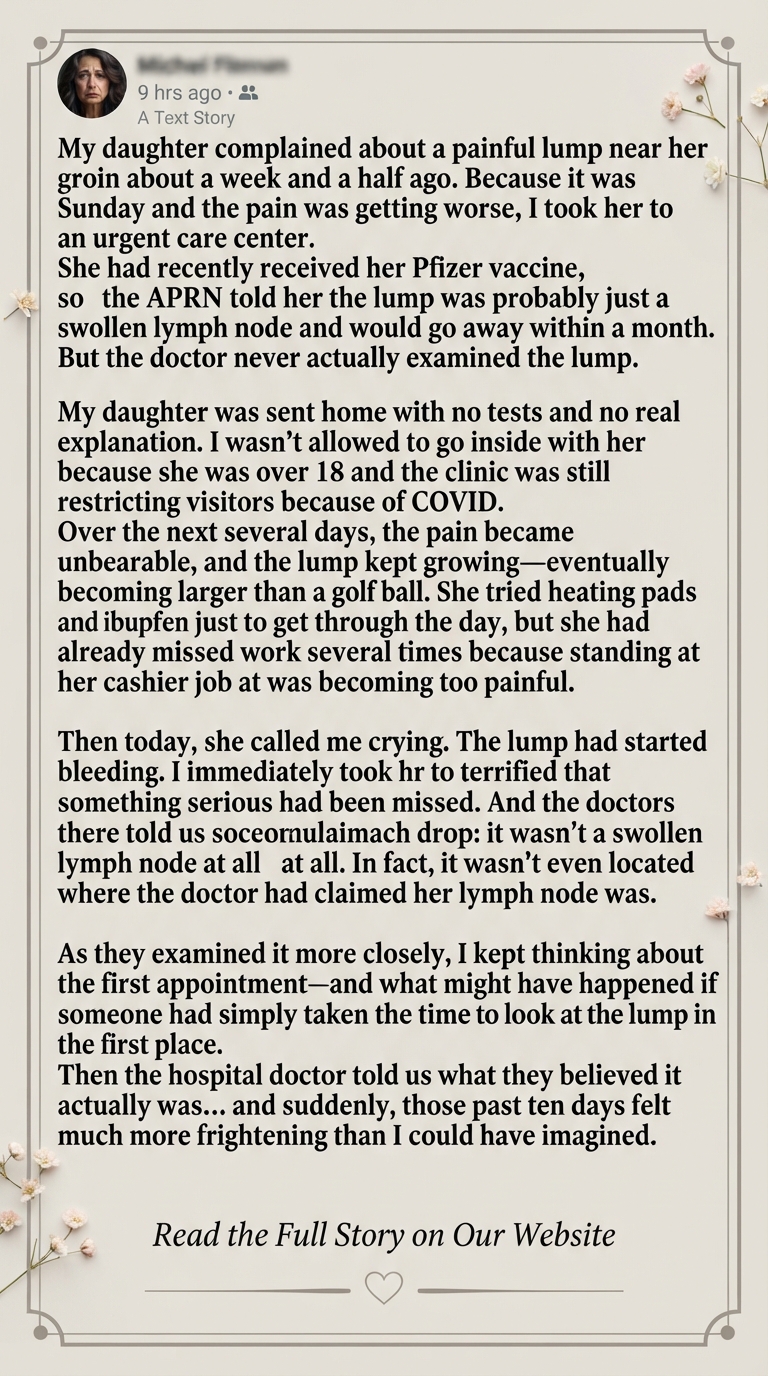
She had received her Pfizer vaccine recently, so when we arrived at urgent care, I expected the visit to be fairly routine.
Because Emily was over eighteen, I wasn’t allowed inside with her. The clinic was still restricting visitors because of COVID, so I waited in the car while she went in alone.
About forty minutes later, she came back.
“They said it’s probably a swollen lymph node,” she told me.
“Did the doctor examine it?”
Emily shook her head.
“The APRN asked me where it was and how big it felt. She said swollen lymph nodes can happen after vaccines and that it should go away within a month.”
I didn’t like the sound of that.
“Did they do any tests?”
“No.”
I looked at the area she was protecting with her hand.
“But it hurts pretty badly.”
“They said to take ibuprofen and use a heating pad.”
So that’s what we did.
For the first couple of days, I tried to believe the clinic was right.
But the lump didn’t shrink.
It grew.
By the fourth day, Emily could barely stand for more than an hour at work.
She worked as a cashier, which meant she couldn’t simply sit down whenever the pain became unbearable.
By the end of her shift, she would come home pale, drop her purse beside the door, and lie on the couch with a heating pad pressed against her hip.
“It’s getting bigger,” she whispered one evening.
I touched her shoulder.
“Let’s get you seen again.”
“They said it could take a month.”
“That doesn’t mean you have to suffer for a month.”
She shook her head.
“I’ll be okay.”
She wasn’t.
Over the next several days, the lump became larger than a golf ball.
The skin around it became red and extremely tender.
Emily missed work twice.
Then three times.
One afternoon, she called me from her bedroom.
“Mom?”
Her voice sounded frightened.
“What?”
“I think something is wrong.”
I rushed upstairs.
She was sitting on the edge of her bed, crying.
The lump had started bleeding.
There was blood on her clothing.
I grabbed my keys.
“We’re going to the hospital.”
“But maybe it’s still the lymph node—”
“No.”
I didn’t care what the first clinic had told us anymore.
Something that had grown that quickly, become that painful, and started bleeding needed to be examined.
At the hospital, the emergency physician examined Emily carefully.
This time, there was no guessing from across the room.
He looked at the lump.
He felt the surrounding tissue.
Then he examined the exact location again.
His expression changed.
“Has anyone actually examined this before?”
I stared at him.
“She went to urgent care ten days ago.”
“What did they tell you?”
“They said it was probably a swollen lymph node.”
The doctor paused.
“This isn’t in the typical location of an inguinal lymph node.”
My stomach tightened.
“What does that mean?”
“It means we shouldn’t assume that’s what it is.”
They ordered blood work and imaging.
A nurse took Emily for an ultrasound first.
Then the doctor came back.
“We need a CT scan.”
That was the moment I realized how scared I actually was.
I had spent ten days telling myself it was probably nothing.
Now everyone was moving quickly.
After the CT scan, the doctor sat down beside us.
“I want to explain what we’re seeing before we go any further.”
Emily squeezed my hand.
The doctor pointed toward the image.
“This appears to be an abscess—a pocket of infection under the skin.”
I stared at him.
“An infection?”
“Yes. Specifically, we’re concerned about an infected skin cyst or a deeper soft-tissue infection. The bleeding is likely because the pressure caused the skin over it to break down.”
Emily looked at me.
“So it isn’t cancer?”
The doctor shook his head.
“The imaging doesn’t suggest a tumor. But this does need treatment.”
I nearly cried from relief.
Then he continued.
“And because it’s become this large and painful, antibiotics alone probably won’t be enough. We need to drain it.”
The procedure was done that evening.
What had looked from the outside like a large lump turned out to contain a significant amount of infected material.
The doctor explained that the infection could have continued spreading if it had been left untreated.
That sentence stayed with me.
If.
If we’d waited another week.
If we’d believed the original diagnosis without question.
If Emily had decided she was simply supposed to tolerate the pain.
After the procedure, she finally looked comfortable for the first time in days.
The doctor came back to speak with us.
“I want to emphasize something,” he said. “A swollen lymph node can happen for many reasons, and sometimes observation is appropriate. But a rapidly enlarging, extremely painful mass should be physically examined. The location, appearance, and progression matter.”
I nodded.
“What caused it?”
“We’re still waiting on the culture results, but this appears consistent with a bacterial infection involving a cyst or blocked gland in the skin.”
He paused.
“And just to be clear, we don’t have evidence that the vaccine caused this.”
I appreciated that clarification.
I had been wondering about it ever since the urgent-care visit.
The doctor explained that timing alone wasn’t enough to determine the cause. The important issue wasn’t what we assumed had caused the lump—it was that the lump itself needed to be properly evaluated.
A few days later, the culture identified the bacteria responsible for the infection.
Emily continued antibiotics and follow-up wound care.
Within a couple of weeks, the swelling had dramatically decreased.
She eventually returned to work.
But the experience changed both of us.
I couldn’t stop thinking about that first appointment.
Emily had gone there because she was scared.
She had described a painful lump.
And because she was an adult, I hadn’t been allowed inside.
I understood the clinic’s visitor policy.
What bothered me was something different.
The lump hadn’t been examined.
There had been no imaging.
No hands-on assessment.
No attempt to determine exactly where it was located.
Instead, a possibility had been treated as an answer.
And that distinction mattered.
Several weeks later, Emily and I went back to the urgent-care center.
Not to make a scene.
Not to demand an apology.
We simply wanted to speak with the clinic manager.
We explained what had happened and provided the hospital records.
The manager listened carefully.
Then she asked a question that surprised me.
“Was the mass ever physically examined during the first visit?”
Emily shook her head.
“No.”
The manager looked uncomfortable.
“I understand why you’re concerned.”
She told us the clinic would review the encounter and use it as part of its quality-improvement process.
That wasn’t everything I wanted to hear.
But it was enough to know someone was taking the complaint seriously.
On the drive home, Emily leaned her head against the window.
“Mom?”
“Yeah?”
“I’m glad you made me go to the hospital.”
I reached over and squeezed her hand.
“I’m glad you called me.”
She smiled weakly.
Then she said something I’ll never forget.
“I thought I was supposed to wait because they told me it would go away.”
I looked at her.
“Never ignore what your body is telling you just because someone gave you an explanation.”
That became the lesson we both carried forward.
The hospital hadn’t discovered some terrifying hidden cancer.
It hadn’t been the worst-case scenario we’d imagined during those hours in the emergency department.
It had been something treatable.
But it had also been something that needed to be looked at.
And that was the part that frightened me most.
Not that the first clinician had been wrong.
Doctors can be wrong.
Nurses can be wrong.
Parents can be wrong.
Patients can be wrong.
The frightening part was how easily a painful, growing lump could be dismissed without anyone actually examining it.
Emily recovered completely.
And whenever she tells the story now, she doesn’t say, “The doctor thought it was a lymph node.”
She says:
“They guessed.
Then someone finally looked.”