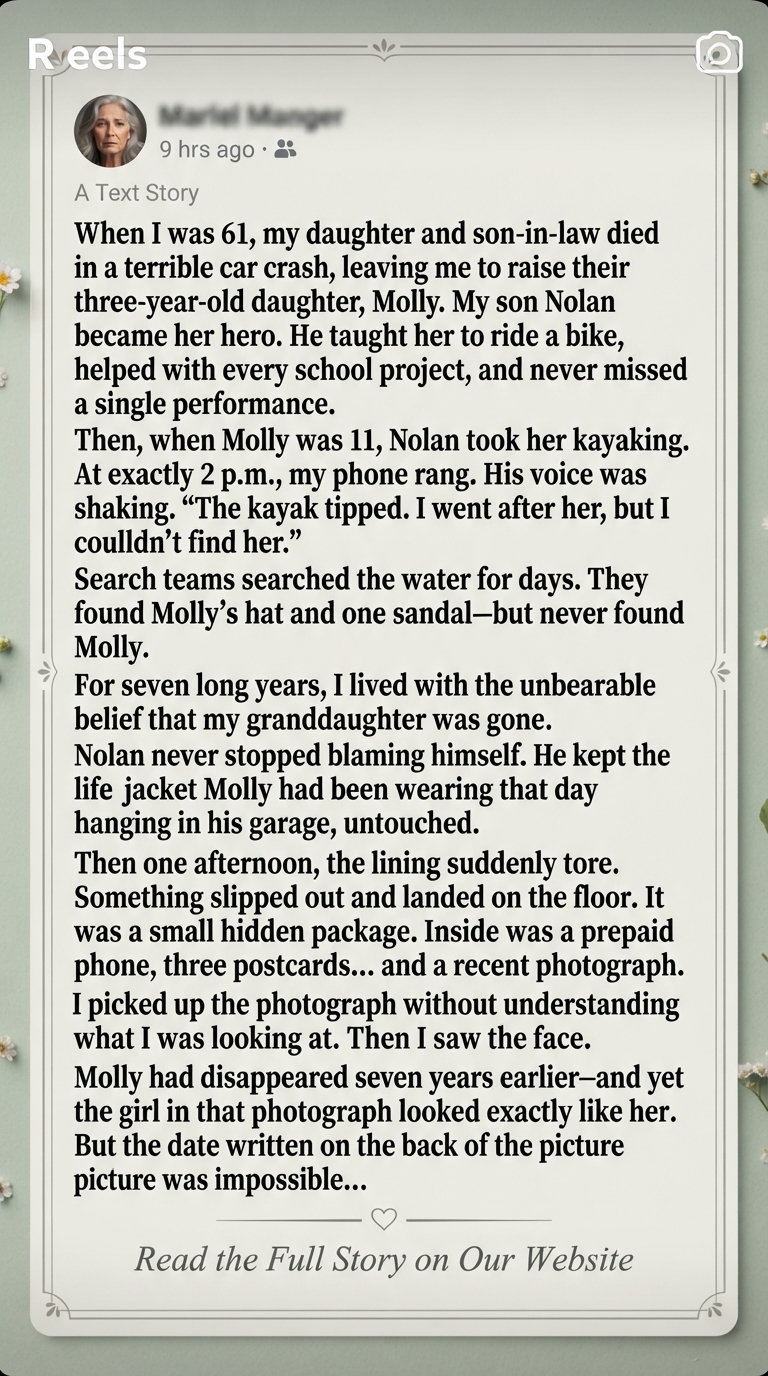
When I was sixty-one, my daughter and son-in-law died in a terrible car crash.
One phone call erased the life I thought I knew.
They left behind a three-year-old daughter named Molly.
And me.
For the next eighteen years, I became a mother all over again.
I packed lunches.
I learned nursery rhymes.
I sat through fevers.
I bought tiny shoes that seemed to become too small overnight.
But Molly had someone else.
Her Uncle Nolan.
To Molly, Nolan wasn’t just her uncle.
He was her hero.
He taught her to ride a bicycle by running behind her until she stopped looking back.
He helped with every school project, even the terrible volcano that covered my kitchen table in baking soda and vinegar.
He never missed a performance.
Not one.
When Molly was eleven, she and Nolan went kayaking on a lake about an hour from our home.
It was supposed to be an ordinary Saturday.
At exactly 2 p.m., my phone rang.
Nolan.
I answered immediately.
His voice was shaking.
“Mom…”
“What happened?”
“The kayak tipped.”
I stood up so quickly my chair fell backward.
“Where’s Molly?”
“I went after her.”
His voice cracked.
“I couldn’t find her.”
I remember dropping the phone.
I remember screaming.
I remember the drive to the lake.
After that, everything became fragments.
Police.
Boats.
Divers.
Helicopters.
Search dogs.
Volunteers.
For days, they searched the water.
They found Molly’s hat.
Then one sandal.
But they never found Molly.
Not her body.
Not the kayak.
Nothing else.
Eventually, the search ended.
People stopped calling.
The posters came down.
The volunteers went home.
And our family was left with the cruelest kind of grief.
The kind without an ending.
For seven years, I woke up every morning knowing Molly was probably gone.
But never knowing for certain.
Nolan took it worse than any of us.
He blamed himself.
Every day.
He stopped kayaking.
He stopped talking about the lake.
And he kept one thing exactly as it had been that day.
Molly’s life jacket.
He hung it from a hook in his garage.
He never washed it.
Never moved it.
Never let anyone touch it.
Seven years passed.
Molly would have been eighteen.
I sometimes found myself doing things automatically.
Buying her favorite cereal.
Seeing a dress in a store and thinking she’d like it.
Then remembering.
One Tuesday afternoon, I was at Nolan’s house when he decided to finally clean the garage.
The life jacket was still hanging there.
Nolan looked at it.
“I should probably put this away.”
He reached for it.
The lining suddenly tore.
Something dropped onto the concrete floor.
A small plastic-wrapped package.
We both stared at it.
“What is that?” I whispered.
Nolan picked it up.
Inside was a prepaid phone.
Three postcards.
And a photograph.
The phone was old but still charged.
The postcards were blank on the front.
Each had the same name written on the back.
Molly.
Nolan’s hands began shaking.
“Mom…”
I took the photograph.
At first, I didn’t understand it.
It showed a teenage girl standing beside a wooden fence.
She was smiling.
Her hair was longer.
Her face was older.
But the eyes.
The chin.
The little crease beside her mouth.
I knew that face.
My knees nearly gave out.
“Molly.”
Nolan grabbed the photograph.
“No.”
He turned it over.
There was a date written on the back.
September 14, 2026.
I stared at it.
Our calendar said September 14.
Today.
The photograph had been taken that very morning.
But Molly had disappeared seven years earlier.
She should have been eighteen.
The girl in the photograph looked eighteen.
Exactly.
I whispered,
“She didn’t die.”
Nolan stared at me.
“Where is she?”
The phone suddenly vibrated.
We both jumped.
One message appeared.
I know you found this.
Nolan looked at me.
Another message appeared.
Please don’t call the police.
Then another.
I’m safe.
My heart was pounding so hard I could hear it.
I typed:
Molly?
The three dots appeared.
Then disappeared.
Then appeared again.
Finally:
Grandma?
I covered my mouth.
Nolan sat down hard.
For seven years, we had been mourning a child.
And she had just called me Grandma.
I typed:
Where are you?
The reply came.
The old train station. 4:30. Come alone.
Nolan immediately shook his head.
“No.”
I looked at him.
“It’s Molly.”
“We don’t know that.”
“I know.”
He stared at the photograph.
Then he said something that changed everything.
“Mom… look at her jacket.”
I looked closer.
Molly was wearing a blue denim jacket.
On the sleeve was a small silver pin.
A butterfly.
I remembered it.
Molly had owned that exact pin when she was eleven.
It had been attached to her backpack.
She loved it.
There was no doubt.
The girl in the photograph was Molly.
At 4:15, I drove to the old train station.
Nolan followed at a distance.
I didn’t argue.
I couldn’t.
At 4:28, I saw her.
She was standing near the far platform.
Older.
Taller.
Thinner.
But the moment she turned around, I knew.
“Molly?”
She froze.
Then she ran toward me.
I barely had time to open my arms before she crashed into them.
She was crying.
So was I.
“Grandma.”
I held her so tightly I was afraid she might disappear again.
“You’re alive.”
“I know.”
“No,” I whispered.
“You don’t understand. We thought you were dead.”
She pulled away.
“I know.”
“Then why didn’t you come home?”
Her expression changed.
Fear replaced the happiness.
“I tried.”
I stared at her.
“What do you mean?”
Molly looked toward the parking lot.
“I couldn’t.”
Then she told me the truth.
The kayak hadn’t simply tipped.
Someone had been following them.
A man had been watching from the shoreline.
Molly remembered him because he had argued with Nolan earlier that afternoon.
Nolan had thought the man was just another kayaker.
After the kayak overturned, Molly surfaced farther downstream.
She was alive.
Cold.
Terrified.
And alone.
A fishing boat found her.
The man who owned it was named Peter.
He brought her to shore.
But before they could call authorities, Peter received a phone call.
He suddenly became frightened.
He told Molly she couldn’t go home yet.
She didn’t understand why.
Then she saw the news.
Her disappearance was everywhere.
And she saw Nolan.
Crying.
Being interviewed.
She also heard something else.
The police were investigating whether Nolan had caused the accident.
Molly became terrified.
She believed Nolan was going to be arrested.
Peter told her they needed to wait until everything was sorted out.
But they never got the chance.
Peter was murdered three days later.
Molly was left with a woman named Elaine, Peter’s sister.
Elaine was afraid too.
She told Molly that someone had been trying to find her.
So they moved.
Again and again.
Molly lived under another name.
She attended school.
She grew up.
But she never forgot us.
“I wanted to call,” she said.
“I wanted to come home.”
“Then why didn’t you?”
She looked down.
“Because every time I tried, someone told me they were still looking for me.”
“Who?”
She hesitated.
“Uncle Nolan.”
I stared at her.
“What?”
“He wasn’t involved.”
She shook her head quickly.
“He was the reason they were afraid.”
I didn’t understand.
Then she explained.
The man who had been watching the lake wasn’t looking for Molly.
He was looking for Nolan.
Nolan had unknowingly witnessed something earlier that day.
He had seen a vehicle parked illegally near the boat launch.
He had written down its license plate because the driver had nearly hit their car.
That vehicle belonged to a man involved in a criminal organization.
Molly’s disappearance had been an accident.
But once the men realized a child had survived, they panicked.
They wanted to make sure she couldn’t identify them.
Peter had protected her.
Elaine had protected her.
And eventually, they had hidden her existence because they believed it was the only way to keep her alive.
Molly looked at me.
“I wasn’t kidnapped for seven years.”
She swallowed.
“I was hidden.”
I cried.
Not because I was angry.
Because suddenly the seven years made sense.
The postcards were proof.
Each one had been written by Molly.
None had been mailed.
They were addressed to me.
The first said:
Dear Grandma, I’m still here.
The second:
I saw your picture today. I miss you.
The third:
Someday I’m coming home.
I pressed them against my chest.
“Why now?”
Molly looked at the photograph.
“Because Elaine died last month.”
My heart sank.
“She was the only person who knew everything.”
Molly had spent the last month gathering the courage to return.
The prepaid phone had been hidden inside the life jacket because Molly had managed to contact Nolan indirectly.
She knew he still had it.
She knew he would recognize the jacket.
And she knew the truth needed to reach us somehow.
“But the date,” I whispered.
“The photograph was taken today.”
Molly nodded.
“I wanted you to know I wasn’t sending you an old picture.”
She smiled through her tears.
“I wanted you to see me now.”
Then I heard footsteps.
Nolan.
He had come anyway.
Molly turned.
For a second, neither moved.
Then Nolan whispered,
“Molly?”
She ran to him.
He caught her.
And the man who had spent seven years blaming himself collapsed onto the platform floor with his arms around the little girl he had believed he lost.
“I looked for you,” he sobbed.
“I know.”
“I should have found you.”
“You didn’t lose me.”
She pulled back and looked into his eyes.
“You saved me.”
Nolan shook his head.
“How?”
“Because you kept looking.”
She pointed toward the life jacket.
“You never threw it away.”
“No.”
“You kept something that reminded everyone I existed.”
Nolan couldn’t speak.
Eventually, the investigation reopened.
The evidence Molly provided led authorities to the men responsible for the crimes surrounding the lake.
The license plate Nolan had written down seven years earlier became important again.
The case took months.
But eventually, arrests were made.
Nolan was cleared completely.
The official report concluded that Molly had survived the accident and that the original search had simply failed to find her.
There was no happy explanation for those seven years.
There was only the truth.
And sometimes, truth is the closest thing we get to closure.
Molly came home.
The first night she slept in her old bedroom.
She had grown far too tall for the little bed we had kept untouched.
So we bought her a new one.
She laughed when she saw it.
“You kept my room?”
“Of course.”
She looked around.
The old posters were still on the wall.
Her childhood books were still on the shelf.
Her stuffed rabbit sat exactly where she’d left it.
She cried.
So did I.
Recovery wasn’t immediate.
Seven years had changed all of us.
Molly needed counseling.
So did Nolan.
And so did I.
There were days when Molly wanted to talk about everything.
There were days when she didn’t want to talk at all.
We learned to let her choose.
A year later, Molly graduated high school.
Her name was printed in the program under her real name.
Molly Anderson.
I kept that program.
Nolan sat beside me during the ceremony.
When Molly walked across the stage, he cried.
Again.
She saw him.
She smiled.
Afterward, she hugged us both.
“I’m glad I’m home,” she said.
I looked at her.
“Me too.”
Seven years earlier, I had received a phone call at exactly two o’clock.
It had shattered my life.
Seven years later, I received another message.
It gave me my granddaughter back.
The life jacket still hangs in Nolan’s garage.
But now it means something different.
It isn’t a symbol of the day we lost Molly.
It’s a symbol of the fact that we never stopped believing she mattered.
And every September 14, Molly sends me a photograph.
The first one showed her at the train station.
The second showed her in college.
The third showed her holding a kayak paddle.
On the back of that one, she wrote:
“This time, Grandma, I’m the one teaching Uncle Nolan how to kayak.”
I laughed so hard I cried.
Because after everything we’d lost, after seven years of fear and unanswered questions, my family finally had something we had forgotten how to have.
A future.