The Birthday Card My Mother Never Wanted Me to Find
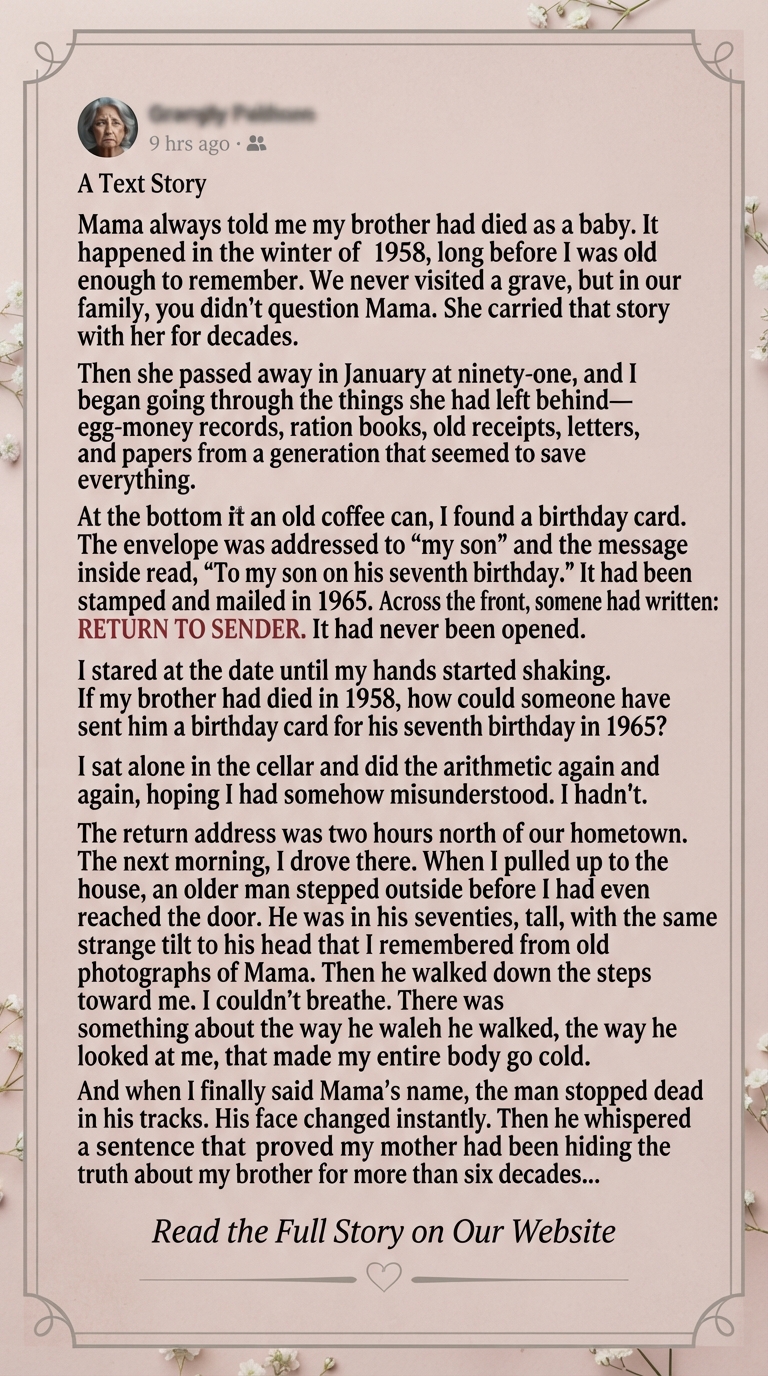
Mama always told me my brother had died as a baby.
It happened in the winter of 1958, long before I was old enough to remember.
I was only three years old.
According to Mama, my brother had been sick from the day he was born. He caught pneumonia during a brutal winter, and one morning he simply stopped breathing.
There was no photograph of him.
No grave that we ever visited.
No hospital bracelet.
No birth certificate that I ever saw.
But in our family, you didn’t question Mama.
If she said something happened, it happened.
She carried that story with her for decades.
Whenever I asked about him, she’d simply say, “He was a beautiful baby.”
Then she’d change the subject.
As I got older, I stopped asking.
Life moved on.
I married.
Raised children.
Watched them grow up.
Mama stayed in the same little house where she’d lived since the early 1960s.
She kept everything.
Egg-money records.
Ration books.
Old grocery receipts.
Church bulletins.
Letters from people she’d known forty years earlier.
Buttons in jars.
Coins in coffee cans.
She couldn’t throw anything away.
In January, Mama died at ninety-one.
After the funeral, my children and I began cleaning out her house.
It took weeks.
One afternoon, I was working in the cellar when I found an old coffee can behind a stack of empty jars.
Inside were receipts, photographs, and several folded pieces of paper.
Then I found the birthday card.
It was yellowed with age.
The envelope was addressed simply:
To My Son
My hands stopped moving.
I opened it.
Inside was a handwritten message.
To my son on his seventh birthday.
The date was 1965.
I stared at it.
Then I looked at the envelope.
There was a return address.
A town two hours north of ours.
Across the front, written in red pencil, were three words:
RETURN TO SENDER
I sat down on the cellar floor.
Seven years old.
I did the arithmetic.
Again.
Seven.
Again.
My hands began to shake.
If my brother had died in 1958, why had someone mailed him a birthday card in 1965?
I spent the next hour trying to convince myself there was another explanation.
Maybe it had been meant for someone else.
Maybe Mama had saved the card by mistake.
Maybe “my son” didn’t mean my brother.
But I knew Mama’s handwriting.
And the handwriting inside the card wasn’t hers.
It belonged to someone else.
A man.
I turned the envelope over again.
The return address was still visible.
Harlan and Ruth Mercer
Oak Street
Briar County
I had never heard the name Mercer.
The next morning, I drove north.
I told myself I was only looking for information.
I didn’t expect to find my brother.
I couldn’t allow myself to think that.
When I reached the address, I found a small white house with a porch and two rocking chairs.
I got out of the car.
Before I reached the front door, it opened.
An older man stepped outside.
He was tall.
Probably in his seventies.
His hair was completely white.
He wore a blue work shirt and held a coffee mug.
Then he looked at me.
Something inside me stopped.
It wasn’t his face exactly.
It was the way he tilted his head.
The same strange tilt Mama had.
The same tilt I’d seen in old photographs.
He walked down the steps.
I couldn’t breathe.
“Can I help you?”
His voice was deeper than I expected.
I stared at him.
Then I said the only name I knew.
“Mama.”
He froze.
The coffee mug slipped slightly in his hand.
“What did you say?”
“Mama’s name was Evelyn.”
The man’s face changed instantly.
His eyes filled with tears.
He whispered:
“She finally died?”
I couldn’t move.
He looked at me.
Then he said something that made the entire world tilt beneath my feet.
“She promised me she’d tell you.”
I gripped the railing.
“Tell me what?”
He stared at me for several seconds.
Then he opened the door wider.
“Come inside.”
His name was Thomas.
He was seventy-one years old.
And according to the birth certificate he showed me, he had been born in December 1958.
My brother.
My brother had not died.
He had been given away.
I sat at his kitchen table while he made coffee.
Neither of us spoke for several minutes.
Finally, I asked the question that had been sitting in my throat since I found the card.
“Why did Mama tell me you died?”
Thomas looked down at his hands.
“Because she didn’t know what else to tell you.”
He told me the story.
Mama had been seventeen when she became pregnant with him.
The baby’s father was a young man from town who left before Thomas was born.
Mama’s parents were deeply ashamed.
In 1958, unmarried teenage mothers in our community weren’t treated kindly.
Her parents sent her away to stay with relatives while she gave birth.
When Thomas was born, Mama wanted to keep him.
But she had no money.
No husband.
No home.
Her parents told her that if she kept him, she would be forced to leave the family.
Thomas was placed with another family temporarily.
But the temporary arrangement became permanent.
A couple named Harold and Ruth Mercer took him in.
They had lost a baby of their own.
They eventually adopted him.
Mama returned home alone.
Her parents told everyone that the baby had died.
And Mama allowed the lie to continue.
“But why didn’t she come for you?” I asked.
Thomas looked out the window.
“She did.”
I stared at him.
“What?”
“She visited me.”
My heart broke.
“How many times?”
“More than you probably think.”
He told me Mama had visited him several times when he was young.
Always secretly.
Always alone.
She would bring small gifts.
A book.
A sweater.
A birthday card.
Sometimes she would simply sit across the room and watch him play.
But she never told him the whole truth.
His adoptive parents eventually discovered who she was.
They weren’t cruel.
They were frightened.
They had legally adopted him and feared losing him.
So the visits stopped.
But the letters continued.
At least for a while.
Thomas went upstairs and returned with a cardboard box.
He placed it on the table.
Inside were letters.
Dozens of them.
Some were from Mama.
Some were returned.
Some had never been opened.
I recognized her handwriting immediately.
One letter was dated 1965.
Thomas handed it to me.
I opened it.
Inside, Mama had written:
My dear boy,
Today you are seven years old.
I don’t know if you will ever read this.
I don’t know if I am doing the right thing.
But I want you to know that I have never forgotten the day you were born.
I couldn’t read the rest.
I started crying.
Thomas reached across the table.
He put his hand over mine.
“I didn’t know where you were,” he said.
I looked at him.
“You knew about me?”
“Your mother told me I had a little sister.”
My breath caught.
“When?”
“When I was about twelve.”
He smiled sadly.
“She said your name was Margaret.”
I laughed through my tears.
“That was me.”
“I know.”
He reached into the box again.
There was a photograph.
A little boy standing beside Mama.
I recognized her immediately.
She looked younger than I’d ever seen her.
Thomas was maybe six.
He was smiling.
Mama wasn’t.
She was looking at him like she was trying to memorize every detail of his face.
On the back of the photograph were six words.
For the son I was forced to lose.
I pressed the photograph against my chest.
For sixty-three years, I’d believed I had no brother.
He had been alive the entire time.
And Mama had carried the truth alone.
Before I left, Thomas asked me something.
“Are you angry with her?”
I thought about it.
“Yes.”
He nodded.
“I was too.”
“What happened?”
He looked toward the window.
“I stopped being angry when I became a father.”
That sentence stayed with me.
Thomas had three children.
Six grandchildren.
He had built a good life.
He wasn’t wealthy.
He wasn’t famous.
He was simply a good man.
And somehow, after all those years, I could see exactly why Mama had never been able to forget him.
We stayed in contact.
At first, it was awkward.
We had missed more than six decades.
We didn’t know each other’s favorite foods.
We didn’t know which movies we liked.
We didn’t know how the other took coffee.
We had no shared childhood memories.
But we had something else.
We had the same mother.
And slowly, we began creating our own memories.
Thomas came to my house that spring.
I showed him Mama’s kitchen.
Her old sewing machine.
The chair where she always sat.
Then I took him to the cellar.
I showed him the coffee can.
The one that had contained the birthday card.
He laughed softly.
“She really did keep everything.”
“She kept you.”
He looked at me.
“What?”
I pointed toward the box of letters.
“She kept every piece of you she could.”
Thomas looked away.
His eyes filled with tears.
Months later, we returned to Mama’s grave together.
Thomas stood quietly beside me.
“I used to wonder if she remembered me,” he said.
“She did.”
“How do you know?”
I handed him the birthday card.
The same card that had brought me to his door.
He read it again.
Then he folded it carefully.
“I think this is yours,” he said.
“No.”
I shook my head.
“It belongs to both of us.”
We placed it between us on the grave.
For years, I thought my mother’s greatest secret was that she had lied about my brother’s death.
But I eventually realized the deeper truth.
She hadn’t stopped loving him.
She had simply lived in a time when fear, shame, and other people’s decisions could separate a mother from her child.
Was that an excuse?
No.
There were choices she could have made differently.
She could have told me.
She could have fought harder.
She could have trusted us with the truth.
But she had also spent sixty-three years carrying a grief nobody else knew existed.
Before Thomas left that day, he looked at Mama’s grave and said:
“You should have told her.”
I smiled sadly.
“Yes.”
He put his hand on my shoulder.
“But she did leave us one thing.”
“What?”
He looked at the old birthday card.
“Each other.”
And that was how I learned that my brother hadn’t died in the winter of 1958.
He had simply been living a life I never knew existed.
For sixty-three years, we had been strangers who shared the same mother.
Now we were brother and sister.
And neither of us intended to waste another day.