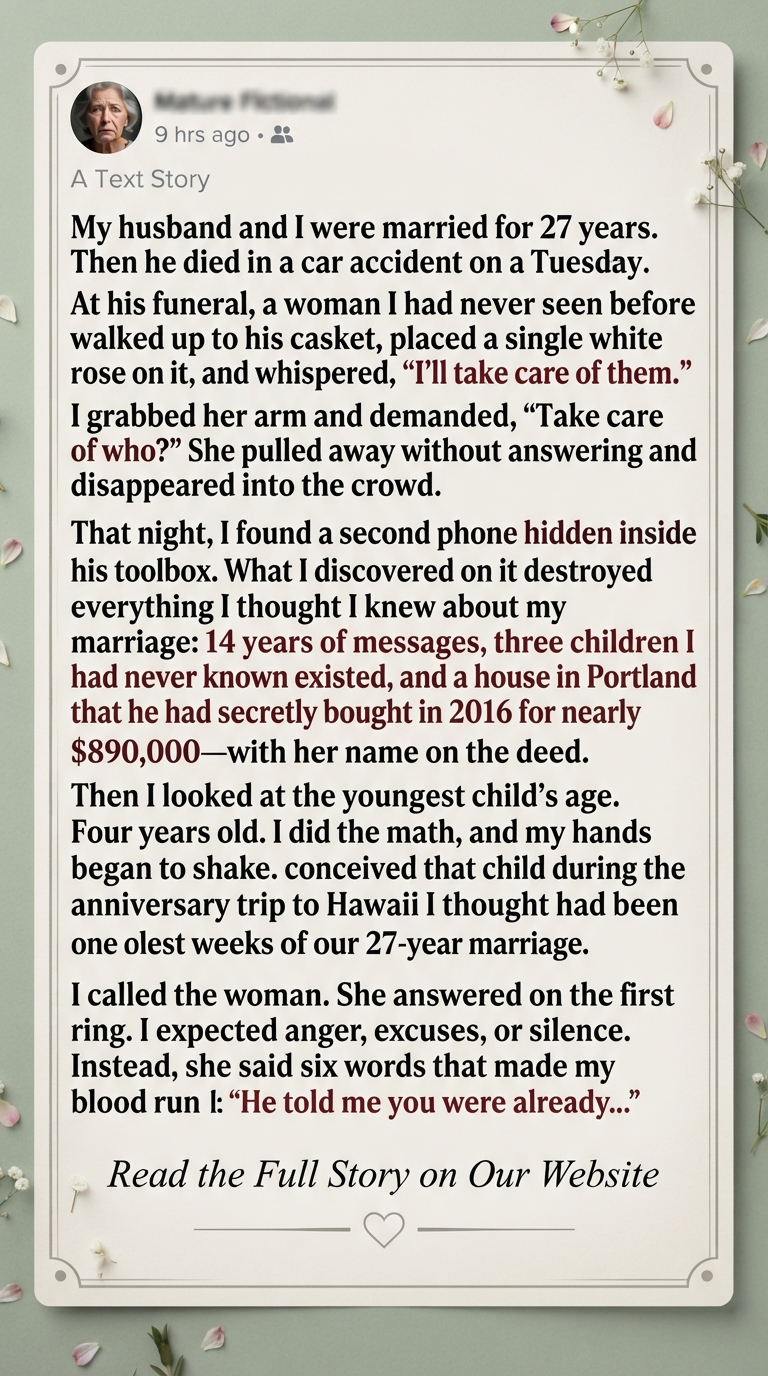
My husband and I were married for twenty-seven years.
Twenty-seven years of birthdays, Christmas mornings, family arguments, vacations, mortgage payments, illnesses, anniversaries, and all the ordinary little things that make you believe you truly know another person.
His name was Daniel.
He was fifty-four when he died in a car accident on a Tuesday morning.
There was no warning.
No final conversation.
No chance to say goodbye.
One moment he was driving to work, and the next, a police officer was standing on my porch telling me that my husband was gone.
For three days, I lived in a fog.
I answered questions without understanding them. I signed paperwork. I called relatives. I chose flowers. I stood beside Daniel’s casket while people told me how sorry they were.
Then, just before the funeral ended, a woman I had never seen before walked toward the casket.
She was probably in her early forties.
Dark hair.
Simple black dress.
No makeup except for a faint red mark around her eyes, as though she had been crying for hours.
She carried a single white rose.
She placed it gently on Daniel’s chest.
Then she leaned forward and whispered something.
I couldn’t hear it at first.
Then she said clearly:
“I’ll take care of them.”
My entire body went cold.
I stepped forward.
“Take care of who?”
She looked at me.
For one second, I saw something in her eyes that wasn’t hatred.
It was pity.
That somehow hurt more.
“Who are you?” I demanded.
She pulled her arm away when I grabbed it.
“Please.”
“Please what?”
She said nothing.
Then she turned and disappeared into the crowd before I could stop her.
I spent the rest of the funeral looking for her.
She was gone.
That night, after everyone left, I sat alone in the kitchen.
Daniel’s coffee mug was still beside the sink.
His jacket was hanging by the door.
His keys were in the bowl where he’d dropped them every night for twenty-seven years.
Everything looked exactly the same.
Except my husband was dead.
I couldn’t sleep.
Around midnight, I went into the garage.
I don’t know why.
Maybe I was looking for something that smelled like him.
Maybe grief makes you search for pieces of a person who is suddenly nowhere.
I opened his old metal toolbox.
Under a pile of wrenches was a phone.
Not his regular phone.
A second phone.
My hands started shaking before I even turned it on.
There was no password.
That should have been my first warning.
The messages went back fourteen years.
Fourteen years.
I sat on the garage floor and read until sunrise.
There was a woman named Rebecca.
The woman from the funeral.
She and Daniel had been together for years.
Not casually.
Not secretly dating for a few months.
Years.
There were photographs.
Hotel reservations.
Christmas messages.
Birthday messages.
Arguments.
Apologies.
Promises.
And then I found something that made my stomach turn.
Three children.
Rebecca had three children.
And Daniel was their father.
The oldest was thirteen.
The middle child was nine.
The youngest was four.
I stared at the screen for a long time.
Four.
I did the math.
Four years ago, Daniel and I had celebrated our twenty-third wedding anniversary.
We had gone to Hawaii.
I remembered that trip perfectly.
At least, I thought I did.
Daniel had told me it was the happiest week of his life.
He had held my hand while we walked along the beach.
We had dinner overlooking the ocean.
He’d bought me a necklace.
He’d told me he loved me.
I’d believed him.
Now I was sitting on a garage floor realizing that during that same trip, my husband had apparently fathered a child with another woman.
I couldn’t breathe.
I kept scrolling.
Then I found something even worse.
A property record.
Daniel had purchased a house in Portland in 2016.
Purchase price:
$887,400.
The deed listed two names.
Daniel Carter.
Rebecca Morgan.
I laughed.
It wasn’t a happy laugh.
It was the sound a person makes when reality becomes so absurd that their mind refuses to accept it.
He had been paying our mortgage.
He had been telling me we needed to cut back.
He had complained about the cost of our daughter’s college.
Meanwhile, he had secretly purchased an $887,400 house for another family.
I called Rebecca.
She answered on the first ring.
Neither of us spoke for several seconds.
Then I said:
“You told me you would take care of them.”
Her breathing changed.
“I know.”
“Who are they?”
“My children.”
“And Daniel?”
Another silence.
“Yes.”
I closed my eyes.
Then I asked the question that had been destroying me all night.
“Did you know about me?”
She whispered:
“Yes.”
My heart sank.
“Then why did you let this happen?”
She started crying.
“I thought you knew.”
“Knew what?”
Her voice broke.
“Daniel told me you were already dying.”
I froze.
“What?”
“He told me you had cancer.”
I couldn’t speak.
Rebecca continued.
“He said you had been sick for years. He told me your doctors didn’t expect you to live much longer. He said you and he had separated emotionally and that you were only staying married because of the house and the family.”
I felt something inside me crack.
“I’ve never had cancer.”
“I know that now.”
“How long did he tell you I was dying?”
“From the beginning.”
My knees almost gave out.
“Fourteen years?”
“Yes.”
I sat down at the kitchen table.
Fourteen years.
Daniel had told another woman that his wife was dying.
He had built an entire second life around that lie.
But there was something I didn’t understand.
“Then why did you have a child with him four years ago?”
Rebecca was silent.
Finally, she said:
“Because by then, I believed him.”
She told me Daniel had promised to leave me after my supposed illness became worse.
He said he couldn’t abandon a sick wife.
He said he needed time.
Then another year passed.
Then another.
Every time Rebecca asked when he would tell me, Daniel gave her another excuse.
The children were born.
He became more involved.
He bought the house.
He told Rebecca that one day they would all live together.
And every year, he came home to me.
I wanted to hate her.
Part of me did.
But as she spoke, I realized something horrible.
She had been deceived too.
Just differently.
“Why did you come to the funeral?” I asked.
“Because I thought your husband was finally going to tell you the truth.”
“He died before he could.”
“I know.”
“Then why did you say you’d take care of them?”
She cried harder.
“Because Daniel left something with me.”
“What?”
“A letter.”
My pulse quickened.
“What letter?”
“One he told me to give you if he died before he could explain everything.”
I stared at the phone.
“Do you have it?”
“Yes.”
“Bring it.”
There was a long pause.
Then she said:
“I’ll come tomorrow.”
The next afternoon, Rebecca arrived at my house.
She wasn’t what I expected.
She looked exhausted.
Behind her stood three children.
The oldest boy stared at the ground.
The nine-year-old girl held a stuffed rabbit.
The youngest—a little girl named Lily—was holding a photograph of Daniel.
She looked exactly like him.
That was the hardest part.
Rebecca handed me an envelope.
My name was written on it in Daniel’s handwriting.
I didn’t open it immediately.
Instead, I looked at Rebecca.
“Did he ever love you?”
She swallowed.
“I thought he did.”
“That’s not an answer.”
She looked at the children.
“Maybe he loved what I made it possible for him to be.”
That sentence stayed with me.
I opened the envelope.
Daniel’s letter was six pages long.
The first paragraph made me want to tear it apart.
But I kept reading.
He admitted everything.
The affair.
The children.
The house.
The money.
The lies.
But then came the part I hadn’t expected.
Daniel hadn’t started his second life because he had stopped loving me.
He had started it because, fourteen years earlier, he had been terrified of losing everything.
He had been diagnosed with a serious heart condition.
He was afraid.
He was convinced he would die young.
Instead of telling me, he began searching for something he called “a second chance.”
Rebecca was an old acquaintance.
He contacted her.
He lied to her about me.
Then the lie became a life.
And somewhere along the way, the secret became more important to him than the truth.
His letter contained one sentence I couldn’t stop reading:
“I kept telling myself I would fix everything tomorrow, until I had built a life where tomorrow was the only place I could put the truth.”
But there was another secret.
The money.
I called our financial advisor the next morning.
Then our accountant.
Then an attorney.
And that was when I discovered Daniel had been moving money between accounts for years.
Not enough to bankrupt us.
But enough to hide the Portland house, the children’s expenses, and the second life.
There were approximately $312,000 in marital funds that had been diverted.
Some had gone to Rebecca.
Some had gone toward the Portland property.
Some had paid for the children’s expenses.
I expected to feel satisfaction when the attorney told me I could pursue the estate for the money.
Instead, I felt tired.
So tired.
I didn’t want revenge.
I wanted my life back.
The attorney explained that Daniel’s estate would be divided according to state law, but the house and certain assets could be disputed because marital funds had been used.
Rebecca and I sat across from each other in my attorney’s office.
For the first time, neither of us was fighting over Daniel.
We were trying to clean up the wreckage he had left behind.
Eventually, we reached an agreement.
The Portland house would be sold.
The proceeds would be placed partly into protected accounts for the three children.
The portion traceable to marital funds would return to my estate.
The remaining money would support the children.
I didn’t want them punished for their father’s lies.
They hadn’t asked to be born into them.
Rebecca and I also agreed on something neither of us expected.
We would tell the children the truth.
Not every ugly detail.
Not yet.
But enough.
Their father had loved them.
Their father had also lied.
Both things could be true.
Months passed.
Grief slowly changed shape.
I stopped expecting Daniel to walk through the door.
I stopped checking my phone.
I stopped waking up angry at three in the morning.
Then one Sunday, Rebecca brought the children to my house.
Lily walked up to me holding a small photograph.
It was a picture of Daniel holding her when she was a baby.
“Can I keep this here?” she asked.
I looked at the photo.
Then at her.
“Why here?”
“Because Daddy’s pictures are here.”
My throat tightened.
“You can.”
She smiled.
Then she asked:
“Did Daddy love you?”
I could have lied.
I could have said yes and left it there.
Instead, I said:
“Yes. He loved me.”
She looked confused.
“But he loved us too.”
I nodded.
“He did.”
“Then why did he lie?”
I looked at Rebecca.
She didn’t answer.
Neither did I.
Because sometimes there isn’t a satisfying explanation.
Sometimes people are selfish.
Sometimes they’re afraid.
Sometimes they make one terrible decision and spend years making more decisions to protect the first one.
That doesn’t make the damage disappear.
But it does mean the people left behind don’t have to carry the damage forever.
A year after Daniel died, I sold our house.
It was too full of memories.
I moved into a smaller place near the coast.
On the wall above my desk, I hung one photograph.
It wasn’t of Daniel.
It was of me, Rebecca, and the three children.
Not because I had forgiven everything.
I hadn’t.
Forgiveness, I learned, wasn’t the same as pretending nothing happened.
It was deciding that his choices would not control the rest of my life.
Rebecca and I never became best friends.
We didn’t need to.
But we became something else.
Two women who had been lied to by the same man.
Two women raising children who deserved to know they were loved.
And one day, almost two years after Daniel’s funeral, Lily asked me something that made me smile.
“Are you my aunt?”
I looked at her.
“No.”
“Then what are you?”
I thought about the woman who had walked to Daniel’s casket carrying a single white rose.
The woman who had promised to take care of them.
Then I smiled.
“I’m someone who loved your dad for twenty-seven years.”
Lily nodded as if that made perfect sense.
“Then you can be family.”
I reached for her hand.
“Yes,” I said. “I can.”
Daniel destroyed the marriage I thought I had.
But he didn’t get to destroy everything that came after it.
That part belonged to me.
And for the first time since that Tuesday, I wasn’t rebuilding my life around the man I lost.
I was building one around the people who remained.