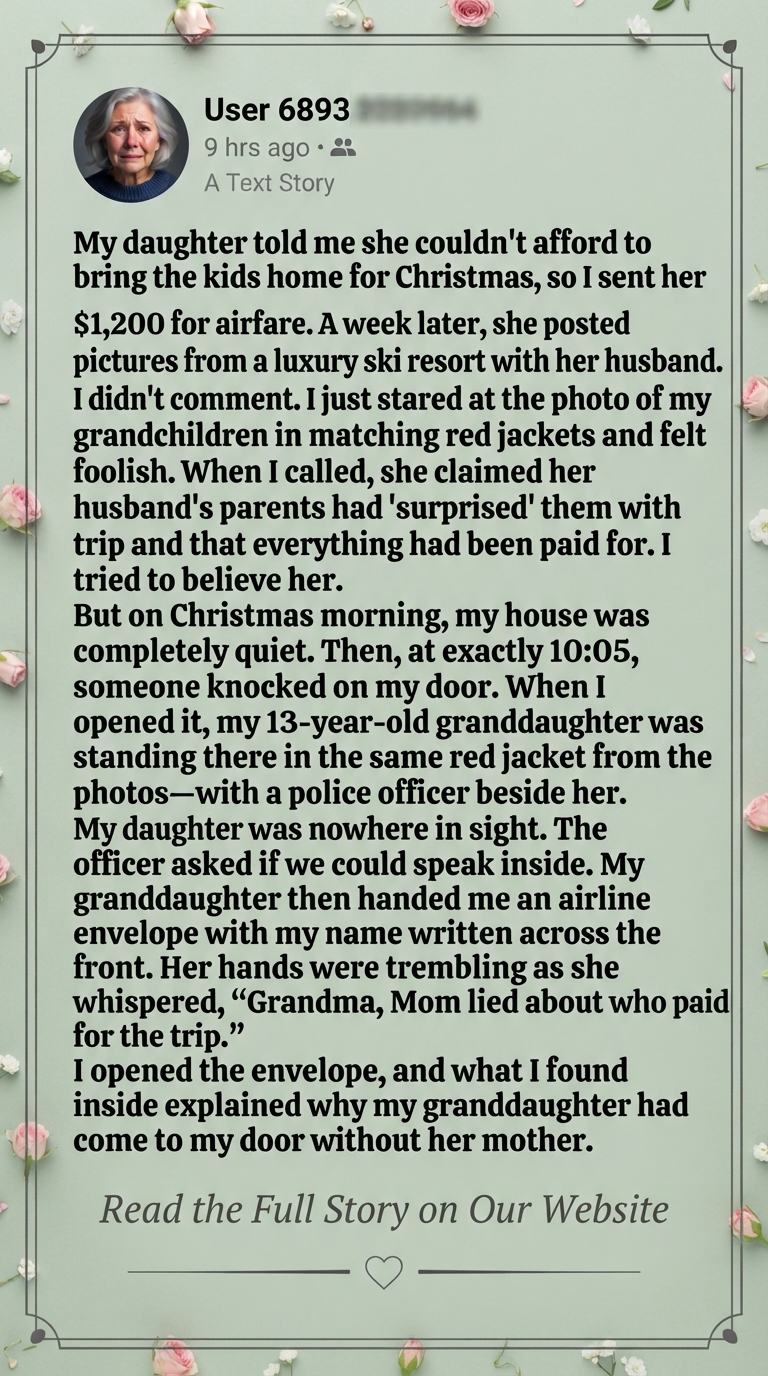
My daughter told me she couldn’t afford to bring the kids home for Christmas.
I understood.
I didn’t like it, but I understood.
Her husband had been struggling at work, their mortgage had gone up, and with three children—thirteen-year-old Emma, ten-year-old Noah, and seven-year-old Sophie—everything cost more than it used to.
So when my daughter, Rachel, called me in early December and said, “Mom, I’m sorry. We just can’t afford the flights this year,” I told her not to worry.
“Christmas isn’t about plane tickets,” I said.
There was a pause.
Then she quietly said, “I wish you could see them.”
“I wish I could see them too.”
That’s when I made the mistake.
“I’ll send you the money.”
“Mom, you don’t have to.”
“I know.”
I transferred $1,200 that afternoon.
It was enough for the airfare.
I told myself it was a gift.
Not a loan.
Not something they owed me.
Just money to bring my grandchildren home.
Rachel promised they would arrive on December 23.
I spent the next two weeks preparing.
I bought Emma’s favorite cookies.
I put new pajamas on the beds.
I wrapped presents until midnight one night because I wanted everything to be perfect.
Then, one week before Christmas, I opened Facebook.
And there they were.
My daughter.
Her husband.
And my three grandchildren.
Standing in front of a massive Christmas tree at a luxury ski resort.
All three children were wearing matching red jackets.
The mountains behind them were covered in snow.
There were expensive-looking cabins.
Horse-drawn sleighs.
A restaurant with enormous windows overlooking the slopes.
The caption said:
“Christmas came early. Best family trip ever! ❤️🎄❄️”
I stared at the photograph.
Then I stared at the bank transfer on my phone.
$1,200.
Airfare.
I didn’t comment.
I didn’t like the post.
I didn’t call immediately.
I just sat there.
Feeling foolish.
A few minutes later, I noticed another photograph.
Rachel and her husband were holding champagne glasses.
Emma stood between them.
She was smiling.
But something about her expression bothered me.
Her smile didn’t reach her eyes.
I called Rachel that evening.
She answered after several rings.
“Hi, Mom.”
“How’s the trip?”
There was a pause.
“What trip?”
I almost laughed.
“The ski resort.”
“Oh.”
Another pause.
“That.”
“Yes. That.”
She sighed.
“Mark’s parents surprised us.”
“With a luxury ski vacation?”
“Yes.”
“And the flights?”
“They paid for everything.”
I didn’t say anything.
She quickly added:
“They’ve wanted to do something like this for years. It was just a surprise.”
I looked at the photo again.
“Why didn’t you tell me?”
“Because I knew you’d be upset.”
“I wouldn’t have been upset.”
“You sent us money because you wanted us home.”
“I did.”
“And now we’re here.”
“Yes.”
“Mom, please don’t make this into something it isn’t.”
I closed my eyes.
“I won’t.”
We ended the call.
I wanted to believe her.
I really did.
Maybe her in-laws had surprised them.
Maybe everything was innocent.
Maybe I was simply hurt because I had been looking forward to Christmas.
So I said nothing.
I waited.
Christmas Eve came.
No one arrived.
No phone call.
No explanation.
Just a short text from Rachel:
“Merry Christmas, Mom. Kids are exhausted. We’ll call tomorrow.”
I replied:
“Merry Christmas. I love you all.”
Then I put my phone down.
Christmas morning was the quietest morning I had experienced in years.
No children running down the hallway.
No wrapping paper.
No laughter.
No Emma yelling, “Grandma!”
Just the ticking of the clock.
At exactly 10:05 a.m., someone knocked on my door.
I assumed it was a neighbor.
Maybe a delivery.
I opened it.
And froze.
Emma was standing on my porch.
She was wearing the same red jacket from the ski resort photographs.
Her cheeks were pale.
Her eyes were swollen.
And beside her stood a police officer.
For several seconds, none of us spoke.
Then Emma whispered:
“Grandma.”
I pulled her into my arms.
“What are you doing here?”
She started crying.
The officer stepped forward.
“Mrs. Carter?”
“Yes.”
“I’m Officer Reynolds. We need to speak with you inside.”
My heart began pounding.
“Where is her mother?”
He exchanged a glance with Emma.
“That’s part of what we need to discuss.”
I moved aside.
“Come in.”
Emma walked directly to the kitchen.
She sat at the table.
Her hands were trembling.
Then she pulled a white airline envelope from her backpack.
My name was written across the front.
In handwriting I didn’t recognize.
She pushed it toward me.
“Grandma,” she whispered, “Mom lied about who paid for the trip.”
I looked at Officer Reynolds.
“What happened?”
He pulled out a chair.
“Before I explain, I need you to understand something. Emma came to us voluntarily.”
I looked at my granddaughter.
“You went to the police?”
She nodded.
“Why?”
She looked down.
“Because Mom told us we weren’t allowed to tell you.”
My stomach tightened.
“Tell me what?”
Emma swallowed.
“The ski trip wasn’t paid for by Grandpa and Grandma Miller.”
“Then who paid for it?”
She pushed the envelope closer.
“I think you did.”
I stared at her.
“What?”
She nodded.
“Not directly.”
I opened the envelope.
Inside were printed airline records.
A hotel receipt.
A credit-card statement.
And a copy of a bank transfer.
My name was on the transfer.
But not from my account.
It was a transaction from an account I didn’t recognize.
I looked at the officer.
“What am I looking at?”
He said carefully:
“Someone appears to have used your personal information to open a financial account.”
My hands went cold.
Emma whispered:
“Mom used your information.”
I couldn’t speak.
Officer Reynolds continued.
“Your daughter contacted a financial institution several weeks ago. The account was opened using personal information connected to you. Money was transferred through that account.”
“How much?”
“Approximately $18,000.”
I stared at him.
“Eighteen thousand?”
He nodded.
“Some of it was used for the ski trip.”
I looked at Emma.
“How did you find out?”
She wiped her eyes.
“Mom was arguing with Dad.”
“When?”
“Three nights ago.”
“What did they say?”
Emma hesitated.
“Mom said she couldn’t pay everything back before you noticed.”
My chest tightened.
“What did your father say?”
“He said you trusted her.”
She looked at the floor.
“He said she had gone too far.”
I felt sick.
“Did your father know?”
“He found out about the account.”
“What happened after that?”
Emma’s voice became smaller.
“Mom told him not to tell anyone.”
“And he agreed?”
She shook her head.
“They fought.”
“What did he do?”
“He left.”
I stared at her.
“Where is your father now?”
“We don’t know.”
That was when the officer spoke again.
“Mr. Miller left the resort two days ago. We’ve confirmed that he is safe. He contacted us this morning.”
I breathed out.
At least he was alive.
“But where is your mother?”
Emma’s face crumpled.
“She left last night.”
“Where?”
“I don’t know.”
Officer Reynolds explained that Rachel had been located at a motel about forty miles from the resort early that morning.
She had left before officers arrived.
But before leaving, she had apparently told Emma something that changed everything.
She had admitted that the $1,200 I sent for airfare had never been used for airfare.
She had used my money to pay part of the family’s outstanding credit-card balance.
Then, when the children couldn’t come home for Christmas, she had needed another way to explain the situation.
So she used my information to open another account.
She transferred money through it.
And part of that money paid for the ski trip.
The luxury vacation had never been a gift from her in-laws.
It had been financed with stolen money.
I sat silently at the kitchen table.
My daughter had stolen from me.
Not a few hundred dollars.
Not something she could explain as desperation.
She had stolen my identity.
She had lied to me.
And she had taken my grandchildren on vacation with the money.
But then Emma reached across the table.
“Grandma?”
I looked at her.
“I’m sorry.”
“You have nothing to apologize for.”
“But I knew.”
“What did you know?”
“I knew Mom wasn’t telling the truth.”
She started crying again.
“I wanted to tell you at the resort, but she said you’d hate her and that you’d never want to see us again.”
I pulled her toward me.
“Emma, listen to me.”
She looked at me.
“You are never responsible for protecting adults from the consequences of their choices.”
She cried against my shoulder.
Officer Reynolds stayed with us for another hour.
He explained that an investigation would follow.
The bank would review the fraudulent account.
My identity would need to be protected.
And Rachel could face serious charges.
After he left, Emma sat quietly at my kitchen table.
Then she asked:
“Can we still have Christmas?”
I looked at the clock.
It was almost noon.
I smiled through my tears.
“Absolutely.”
We made pancakes.
Then we opened presents.
Emma called her brothers.
They were staying with their father temporarily.
An hour later, they arrived.
No matching outfits.
No luxury resort.
No mountains.
Just three tired children in sweatshirts and socks.
And somehow, it was the best Christmas morning I’d had in years.
A week later, Rachel turned herself in.
She admitted what she had done.
She told investigators that the ski trip had started as an attempt to make the children happy after she realized they couldn’t afford Christmas.
Then she kept making one bad decision after another.
She used my $1,200.
Then my identity.
Then more money.
Each lie required another lie.
Eventually, she couldn’t stop.
She pleaded guilty to the financial crimes.
The court ordered restitution.
The fraudulent account was closed.
My stolen money was gradually recovered through the legal process and the sale of some of Rachel’s assets.
But the money wasn’t what mattered most to me.
My relationship with my daughter was broken.
For a long time, I didn’t know if it could be repaired.
But I refused to let that broken relationship destroy my relationship with my grandchildren.
Emma visited every weekend.
Noah started helping me in the garden.
Sophie insisted on sleeping in the guest room whenever she stayed over.
And slowly, Christmas became something different.
Not something expensive.
Not something perfect.
Just something honest.
Months later, Emma asked me a question.
“Grandma?”
“Yes?”
“Do you still love Mom?”
I thought carefully before answering.
“Yes.”
“Even after everything?”
“Yes.”
“How?”
I looked at her.
“Loving someone doesn’t mean approving of what they did.”
She nodded.
“Do you forgive her?”
I smiled sadly.
“Not yet.”
She seemed surprised.
“But maybe someday.”
“Why?”
“Because forgiveness isn’t something I owe her.”
I touched her hand.
“It’s something I might choose for myself when I’m ready.”
Emma smiled.
“I think that’s fair.”
She was thirteen.
But that Christmas had forced her to learn something many adults never understand.
Sometimes telling the truth hurts.
But living inside a lie hurts everyone around you.
A year later, Rachel came to my house for Christmas dinner.
She was quieter than I remembered.
She looked older.
Before dinner, she stood in the kitchen and handed me an envelope.
Inside was $1,200.
Every dollar I had originally sent her for airfare.
“I know this doesn’t fix anything,” she said.
“No.”
“I know.”
She looked down.
“But I wanted to give it back.”
I nodded.
“Thank you.”
She started crying.
“I’m sorry, Mom.”
I didn’t rush to hug her.
I didn’t tell her everything was fine.
Because it wasn’t.
But I did walk over and put my hand on her shoulder.
“We’ll figure out what comes next.”
She nodded.
And that was enough.
Later that evening, Emma sat beside me on the couch.
She was wearing a new red sweater.
Not the red ski jacket.
That jacket was gone.
She had donated it.
She leaned against my shoulder.
“Grandma?”
“Yes?”
“Do you remember the first Christmas morning I came here?”
I smiled.
“I’ll never forget it.”
“Me neither.”
She looked toward the Christmas tree.
“That was the Christmas I learned that home isn’t where you have the most money.”
I looked at her.
“Where is home?”
She smiled.
“Where people tell the truth.”
I wrapped my arm around her.
And for the first time, I understood why she had come to my door that morning.
She hadn’t come because she needed a place to stay.
She had come because she needed somewhere the truth was still safe.
And I was grateful that, when everything else in her life became uncertain, she still knew where to knock.