My husband died after twenty-nine years of marriage.
At his funeral, I thought I was saying goodbye to the man I had spent most of my adult life loving.
I was wrong.
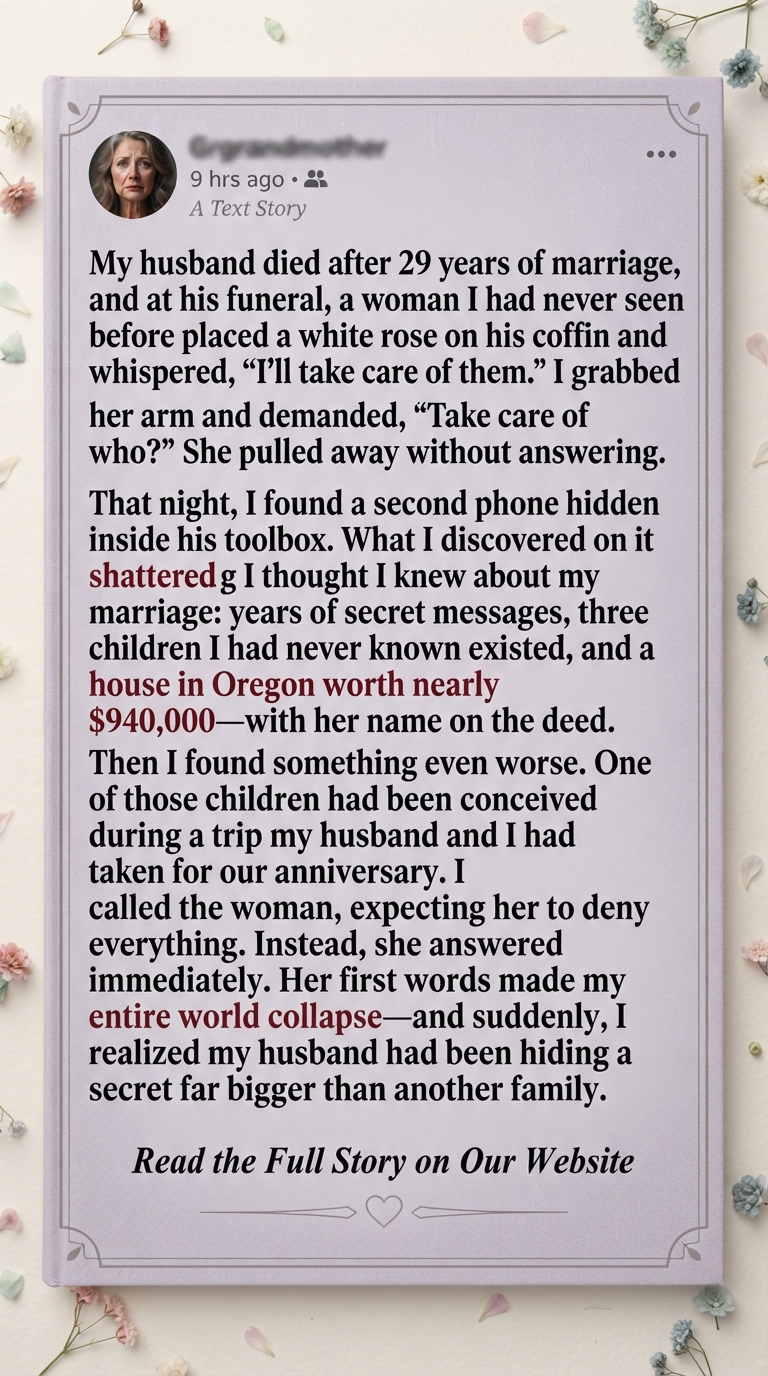
The woman appeared just before the service ended.
I had never seen her before.
She was probably in her late forties, dressed in a simple black coat, holding a single white rose. She walked slowly toward my husband’s coffin while everyone else stood quietly around the room.
She placed the rose against the flowers.
Then she leaned forward and whispered something.
I couldn’t hear it at first.
Then she said it again.
“I’ll take care of them.”
My stomach tightened.
I stepped forward.
“Take care of who?”
She froze.
I grabbed her arm before she could walk away.
“Who are you?”
She looked at me with an expression I couldn’t understand.
Pity.
Not guilt.
Pity.
“I’m sorry,” she whispered.
“For what?”
She pulled her arm free.
Then she walked out.
I stood there watching the doors close behind her.
For the rest of the funeral, I couldn’t hear what anyone was saying.
My husband’s name was Daniel.
We had been married for twenty-nine years.
We had two children, both grown.
We had a house, two cars, a comfortable life, and the ordinary collection of memories that comes from spending nearly three decades with someone.
Or at least I thought we did.
That night, after everyone left, I couldn’t sleep.
I kept thinking about the woman.
Who was she?
And what had she meant when she said, “I’ll take care of them”?
Around midnight, I went into Daniel’s workshop.
I don’t know why.
Maybe I was looking for something that would make sense.
His toolbox sat exactly where it had always been.
I opened the top drawer.
Inside were his screwdrivers, wrenches, tape measure, and the small things he always used to repair around the house.
Then I noticed something I had never seen before.
A second phone.
It was tucked underneath an old rag.
My hands began shaking.
Daniel had always told me he hated smartphones.
He had one phone.
I knew the passcode because we’d been married almost thirty years.
I entered it.
The screen opened.
There were hundreds of messages.
Some went back years.
The first message I opened was from a woman named Rebecca.
I miss you. The children keep asking when you’re coming home.
My heart stopped.
Children?
I kept scrolling.
There were photographs.
A little boy.
A teenage girl.
A younger girl with Daniel’s unmistakable smile.
Three children.
Then I found messages between Daniel and Rebecca discussing a house in Oregon.
I searched the address online.
It was a beautiful house worth nearly $940,000.
And according to the messages, Rebecca’s name was on the deed.
My hands went numb.
Then I found the dates.
One of the children, a boy named Lucas, had been born twenty years earlier.
I did the math.
He had been conceived during the anniversary trip Daniel and I took to Hawaii.
Our tenth anniversary.
I remembered that trip.
Every detail.
The hotel.
The restaurant where Daniel surprised me with a necklace.
The morning we watched the sunrise from the beach.
I remembered thinking that marriage was the safest place in my life.
Apparently, I had been the only one believing that.
I called the number listed beside Rebecca’s name.
She answered on the first ring.
“Hello?”
Her voice was calm.
“It’s me,” I said.
There was a long silence.
Then she whispered,
“I wondered how long it would take you to find me.”
My heart dropped.
“You knew who I was?”
“Yes.”
“Who are you?”
Another silence.
Then she said,
“My name is Rebecca. And Daniel was not the man you thought he was.”
I gripped the phone.
“I know about the children.”
“I’m sorry.”
“And the house.”
“Yes.”
“And Lucas.”
She didn’t answer.
“Was he conceived during my anniversary trip with Daniel?”
Rebecca exhaled.
“Yes.”
I closed my eyes.
For several seconds, neither of us spoke.
Then I heard something I wasn’t expecting.
Rebecca began crying.
“He told me you knew.”
I opened my eyes.
“What?”
“He told me you knew about us.”
I almost laughed.
Not because anything was funny.
Because sometimes the truth is so cruel that your mind doesn’t know how else to react.
“I didn’t know anything.”
Rebecca went silent.
Then she said,
“Oh God.”
“What?”
“He lied to both of us.”
I sat down.
“What do you mean?”
Rebecca told me everything.
She had met Daniel twenty-one years earlier.
He told her he was separated from his wife.
He said our marriage had been over emotionally for years.
He claimed he was only staying with me because of finances and appearances.
Rebecca believed him.
They had three children together.
Daniel visited them regularly.
He paid for the house.
He attended birthdays.
He took them on vacations.
But he always returned to me.
For years, Rebecca believed he would eventually leave.
He never did.
And she eventually stopped asking.
“Then why did you say at the funeral that you’d take care of them?” I asked.
“Because Daniel asked me to.”
My heart tightened.
“He knew he was dying?”
“Yes.”
“How long?”
“Almost a year.”
I stared at the wall.
A year.
He had known he was sick and never told me the truth.
“What did he ask you to do?”
Rebecca hesitated.
“He told me that if something happened to him, you would eventually find out about us. He asked me to make sure the children didn’t blame themselves.”
I swallowed.
Then she said something that changed everything.
“He also told me that if you ever learned the truth, I should tell you about the money.”
“What money?”
“The money he took from you.”
I felt cold.
Rebecca continued.
“Daniel wasn’t using his salary to support us.”
My chest tightened.
“He had another account.”
I already knew where this was going.
“For years, he transferred money from your joint accounts into an investment account. Some of it went to the Oregon house. Some paid for the children’s expenses.”
I couldn’t speak.
Rebecca gave me the account number.
The next morning, I called our bank.
The records were worse than I expected.
Over eleven years, Daniel had transferred more than $300,000 from our joint finances.
Some of it came from savings.
Some from investment accounts.
Some from money I had inherited from my mother.
He had hidden everything behind ordinary-looking transfers.
I sat at my kitchen table for hours, staring at the statements.
Then I noticed something.
A transfer made three months before his death.
$48,000.
I called the bank.
That account was still active.
Daniel had apparently intended to move the final amount before he died.
But he never completed the transfer.
The money was still there.
For the first time since his funeral, I felt something other than grief.
Anger.
Not the kind that makes you scream.
The quiet kind.
The kind that makes you finally stop making excuses for someone.
I contacted an attorney.
We reviewed the records, the property documents, and Daniel’s financial history.
Because Rebecca’s name was on the Oregon deed, the house itself was not automatically mine.
But the money Daniel had taken from our marital accounts was another matter.
The attorney told me we had options.
I could pursue the funds through the estate.
I could also challenge certain transfers depending on when and how they were made.
I decided to do exactly that.
But there was one thing I needed to understand first.
Why had Daniel done this?
So I met Rebecca.
We sat across from each other at a quiet café.
For the first time, I saw the woman from the funeral clearly.
She wasn’t my enemy.
She was another person Daniel had lied to.
“Did he love you?” I asked.
Rebecca looked down.
“I thought he did.”
“Did he love our children?”
She nodded.
“I believe he did.”
I looked at her.
“And did he love me?”
She started crying.
“I think he did.”
That answer hurt more than if she had said no.
Because it meant Daniel had spent twenty-nine years loving people while repeatedly choosing deception.
Rebecca reached into her purse.
She pulled out a small envelope.
“Daniel gave me this two weeks before he died.”
I opened it.
Inside was a handwritten letter.
It wasn’t addressed to Rebecca.
It was addressed to me.
I read it slowly.
Daniel admitted everything.
He wrote that he had been selfish.
He wrote that he had convinced himself he could keep two lives separate.
He wrote that every year he planned to tell me.
Every year, he found another reason not to.
Then came the sentence that stayed with me.
I kept telling myself I was protecting everyone from the truth. The truth is, I was protecting myself from the consequences of it.
I folded the letter.
Rebecca watched me.
“There’s one more thing,” she said.
“What?”
“Daniel left instructions for the children.”
She handed me another envelope.
Inside were letters to each of his three children.
He told them that his decisions were his alone.
That neither Rebecca nor I should be blamed.
That they had been loved, even though the way he created their family was wrong.
Then I saw the final paragraph.
If my wife ever meets you, please don’t ask her to forgive me through you. She owes me nothing. If she wants to know you, let it be because she chooses to—not because I made another decision for her after I was gone.
I put the letter down.
For the first time, I understood why Rebecca had looked at me with pity at the funeral.
She wasn’t afraid of me.
She was afraid of what Daniel had left behind.
Three children who had lost their father.
Two women who had spent decades believing different versions of the same man.
And a mountain of lies that neither of us had created.
The legal process took months.
The Oregon house was eventually sold.
Rebecca kept the portion that could be properly established as hers, while the estate and I reached a settlement concerning the money Daniel had taken from our marital accounts.
It didn’t erase what happened.
Money never could.
But it gave me back something Daniel had taken without permission.
Control over my own future.
I didn’t become friends with Rebecca.
Not immediately.
But we stayed in contact because of the children.
And slowly, something unexpected happened.
I met them.
Lucas was twenty.
Sophie was eighteen.
Emily was sixteen.
They were nervous.
So was I.
Lucas looked at me and said,
“I’m sorry.”
I shook my head.
“You didn’t do anything.”
He started crying.
And I realized something.
The children were innocent.
They hadn’t asked to be born into a secret.
They hadn’t asked their father to lie.
So I didn’t punish them for his choices.
Over time, I got to know them.
Not as replacements for my own children.
Not as Daniel’s secret family.
Just as three young people who had lost their father.
My children eventually met them too.
It wasn’t easy.
There were uncomfortable dinners.
Angry conversations.
Tears.
But eventually, there was understanding.
One year after Daniel’s death, I returned to the cemetery.
I brought a single white rose.
I placed it on his grave.
For a long time, I stood there without speaking.
I thought about the man I had married.
The man I loved.
The man I thought I knew.
And the man he had actually been.
I didn’t forgive him that day.
Maybe I never completely will.
But I finally stopped asking myself the question that had haunted me for months:
How could I have been so blind?
The answer was simple.
I wasn’t blind.
I trusted my husband.
There is a difference.
Trusting someone isn’t stupidity.
Their betrayal is their choice.
As I walked away from the cemetery, my phone rang.
It was Rebecca.
“Are you okay?” she asked.
I looked back at the grave.
“Yes,” I said.
And for the first time, I meant it.
My marriage had lasted twenty-nine years.
The truth had shattered the life I thought I had.
But it hadn’t destroyed me.
Daniel had built his secret life by dividing people.
I refused to let his death do the same thing.
I couldn’t change the past.
I couldn’t erase the lies.
But I could decide what came next.
And this time, the decision was mine.