FULL STORY
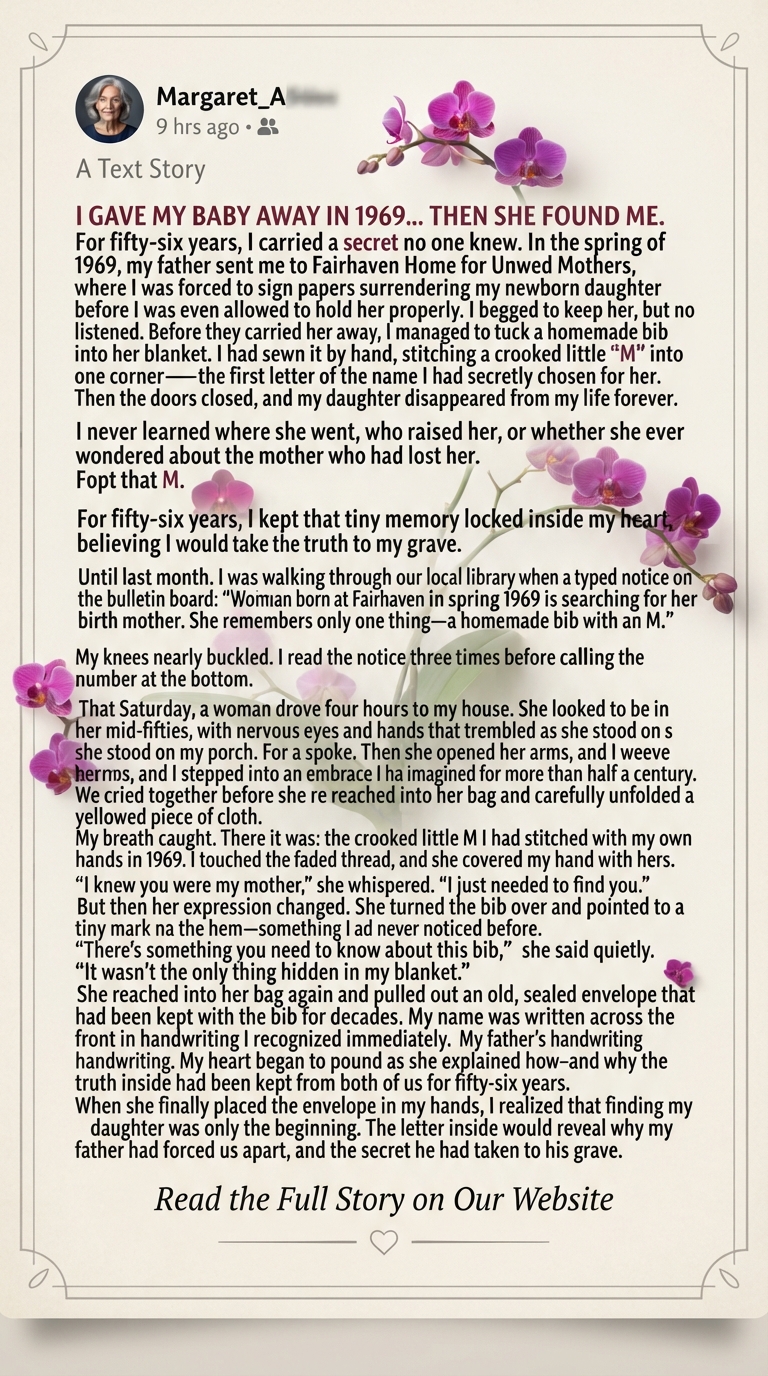
I Gave My Baby Away in 1969… Then She Found Me 56 Years Later
For fifty-six years, I believed I would die without ever knowing what had happened to my daughter.
I was seventeen when she was born in the spring of 1969. My father called my pregnancy a disgrace, a mistake that would destroy our family’s reputation. He refused to let me speak to the boy who had promised to marry me, and when my belly began to show, he sent me away to Fairhaven Home for Unwed Mothers.
He told our neighbors I was visiting an aunt.
He told me I would come home when the problem had been taken care of.
But there was no problem to take care of.
There was a baby girl growing inside me, a child I already loved more deeply than I knew how to explain.
At Fairhaven, the days were long, the rules were strict, and the girls were discouraged from talking about their babies as if they were people we might actually get to keep. The staff spoke about adoption as though it were a simple solution to an embarrassing situation.
I begged to keep my daughter.
I promised I would work. I promised I would leave school and take any job I could find. I even wrote a letter to my father, asking him to let me come home with the baby.
He never answered.
When my daughter was born, I was exhausted and frightened. A nurse placed her beside me for only a short time. I remember her warm cheek, her tiny fingers, and a soft cry that sounded like a question.
I had secretly chosen a name for her.
Margaret.
I liked the way it sounded. I imagined calling it across a garden while she ran toward me, her little shoes muddy from playing outside.
But I never got the chance.
Before the staff carried her away, I slipped a homemade bib into her blanket. I had sewn it by hand from a piece of soft cotton, stitching a crooked little M into one corner.
It was the only thing I could give her that proved I had loved her before I ever knew what her future would be.
Then the door closed.
And my daughter disappeared.
When I returned home, my father ordered me never to speak of the pregnancy again. He told me the baby had gone to a good family and that remembering her would only make my life harder.
I obeyed.
Not because I had stopped loving my daughter, but because I was seventeen, frightened, and completely dependent on a man who believed obedience mattered more than my heartbreak.
I finished school. I found work. Eventually, I married a kind man named Robert, who knew I had experienced a painful loss in my youth but never pressed me for details.
We built a quiet life together.
We had no children of our own. After several years of trying, we learned that having a baby was unlikely, and we stopped talking about it because the silence hurt less than the hope.
Robert died twelve years ago.
My father died long before him, taking his explanations and whatever secrets he had kept with him.
And through every birthday, every Christmas, and every Mother’s Day, I wondered whether my daughter was alive.
Did she have her father’s eyes?
Did she laugh like me?
Did she ever look at her own children and wonder whether the woman who gave birth to her had wanted her?
I never stopped wondering.
I simply learned to live with questions that had no answers.
Until last month.
I was visiting our local library when I noticed a typed notice on the community bulletin board.
BIRTH MOTHER SEARCH — FAIRHAVEN, SPRING 1969
I am a woman in my mid-fifties searching for my biological mother. I was born at Fairhaven Home for Unwed Mothers in the spring of 1969. The only identifying item I have from my birth was a homemade bib with a crooked letter M stitched into one corner. If this sounds familiar, please contact me.
I read it once.
Then twice.
On the third reading, my knees began to tremble so badly that I had to sit down.
There were thousands of babies born in 1969.
There were countless women who had surrendered children.
But how many of them had sewn a crooked M into a homemade bib?
I copied the phone number onto a piece of paper.
For nearly an hour, I sat in my car outside the library, staring at it.
I was terrified.
What if the woman wasn’t my daughter?
What if she was, and she hated me?
What if I had spent fifty-six years longing for someone who had spent fifty-six years wishing she had never been born to me?
Finally, I dialed.
A woman answered after the second ring.
“Hello?”
My mouth went dry.
“I’m calling about the notice at the library. The one about a baby born at Fairhaven in 1969.”
The line became quiet.
Then she whispered, “Do you know something about the bib?”
I closed my eyes.
“I made it.”
She began to cry.
And so did I.
We agreed to meet that Saturday.
She told me her name was Margaret Ellis.
The name I had chosen for my daughter before I had even been allowed to hold her properly.
I spent the next two days barely sleeping. I cleaned my small house, then cleaned it again. I bought groceries I didn’t need and changed my clothes three times before deciding what to wear.
On Saturday morning, I stood at the kitchen window, watching every car that passed.
At noon, a dark blue sedan pulled into my driveway.
A woman stepped out.
She looked to be in her mid-fifties, with silver beginning to show in her brown hair. She wore a pale blue sweater and held a leather bag against her side.
Her eyes were nervous.
So were mine.
When she reached the porch, we stood facing each other without speaking.
I saw something familiar in her face. I couldn’t explain it. Perhaps it was the shape of her eyes, or the way she pressed her lips together when she was trying not to cry.
Then she opened her arms.
I stepped into them.
For the first time in fifty-six years, I held my daughter.
We cried until neither of us could speak. She held me tightly, as though she were afraid I might disappear if she loosened her grip.
Eventually, we sat at my kitchen table.
Margaret reached into her bag and carefully unfolded a yellowed piece of cloth.
My breath caught.
There it was.
The tiny bib.
The cotton had faded to a soft cream color, and the edges had worn thin. But the crooked M was unmistakable.
I touched the thread with trembling fingers.
“I made this for you,” I whispered. “I wanted you to have something that came from me.”
Margaret covered my hand with hers.
“I knew you were my mother,” she said. “I just needed to find you.”
I pressed the bib against my chest and wept again.
Then she turned it over.
“There’s something else you need to know.”
Near the hem was a tiny dark mark I had never noticed before. It looked like a small ink stain, but when Margaret tilted the cloth toward the window, I could see that it was actually a few faint letters.
“Someone wrote on it,” she said.
I leaned closer.
The marks were almost impossible to read, but three words remained visible.
Ask your father.
My stomach tightened.
“What does that mean?”
Margaret looked at me.
“When I was twenty-six, I requested my original adoption records. I wanted to know where I came from. Most of the information had been sealed, but I eventually obtained access to some nonidentifying records and a copy of the notes that had accompanied my belongings.”
She took a breath.
“The bib had been preserved with a sealed envelope. The adoption agency kept the envelope in my file because it was marked as correspondence that should be delivered to me when I reached adulthood.”
I stared at her.
“You’ve had it all these years?”
“Not all of them. I only received it after I began searching for my birth family. I didn’t open it at first because I was afraid of what it might say. Then I saw the handwriting on the outside.”
She reached into her bag and pulled out an old envelope.
My name was written across the front.
Not Margaret.
My birth name.
The name I had stopped using after I married Robert.
The handwriting was unmistakable.
My father’s.
My hands began to shake so badly that Margaret had to help me hold the envelope.
“How did he know where to send this?” I whispered.
“He didn’t address it to me. It was included with the documents transferred to my adoption file. The agency’s notes said it had been found among the papers accompanying my birth records. It was to be delivered to you if you could ever be identified.”
I turned the envelope over.
It had never been opened.
My father’s name appeared in the corner, along with a date from the summer of 1969.
I could barely breathe.
Margaret touched my arm.
“You don’t have to open it now.”
But I knew I had waited long enough.
Carefully, I slid a butter knife beneath the flap.
Inside was a single folded letter.
The first line made my blood run cold.
My dearest daughter,
If you are reading this, I have failed to find the courage to tell you the truth while I am alive.
I stopped.
My father had never written to me like that. He had been a man of short sentences, strict rules, and an almost frightening certainty that he was always right.
I continued reading.
I told you that giving up your baby was the only way to save our family from disgrace. That was a lie.
My eyes blurred.
Margaret reached for my hand.
I read the next paragraph.
Your mother died believing that the child you carried would be welcomed into our family. Before she became ill, she asked me to promise that if you ever had a baby, I would protect you both.
I stopped breathing for a moment.
My mother had died when I was fifteen, two years before my pregnancy. I had spent the rest of my teenage years believing she would have been ashamed of me.
But according to the letter, she had wanted me to have a family of my own.
My father had told me otherwise.
The letter continued.
When you became pregnant, I was frightened. I had built my life around the belief that people respected our family because we followed the rules. I was afraid of gossip, afraid of losing my position in town, and afraid that people would learn the truth about my own past.
I gripped the paper.
Then I reached the sentence that changed everything.
The boy who fathered your child was not the reason I sent you away. I knew he wanted to marry you. I knew he had offered to take responsibility for the baby. I refused to let him speak to you because I had already promised your grandfather that I would never allow his family to become connected to ours.
My father had forbidden me from seeing the boy I loved.
I had spent decades believing he had abandoned me.
The letter revealed that my father had intercepted his letters and returned them without telling me.
He had even written a letter in my name, claiming I wanted nothing more to do with him.
I pressed my hand over my mouth.
Margaret looked at me with tears in her eyes.
“Did you know my father?”
I shook my head.
“I knew the boy I loved. His name was Daniel.”
She went very still.
“Daniel Reed?”
I looked up.
“Yes.”
Margaret reached into her bag again and pulled out a photograph.
It showed an older man standing beside a woman and two grown children.
“I think this is him,” she whispered. “My adoptive parents helped me search for my biological family. I found his obituary several years ago. He died in 2008.”
She pointed to the photograph.
“He married a woman named Susan. They had two children. His obituary mentioned that he had spent most of his life regretting the loss of someone he loved when he was young.”
I couldn’t stop crying.
Daniel had not abandoned me.
He had been separated from me by my father’s lies.
I continued reading.
I found Daniel’s letters after you left for Fairhaven. He had written to you repeatedly, begging me to let him see you. He wanted to marry you and raise the child with you.
I told myself I was protecting you from a difficult life. The truth is that I was protecting my reputation.
I sent the baby away without giving you a chance to choose. I allowed you to believe Daniel had abandoned you because I was too proud to admit that I had been wrong.
I have carried this guilt for years.
Then came the final paragraph.
I do not expect you to forgive me. I only ask that, if you ever find your daughter, you tell her that she was wanted. Tell her that the decision was mine, not yours. Tell her that you tried to keep her.
I failed you both.
Your father.
The letter slipped from my fingers onto the table.
For fifty-six years, I had carried the belief that I had failed my daughter.
Now I knew the truth.
I had been a frightened seventeen-year-old girl, surrounded by adults who made decisions for her and then demanded that she live with the consequences.
I had loved my baby.
I had tried to keep her.
And I had been denied the chance.
Margaret moved her chair closer.
“Mom?”
It was the first time she had called me that.
I looked at her.
“I’m so sorry,” I whispered. “I’m sorry I wasn’t there for your first day of school. I’m sorry I didn’t hold you when you were sick. I’m sorry I wasn’t there to watch you grow up.”
She shook her head.
“You were a child yourself.”
“But I was your mother.”
“And you loved me,” she said. “I can see that now.”
She took my hand.
“I spent years wondering whether you had wanted me. I thought perhaps you had chosen a different life and never looked back.”
I shook my head fiercely.
“Never. Not one day.”
She began to cry again.
“I needed to hear that.”
We sat together for a long time, talking about the lives we had lived separately.
Margaret told me about her adoptive parents, who had loved her deeply and raised her with kindness. Her mother had died several years earlier, but her father was still alive and living in a retirement community nearby.
She had grown up knowing she was adopted, but she had never been told why the bib mattered so much or why the envelope had been kept with it.
Her adoptive mother had saved the bib in a small box of childhood keepsakes. When Margaret began searching for her birth mother, she took it with her because it was the only object that connected her to the first days of her life.
“I never wanted to replace my parents,” she explained. “I loved them. I just wanted to know where I came from.”
I understood.
I had spent fifty-six years wondering whether my daughter had a good life.
Knowing she had been loved made the grief inside me change shape.
It didn’t disappear, but it was no longer filled with the fear that she had spent her life believing she was unwanted.
Then Margaret asked about Daniel.
I told her everything I remembered: the way he used to bring me wildflowers from the field behind his parents’ house, how he saved his money to buy me a silver bracelet, and how he promised that if we ever had a child, he would never let anyone make that child feel ashamed of where she came from.
I told her how my father had sent me away before I could tell Daniel I was pregnant.
Margaret listened quietly.
When I finished, she took another photograph from her bag.
It was Daniel’s obituary, folded carefully into a plastic sleeve.
“He had a good life,” she said. “His wife and children loved him. But I think he carried that loss with him.”
I touched the photograph.
“I wish I could have told him the truth.”
“So do I.”
For a moment, we sat with the sadness of a reunion that had arrived too late for one person we both wished we could have known.
Then Margaret smiled through her tears.
“But we found each other.”
She was right.
The next several weeks were unlike anything I had experienced before.
Margaret came to my house every Saturday. We went through old photographs, compared stories, and discovered little similarities that made us laugh.
She made the same face I did when she was concentrating.
We both hated raisins in cookies.
We both kept birthday cards long after most people would have thrown them away.
And we both cried at the same kind of sentimental movies.
One afternoon, she brought her adoptive father to meet me.
His name was George. He was eighty-three, gentle, and slightly nervous.
“I hope you understand,” he told me, “that I never thought of Margaret as anything other than my daughter.”
I reached for his hand.
“I wouldn’t want you to.”
He smiled with relief.
“I knew she would search for you someday. I hoped she would find you while there was still time.”
I looked at Margaret, who stood between us.
For years, I had imagined that meeting my daughter would mean entering a life that had been denied to me.
Instead, it meant discovering a family that had loved her, protected her, and helped her become the woman standing in front of me.
There was room for all of us.
No one had to lose their place for me to find mine.
As for my father’s letter, I placed it in a small wooden box beside the bib.
I didn’t forgive him immediately.
I couldn’t pretend that his confession erased the years he had taken from us. He had denied me the chance to raise my daughter, and he had denied Daniel the chance to know his child.
His fear had shaped three lives.
But eventually, I began to understand that I no longer wanted to spend the rest of my life carrying his choices as if they were my own.
I could acknowledge what he had done without allowing it to define me.
I could grieve the years we had lost without refusing the years we still had.
On the first anniversary of the day Margaret found me, she came to my house carrying a small package.
Inside was a new bib.
She had sewn it herself, using soft white cotton and pale blue thread.
In one corner, she had stitched a crooked M.
I laughed through my tears.
“That looks just like mine.”
“That was the idea,” she said.
Then she took my hand.
“I wanted us to have something that belonged to both of us.”
I held the new bib beside the old one.
One had been sewn by a frightened seventeen-year-old girl who believed she would never see her child again.
The other had been sewn by the daughter who had crossed four hours of highway to find her.
For fifty-six years, I had believed that the story of my motherhood ended when the doors of Fairhaven closed.
I was wrong.
It had been interrupted by fear, silence, and other people’s decisions.
But it had not ended.
My daughter had found me.
And at an age when I thought the past could offer nothing but regret, I was given the chance to hold the child I had once held for only a few precious moments.
Sometimes, when Margaret visits, she asks me to tell her the story of the day she was born.
I tell her about the spring rain, the hospital room, and the tiny fingers that curled around mine.
I tell her about the bib.
And I always tell her the same thing.
“You were wanted, Margaret. You were loved before I ever saw your face. And not a single day passed when I didn’t wonder where you were.”
She always reaches for my hand when I say it.
Now, the old bib rests in a glass frame on my living room shelf. Beside it is the letter my father wrote, the one that revealed the truth he had hidden for more than half a century.
I keep both because I need to remember two things.
The first is that love can survive an extraordinary amount of time and silence.
The second is that the truth, even when it arrives decades too late, can still give a wounded heart something it desperately needs.
It cannot return the years.
It cannot bring Daniel back.
It cannot give me the chance to watch Margaret grow up.
But it can end the lie that we were ever unwanted.
And at seventy-three years old, I finally know that the little girl I surrendered in 1969 never stopped being my daughter.
She simply took the longest road home.