The Box Beneath My Daughter-in-Law’s Blanket Revealed a Secret My Husband Took to His Grave
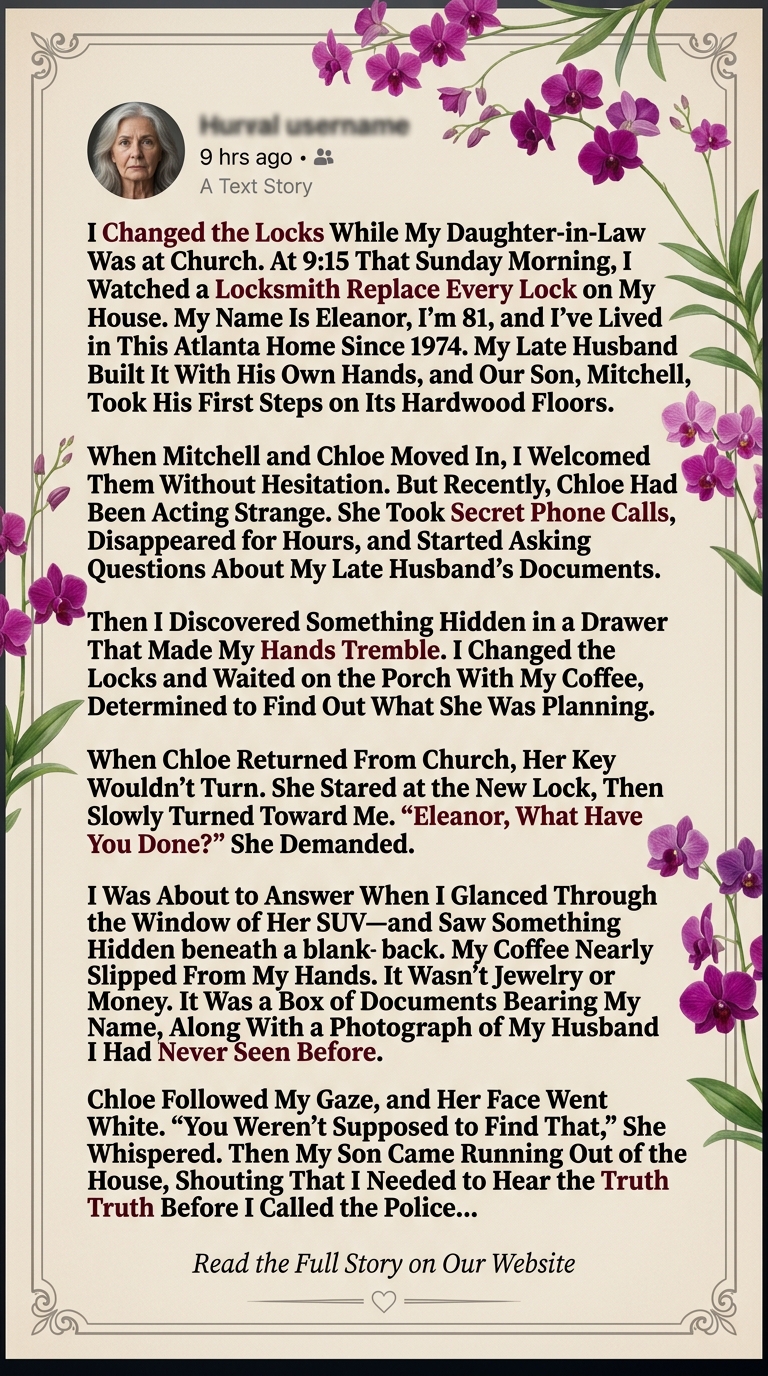
At 9:15 on Sunday morning, I watched a locksmith replace every lock on my house.
I was eighty-one years old, and I had lived in that Atlanta home since 1974. My late husband, Walter, had built it with his own hands, laying the hardwood floors himself and planting the magnolia tree beside the front steps. Our son, Mitchell, had taken his first steps in the living room, gripping the edge of Walter’s workbench before wobbling into my arms.
I had never imagined I would need to change the locks against my own family.
But for the past three months, my daughter-in-law, Chloe, had been acting strangely.
She took phone calls outside and lowered her voice whenever I entered a room. She disappeared for hours, claiming she had errands to run. And she had developed an unusual interest in Walter’s old paperwork.
At first, I thought she was simply helping Mitchell organize the house.
Then I found the envelope.
It was tucked behind a loose panel in the bottom drawer of Walter’s old writing desk, a place I had cleaned hundreds of times without noticing anything unusual.
Inside were photocopies of property records, a bank statement, and a letter bearing Walter’s signature.
The letter was dated six months before he died.
My hands trembled as I read the first sentence.
“Eleanor, if you are reading this, it means I never found the courage to tell you what happened before Mitchell was born.”
I sat down.
Walter had been a good husband. Not a perfect man, but a steady one. He worked long hours, paid our bills, and spent every Saturday repairing something around the house. When he died, I believed I knew the important parts of his life.
Apparently, I didn’t.
The letter referred to a property in rural Georgia that I had never heard of. It mentioned a woman named Margaret, an account opened under a different business name, and a document Walter had instructed someone to keep until the right time.
The last paragraph frightened me most.
“If anyone asks you to sign papers concerning the house or my estate, do not sign anything until you have spoken to an independent attorney. There are things Mitchell does not know, and there are things I should have told you years ago.”
I read it three times.
Then I put everything back into the envelope and listened for Chloe’s footsteps.
That evening, I watched her walk into the study and open the same drawer.
She didn’t know I was standing in the hallway.
She searched beneath the papers, checked the back panel, and muttered something under her breath.
When she turned, I stepped into the room.
“Looking for something, Chloe?”
She nearly dropped the drawer handle.
“No, Eleanor. Just looking for the house insurance papers.”
“They’re in the filing cabinet.”
“Oh. Right.”
She smiled, but it didn’t reach her eyes.
That night, I barely slept.
By Saturday afternoon, I had decided I needed to protect my home until I understood what was happening. I called a locksmith, confirmed that the property was still registered in my name, and arranged for the locks to be changed the following morning while Chloe attended church.
I also called an attorney recommended by a neighbor.
He told me not to accuse anyone of anything yet. He advised me to preserve the letter, make copies of every document, and avoid signing anything presented by family members until he could review it.
So I did exactly that.
At 9:15 Sunday morning, the locksmith finished replacing the final lock.
I paid him, thanked him, and sat on the porch with my coffee.
Then I waited.
At 11:42, Chloe’s SUV turned into the driveway.
She climbed out wearing a pale blue dress, carrying her church bag over one arm. She approached the front door, inserted her key, and turned it.
Nothing happened.
She tried again.
Then she rattled the handle hard enough to shake the glass.
I watched her from the porch.
She turned toward me.
“Eleanor, what have you done?”
“I changed the locks.”
“You can’t do that without telling us!”
“It’s my house.”
Her expression hardened.
“Mitchell and I live here.”
“And I welcomed you here. That doesn’t mean you get to search my belongings or interfere with my husband’s estate.”
For a second, her face showed something close to fear.
Then she looked toward her SUV.
I followed her gaze.
The rear window was partially covered by a blanket. But the fabric had slipped, exposing the corner of a cardboard box.
My coffee nearly slid from my hand.
On the side of the box, written in black marker, was my full name.
Beneath it was a date from nearly forty years earlier.
Chloe moved quickly toward the vehicle.
Too quickly.
“What is that?” I asked.
“Nothing.”
“Then you won’t mind showing me.”
She stopped.
I stepped closer to the SUV and looked through the open rear window.
The box was full of documents. I could see copies of my marriage certificate, Walter’s old property records, and several pages bearing my signature.
Then I saw the photograph.
Walter stood beside a woman I had never seen before. He was younger, perhaps in his early thirties, and he had his arm around her shoulders. The woman was holding a baby wrapped in a yellow blanket.
On the back of the photograph, someone had written:
“Walter, Margaret, and David — October 1973.”
I felt the blood drain from my face.
October 1973.
A year before we moved into our Atlanta home.
I looked at Chloe.
“Who is David?”
Her lips parted, but no answer came.
Then a voice rang out from behind us.
“Mom! Please don’t call the police!”
Mitchell came running down the driveway, his face pale and his shirt untucked. He had been inside the house when the locksmith arrived, but I had assumed he was upstairs getting ready for church. I hadn’t realized he had stayed home.
He stopped between Chloe and me.
“Mom, I can explain.”
“Then explain,” I said. “Who is Margaret? Who is David? And why is my daughter-in-law carrying documents with my name on them?”
Mitchell looked at Chloe.
She shook her head slightly.
That small movement told me more than either of them intended.
“Mitchell,” I said quietly, “I am eighty-one years old. I have buried your father, watched my friends grow old, and learned that there is very little time left for pretending. I want the truth.”
He closed his eyes.
“Dad had another son.”
The words seemed to echo across the driveway.
I stared at him.
“No.”
“Mom—”
“No. Your father would have told me.”
Mitchell looked down.
“He wanted to. He just never knew how.”
I gripped the porch railing.
Walter had another child.
A son.
And apparently, my son had known.
“How long have you known?”
“Since last year.”
I felt something break inside me.
“You knew for a year and didn’t tell me?”
“I was trying to understand what happened.”
“And Chloe?”
He glanced at her.
“She found out six months ago.”
Chloe folded her arms, but she was trembling.
I pointed toward the box.
“Why are you taking my documents?”
Mitchell swallowed.
“Because David contacted us. He said Dad had promised him something before he died, and he wanted to know whether the promise had been kept.”
“What promise?”
Mitchell took a slow breath.
“Dad promised him a piece of property.”
I remembered the letter in the desk.
The rural Georgia property.
The one Walter had mentioned but never explained.
“Which property?”
Mitchell looked at me.
“The land near Savannah. The one Dad bought before you married him.”
I shook my head.
“Your father never told me he owned land near Savannah.”
“He kept it separate from the house and the other family assets. He said it was meant for David.”
I could barely hear him over the pounding in my ears.
“Then why is Chloe carrying my marriage certificate and my property records?”
Neither of them answered.
I looked at Chloe again.
“Tell me.”
She pressed her lips together.
Then, finally, she spoke.
“David’s attorney requested proof of Walter’s marriage and estate history. I was trying to gather the documents before your attorney got involved.”
“My attorney?”
Her face went white.
I understood then.
She hadn’t been searching for the documents simply to learn about Walter’s past. She had been collecting them for someone else, and she had hoped to do it before I realized what she was doing.
But why?
I turned to Mitchell.
“Did David’s attorney ask you to take these?”
Mitchell hesitated.
“No.”
“Then who did?”
He looked at Chloe again.
She lowered her eyes.
“I did,” she whispered. “I thought if I could get everything together, we could settle the matter before it became a legal fight.”
“What legal fight?”
Chloe’s voice broke.
“David believes Walter promised him an inheritance. He has a copy of an agreement. He says your house was supposed to be part of the arrangement.”
I stared at her.
“My house?”
“He thinks Walter intended to leave him an interest in the property.”
For a moment, I couldn’t speak.
Walter and I had built our life together in that house. I had paid bills, raised our son, and spent decades caring for my husband when his health declined. The thought that someone might claim part of it because of a promise I had never heard of filled me with dread.
But dread was not proof.
And I had learned enough over the years to know that panic was the quickest way to make a bad situation worse.
“Show me the agreement,” I said.
Chloe looked at Mitchell.
He shook his head.
“It’s not here,” he said. “David has the original. Chloe only brought copies of the other records.”
“Then why did you let her search my desk?”
Mitchell’s shoulders slumped.
“Because I thought we could settle this quietly. I was afraid you would be hurt.”
I laughed once, without humor.
“You were afraid I would be hurt, so you let your wife search my belongings behind my back?”
He had no answer.
I stepped away from them and went inside through the side entrance, using my new key. Mitchell followed me, but I held up my hand.
“Not another word until we call my attorney.”
That afternoon, the three of us sat at my kitchen table while my attorney, Mr. Lawson, joined us by phone. I described the letter, the photograph, the box, and the agreement David supposedly possessed.
Mr. Lawson asked me to read the relevant passage from Walter’s letter.
When I finished, he was silent for a moment.
Then he asked, “Eleanor, did Walter ever discuss making a will or changing the ownership of your home?”
“He had a will. We reviewed it together years ago.”
“Do you have a copy?”
“Yes.”
“Good. Do not hand over any original documents, and do not sign anything. I’ll review the will, the property title, and the agreement David is relying on. Until then, nobody should make assumptions about ownership.”
Chloe looked relieved.
I didn’t.
“Why did you hide the box in your vehicle?” I asked her after the call ended.
She stared at the table.
“Because I knew you would ask questions.”
“That is not an answer.”
She took a shaky breath.
“David said if we helped him establish his claim, he would give Mitchell a share of the Savannah property. He told us it was what Walter would have wanted.”
Mitchell turned toward her.
“You said you were only helping him find records.”
“I was!”
“You told me there was no money involved.”
“There wasn’t at first.”
Their argument grew louder until I struck the table with my palm.
“Enough!”
They both fell silent.
“You have spent weeks discussing my husband’s property without telling me. You searched my desk, took my documents, and allowed me to believe I was losing my mind when I questioned your behavior. You don’t get to argue about who lied more. You both owe me the truth.”
Mitchell’s eyes filled with tears.
“I’m sorry, Mom.”
I believed he was sorry.
But being sorry did not undo what he had done.
For the next several days, my attorney examined the documents. He contacted David’s attorney, requested the original agreement, and obtained certified copies of the property records.
The truth emerged slowly.
Walter had indeed fathered a son before our marriage.
Margaret had been a woman he knew when he was young. Their relationship had ended before Walter met me, but he had continued providing financial support for David. He had never told me because he feared that revealing his past would destroy the life he had built.
It was a cowardly choice, but it was his choice.
The Savannah property had been purchased in Walter’s name years before our marriage. He had later placed it in a separate legal arrangement intended to benefit David.
However, the agreement David was relying on was not a deed to my Atlanta home. It was a letter describing Walter’s intention to provide David with an inheritance from the separate property.
The letter was emotionally important, but it did not automatically give David ownership of everything Walter had ever possessed.
My attorney found no evidence that Walter had transferred my Atlanta house to David or granted him an ownership interest in it. The home’s title remained in my name, and the documents Chloe had taken did not change that.
The question of David’s rights to the Savannah property required a separate review. Walter’s estate records were incomplete, and the legal arrangement had not been properly updated after his death. My attorney worked with David’s counsel to determine what could be established and what would need to be resolved through the estate.
But the house where I had lived for nearly fifty years was not the inheritance David had been promised.
When my attorney explained this, I sat very still.
I wasn’t relieved because Walter had kept a secret.
I was relieved because the truth, however painful, was finally being separated from the fear.
A week later, David came to my house.
He was in his late forties, with Walter’s dark eyes and the same slight tilt of the head I remembered from old family photographs. When I opened the door, he looked at me with a mixture of hope and shame.
“Mrs. Whitmore?”
“Eleanor,” I said. “Please come in.”
He sat across from me in the living room, looking around at the bookshelves and family photographs.
“I’ve imagined meeting you for years,” he admitted.
“Did your father tell you about me?”
“He told me he was married and had a son. He said he was trying to make things right, but he never explained everything. I was angry with him for a long time.”
“Did he tell you he intended to give you our house?”
David shook his head.
“No. I don’t want your house. I want the land he promised me, and I want to understand why he kept me a secret.”
His answer surprised me.
I had expected someone who wanted to take what belonged to me. Instead, I saw a man who had spent much of his life trying to understand why his father had never fully acknowledged him.
“I can’t answer every question about Walter,” I said. “I wish I could.”
David looked down.
“I know. I’m sorry my search for answers frightened you.”
He explained that Chloe had approached him after finding an old letter among Walter’s papers. She had offered to help him collect records, believing that the matter could be settled without lawyers. She had also told him that Mitchell might receive a share of the Savannah property if they cooperated.
David admitted that he had accepted her help without asking how she planned to obtain the documents.
“I never asked her to take anything from your house,” he said. “I told her to ask you.”
I believed him, although I understood that the legal questions still needed to be resolved properly.
Before he left, David placed a photograph on the table.
It showed Walter holding a toddler on his shoulders beside a small lake.
On the back, in Walter’s handwriting, were the words:
“For David, my son. I hope one day I find the courage to tell everyone the truth.”
I touched the photograph with my fingertips.
For the first time, I felt grief not only for the secret Walter had kept from me, but for the years he had lost with a child who deserved to know his father.
“I’m not ready to call you family,” I told David honestly. “But I’m willing to learn who you are.”
He nodded.
“That’s more than I expected.”
The legal matter took several more months to resolve. The estate review confirmed that the Savannah property had been intended to benefit David, but additional paperwork was needed to establish the proper transfer. My attorney ensured that the process respected the rights documented in Walter’s estate and did not involve my Atlanta home.
David ultimately received the interest in the Savannah property that the estate could lawfully transfer to him. No one took my house, and no one asked me to sign away my rights.
Chloe apologized for taking the documents without permission. Mitchell apologized for allowing his fear of conflict to override his responsibility to me.
I told them they could remain in my life, but things would change. They would no longer treat my home as a place where they could make decisions on my behalf. If they wanted to discuss the estate, they would do so openly and through the appropriate legal channels.
They agreed.
I did not change the locks back.
Not because I wanted to punish them, but because I had learned that boundaries were not acts of cruelty. They were a way of making sure love could exist without secrecy or entitlement.
Months later, David visited again. He brought a small wooden box he had found among Margaret’s belongings. Inside was Walter’s original wedding ring from his first relationship and several letters he had written to David as a child.
We spent the afternoon reading them.
Walter had written about fishing, school, and the hope that one day he could bring David into the rest of his life. Some letters were tender. Others were full of excuses.
I felt anger at the man I had loved, but I also felt compassion for the child who had grown up waiting for a father to stop hiding.
When David left, he hugged me awkwardly at the door.
“Thank you for listening,” he said.
“Thank you for telling me the truth.”
After he drove away, I sat on the porch with a cup of coffee, looking at the magnolia tree Walter had planted.
I thought about the locks I had changed that Sunday morning, convinced that someone was trying to steal my home.
I had been right to protect my property, but the real thing I needed to protect was my right to know the truth about my own life.
Walter had left behind a house, a complicated estate, and a secret that had hurt more than one person.
But he had also left behind the possibility of making things right.
At eighty-one, I knew I could not rewrite the past. I could not give David back the years he had lost, and I could not make Mitchell unlearn the habit of keeping peace by keeping secrets.
What I could do was insist that the rest of our lives be built on honesty.
The locks on my front door were new.
The truth behind it was finally coming into the light.