The Suitcase My Missing Brother Left Behind Changed Everything I Knew About My Family
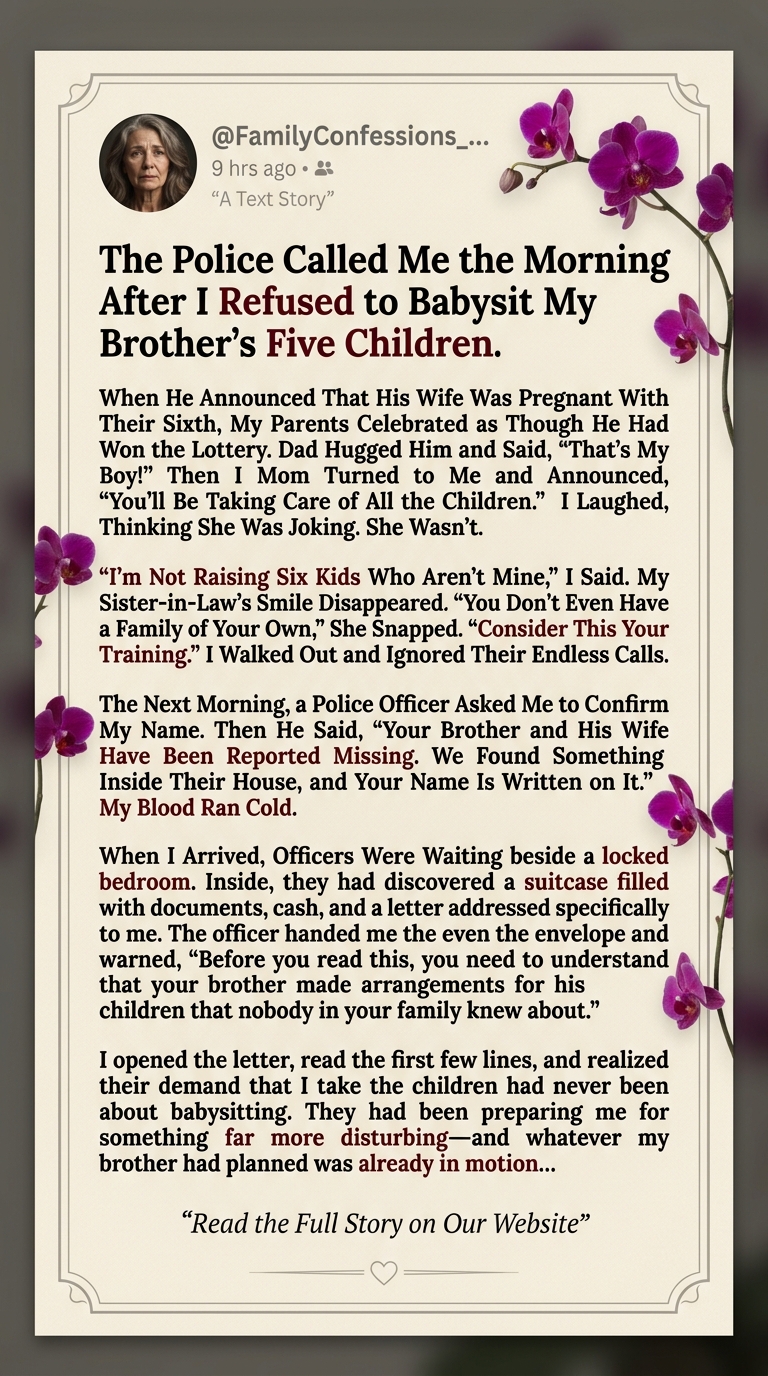
The police called me at 7:12 on Monday morning, less than twelve hours after I refused to raise my brother’s five children.
“Am I speaking with Ms. Rebecca Hayes?” the officer asked.
“Yes. What is this about?”
“Your brother, Daniel Hayes, and his wife, Melissa, have been reported missing. We found something inside their home with your name on it. We need you to come down and help us establish a few facts.”
My stomach tightened.
The last time I had seen Daniel, he had been standing in our parents’ living room, smiling proudly while our mother announced that his wife was pregnant with their sixth child.
Dad had hugged him so hard that Daniel laughed.
“That’s my boy!” Dad declared. “A real family man.”
Mom wiped happy tears from her cheeks before turning toward me.
“Rebecca, you’ll be taking care of all the children when the baby arrives.”
I stared at her.
“Sorry?”
“You heard me. Daniel and Melissa have their hands full. You have a stable job, a spare bedroom, and no children of your own. It makes perfect sense.”
I laughed because I honestly thought she was joking.
She wasn’t.
“I’m not raising six kids who aren’t mine,” I said. “I can help occasionally, but I’m not becoming their full-time parent.”
Melissa’s smile disappeared.
“You don’t even have a family of your own,” she snapped. “Consider this your training.”
The room went silent.
I looked at Daniel, waiting for him to tell his wife she had crossed a line.
Instead, he looked down at his shoes.
Mom folded her arms.
“After everything this family has done for you, you could at least make one sacrifice.”
I had spent years making sacrifices for them.
I had paid Dad’s overdue electricity bill when his business struggled. I had lent Daniel money after his second child was born. I had watched his children on countless weekends so he and Melissa could travel, attend parties, or simply enjoy a quiet evening.
Every time I helped, it became an obligation.
Every time I said no, I became selfish.
But I had finally reached my limit.
“I love my nieces and nephews,” I told them. “That doesn’t mean I owe you my life.”
Then I left.
My phone rang repeatedly that evening. Mom called eleven times. Daniel sent messages accusing me of abandoning his family. Melissa wrote that she hoped I could live with myself if the children suffered because of my selfishness.
I turned off my phone and went to bed.
At 7:12 the next morning, the police woke me.
And suddenly, my family’s argument about babysitting seemed like the least frightening part of the story.
The officer introduced himself as Detective Harris. He asked me to meet him at Daniel’s house on the north side of town.
When I arrived, two patrol cars were parked outside. The front door stood open, and a uniformed officer was speaking with a neighbor.
“Where are the children?” I asked immediately.
“They’re safe,” Detective Harris assured me. “They were with your parents when we located the residence.”
I exhaled so sharply that I had to lean against my car.
“What happened to Daniel and Melissa?”
“That’s what we’re trying to determine.”
He led me inside.
The house looked as though someone had left in a hurry. A bowl of cereal sat on the kitchen counter. Laundry lay in a basket beside the stairs. One of the children’s backpacks was open on the floor.
There were no obvious signs of a struggle.
But upstairs, in the bedroom Daniel and Melissa shared, officers had discovered a locked suitcase hidden behind a false panel inside the wardrobe.
The suitcase had been forced open.
Inside were several folders, a substantial amount of cash, passports, a small USB drive, and an envelope bearing my name.
Detective Harris handed me a pair of gloves.
“We haven’t finished reviewing everything. The letter appears to have been written by your brother. Before you read it, I need to explain something.”
He paused.
“Daniel made arrangements for his children that nobody in your family appears to have known about.”
My hands went cold.
“What kind of arrangements?”
“We’re still establishing that. Please read the letter, and tell me if you recognize anything in it.”
I opened the envelope.
The handwriting was unmistakably Daniel’s.
Rebecca,
If you’re reading this, then the plan has moved forward, and I haven’t been able to explain everything to you myself.
First, I need you to understand that I never expected you to raise my children. Mom and Dad may have told you otherwise, but that was never supposed to be your responsibility.
I stopped reading.
What?
I looked up at Detective Harris.
“Can I continue?”
He nodded.
I returned to the letter.
For the past eighteen months, Melissa and I have been dealing with a problem that has grown beyond our control. I made decisions I thought would protect my children, but I should have told you the truth before things reached this point.
The children are not in danger because of anything you’ve done. If anyone tells you that you caused this situation by refusing to take them, do not believe them.
The suitcase contains records that explain why we were preparing to leave. The USB drive contains the information you need to understand what happened.
Do not give the documents to Mom or Dad.
And whatever you do, don’t let them convince you to sign anything on my behalf.
The final line made my pulse race.
I’m sorry I let you believe that I agreed with them about your future. I should have defended you. I should have told you what was happening.
If I get the chance, I’ll explain everything.
Daniel.
I lowered the letter.
“What does he mean by signing something on his behalf?”
Detective Harris glanced at the folders.
“We found several unsigned legal documents. Some concern financial accounts. Others appear to concern temporary guardianship arrangements. Our investigators are examining them.”
“Guardianship?”
“Yes. One document names you as a potential temporary caregiver, but it isn’t signed by you, and it doesn’t establish that you’ve accepted any responsibility.”
I felt both relieved and sick.
My parents had been telling everyone that I would take the children. Had they been preparing to make it official without my consent?
I opened the first folder.
Inside were copies of bank statements, loan agreements, and records from a company Daniel had established two years earlier. The company had received payments from several businesses, but the amounts didn’t match the work it claimed to perform.
The next folder contained printed messages between Daniel and someone identified only as “M.”
One message stood out.
The sixth baby changes everything. We can’t keep moving money around and pretending another child will make the numbers work.
A reply followed.
Then Rebecca needs to be brought into it before the deadline. Once she signs, the responsibility shifts.
I stared at the words.
“Who is M?”
“We don’t know yet,” Detective Harris said. “We’re working to identify the sender.”
I continued sorting through the papers until I found a document with my full name, date of birth, and home address.
It was a proposed personal guarantee for a business loan.
The amount was far beyond anything I could afford.
My signature line was blank.
Beneath it was a note in Daniel’s handwriting:
She won’t agree unless Mom makes it about the children.
I felt the room tilt.
The family meeting had not been about finding a babysitter.
It had been about making me feel guilty enough to accept a responsibility I had never agreed to carry.
But why had Daniel disappeared?
And where were the children’s parents?
Detective Harris asked me to sit down while another officer photographed the documents.
“Rebecca, I need to ask you something directly. Did your brother ever ask you to invest in his business?”
“Not officially. He told me he was expanding a logistics company and needed temporary help with cash flow. I lent him money once, but he repaid part of it.”
“Did he ask you to sign a loan guarantee?”
“No.”
“Did your parents ever discuss signing financial paperwork with you?”
I thought back to a conversation with my mother two weeks earlier.
She had called to ask whether I still had the documents from the purchase of my condo. When I asked why she needed them, she said she was helping me organize my finances.
I had refused to send them.
At the time, it seemed like an ordinary disagreement.
Now, it felt like a warning I had failed to recognize.
“I think my mother was trying to get my financial information,” I said.
Detective Harris made a note.
“Don’t contact your family about these documents yet. We need to establish what happened before anyone has a chance to destroy evidence.”
I nodded.
Then I asked the question I had been afraid to ask since arriving.
“Do you think Daniel hurt Melissa?”
“We have no evidence establishing that. We also have no confirmation that either of them has been harmed. Right now, we are treating their whereabouts as unknown and investigating all possibilities.”
His answer was careful, but it did nothing to quiet my fear.
Before I left, Detective Harris gave me his contact information and told me not to sign anything related to Daniel’s business or the children’s care without obtaining independent legal advice.
I drove straight to my parents’ house.
I know the detective had advised me not to confront them, but I needed to see the children with my own eyes.
When Mom opened the door, she looked startled.
“Rebecca! What are you doing here?”
“I want to see the children.”
“They’re upstairs.”
I hurried past her.
All five children were in the family room. The oldest, ten-year-old Sophie, was sitting beside her younger brother with a tablet in her lap. The twins were playing with blocks, while the youngest was asleep on the couch.
They looked tired and frightened.
I knelt in front of Sophie.
“Have you heard from your mom or dad?”
She shook her head.
“Dad said we might have to stay here for a while.”
“When did he say that?”
“Friday night.”
My chest tightened.
“What else did he tell you?”
Sophie hesitated.
“He told me that if anything happened, I should give you something.”
She reached beneath the couch cushion and pulled out a small envelope.
Inside was a key and a handwritten note.
Rebecca, the spare drive is in the place where we used to hide during thunderstorms. Don’t trust anyone who says the children are the reason you must sign.
I recognized the place immediately.
When we were children, Daniel and I used to hide in the storage room beneath our grandparents’ old house whenever storms frightened us. The house had been sold years ago, but I remembered that Daniel had kept a small metal box from the room.
I showed the note to Detective Harris over the phone.
He told me not to go searching alone. Investigators were already tracing Daniel’s recent movements, and they would examine the note as part of the case.
I gave the key and note to the detective and returned to the family room.
Mom stood in the doorway.
“What did Daniel leave you?”
I looked at her.
“Why are you asking?”
She pressed her lips together.
“Because I’m his mother, and I’m trying to understand what’s happening.”
“Then tell me why he wrote that I shouldn’t trust anyone who says I must sign something.”
Her face changed.
Only slightly, but enough.
“I don’t know what you’re talking about.”
I wanted to believe her.
But for the first time in my life, I wondered whether my mother’s insistence that I sacrifice everything for Daniel had been part of something much more calculated.
That afternoon, Detective Harris called.
Investigators had identified “M” as Marcus Bell, a business associate who had helped Daniel establish the logistics company. Records suggested that Daniel’s company had taken out several loans using financial projections that did not match its actual revenue.
Some payments had been redirected to accounts controlled by Marcus.
Daniel had apparently discovered the discrepancy months earlier.
Instead of reporting it immediately, he had tried to recover the missing money privately. He borrowed from friends, delayed payments to suppliers, and continued accepting contracts he could not reliably fulfill.
The business began collapsing.
The sixth pregnancy had not caused the financial crisis. It had simply made the family’s expenses harder to conceal.
Daniel was terrified of losing the house and exposing the business problems to our parents, who had spent years boasting about his success.
He had also become increasingly worried about Marcus.
According to the records, Marcus had threatened to accuse Daniel of fraud unless he agreed to take responsibility for the missing funds.
Daniel had begun collecting evidence against him.
But the strangest part concerned the guardianship papers.
Detective Harris explained that Daniel had consulted a lawyer about what would happen to his children if he and Melissa became unable to care for them. He had listed several possible relatives, including me, as people who might be willing to help temporarily.
He had not signed the final document.
Nor had I.
Somebody had taken the draft and altered it, adding language that suggested I had already agreed to accept responsibility for the children and certain household expenses.
The alterations were not yet conclusively attributed to anyone, but they raised serious questions.
The personal guarantee in the suitcase was part of a separate financial arrangement. If I had signed it, I could have become liable for a substantial portion of Daniel’s business debt.
And the note about using the children to persuade me made the family’s behavior at Sunday dinner seem even more sinister.
My parents had not merely assumed I would help.
Someone had expected my love for the children to become leverage.
I felt angry enough to shake.
But I was also afraid.
If Daniel had been collecting evidence against Marcus, had he and Melissa gone into hiding to protect themselves? Had they been forced to leave? Or had they disappeared because they knew the investigation was closing in?
The police were still trying to establish the answer.
Then, shortly after six that evening, Detective Harris called again.
“We’ve located your brother’s vehicle,” he said. “It’s parked at a long-term lot outside the city. There are no signs of a collision or obvious damage.”
“Is Daniel inside?”
“No. We’re reviewing nearby camera footage and contacting people who may have seen him. We have also received information suggesting your parents may know more than they’ve told us.”
My heart pounded.
“What kind of information?”
“I can’t share all the details yet. But I need you to tell me whether your father has ever been involved in Daniel’s business.”
“Not that I know of.”
“Has he ever lent Daniel a large amount of money?”
I remembered Dad’s boast at the family gathering.
That’s my boy!
He had sounded proud, but there had been something else in his expression. A kind of relief.
“I don’t know,” I answered.
Detective Harris asked me to remain available.
That night, I didn’t sleep.
I kept thinking about Daniel as a boy, the brother who used to sneak into my bedroom during thunderstorms because he hated the sound of thunder. I remembered him giving me his last piece of birthday cake and defending me when other children made fun of my glasses.
He had changed over the years. Success had made him arrogant, and our parents had encouraged him to believe that being the favorite meant he could do no wrong.
But I had never imagined he would be involved in something this serious.
Or that he would leave his children without an explanation.
The next morning, Detective Harris asked me to come to the station.
He had news.
A camera near the long-term parking lot had captured Daniel’s vehicle arriving shortly after midnight on Sunday. A second camera showed a man matching Daniel’s description leaving the area in a different vehicle.
Hours later, another recording placed Melissa at a bus terminal several miles away.
The two appeared to have traveled separately.
Neither had yet been located.
“Do you believe they planned to disappear?” I asked.
“We believe they prepared for the possibility of leaving. Whether they intended to return, and why they left when they did, are still under investigation.”
He showed me a photograph recovered from the USB drive.
It was a scanned copy of a handwritten agreement between Daniel and Marcus. The agreement appeared to document a loan Marcus had made to Daniel’s company, but the repayment terms were unusually vague.
Attached was a spreadsheet showing transfers between the business and several personal accounts.
One of the accounts belonged to my father.
I stared at the screen.
“Why is Dad’s account here?”
“We’re trying to establish that. The transactions may indicate a loan, a repayment, or something else. We need the bank records before drawing conclusions.”
Then he showed me another document.
It was a draft letter from Daniel to our parents.
I know you told me to make the business look successful until the refinancing was approved. I should have refused. But I won’t let Rebecca be made responsible for the money Marcus took, and I won’t let you use the children to force her into signing a guarantee.
I read the sentence again.
My father had been involved.
But how much had he known?
Detective Harris explained that the evidence suggested Dad had encouraged Daniel to secure additional financing while concealing the company’s financial problems. It was not yet clear whether he knew about Marcus’s transfers or whether he had personally benefited from them.
The letter was not proof of a crime by itself, but it gave investigators a direction to pursue.
I felt sick.
My parents had spent years telling me that Daniel was the family’s success story and that I was the one who needed to learn responsibility.
Now it appeared they had helped him hide his failures while preparing to place the consequences on me.
And when I refused to accept that burden, the entire arrangement had begun to unravel.
The breakthrough came three days later.
A lawyer representing Melissa contacted the police. She had received a brief message from her client asking her to arrange a meeting and confirm that the children were safe.
Melissa agreed to speak with investigators at a secure location.
Daniel was found the following morning at a small motel in another county.
Neither had been physically harmed.
When Detective Harris called to tell me, I sat down on the kitchen floor and cried with relief.
The children had been asking for their parents constantly. I couldn’t imagine what it would have been like if the search had ended differently.
But the relief did not mean the story was over.
Daniel and Melissa had left because they believed Marcus was about to expose the business’s financial problems and that our father was preparing to distance himself from the entire arrangement.
Daniel had intended to give investigators the evidence on the USB drive. He had also planned to arrange temporary care for the children while he and Melissa addressed the legal situation.
But he had made a serious mistake.
Rather than tell me what was happening and ask whether I was willing to help, he had allowed our parents to turn a possible caregiving arrangement into an expectation. He had also kept the financial crisis secret until the situation became dangerous.
When investigators questioned him, he admitted that he had hoped I would sign the guarantee because he believed the business could recover if the debt were refinanced.
He insisted that he had never intended to force me.
I thought about the note in the suitcase.
She won’t agree unless Mom makes it about the children.
“Did you write that?” I asked him when I finally had the chance to speak with him.
Daniel lowered his head.
“Yes.”
“Then you knew what they were doing.”
“I knew Mom was pressuring you. I thought if I could buy enough time, I could fix everything before you found out.”
“You were going to let me sign a guarantee for a company you knew was in trouble.”
“I was desperate.”
“So was I, Daniel. I just wasn’t allowed to be.”
He began to cry.
For a moment, I saw the little boy who had hidden beside me during thunderstorms.
Then I remembered the adult who had allowed our parents to treat my life as a resource they could use whenever his own plans failed.
“I love your children,” I told him. “I would do almost anything to protect them. But loving them does not mean I have to sign away my future.”
He nodded.
“I know that now.”
The investigation continued for months. Investigators reviewed the business records, the loan documents, the altered guardianship paperwork, and the transfers involving Marcus and my father. Marcus was eventually charged in connection with financial misconduct, while the evidence concerning Daniel and our father’s roles was assessed separately. The exact legal outcomes depended on what prosecutors could establish from the records and testimony.
My father denied that he had encouraged anyone to mislead lenders. My mother insisted that she had only been trying to keep the family together.
Neither explanation erased the pressure they had put on me.
Daniel’s company eventually closed. He had to cooperate with the financial investigation and work through the debts and claims against him. Melissa began rebuilding her life with the children, while both of them received legal advice about the arrangements they had made.
The children stayed with our parents temporarily, but I refused to sign any document that assigned me permanent guardianship or financial responsibility. I offered practical help on terms I chose myself: school pickups when I was available, meals, and time with the children so they could feel secure.
No one got to decide for me again.
Several months later, Daniel came to my apartment.
He looked exhausted, older than his years.
“I wanted to tell you something,” he said.
I invited him in.
He sat on the sofa and looked at his hands.
“When Mom announced that you would take the children, I should have stopped her. When Melissa insulted you, I should have defended you. And when I knew the financial papers might put you in danger, I should have told you everything.”
“Yes,” I said.
“I was afraid of losing the life I had built.”
“You were afraid of losing the life everyone believed you had built.”
He looked up.
The distinction seemed to hurt him, but he didn’t argue.
“I can’t ask you to forgive me,” he said. “I just want you to know that I’m sorry.”
I studied my brother’s face.
“I don’t know what forgiveness will look like yet,” I told him. “But if you want to rebuild our relationship, you need to stop treating my help as something you are entitled to.”
“I understand.”
“And your children will never be punished for the mistakes you made.”
He nodded, tears filling his eyes.
That was the first conversation we had in years that felt honest.
I didn’t agree to raise his children. I didn’t take responsibility for his debt. And I didn’t pretend that one apology erased everything.
But I did begin to see my nieces and nephews more often. I helped them with homework, attended their school events, and reminded them that none of what happened was their fault.
When the baby was born, I visited Melissa at the hospital. She looked frightened and exhausted, and for the first time, she didn’t tell me what I owed her.
She simply asked if I would hold the baby.
I did.
The little girl curled her fingers around mine.
I thought of the suitcase, the letter, and the plan that had nearly made me responsible for a crisis I had never created.
Then I looked at the child in my arms.
She deserved a family that loved her without using her as leverage.
So did her siblings.
And so did I.
The police call that Monday morning had begun with a terrifying question about my missing brother. It ended by exposing a truth my family had spent years avoiding: being the dependable daughter did not mean I had to carry everyone else’s mistakes.
I could love my brother.
I could love his children.
And I could still say no.