The Sister Who Sacrificed Everything for Her Brother
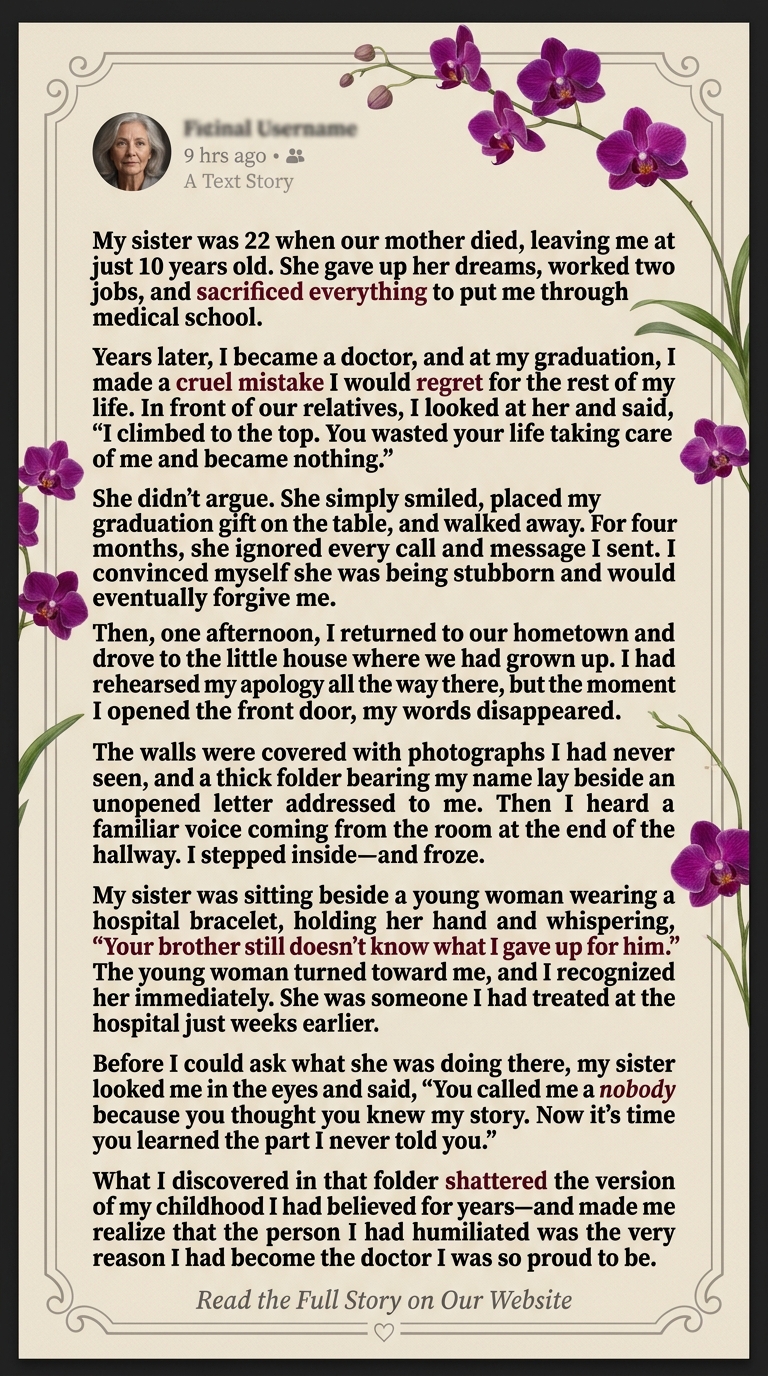
I was ten years old when our mother died, and my sister, Rebecca, was only twenty-two. She gave up her dream of becoming a teacher, worked two jobs, and sacrificed nearly everything to raise me. She paid my school fees, bought my textbooks, and made sure I never went to bed hungry. Whenever I asked why she never bought herself new clothes or went out with friends, she would smile and say, “My future is sitting right here, little brother. Now finish your homework.” I grew up believing her sacrifices were simply what older sisters did. As I advanced through medical school, however, I became increasingly ashamed of our differences. My classmates came from wealthy families, and I wanted to fit in. I stopped inviting Rebecca to certain events because I worried people would judge her simple clothes and modest job. I was so focused on becoming someone important that I forgot who had made my success possible. On graduation day, Rebecca arrived early, wearing a simple blue dress and carrying a small wrapped gift. When my name was announced, she stood and applauded louder than anyone else. After the ceremony, our relatives gathered at a restaurant to celebrate. My uncle raised his glass and said, “Daniel wouldn’t be a doctor without his sister. She deserves as much credit as he does.” Everyone applauded. Instead of thanking Rebecca, I laughed bitterly and said, “I climbed to the top. You wasted your life taking care of me and became nothing.” The entire room fell silent. Rebecca’s smile vanished, but she didn’t argue. She placed her gift beside my plate and said softly, “I hope you become the kind of doctor you wanted to be.” Then she walked away. I was too proud to follow her. I convinced myself she was being overly sensitive and would eventually forgive me. For four months, she ignored every call and message I sent. I even left a voicemail telling her to stop punishing me over one careless remark. I never considered that my words might have destroyed something inside her. Eventually, guilt became impossible to ignore. I took a day off from the hospital and drove to the little house where we had grown up. I rehearsed my apology the entire way, promising myself I would tell her how sorry I was. But the moment I opened the front door, my words disappeared. The walls were covered with photographs I had never seen: Rebecca standing outside a university, smiling in a classroom, and holding the hand of a young woman wearing a hospital bracelet. Beside the photographs sat a thick folder bearing my name and an unopened letter addressed to me. Then I heard a familiar voice from the room at the end of the hallway. “Your brother still doesn’t know what I gave up for him,” Rebecca whispered. I stepped inside and froze. My sister was sitting beside a young woman, holding her hand. I recognized her immediately. Her name was Lily Morgan, a patient I had treated at the hospital just weeks earlier after she was admitted with complications from a severe infection. “Dr. Daniel?” Lily whispered when she saw me. Rebecca stood and looked directly into my eyes. “You called me a nobody because you thought you knew my story. Now it’s time you learned the part I never told you.” She opened the folder and handed me an acceptance letter from a teacher-training university, dated shortly before our mother died. Rebecca had earned a scholarship and had been preparing to begin her studies. After our mother passed away, she deferred her admission, hoping to enroll the following year. But the bills continued to arrive, and there was no one else to care for me. Eventually, she withdrew from the program. “I always thought you never really wanted to go to university,” I whispered. “I wanted it more than anything,” she replied. “But you were ten years old, and you had nobody else.” She showed me receipts for my school fees, university tuition, and medical school expenses. I had assumed our mother’s insurance money had paid for most of my education. The documents proved otherwise. Almost everything had come from Rebecca’s wages. She had sold the gold necklace our mother left her to cover my first semester’s expenses. She had worked extra shifts when I needed money for examinations and continued working even when her health began to deteriorate. At the back of the folder were letters from Thomas, the man she had once hoped to marry. He had offered to help her finish university if she moved with him to another city. In her replies, Rebecca explained that she couldn’t abandon me or risk sending me from one temporary home to another. Eventually, Thomas married someone else, and Rebecca never spoke about him again. “You could have told me,” I said, my voice breaking. “You were a child,” she replied. “I wanted you to have a childhood, not spend every night worrying about what your sister had given up.” Then Lily reached for another document. It was a medical report bearing Rebecca’s name. Years earlier, Rebecca had collapsed while working a double shift. Doctors discovered a serious heart condition that required ongoing treatment and eventually surgery. She had delayed seeking comprehensive care because she couldn’t afford to lose the income that kept me in school. She eventually underwent surgery, but she still needed medication and regular monitoring. “When Lily was in the hospital,” Rebecca explained, “she told me you were the doctor who made sure she wasn’t sent home without support. She said you were kind to people who had nobody.” Lily squeezed my sister’s hand. “Your sister told me about you all the time,” she said. “She kept your graduation photograph beside her bed. She was so proud of you.” I looked at the photographs, the receipts, and the medical reports. My entire understanding of my childhood had been built around the belief that Rebecca had happily given up her dreams because she loved me. The truth was more complicated. She had grieved the life she wanted, endured hardships she had never shared with me, and continued sacrificing because she believed my future mattered. I opened the letter addressed to me. Daniel, it began, I never regretted raising you. I only regretted that you came to believe my life had no value beyond helping you succeed. I wanted to teach children. I wanted to travel and have a family of my own. Sometimes I wondered what might have happened if our mother had lived long enough to see me graduate. But I never wanted you to feel that your life was a debt you had to repay. I only wanted you to become a good man. Please remember that the people standing behind you are not there because they are less important. They are there because they love you. Never mistake their sacrifice for weakness, and never make someone feel small just because their life looks different from yours. I couldn’t finish reading. I sank into a chair and covered my face. “I’m sorry,” I whispered. “Rebecca, I’m so sorry.” She didn’t rush to comfort me. She didn’t tell me everything was fine. She simply stood there, allowing me to understand the pain I had caused. After a long silence, she asked, “Do you know what hurt the most at that restaurant?” I shook my head. “It wasn’t that you thought I had accomplished nothing. It was realizing that you had watched me for years and never once wondered whether I was happy.” I wanted to explain that medical school had made me stressed, that I had been insecure, and that I hadn’t meant what I said. But none of those excuses could undo my cruelty. “I thought success meant becoming someone important,” I admitted. “I was so busy trying to prove myself that I couldn’t recognize the person who made it possible.” Rebecca’s eyes filled with tears. I asked what she needed from me now. For the first time, I didn’t assume I already knew the answer. She told me she needed time, honesty, and proof that I understood the difference between an apology and a change in behavior. “I can’t give you back the years you lost,” I said. “No,” she replied. “But you can stop acting as though my life ended when yours began.” That evening, I accompanied Rebecca to her cardiology appointment and listened as her doctor explained her treatment plan. I learned she had been skipping some appointments because of the cost and because she didn’t want to ask anyone for help. I offered to help cover her medical expenses, but I let her decide what she was comfortable accepting. She agreed to let me help arrange her care, though she refused to let me turn it into a grand gesture. “I’m your sister, not your charity project,” she reminded me. “I know,” I replied. “I’m trying to learn how to be your brother.” In the months that followed, I began making changes that mattered more than any speech. I visited Rebecca regularly, listened when she spoke, and stopped using work as an excuse to neglect the people who loved me. I also helped her explore opportunities to return to education. I didn’t pressure her or pretend I could restore the years she had lost. I simply wanted her to know that her dreams still mattered. After months of consideration, Rebecca enrolled in a part-time community education program that would allow her to become a reading tutor. The first time she walked into a classroom full of children, she called me afterward, laughing with a joy I hadn’t heard in years. “I forgot how much I love this,” she said. I sat in my car outside the hospital and cried. I hadn’t fixed her life. She had found a part of herself that had never truly disappeared. A year after my graduation, our relatives gathered again at Rebecca’s house. Before dinner, I asked if I could say a few words. I didn’t make a grand speech or try to turn her suffering into a story about my redemption. I simply stood beside her and said, “Last year, I humiliated the person who gave me the chance to become a doctor. I treated her sacrifices as proof that she had failed, when they were actually proof of how deeply she loved me. I was wrong, and I am sorry. Rebecca did not waste her life raising me. She gave me the chance to build mine, and she deserves the chance to build the life she wants.” I turned to my sister. “I can never repay you for what you did, and I won’t pretend I can. But I promise I will never again measure your worth by what you gave up for me.” Rebecca looked at me for a long moment before taking my hand. “That’s a start,” she said. It wasn’t complete forgiveness, and I didn’t expect it to be. Trust returned slowly through ordinary visits, honest conversations, and the simple effort of keeping my promises. Rebecca continued her studies, and Lily eventually recovered enough to volunteer alongside her at the reading program. The three of us sometimes met for dinner, and I came to understand that my sister’s life had never been empty. It had been filled with work, grief, kindness, and choices she had made without asking for applause. She had not become a doctor or a university professor, but she had raised a child, supported strangers in moments of crisis, and found her way back to a dream she had once set aside. The day Rebecca completed her first teaching certificate, I sat in the audience and applauded until my hands hurt. She spotted me in the crowd and smiled. This time, I felt no embarrassment about her simple clothes or worry about what anyone might think. I felt honored to be her brother. After the ceremony, she handed me a small gift wrapped in blue paper. It was the same graduation gift she had placed beside my plate the year before. She had taken it home unopened and kept it in her closet. Inside was a fountain pen engraved with the words, For the doctor who never stops learning. I looked at her with tears in my eyes. “I don’t deserve this.” She smiled gently. “Maybe not yet, Daniel. But you can keep working on it.” I hugged her, and she hugged me back. For years, I had believed becoming a doctor meant reaching the top of a mountain. I imagined success as something I had climbed toward alone, leaving everyone else behind. Rebecca taught me otherwise. She had carried me through the steepest part of that mountain, then stepped aside so I could believe I had climbed it myself. My greatest mistake was confusing the spotlight with importance and overlooking the person standing just outside it. I could never return the years she had sacrificed or erase the cruelty of my words. But I could spend the rest of my life honoring the truth I had finally learned: success is not measured by the title printed on a certificate, but by the love, courage, and humanity a person brings into the world. And the first person I needed to treat with that understanding was the sister who had spent her life helping me become a doctor—and had never stopped hoping I would become a good man.