For three weeks, I had watched my ten-year-old daughter, Sophie, slowly become someone I barely recognized.
She used to wake up singing, rush downstairs for breakfast, and tell me every detail about what had happened at school. Lately, she spent most mornings sitting quietly at the kitchen table, pressing her fingers against her temples.
At first, I thought she was experiencing ordinary childhood headaches. She had recently started wearing glasses, and her teacher mentioned that she sometimes struggled to concentrate during lessons.
But the headaches became more frequent.
Some mornings, Sophie complained that the light hurt her eyes. Other times, she became nauseated and asked to lie down. Twice, she woke during the night crying because the pain behind her forehead was so severe.
My husband, Mark, insisted it was probably stress.
“She’s been worrying about school,” he told me. “Children get headaches. Let’s not frighten her.”
I wanted to believe him, but something about Sophie’s behavior worried me.
One evening, while brushing her hair, I noticed she had become unusually sensitive when I touched the back of her head.
“Does it hurt here, sweetheart?”
She nodded.
“Sometimes it feels like something is pushing inside my head.”
The next morning, I called her pediatrician and arranged an appointment.
Mark offered to drive us but then claimed an urgent meeting had come up. I took Sophie myself.
The doctor examined her, asked about her symptoms, and ordered blood tests and imaging. She also requested a more detailed neurological assessment because Sophie had begun experiencing brief episodes of blurred vision.
I tried to remain calm while we waited.
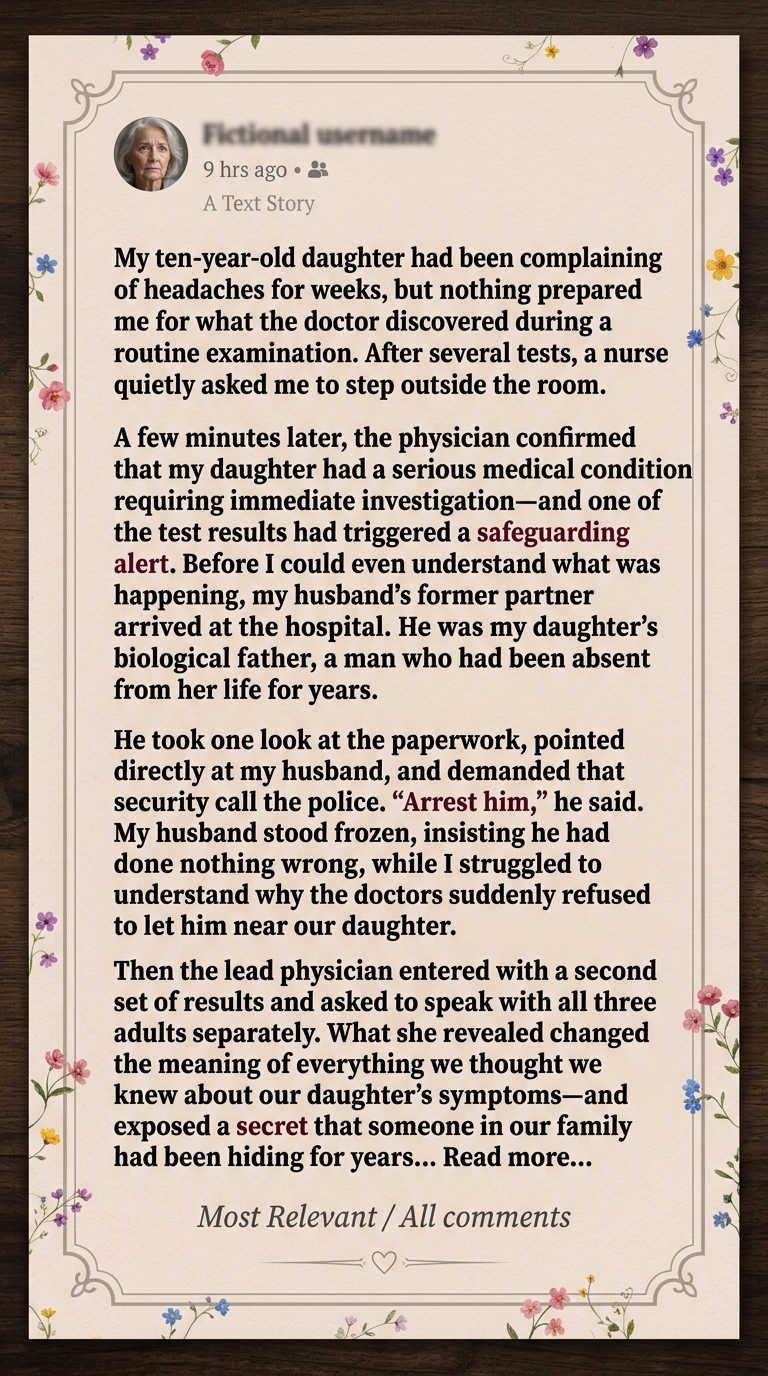
Then the nurse returned and asked me to step outside.
“Mrs. Bennett, the doctor needs to speak with you privately.”
My stomach tightened.
She led me into a small consultation room. A few minutes later, Dr. Lewis entered carrying a folder.
“Some of the results require immediate attention,” she explained. “The imaging shows a mass near the base of Sophie’s skull. We don’t yet know whether it’s benign or malignant, but it is affecting the structures responsible for controlling fluid around the brain.”
I gripped the edge of my chair.
“Does she have cancer?”
“We cannot say that yet. We need additional imaging and a specialist assessment. The important thing is that we’ve identified a condition that could explain her headaches and visual symptoms.”
I struggled to breathe normally.
Then the doctor continued.
“There is another matter. One of Sophie’s laboratory results triggered a safeguarding alert. It suggests a possible exposure to a medication that has not been prescribed to her.”
I stared at her.
“What medication?”
“An anti-seizure drug. The concentration in her blood is higher than we would expect from accidental environmental exposure.”
I felt cold.
“Are you saying someone gave my daughter medication?”
“We are not making an accusation. There are several possibilities, including a dispensing error or an undocumented prescription. But until we understand what happened, we must follow safeguarding procedures.”
The doctor explained that Sophie would remain under observation while the hospital reviewed her medical history and arranged further testing. She also told me that visitors would be managed carefully until the team understood how the medication had entered her system.
I returned to Sophie’s room feeling as though the floor had shifted beneath me.
She was sitting in bed, holding her stuffed rabbit.
“Mom, am I going to die?”
I rushed to her side.
“No, sweetheart. The doctors are going to help you. We’re going to take this one step at a time.”
She looked at me.
“Did I do something wrong?”
My heart broke.
“Absolutely not. None of this is your fault.”
I was still holding her hand when the room door opened.
A man walked in without knocking.
I recognized him immediately.
It was David, Sophie’s biological father.
He and I had separated when Sophie was very young. He had moved away after our relationship ended, and although he occasionally sent birthday cards, he had been absent from most of her life.
He had recently begun contacting us again after learning that I had married Mark.
I hadn’t expected to see him at the hospital.
“Where is she?” he demanded.
“David, what are you doing here?”
He ignored me and looked at the medical paperwork on the counter.
His face changed.
He picked up one of the documents, read it, and turned toward the doorway.
“Call security,” he shouted. “Call the police. Arrest him!”
Mark was standing in the corridor.
He had arrived without telling me.
“What are you talking about?” Mark demanded.
David pointed at him.
“You know exactly what I’m talking about.”
Mark’s face drained of color.
“I haven’t done anything.”
Two nurses entered immediately, followed by a hospital security officer. The lead nurse asked everyone to step away from Sophie’s bed.
The doctor arrived moments later.
“Nobody is to question the child or approach her without authorization until our safeguarding team has completed its initial assessment.”
Mark looked at me.
“Claire, tell them this is ridiculous.”
I wanted to believe him.
He had helped raise Sophie for seven years. He attended her school events, bought her birthday presents, and had always called her his daughter.
But why had David reacted so violently?
And why did Mark look frightened rather than confused?
Dr. Lewis asked the three adults to speak with her separately.
David was taken to one consultation room. Mark was escorted to another. I remained with Sophie until a specialist nurse came to sit beside her.
The doctor returned about twenty minutes later.
“We have reviewed Sophie’s current blood results alongside her earlier medical records,” she said. “The medication appears to have been entering her system repeatedly, not just once. We need to establish the source.”
“Could it have caused the headaches?”
“It may have contributed to some of her symptoms, particularly the nausea and changes in alertness. However, it does not explain the mass we found on her imaging. That requires a separate investigation.”
I was confused.
“Then what does it mean?”
The doctor took a breath.
“We discovered that Sophie had been prescribed this medication several years ago by a specialist outside our hospital. The prescription was later discontinued, but there are indications that someone may have continued giving it to her.”
I looked at her.
“Who prescribed it?”
She turned a page.
“Dr. Samuel Reed.”
The name meant nothing to me.
But when she showed me the old medical record, I recognized the handwriting on the attached consent form.
It belonged to Mark.
I stared at the signature.
“Why did my husband sign this?”
Dr. Lewis didn’t answer immediately.
“We are trying to establish that. The records indicate that Sophie was treated at a private neurological clinic when she was three years old. The clinic’s notes describe episodes of unusual movement during sleep. The medication was prescribed temporarily while further testing was planned.”
I remembered those years.
Sophie had been a toddler when Mark and I met. Her biological father, David, had been living in another city, and I was managing most of her appointments alone.
Mark had been kind to her from the beginning. When he offered to help with medical visits, I had been grateful.
I remembered him taking Sophie to a clinic once because I had been called into work unexpectedly.
He had told me the doctor thought she was perfectly healthy.
I had never questioned him.
The doctor continued.
“According to the records, the medication was discontinued after a follow-up assessment. However, the prescription history shows several later requests for refills under a different patient account.”
My hands began shaking.
“Whose account?”
“We are still verifying that information.”
I looked toward the corridor.
“Where is Mark?”
“He is being interviewed by the safeguarding team.”
I felt a mixture of fear and anger.
“What has he done to my daughter?”
Dr. Lewis leaned forward.
“Mrs. Bennett, we need to be careful. The results are concerning, but we must establish the facts before drawing conclusions.”
I nodded, though I could barely hear her.
A few minutes later, David asked to speak with me.
I agreed.
He entered the room looking older than I remembered. His eyes were red, and he seemed to be struggling to control his emotions.
“Claire, I need to tell you something.”
“Why did you accuse Mark?”
David looked at Sophie, who was resting quietly.
“Because I recognized the medication.”
I stared at him.
“What do you mean?”
He pulled a folded document from his jacket.
It was an old copy of a prescription.
“I found this in my daughter’s medical records years ago. I asked Mark about it, and he told me Sophie had been diagnosed with a seizure disorder.”
I felt my stomach tighten.
“She was never diagnosed with epilepsy.”
“I know that now.”
David explained that after his relationship with me ended, he had remained in contact with a family doctor who occasionally updated him about Sophie’s health. When Mark became involved in her life, David was told that Sophie had experienced possible seizure episodes and was receiving treatment.
He had trusted the information because he assumed I knew about it.
But several years later, David received a copy of an insurance statement showing that medication had been purchased under Sophie’s name long after the treatment was supposedly discontinued.
He contacted Mark.
Mark told him that the medication was part of an ongoing treatment plan and that I had agreed to it.
David said he had tried calling me, but Mark answered and told him I didn’t want to discuss Sophie’s medical history with him.
I looked at David.
“Why didn’t you contact me another way?”
“I should have. I thought you were aware, and I didn’t want to start another argument. Then I found out the medication had been prescribed under a different doctor’s name.”
He swallowed.
“I hired someone to help me obtain the records. That’s how I discovered the original prescription had been discontinued.”
I felt sick.
“Why did you come here today?”
“Because I received a message from the hospital saying Sophie had been admitted and that the safeguarding team needed to speak with me as her biological father. When I saw the medication listed on the paperwork, I knew something was wrong.”
He looked toward the door.
“I didn’t come here to fight with your husband. I came because I was afraid someone had been giving my daughter medication without telling either of us.”
For the first time, I understood why he had reacted so strongly.
But I still didn’t understand Mark’s role.
The safeguarding investigator arrived later that afternoon.
Her name was Rachel Morgan. She explained that the hospital had contacted the appropriate child protection authorities because Sophie’s blood results suggested repeated exposure to a medication without a current prescription.
She also explained that the investigation would focus on how the medication had been obtained, who had administered it, and whether anyone had deliberately misrepresented Sophie’s medical history.
“Is my daughter safe?” I asked.
“She is safe here. We are arranging supervised access while the investigation continues. No one is accusing you of wrongdoing, but we need to understand who had access to her medication and medical records.”
I agreed to cooperate.
Then Rachel asked whether Mark had ever taken Sophie to medical appointments without me.
I told her about the visit when Sophie was three.
Rachel wrote something down.
“Did he ever mention that the doctor suspected seizures?”
“No. He told me the doctor said she was healthy.”
“Did you ever see a prescription bottle?”
I shook my head.
“No.”
Rachel looked at me carefully.
“That may be important.”
Later that evening, the lead physician returned with the second set of results.
The additional imaging showed that Sophie had a small, slow-growing brain tumor near the base of her skull. It was pressing against a structure that affected the flow of cerebrospinal fluid, explaining the persistent headaches and visual disturbances.
The doctors believed it was likely a low-grade tumor, but they needed a biopsy to determine its exact type.
I felt my legs weaken.
“Can it be treated?”
“Yes. The neurosurgical team believes they can remove it safely, although we need to monitor her closely. The sooner we address the pressure, the better.”
I held my daughter’s hand.
She had a serious condition, but there was a treatment plan.
That was something I could hold on to.
The doctor then explained that the medication exposure had complicated the assessment because it could affect her alertness and neurological examination. The team would discontinue the unprescribed medication under medical supervision and monitor her carefully.
I asked whether the drug had caused the tumor.
“No,” she replied firmly. “There is no evidence that this medication caused the mass. We must treat these as two separate medical issues.”
I appreciated her clarity.
One mystery had been answered, but another remained.
Why had someone continued giving Sophie medication that had been discontinued years earlier?
The answer came the following morning.
Rachel returned with a preliminary finding from the pharmacy records.
The prescriptions had been issued through a small private clinic that had closed several years earlier. The doctor named on the forms had retired, and his signature appeared to have been copied onto later prescriptions.
The pharmacy records showed that the medication had been collected regularly by one person.
Mark.
When confronted with the records, he finally admitted what he had done.
He had continued giving Sophie the medication for years, even after the original doctor discontinued it.
He claimed he believed the drug helped prevent the strange movements Sophie had experienced as a toddler. He said he had read about childhood seizures online and convinced himself that stopping the medication would put her at risk.
But the records showed something worse.
Several years earlier, Mark had consulted another physician after Sophie began complaining of headaches. The doctor had recommended a neurological examination and warned that the medication should not be continued without reassessment.
Mark had never arranged the follow-up.
Instead, he had continued obtaining the drug through the old clinic’s prescription records.
When I confronted him, he tried to defend himself.
“I was protecting her.”
“You were giving her medication without telling me.”
“I thought you would panic.”
“You lied to me about her medical care for years!”
He lowered his voice.
“I didn’t want her to be treated like a sick child.”
I stared at him.
“So you secretly medicated her to avoid admitting she might need medical attention?”
He looked down.
He admitted that he had become frightened when Sophie first experienced unusual movements as a toddler. He had been convinced that she would develop a serious neurological disorder, and he had wanted to control the situation without involving David or creating conflict between us.
But once the medication became part of his secret routine, he was too ashamed to admit that he had continued it.
He had lied to me, misled David, and falsified prescription information to obtain the medication.
His actions were dangerous, even if he had convinced himself he was helping.
The safeguarding team referred the matter to the police and the relevant medical authorities. Mark was not allowed to visit Sophie while the initial investigation was underway.
I asked him to leave our home.
He begged me to reconsider.
“Claire, I love her. I’ve raised her since she was little.”
“Then you should have protected her by telling the truth.”
“I made a mistake.”
“You made the same decision again and again for years.”
He began crying.
I felt sorry for the man I had once trusted, but I could no longer confuse his fear with an excuse.
Sophie underwent surgery several days later.
The neurosurgical team successfully removed the tumor. The biopsy confirmed that it was a low-grade, non-malignant growth. The doctors explained that she would need regular imaging and follow-up appointments, but the prognosis was encouraging.
When Sophie woke up, she looked around the recovery room.
“Mom?”
I leaned toward her.
“I’m here, sweetheart.”
“Did they fix my head?”
The nurse smiled.
“The doctors did a very good job.”
Sophie looked at me.
“Can I go back to school?”
I laughed through my tears.
“Not immediately. First, you need to rest and let everyone spoil you for a little while.”
She smiled faintly.
“Can I have pancakes?”
“Absolutely.”
For the first time in weeks, I felt hope.
David visited regularly during her recovery. He didn’t try to replace the years he had missed with grand promises. He simply showed up, brought her favorite books, and sat beside her when she was tired.
One afternoon, Sophie asked him why he hadn’t been around more when she was younger.
He didn’t blame me or Mark.
“Your mother and I made mistakes when we were younger,” he said. “I should have tried harder to stay involved. I’m sorry.”
Sophie considered his answer.
“Are you going to come to my school concert?”
“If you want me there.”
She nodded.
“Then you can sit beside Mom.”
It was a small beginning, but it meant something.
As for Mark, the investigation established that he had repeatedly obtained and administered medication without a valid prescription and had misrepresented Sophie’s medical history. The authorities treated the matter seriously. He faced legal and professional consequences, and the court eventually imposed restrictions on his contact with Sophie while requiring him to complete a formal assessment and comply with all safeguarding conditions.
I filed for divorce.
It wasn’t because I believed Mark had never loved Sophie. I knew he had. But love without honesty and responsibility could still cause harm.
I also couldn’t raise my daughter in a home where medical decisions were hidden from the people responsible for protecting her.
Months later, Sophie returned to school.
Her hair had grown back around the small surgical scar, and the headaches had disappeared. She still had regular hospital appointments, but she was gradually returning to her old self.
She started drawing again, played with her friends, and complained about homework with the enthusiasm I had missed so much.
One evening, she sat beside me at the kitchen table.
“Mom, am I going to be sick forever?”
I put down my cup.
“No, sweetheart. The doctors will keep checking to make sure you’re healthy, but you can still have all the ordinary things you want. School, friends, birthday parties, and everything else.”
She smiled.
“Good. I want to be a veterinarian.”
I laughed.
“Then I suppose we’ll need to find you a lot of books about animals.”
She leaned against me.
After she went to bed, I looked at the photograph of her taken before the hospital visit. She was smiling with a missing front tooth, holding a stuffed rabbit.
I thought about how close I had come to accepting Mark’s explanation that her headaches were nothing more than stress.
I also thought about the difference between the two discoveries we had made.
The tumor was a medical condition that needed treatment.
The medication was a secret that needed accountability.
Neither should have been hidden from me.
David eventually became a consistent part of Sophie’s life. He attended her school events, called regularly, and respected the relationship she had with the people who had helped raise her. We learned to communicate as parents without allowing our past relationship to interfere with her needs.
One year after the surgery, Sophie had her follow-up scan.
The neurosurgeon smiled when he entered the consultation room.
“Everything looks stable. There’s no evidence of regrowth.”
Sophie squeezed my hand.
“Does that mean I can have ice cream?”
The doctor laughed.
“I think we can make an exception.”
On the way home, she held my hand and talked excitedly about a class project.
I listened, grateful for every ordinary complaint and every unnecessary detail.
For months, I had feared losing my daughter to an illness I couldn’t understand. Instead, I discovered that the greatest danger had come from someone who believed he had the right to make decisions about her health in secret.
I couldn’t change what had happened.
But I could make sure Sophie grew up knowing that her body belonged to her, that medical decisions required honesty, and that no adult’s fear gave them permission to hide the truth.
And that was the promise I intended to keep for the rest of her life.