The Woman Who Shared Her Pie
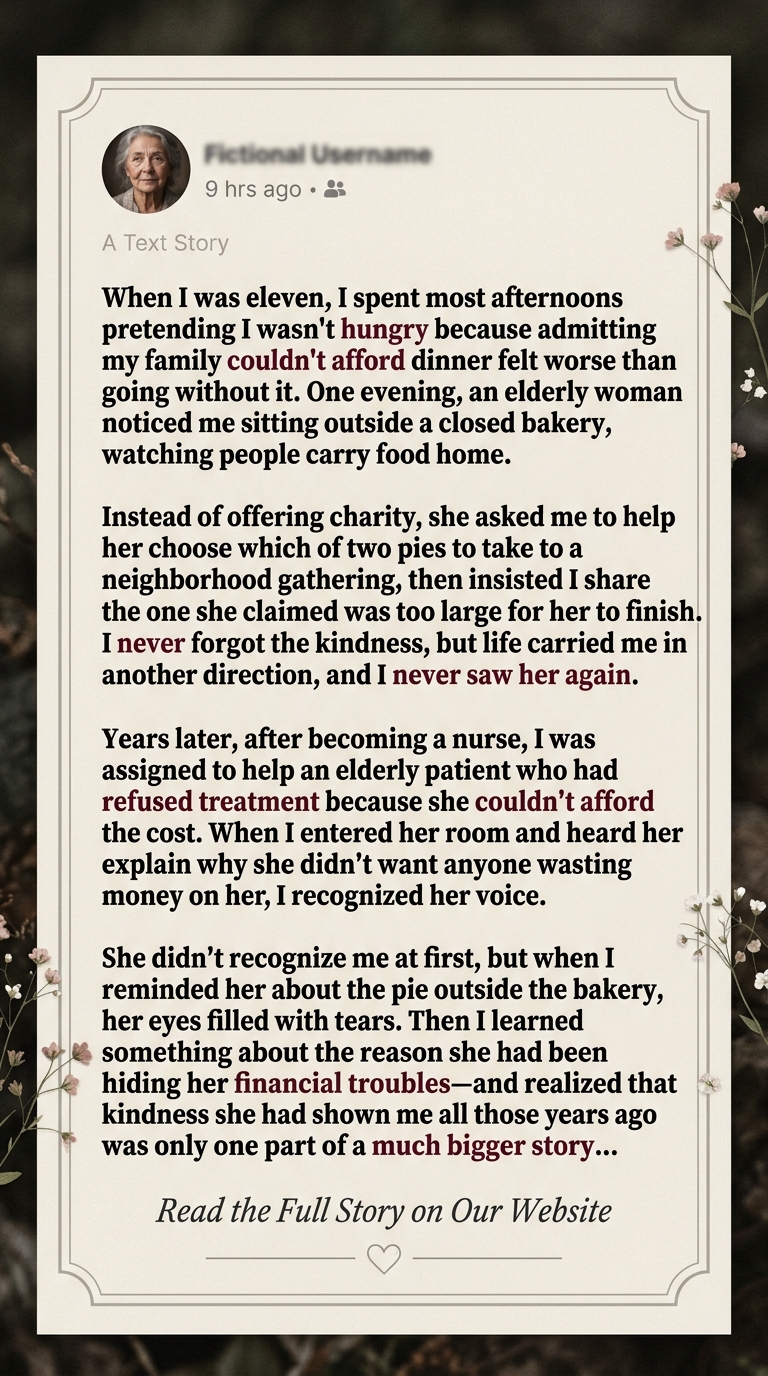
When I was eleven years old, I learned how to make hunger look like a choice.
If someone asked whether I had eaten, I would shrug and say I wasn’t hungry. If my classmates opened their lunchboxes, I would pretend to be busy with homework. And when my stomach growled during lessons, I would press my arms against it and hope nobody noticed.
My mother worked long shifts cleaning offices, and my father had disappeared from our lives when I was seven. Some weeks, there was enough money for groceries. Other weeks, my mother would make a pot of rice last as long as possible, telling me she had already eaten at work.
I knew she was lying. I also knew she was trying her best.
One November evening, after school, I found myself sitting outside a closed bakery. The smell of fresh bread lingered around the entrance, and I watched people walk past carrying paper bags and boxes of pastries.
I wasn’t waiting for anyone. I simply didn’t want to go home yet because I knew there would be nothing for dinner.
An elderly woman came out of a nearby shop carrying two small boxes. She had silver hair tucked beneath a knitted hat and wore a long brown coat with a loose button.
She stopped when she noticed me.
“Are you waiting for someone, young man?”
I shook my head.
“Then perhaps you can help me with a difficult decision.”
She held up the two boxes.
“Apple pie or cherry pie? I’m supposed to bring one to a neighborhood gathering, but I can’t decide.”
I looked at the boxes, surprised.
“Which one do you like?”
“That’s exactly the problem. I like both.”
I pointed toward the apple pie.
She nodded thoughtfully, as if I had just offered expert advice.
“Excellent choice. Then the cherry pie is coming home with me.”
She sat beside me on the low stone wall and opened the apple pie.
“Unfortunately,” she said, “this one is far too large for me to finish alone. You’ll have to help.”
I hesitated.
My mother had taught me never to accept food from strangers, but the woman didn’t seem interested in making me feel sorry for myself. She simply handed me a paper plate and a plastic fork.
“Besides,” she added with a mischievous smile, “I make terrible decisions when I’m left alone with an entire pie.”
I took a small piece.
It was the sweetest thing I had tasted in months.
We sat together until the bakery’s lights went out completely. She asked about school, my favorite subjects, and what I wanted to become when I grew up.
“A nurse,” I told her.
“That’s a wonderful choice. People need someone who doesn’t make them feel small when they’re already having a difficult day.”
I didn’t fully understand what she meant, but I remembered her words.
Before leaving, she asked my name.
“Daniel.”
“I’m Margaret,” she said. “And Daniel, never be embarrassed because you need something. Everyone needs help sometimes.”
Then she stood, gathered her boxes, and walked toward the bus stop.
I never saw her again.
Years passed. My mother eventually found a better job, and our circumstances improved. I worked through school, earned a nursing degree, and began working at a regional hospital.
I never forgot Margaret. Sometimes, when I saw an elderly woman sitting alone in a hospital corridor, I remembered the pie and wondered whether she was still alive.
Then, nearly twenty years after that evening, I heard her voice again.
It happened during my afternoon shift.
A nurse from the admissions department called to say an elderly patient had refused a recommended procedure. She had been admitted after collapsing at home, and the doctors suspected a serious heart condition. Her blood tests and examination suggested that delaying treatment could put her life at risk.
When I entered her room, I found a thin woman sitting upright in bed, carefully folding a tissue between her fingers.
Her silver hair was shorter now. Her face was deeply lined, and her hands trembled slightly.
But I recognized her voice immediately.
“I’ve already told everyone,” she said to the doctor. “I can’t afford to keep doing this. There are people who need that money more than I do.”
The doctor explained that the hospital had financial assistance programs, but she shook her head.
“I don’t want charity. I’ve managed this long. I’ll manage the rest.”
I stepped closer.
“Mrs. Margaret?”
She looked at me.
“Yes?”
I studied her face, trying to be certain.
“Do you remember sitting outside a bakery one November evening with a boy who couldn’t afford dinner?”
Her expression changed slightly.
I continued.
“You asked him to help you choose between an apple pie and a cherry pie. Then you said the apple pie was too large for you to finish.”
For several seconds, she said nothing.
Then her eyes filled with tears.
“Daniel?”
I smiled.
She reached for my hand.
“Oh, my goodness. Look at you.”
I laughed softly, although my own eyes were beginning to sting.
“You gave me dinner when I needed it most.”
Margaret shook her head.
“It was only a piece of pie.”
“It wasn’t only a piece of pie to me.”
She looked down at our hands.
“I wondered sometimes what happened to that little boy.”
“I became a nurse,” I told her. “You asked me what I wanted to be, and I never forgot what you said about helping people without making them feel small.”
She began to cry quietly.
I pulled a chair beside her bed and asked why she had refused treatment.
At first, she gave the same answer she had given the doctor. She didn’t want to spend money on herself. She had lived a long life, and there were others who needed help more urgently.
But something about the way she avoided my eyes told me there was more.
I didn’t pressure her. I simply stayed with her while the doctor explained the treatment options again.
Eventually, Margaret sighed.
“I haven’t told anyone the whole truth,” she said.
She explained that her husband had died twelve years earlier. They had never had children, and most of their savings had gone toward keeping their small grocery shop open during its final years.
After his death, Margaret discovered that a young woman who had worked for them, named Rebecca, was struggling to raise her little boy alone.
Rebecca had once been a regular customer at the shop. Her husband had left, she had lost her apartment, and she was working two jobs while trying to keep her son in school.
Margaret began helping her.
At first, it was groceries. Then came rent assistance, school supplies, and eventually money for childcare so Rebecca could accept a better job.
She never called it charity. She told Rebecca that she was repaying a kindness someone had shown her years earlier.
But Rebecca wasn’t the only person she had helped.
For years, Margaret quietly used her savings to assist people in the neighborhood who were struggling. She paid for a widow’s heating bill, bought uniforms for children whose parents couldn’t afford them, and covered the cost of groceries for families who had lost their jobs.
She never advertised what she did. Most people didn’t even know where the money came from.
“After my husband died, I couldn’t bear the thought of the shop closing and everything we had built disappearing,” she explained. “Helping people was the only way I knew to keep his kindness alive.”
I listened carefully.
“But why didn’t you tell the hospital about your financial situation? We have programs that might help.”
She looked embarrassed.
“Because I don’t have much left. I spent more than I should have. I thought I could manage, but the medical bills frightened me. I didn’t want to become another person’s responsibility.”
I asked whether she had anyone who could help her make decisions.
She mentioned Rebecca, who had recently moved to another city. They had stayed in touch, but Margaret had stopped telling her about her health problems because she didn’t want to interrupt her new life.
“She has a family now,” Margaret whispered. “I don’t want her to feel obligated to look after an old woman who isn’t even related to her.”
I gently reminded her that caring about someone didn’t always require a family connection.
Then I explained that refusing treatment without understanding the available options could put her life in danger. I promised to help her speak with the hospital’s financial counselor, but I made it clear that the decision about treatment remained hers.
For the first time since I had entered the room, Margaret stopped arguing.
“Do you really think they might help?”
“I know we can at least find out.”
The next morning, I arranged for the hospital’s financial assistance coordinator to meet with her. After reviewing her income, savings, and circumstances, the coordinator explained that Margaret qualified for substantial assistance through a program designed for patients with limited resources.
Her necessary treatment would be covered.
Margaret sat silently while the coordinator explained the details.
Then she covered her face with both hands.
“I thought I had used up every chance I had,” she whispered.
The treatment was scheduled for the following day.
Before it began, Margaret asked me to contact Rebecca. With her permission, I found the number in her phone and called.
Rebecca answered after several rings.
When I explained that I was calling from the hospital, her voice immediately became frightened.
“Is Margaret all right?”
I told her about the heart condition and the treatment. Rebecca began crying.
“She told me she was just tired. She said she was fine.”
I explained that Margaret had been afraid of becoming a burden.
There was a long silence.
Then Rebecca said something that stayed with me.
“She helped me when I had nowhere to go. When my son was sick, she sat with him so I could work. When I couldn’t afford his school uniform, she bought it and pretended it was something her husband had ordered by mistake. I kept telling her that one day I would repay her, but she always said I didn’t owe her anything.”
Rebecca arrived at the hospital that evening.
When Margaret saw her, she immediately tried to apologize.
“I’m sorry I didn’t tell you.”
Rebecca shook her head and hugged her.
“You don’t get to disappear on me just because you’re afraid I’ll care about you.”
Margaret began crying against her shoulder.
I stepped outside to give them privacy.
The procedure went well. Margaret needed several more days of monitoring and rehabilitation, but her condition stabilized. Rebecca stayed nearby, and her son visited after school, bringing drawings and telling Margaret stories about his classes.
A week later, Margaret asked me to sit with her during my break.
“I’ve been thinking about something,” she said.
She told me that she wanted to establish a small neighborhood fund using what remained of her savings, but she didn’t want it to become another organization with complicated rules and public attention.
“I don’t have enough money to help everyone,” she admitted. “But perhaps I can help a few people before I go.”
I reminded her that she still needed to focus on her recovery.
She smiled.
“I intend to. But I also want to make sure the little I have left is used properly.”
With help from Rebecca and a local community organization, Margaret eventually arranged for the remaining funds to support emergency groceries and transportation for elderly residents who struggled to attend medical appointments.
She insisted that the assistance be offered privately, without public recognition or photographs.
Three months later, she returned to the hospital for a follow-up appointment.
She was walking more slowly than before, but she looked stronger. When she saw me at the nurses’ station, she held up a small paper bag.
“I brought you something.”
Inside was a freshly baked apple pie.
I laughed.
“You remembered.”
“Of course I remembered. You were the one who chose it.”
We sat together in the hospital garden during my break. She told me that Rebecca’s son had started helping her organize the neighborhood fund, and that she was finally allowing people to help her without feeling ashamed.
Before she left, she took my hand.
“Daniel, do you know why I stopped that evening outside the bakery?”
I shook my head.
“I had been buying food for a gathering at the community hall. I saw you watching people carry their bags, and I remembered my own childhood. My mother used to tell me that the hardest kind of hunger wasn’t always in the stomach. Sometimes it was the feeling that everyone could see what you didn’t have.”
She paused.
“I couldn’t give you a better childhood that night. But I could make sure you didn’t go home hungry.”
I looked at the woman who had once shared a pie with a boy she barely knew.
For years, I had thought that evening was a small act of kindness that had changed my life. Now I understood that it was part of a lifetime of quiet decisions she had made to ensure other people never felt forgotten.
And I finally understood something else.
Margaret had spent years convincing herself that accepting help made her a burden. Yet the people she had helped never saw her that way. To them, she was the person who had appeared when life became unbearable and reminded them they were not alone.
That afternoon, I told her something I had carried in my heart since childhood.
“You once told me not to be embarrassed when I needed something. I think it’s time you followed your own advice.”
She smiled, squeezed my hand, and nodded.
From then on, Margaret allowed Rebecca to accompany her to appointments. She accepted rides from neighbors and stopped pretending she could manage everything alone.
And whenever a patient on my ward refused help because they were afraid of the cost, I remembered the woman who had shared her pie with a hungry boy.
I never promised Margaret that I could repay what she had done for me. She wouldn’t have accepted such a promise anyway.
Instead, I began doing what she had taught me.
I looked for the person sitting quietly in the corner, the one pretending not to need anything, and found a way to make them feel welcome without making them feel ashamed.
Because sometimes, the kindness that changes someone’s life doesn’t arrive as a grand gesture.
Sometimes, it arrives in a cardboard pie box, beside a closed bakery, with a stranger who simply refuses to let you go hungry.